
TabICL MCP Server
State-of-the-art tabular ML inside Claude or ChatGPT — share a CSV, ask a question, get predictions, explanations, and a report. Free and self-hostable.
TabICL (Inria, ICML 2025/2026) is a tabular foundation model: it classifies and regresses on tabular data without any hyperparameter tuning, via in-context learning. This MCP server makes it usable from natural language in any MCP-compatible assistant or agent.
You:    Here's my customer spreadsheet — who is likely to churn, and why?
Claude: [load_data]  → 2,340 rows, 12 columns, target "churned" looks binary
        [evaluate]   → 89% accuracy, 0.93 ROC-AUC on held-out data
        [explain]    → top drivers: contract_type, tenure, monthly_charges
        [create_report] → here's a shareable HTML report with the details…
Tools
| Tool | What it does |
|---|---|
load_data |
Ingest a CSV — pasted text, a URL (Google Sheets share link, raw GitHub, any CSV URL), or a local file path. Returns a dataset_id so data is transferred once, not per call |
evaluate |
"How well can you predict X?" from a single labeled CSV — honest held-out metrics (accuracy, balanced accuracy, F1, ROC-AUC, confusion matrix / R², RMSE, MAE) |
predict |
Fit on labeled data, predict new rows — labels + per-row confidence (classification) or numbers (regression) |
explain |
Which columns drive the predictions (permutation feature importance) |
create_report |
Self-contained HTML report: metric cards in plain language, confusion matrix, feature importance chart, distributions. Served as a link (remote) or file (local) |
export_predictions |
Page through large prediction results as CSV |
Data limits: ~10k rows pasted inline, ~50k via URL or file. TabICLv2 handles 2–100 features natively.
Try it in 60 seconds
Connect the public server to claude.ai (Pro/Max/Team plans):
- Go to Settings → Connectors → Add custom connector
- Name:
tabicl· URL:https://gblayer-tabicl-mcp.hf.space/mcp - Leave the OAuth fields empty and click Add — that's it.
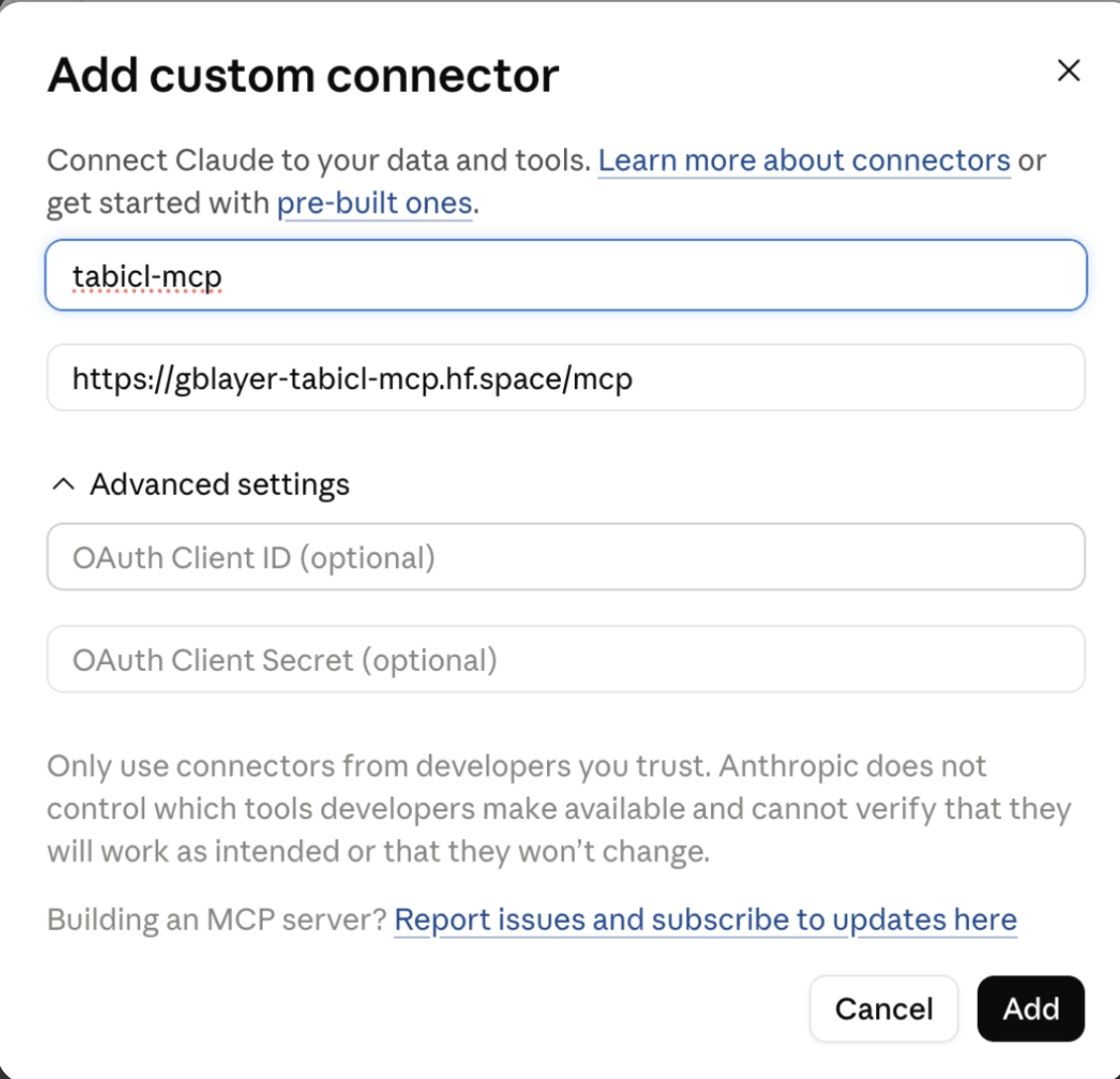
Then paste this into a new chat:
Load this CSV and tell me: can you predict the
churnedcolumn? How accurate is it, what drives churn the most, and can you make me a report? https://raw.githubusercontent.com/gblayer/tabicl-mcp/main/examples/customer_churn.csv
You'll get honest held-out metrics, the churn drivers ranked, and a shareable report — see a sample of what the report looks like (source).
Use it
Option A — Local (free, private, fastest)
Requires Python ≥ 3.10. With uv: nothing to install, clients run uvx tabicl-mcp.
Claude Desktop — ~/Library/Application Support/Claude/claude_desktop_config.json (macOS) or %APPDATA%\Claude\claude_desktop_config.json (Windows):
{
  "mcpServers": {
    "tabicl": { "command": "uvx", "args": ["tabicl-mcp"] }
  }
}
Claude Code: claude mcp add tabicl -- uvx tabicl-mcp
Cursor / VS Code (.vscode/mcp.json or Cursor Settings → MCP):
{
  "servers": {
    "tabicl": { "type": "stdio", "command": "uvx", "args": ["tabicl-mcp"] }
  }
}
(Or pip install tabicl-mcp and use "command": "tabicl-mcp".)
With a local server, load_data accepts file paths — no pasting needed, and no data ever leaves your machine.
Option B — Deploy your own private server (free, for claude.ai / ChatGPT)
Who this is for: when you use the public URL above, your CSV data is processed on a server operated by this project. That's fine for demos and non-sensitive data — but if you're working with confidential data (customer lists, medical records, company financials), deploy your own copy instead: identical functionality, but your data only ever touches infrastructure you control. A second reason: the public Space is a single shared free instance — if it's busy or asleep you wait, while your own deployment serves only you.
Deploying your own free endpoint on HuggingFace Spaces:
-
Create a Space → Docker SDK → CPU basic (free).
-
HF Spaces reads its deployment settings from a YAML header at the very top of the Space's
README.md— add this before pushing (only needed for the copy that lives on HuggingFace, not for using the server):--- title: TabICL MCP emoji: 🤖 colorFrom: blue colorTo: green sdk: docker app_port: 7860 pinned: false ---
-
Push this repo to the Space (the
Dockerfilepre-downloads model checkpoints at build). -
Your MCP endpoint:
https://YOUR-SPACE.hf.space/mcp
Then connect:
- claude.ai — Settings → Connectors → Add custom connector → paste the URL.
- ChatGPT — enable Developer Mode (Settings, paid plans) → Apps & Connectors → add the URL.
ChatGPT + file uploads: ChatGPT often can't hand chat-uploaded files to connectors (it only shows the model a preview). Workaround: open the server's homepage (
https://YOUR-SPACE.hf.space/), upload your CSV there, and paste the returned dataset id into the chat. Claude reads chat uploads directly — no workaround needed.
Free Spaces sleep after inactivity — the first request after idle takes a minute or two while the Space wakes. Everything after that is fast.
Option C — Docker anywhere
docker build -t tabicl-mcp .
docker run -p 7860:7860 tabicl-mcp
# MCP endpoint: http://localhost:7860/mcp   ·   healthcheck: /health
Development
python -m venv .venv && .venv/bin/pip install -e ".[dev]"
.venv/bin/pytest -m "not slow"   # fast tests
.venv/bin/pytest                 # includes real-model tests (downloads checkpoints)
Layout: tabicl_mcp/server.py (MCP tools) · data.py (ingestion + cache) · ml.py (evaluate/predict/importance) · report.py (HTML reports).
MIT licensed. TabICL itself is by soda-inria (BSD-3). PRs welcome.
1 maintainer

Metadata
1 maintainer
Release files for tabicl-mcp 0.2.2
For a detailed explanation of source distributions (sdists) and built distributions (wheels), please see the package formats documentation.
Source distribution (sdist)
| File | Size | Uploaded | Provenance | |
|---|---|---|---|---|
| tabicl_mcp-0.2.2.tar.gz | 311.3 kB | With provenance | Details |
Built distribution (wheel)
| File | Interpreter | ABI | Platform | Reset |
|---|---|---|---|---|
| tabicl_mcp-0.2.2-py3-none-any.whl | Python 3 | none | any | Details |
Total release size: 332.5 kB
Release files / tabicl_mcp-0.2.2.tar.gz
| Download URL | tabicl_mcp-0.2.2.tar.gz |
|---|---|
| Size | 311.3 kB |
| Tags | Source |
|
SHA-256 checksum How to use checksums |
2de80c5fdadfea496a473450d086408d18d2f3db1a8cf4b638c50c4489a720b5
|
|
BLAKE2b-256 checksum How to use checksums |
330857818c9905f9f5c3d74eaceb3a82378b60581dc9eba29af5ee343e1a03de
|
| Upload date | |
|
Uploaded using Trusted Publishing? What is trusted publishing? |
Yes |
| Uploaded via |
twine/7.0.0 CPython/3.13.14
|
Provenance
Provenance describes where a file came from. On PyPI, provenance is shared via attestations, which provide a verifiable record of the build or publishing details. View details, limitations and caveats.


PyPI Publish Attestation
PyPI verified that this artifact, at this checksum, originated from the publisher listed below.
Signed by GitHub Actions, verified by PyPI on Jul 31, 2026.
Transparency logRelease files / tabicl_mcp-0.2.2-py3-none-any.whl
| Download URL | tabicl_mcp-0.2.2-py3-none-any.whl |
|---|---|
| Size | 21.3 kB |
| Tags | Python 3 |
|
SHA-256 checksum How to use checksums |
48cc120286372aef1150da4731818a38c9cfff9ef079122cf14af0c0da73f2b2
|
|
BLAKE2b-256 checksum How to use checksums |
ce7db0faf62957cbb915cdefc590c4df66a91f7408c81b1607702139b37ec366
|
| Upload date | |
|
Uploaded using Trusted Publishing? What is trusted publishing? |
Yes |
| Uploaded via |
twine/7.0.0 CPython/3.13.14
|
Provenance
Provenance describes where a file came from. On PyPI, provenance is shared via attestations, which provide a verifiable record of the build or publishing details. View details, limitations and caveats.
PyPI Publish Attestation
PyPI verified that this artifact, at this checksum, originated from the publisher listed below.
Signed by GitHub Actions, verified by PyPI on Jul 31, 2026.
Transparency logSecurity for tabicl-mcp 0.2.2
Provenance
Provenance describes where a file came from. On PyPI, provenance is shared via attestations, which provide a verifiable record of the build or publishing details. View details, limitations and caveats.
Full provenance
All 2 files in this release have been uploaded with provenance metadata.
Attestation for tabicl_mcp-0.2.2.tar.gz
PyPI Publish Attestation
PyPI verified that this artifact, at this checksum, originated from the publisher listed below.
Signed by GitHub Actions, verified by PyPI on Jul 31, 2026.
Transparency logA note on package security
PyPI is a repository for distributing packages, not a service for auditing them. While third-party security researchers and our staff do their best to detect and remove malicious packages, PyPI cannot guarantee the quality, security or suitability of any given package.
To learn more about protecting yourself from malicious actors, visit our package security documentation.














