
A Time-varying, Attributed, Degree-Corrected Stochastic Block Model

Project description
TADC-SBM: a Time-varying, Attributed, Degree-Corrected Stochastic Block Model




This is the code repository for the accompanying paper:
Passos, N.A.R.A., Carlini, E., Trani, S. (2025). TADC-SBM: a Time-varying, Attributed, Degree-Corrected Stochastic Block Model. 2025 IEEE Symposium on Computers and Communications (ISCC), Bologna, Italy, 2025, pp. 1-6.
About
TADC-SBM is a synthetic dataset generator based on Ghasemian et al. (2016) and Tsitsulin et al. (2021) that produces temporal graphs with varying community structures, attribute features, and mesoscale dynamics, suited for community detection and graph representation learning benchmarks under controlled experimental settings:
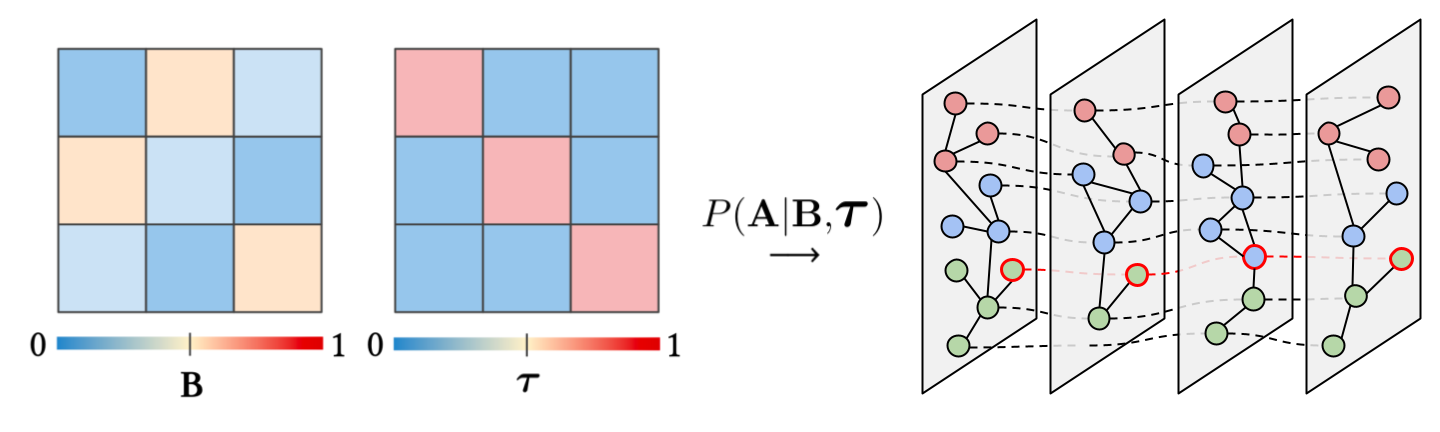
where $\mathbf{B}$ is the block matrix describing the probability of an edge being created among nodes in each community and $\boldsymbol{\tau}$ is the transition matrix with the probabilities of nodes switching communities over time. Node- and edge-level attribute features are drawn from a multivariate distribution considering the node communities in either the first or the last graph snapshot, optionally representing hierarchical (nested) structures in the feature space.
Install
The package is available on PyPI as tadc-sbm and can be installed with:
pip install tadc-sbm
A binary script tadc-sbm is included for command line usage, which can be run with python -m tadc-sbm or simply tadc-sbm if the package is installed. Note that it is not necessary to install the package to run the script.
Requirements
Requirements may be installed from PyPI (requirements.txt) or using conda (environment.yml).
It is not advised to install the conda environment as-is (but you certainly may!). Instead, try the following, more flexible environment to solve. Last tested with Python 3.11 (but should work recent versions as well):
conda create -n tadcsbm -c conda-forge python=3.11 graph-tool  # tested with 2.96
conda activate tadc-sbm
pip install -r requirements.txt
The graph-tool library must be available in the user space:
conda install -c conda-forge graph-tool. See also the documentation for other platforms and package managers, including Docker and Homebrew.
Usage
To import the generator function in your code:
from tadcsbm import tadcsbm_simulator
sbm = tadcsbm_simulator(...)
An interactive example may be found in the included notebook file.
Command line
A command line interface is included to stremaline graph generation:
usage: tadc-sbm [-h] -n NUM_VERTICES -e NUM_EDGES -k COMMUNITIES
                [-t SNAPSHOTS] [-p INTRA_PROBABILITY] [-q INTER_PROBABILITY]
                [--eta COMMUNITY_STABILITY] [--gamma {0,1}]
                [--beta EDGE_SAMPLING_RATE] [--feature-dim FEATURE_DIM]
                [--feature-center-distance FEATURE_CENTER_DISTANCE]
                [--feature-cluster-variance FEATURE_CLUSTER_VARIANCE]
                [--feature-groups hat_k] [--edge-feature-dim EDGE_FEATURE_DIM]
                [--edge-center-distance EDGE_CENTER_DISTANCE]
                [--edge-cluster-variance EDGE_CLUSTER_VARIANCE]
                [--reverse-order] [--uniform-all] [--dir OUTPUT_DIR]
                [--ext OUTPUT_EXT] [--random-seed RANDOM_SEED] [--silent]

options:
  -h, --help            show this help message and exit
  -n NUM_VERTICES, --num-vertices NUM_VERTICES
                        Number of vertices (nodes)
  -e NUM_EDGES, --num-edges NUM_EDGES
                        Number of edges per snapshot
  -k COMMUNITIES, --communities COMMUNITIES
                        Number of communities
  -t SNAPSHOTS, --snapshots SNAPSHOTS
                        Number of snapshots
  -p INTRA_PROBABILITY, --intra-probability INTRA_PROBABILITY
                        Intra-community edge probability
  -q INTER_PROBABILITY, --inter-probability INTER_PROBABILITY
                        Inter-community edge probability
  --eta COMMUNITY_STABILITY
                        Community stability factor (0.0 to 1.0, default: 1.0)
  --gamma {0,1}         Set transition probabilities based on initial ground
                        truths (0, default) or current (1) node memberships
  --beta EDGE_SAMPLING_RATE
                        Edge sampling rate (0.0 to 1.0)
  --feature-dim FEATURE_DIM
                        Dimensionality of node features
  --feature-center-distance FEATURE_CENTER_DISTANCE
                        Distance between feature clusters
  --feature-cluster-variance FEATURE_CLUSTER_VARIANCE
                        Variance of feature clusters (default: 1.0)
  --feature-groups hat_k
                        Number of feature groups (default: k communities)
  --edge-feature-dim EDGE_FEATURE_DIM
                        Dimensionality of edge features
  --edge-center-distance EDGE_CENTER_DISTANCE
                        Distance between edge feature clusters
  --edge-cluster-variance EDGE_CLUSTER_VARIANCE
                        Variance of edge feature clusters (default: 1.0)
  --reverse-order       Reverse generation order of snapshots (i.e., so the
                        initial ground truths correspond to the last snapshot)
  --uniform-all         Uniform transition probabilities (including current
                        community, i.e., like in Ghasemian et al. 2016)
  --dir OUTPUT_DIR, --output-dir OUTPUT_DIR
                        Directory to save output files (default: 'output')
  --ext OUTPUT_EXT, --output-ext OUTPUT_EXT
                        Extension for output files (default: 'gexf')
  --random-seed RANDOM_SEED, --seed RANDOM_SEED
                        Random seed for reproducible results
  --silent              Suppress verbose output at the end of simulation
Example
To generate graphs with the same configuration used in the experimental evaluation of the paper:
./tadc-sbm.py --communities 8 \
              --snapshots 8 \
              --num-vertices 1024 \
              --num-edges 10240 \
              --intra-prob 0.9 \
              --eta 0.75 \
              --gamma 0 \
              --feature-dim 32 \
              --feature-center 6.0 \
              --reverse-order
The following output is printed at the end of the simulation, unless the --silent flag is set:
TemporalMultiGraph (t=8) with 1024 nodes and 39334 edges
Snapshot 1/8: 1024 nodes, 4871 edges, communities: [123 119 124 124 127 127 136 144]
Snapshot 2/8: 1024 nodes, 4996 edges, communities: [124 118 116 139 117 123 143 144]
Snapshot 3/8: 1024 nodes, 4827 edges, communities: [122 131 115 141 116 127 123 149]
Snapshot 4/8: 1024 nodes, 5008 edges, communities: [115 123 125 130 115 117 145 154]
Snapshot 5/8: 1024 nodes, 4950 edges, communities: [112 134 135 112 118 123 143 147]
Snapshot 6/8: 1024 nodes, 4964 edges, communities: [113 129 128 111 125 125 154 139]
Snapshot 7/8: 1024 nodes, 4846 edges, communities: [118 123 136 133 119 128 133 134]
Snapshot 8/8: 1024 nodes, 4872 edges, communities: [128 128 128 128 128 128 128 128]
Total nodes across snapshots: 8192
Total edges across snapshots: 39334
Total transitions across snapshots: 1844 (25.73%)
See the included examples directory for sample outputs used in the accompanying paper.
Varying the value of $\eta \in [0, 1]$ (
--eta) produces snapshots with different community stability rates, while the value of $\gamma \in \{0, 1\}$ (--gamma) fixes the community transition probabilities for nodes in each snapshot.
Data conversion
Resulting output is saved in compressed NetworkX-compatible and NumPy formats, and may be opened with a number of libraries and tools.
See also: the convert and read_graph functions from NetworkX-Temporal.
Acknowledgements
Google Research for the graph embedding simulations that TADC-SBM is based on.
Cite
In case this repository is useful for your research, kindly consider citing:
@inproceedings{tadcsbm2025,
  author={Passos, Nelson A. R. A. and Carlini, Emanuele and Trani, Salvatore},
  booktitle={2025 IEEE Symposium on Computers and Communications (ISCC)},
  title={TADC-SBM: a Time-varying, Attributed, Degree-Corrected Stochastic Block Model},
  year={2025},
  volume={},
  number={},
  pages={1-6},
  keywords={Representation learning;Systematics;Computational modeling;Perturbation methods;Stochastic processes;Transportation;Benchmark testing;Stability analysis;Recommender systems;Synthetic data;Temporal Graphs;Community Detection;Stochastic Block Modeling;Graph Representation Learning},
  doi={10.1109/ISCC65549.2025.11326334}
}
Project details


Download files
Download the file for your platform. If you're not sure which to choose, learn more about installing packages.
Source Distribution
Built Distribution
Filter files by name, interpreter, ABI, and platform.
If you're not sure about the file name format, learn more about wheel file names.
Copy a direct link to the current filters
File details
Details for the file tadc_sbm-0.1.7.tar.gz.
File metadata
- Download URL: tadc_sbm-0.1.7.tar.gz
- Upload date:
- Size: 27.5 kB
- Tags: Source
- Uploaded using Trusted Publishing? No
- Uploaded via: twine/6.2.0 CPython/3.11.15
File hashes
| Algorithm | Hash digest | |
|---|---|---|
| SHA256 |
ebbf9591f7effa0fc0ec84cb8c9cb1d3ed0581e8a7047d52951d64b076cfac5c
|
|
| MD5 |
17cc372cdc1b82aa4d8e880bb6338ff8
|
|
| BLAKE2b-256 |
6752192c071144cd1b25bd841c8a18e9ee20afb8fd73da402cf036c365727175
|
File details
Details for the file tadc_sbm-0.1.7-py3-none-any.whl.
File metadata
- Download URL: tadc_sbm-0.1.7-py3-none-any.whl
- Upload date:
- Size: 35.5 kB
- Tags: Python 3
- Uploaded using Trusted Publishing? No
- Uploaded via: twine/6.2.0 CPython/3.11.15
File hashes
| Algorithm | Hash digest | |
|---|---|---|
| SHA256 |
da27a9d6d5dfce0706515ea1319e9c37b7422de1730abef4f6252e7cfc58af08
|
|
| MD5 |
4ab415fff0248ee7e88401197ae4ea2d
|
|
| BLAKE2b-256 |
dbd9b33e236187f85b67d4d62422980e6e275ba50d9421cf210b7d3415d9c730
|






