









Techno-economic ANalysis of Geoenergy Operations. TANGO couples reservoir, wells, and surface plant in one modular simulator, solves them over the project's lifetime, and computes the levelized cost of electricity or heat.
Contents
- What TANGO models
- How you use TANGO
- How the code is organized
- Start here
- Setup
- Documentation and layout
- Development and help
- License
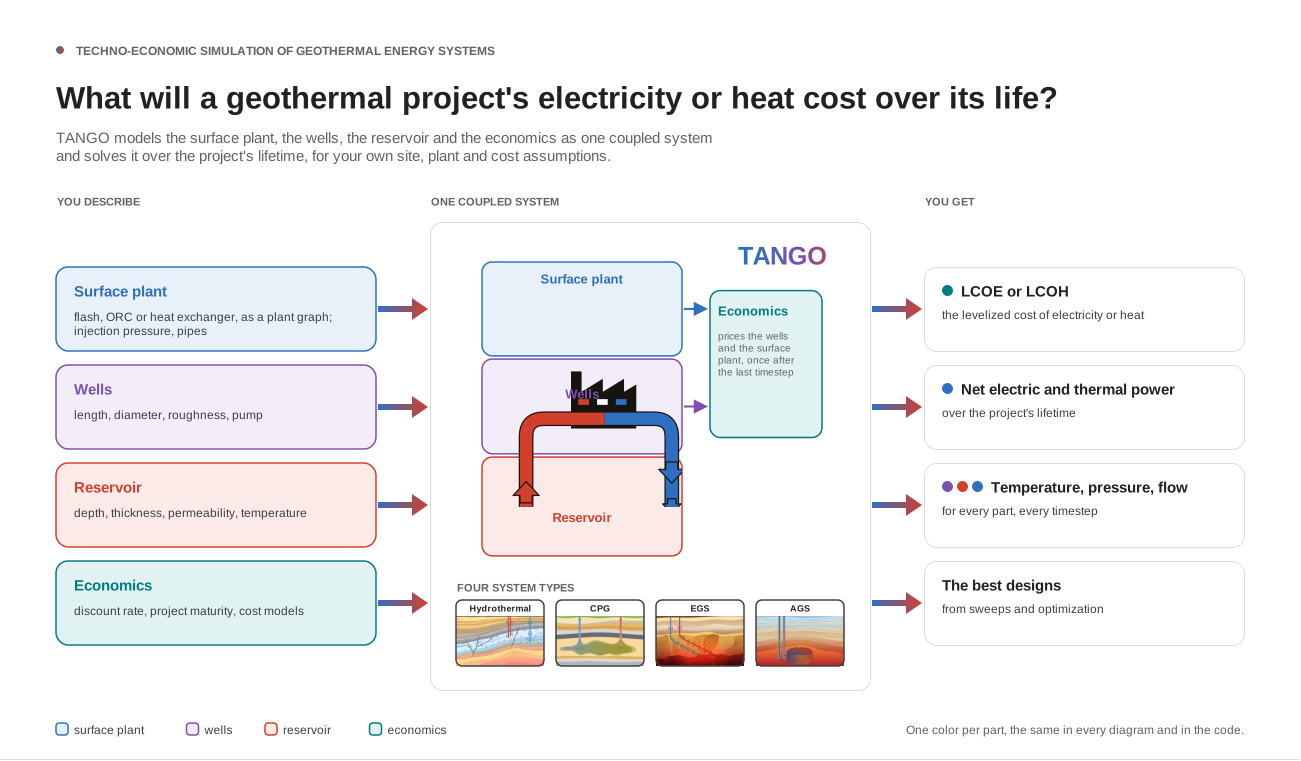
What TANGO models
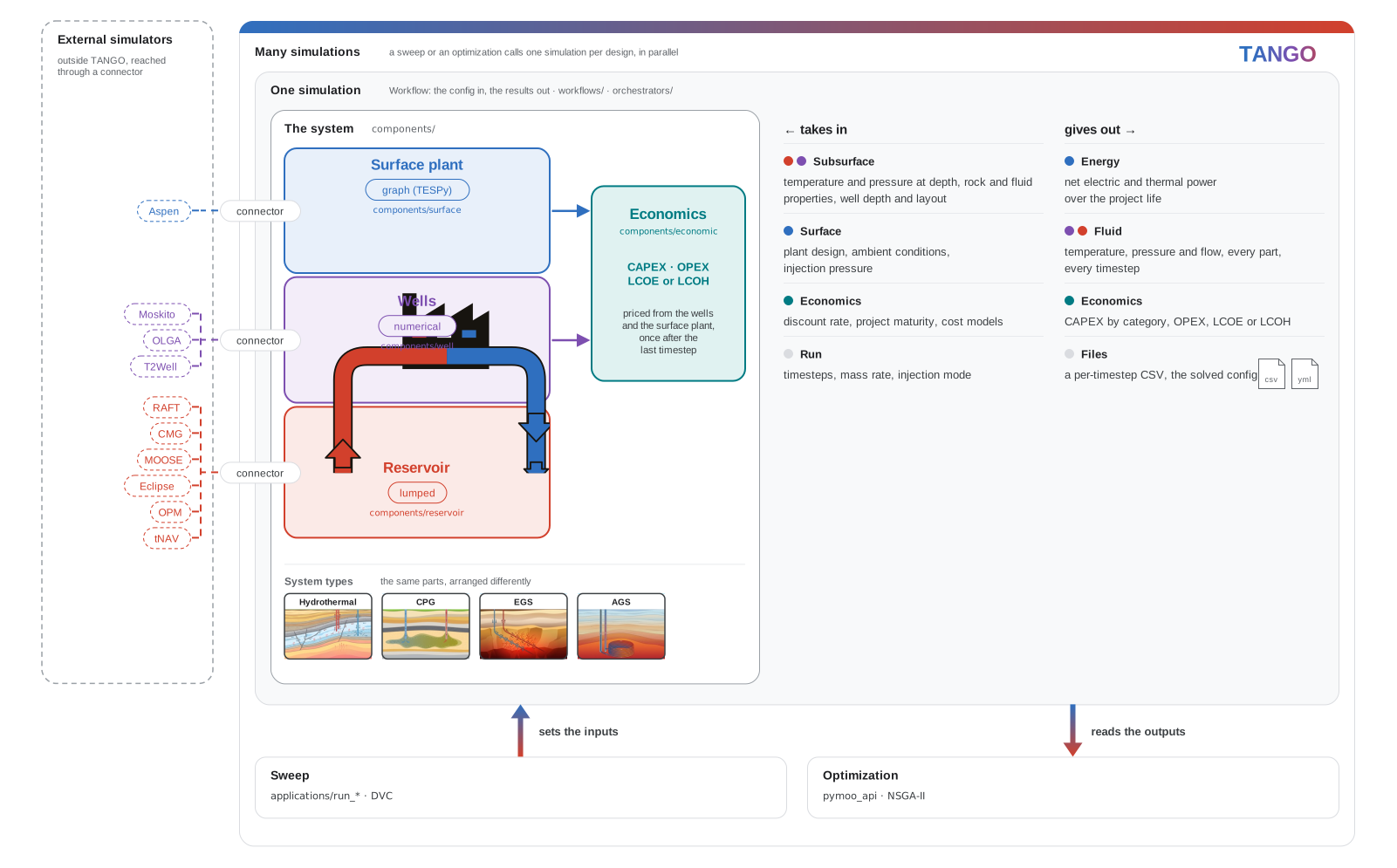
How you use TANGO
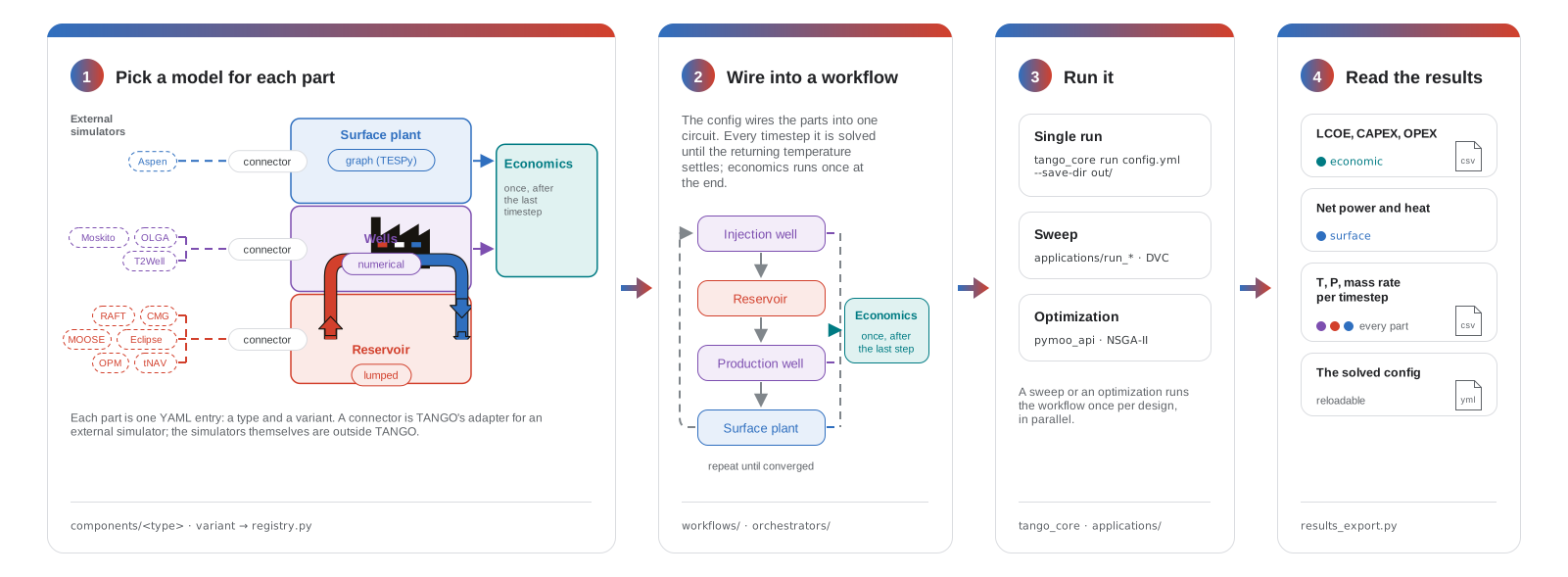
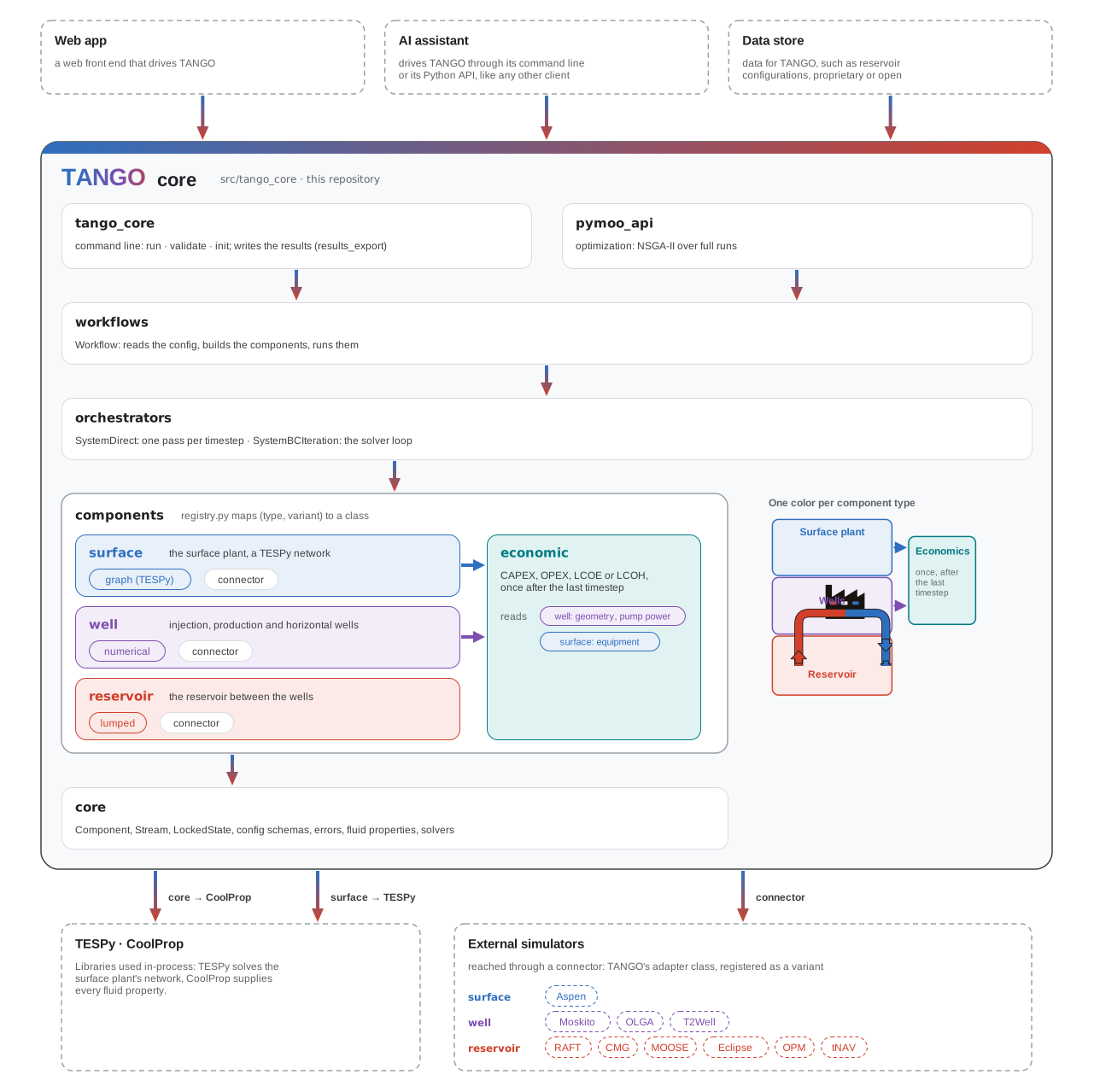
How the code is organized
Start here
To run TANGO, go to Setup. To work on it, read the package tour and CONTRIBUTING.md. Working with an AI agent? Paste this into it:
Read AGENTS.md in GEG-ETHZ/TANGO-core; it holds every instruction for agents in this repository.
Setup
TANGO needs Python 3.11, 3.12, or 3.13 (>=3.11,<3.14) and uv. just and direnv are optional. The distribution is tango-core, the import name is tango_core, and the command is tango_core.
Add it to your own project from PyPI:
uv add tango-core               # or: pip install tango-core
uv run tango_core init .        # copies the templates into ./templates
To install a tagged release from source instead, use uv add "git+https://github.com/GEG-ETHZ/TANGO-core.git" --tag v1.1.0.
Or clone the repository to work on it:
git clone git@github.com:GEG-ETHZ/TANGO-core.git tango-core
cd tango-core
just setup                     # installs dependencies and all git hooks
Then run the flagship example, a single-flash hydrothermal power plant, and save its results:
uv run tango_core validate templates/hydro_sf_electric.yml
uv run tango_core run templates/hydro_sf_electric.yml --save-dir results/
results/ then holds the solved config, a per-timestep CSV and an economics CSV. The same from Python:
from tango_core.workflows.workflow import Workflow

wf = Workflow.from_file("templates/hydro_sf_electric.yml")
wf.run()
The installation guide covers installing from PyPI, pinning a release, upgrades, and setting up a development checkout; Run a simulation describes each result file and the exit codes; optimizations live in applications/.
Documentation and layout
The documentation is published at https://geg-ethz.github.io/TANGO-core/, built from docs/; just docs previews it locally.
| Section | What it covers |
|---|---|
| Getting started | Installation, first run, templates, applications, Euler |
| Architecture | Package layers, config to objects, the component circuit |
| Runtime | The nested loops, boundary-condition iteration, one run end to end |
| API reference | Generated from the docstrings |
| Contributing | The TANGO commandments, workflow, tests, releases |
src/tango_core/        the package: core, components, orchestrators, workflows, CLI, optimization
templates/        maintained configs, one or more per system type; back the tests and applications
applications/     optimizations and demos; each optimization is a DVC pipeline with a SLURM script
tests/            unit/ (fast, run in CI) and regtest/ (full simulations; the fast subset runs before push)
docs/             the documentation site: guides, architecture, runtime, deep dives, API reference
tools/            maintenance scripts, the diagram generators and git-hook helpers
Development and help
just check          # format, lint, strict type check, fast tests
just docs           # documentation site on localhost
just diagrams       # regenerate the banner and the diagrams
Code changes follow the TANGO commandments; branching, pull requests and releases are in CONTRIBUTING.md and changes per release in CHANGELOG.md.
| Need | Where |
|---|---|
| A question about using TANGO | Open an issue on GitHub |
| A bug | Open an issue with the config and the full traceback; see Error tracebacks |
| A security problem | Follow SECURITY.md; do not open a public issue |
| A publication | Cite TANGO with CITATION.cff; GitHub shows a "Cite this repository" button for it |
License
Copyright © 2025 ETH Zurich. Authors: Chad Baker and Dubhaltach McSweeney, Geothermal Energy and Geofluids (GEG) group, Department of Earth and Planetary Sciences.
TANGO is licensed under the Apache License, Version 2.0; see LICENSE.txt.
3 maintainers


Metadata
3 maintainers
Release files for tango-core 1.1.0
For a detailed explanation of source distributions (sdists) and built distributions (wheels), please see the package formats documentation.
Source distribution (sdist)
| File | Size | Uploaded | Provenance | Actions |
|---|---|---|---|---|
| tango_core-1.1.0.tar.gz | 680.3 kB | Without provenance | Details for tango_core-1.1.0.tar.gz |
Built distribution (wheel)
| File | Interpreter | ABI | Platform | Actions Reset |
|---|---|---|---|---|
| tango_core-1.1.0-py3-none-any.whl | Python 3 | none | any | Details for tango_core-1.1.0-py3-none-any.whl |
Total release size: 1.2 MB
Release files / tango_core-1.1.0.tar.gz
| Download URL | tango_core-1.1.0.tar.gz |
|---|---|
| Size | 680.3 kB |
| Tags | Source |
|
SHA-256 checksum How to use checksums |
f3eb17593e80effa0caf39786b52eb0a22e3a8851f56957176395f01391353f0
|
|
BLAKE2b-256 checksum How to use checksums |
acb71c8f242e0ff066079390487256620967eaf994930db87dec71ee9ea5a273
|
| Upload date | |
|
Uploaded using Trusted Publishing? What is trusted publishing? |
Yes |
| Uploaded via |
uv/0.13.7 {"installer":{"name":"uv","version":"0.13.7","subcommand":["publish"]},"python":null,"implementation":{"name":null,"version":null},"distro":{"name":"Ubuntu","version":"26.04","id":"resolute","libc":null},"system":{"name":null,"release":null},"cpu":null,"openssl_version":null,"setuptools_version":null,"rustc_version":null,"ci":true}
|
Release files / tango_core-1.1.0-py3-none-any.whl
| Download URL | tango_core-1.1.0-py3-none-any.whl |
|---|---|
| Size | 495.2 kB |
| Tags | Python 3 |
|
SHA-256 checksum How to use checksums |
aa6baeabf51f96cce8a0e320b69b9f604f30dc31e4064e8a94fd674a14b81b6f
|
|
BLAKE2b-256 checksum How to use checksums |
5f468b1186af10cc81c815517f37432242d29843bd440d799f4c65f1fecd84bf
|
| Upload date | |
|
Uploaded using Trusted Publishing? What is trusted publishing? |
Yes |
| Uploaded via |
uv/0.13.7 {"installer":{"name":"uv","version":"0.13.7","subcommand":["publish"]},"python":null,"implementation":{"name":null,"version":null},"distro":{"name":"Ubuntu","version":"26.04","id":"resolute","libc":null},"system":{"name":null,"release":null},"cpu":null,"openssl_version":null,"setuptools_version":null,"rustc_version":null,"ci":true}
|
Security for tango-core 1.1.0
Provenance
Provenance describes where a file came from. On PyPI, provenance is shared via attestations, which provide a verifiable record of the build or publishing details. View details, limitations and caveats.
No provenance found
None of the files in this release were uploaded with provenance metadata.
A note on package security
PyPI is a repository for distributing packages, not a service for auditing them. While third-party security researchers and our staff do their best to detect and remove malicious packages, PyPI cannot guarantee the quality, security or suitability of any given package.
To learn more about protecting yourself from malicious actors, visit our package security documentation.














