
🛡️ Tardigrade
Resilience middleware that makes AI agents self-healing.
Retries · Checkpointing · Circuit breakers · Cost budgets · Graceful degradation
Works with LangGraph, CrewAI, OpenAI SDK, or raw API calls.




An agent with 85% accuracy per step has just 20% end-to-end success over 10 steps.
Tardigrade wraps your agent with production-grade resilience so step 7 failing
does not mean starting over from scratch.
Install
pip install tardigrade-ai

# With the real-time dashboard:
pip install tardigrade-ai[dashboard]
Quickstart
from tardigrade import armor, Workflow, RetryConfig, BudgetConfig, StepCostReport

@armor(name="fetch", retry=RetryConfig(max_attempts=3))
def fetch_data(url: str) -> dict:
    return {"result": "..."}, StepCostReport(input_tokens=500, output_tokens=200, model="gpt-5.4")

@armor(name="analyze")
def analyze(data: dict) -> str:
    return "analysis", StepCostReport(input_tokens=2000, output_tokens=1000, model="gpt-5.4")

with Workflow("my_pipeline", budget=BudgetConfig(max_budget_usd=1.00)) as wf:
    data = fetch_data("https://api.example.com")
    result = analyze(data)
If the workflow crashes, rerun it with the same run_id and Tardigrade resumes
from the last checkpoint instead of starting from scratch.
Features
| Feature | What it does | Docs |
|---|---|---|
| Automatic retries | Exponential backoff with jitter. Configurable per step. | API |
| Checkpointing | Resume multi-step workflows from the last successful step. | API |
| Circuit breakers | Switch to a fallback model when your primary provider is down. | API |
| Cost budgets | Hard spending limits per workflow with policy-driven enforcement. | API |
| Graceful degradation | Collect partial results instead of crashing on step failures. | API |
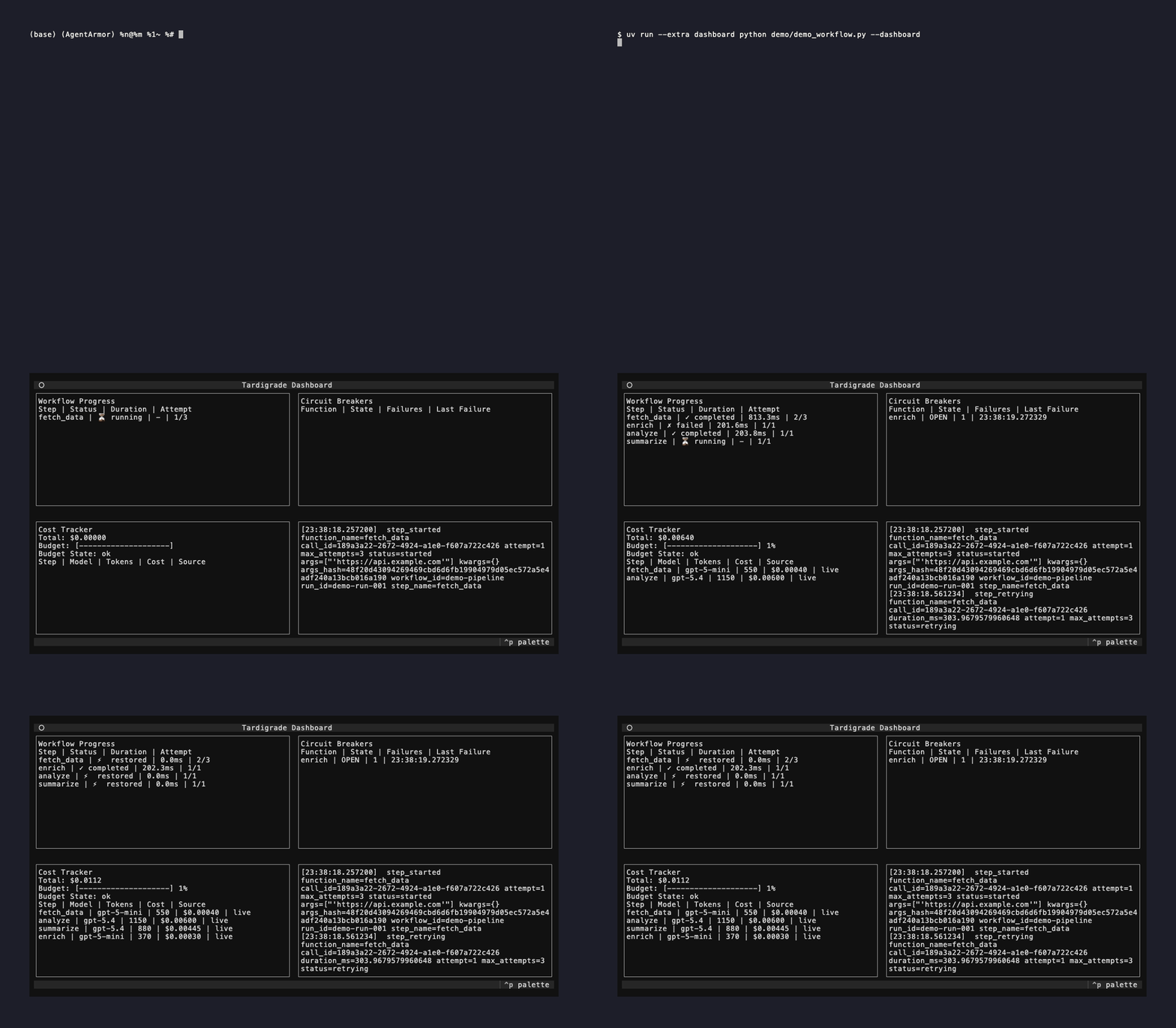
| Real-time dashboard | Terminal UI showing workflow progress, costs, and circuit states. | API |
| Framework-agnostic | Works with any Python code. No lock-in to LangGraph or CrewAI. | Examples |
| Structured logging | Every event is a structured log event via structlog. |
API |
Before and After
| Without Tardigrade | With Tardigrade | |
|---|---|---|
| Step 7 of 10 fails | Start over. Waste $3 and 4 minutes. | Resume from step 7. About $0.15 and 30 seconds. |
| Provider goes down | Cascade failure across all agents. | Circuit breaker routes to a backup model. |
| Agent runs away on tokens | Surprise bills and no hard stop. | Hard budget cap with degradation or stop. |
| Debugging a failure | Wall of JSON, grep, and prayer. | Dashboard plus structured event history. |
Examples
Retry a flaky step
from tardigrade import RetryConfig, armor

class RateLimitedError(RuntimeError):
    pass

@armor(retry=RetryConfig(max_attempts=4, retryable_exceptions=(RateLimitedError, TimeoutError)))
def call_provider(prompt: str) -> str:
    ...
Switch to a fallback model when the primary is down
from tardigrade import CircuitBreakerConfig, armor

def call_claude_haiku(prompt: str) -> str:
    return "fallback response"

@armor(circuit_breaker=CircuitBreakerConfig(failure_threshold=3, fallback=call_claude_haiku))
def call_gpt54(prompt: str) -> str:
    ...
Resume a checkpointed workflow
from tardigrade import Workflow, armor

@armor(name="fetch")
def fetch() -> str:
    return "data"

with Workflow("pipeline", run_id="run-001"):
    fetch()
Enforce a workflow budget
from tardigrade import BudgetConfig, StepCostReport, Workflow, armor

@armor(name="summarize")
def summarize(text: str) -> str:
    return "summary", StepCostReport(input_tokens=500, output_tokens=200, model="gpt-5.4")

with Workflow("pipeline", budget=BudgetConfig(max_budget_usd=0.50)):
    summarize("hello")
Return partial results instead of crashing
from tardigrade import DegradationConfig, DegradationPolicy, Workflow, armor

@armor(name="enrich")
def enrich(data: dict) -> dict:
    raise ConnectionError("provider down")

with Workflow("pipeline", degradation=DegradationConfig(policy=DegradationPolicy.COLLECT)) as wf:
    enrich({"id": 1})

assert wf.result is not None
assert wf.result.status == "failed"
Extended runnable examples live in docs/examples.
Dashboard
# CLI
tardigrade dashboard
# Programmatic
from tardigrade import Dashboard

Dashboard().start_in_thread()
Demo
Run the self-contained demo script:
uv run demo/demo_workflow.py
Record the hero GIF when vhs is installed:
vhs demo/hero.tape
API and Project Docs
1 maintainer

Metadata
1 maintainer
Release files for tardigrade-ai 0.1.0
For a detailed explanation of source distributions (sdists) and built distributions (wheels), please see the package formats documentation.
Source distribution (sdist)
| File | Size | Uploaded | |
|---|---|---|---|
| tardigrade_ai-0.1.0.tar.gz | 237.1 kB | Details |
Built distribution (wheel)
| File | Interpreter | ABI | Platform | Reset |
|---|---|---|---|---|
| tardigrade_ai-0.1.0-py3-none-any.whl | Python 3 | none | any | Details |
Total release size: 268.4 kB
Release files / tardigrade_ai-0.1.0.tar.gz
| Download URL | tardigrade_ai-0.1.0.tar.gz |
|---|---|
| Size | 237.1 kB |
| Tags | Source |
|
SHA-256 checksum How to use checksums |
3acd88f2fa8723848bef9c1ff42d19e84b66f5bdaba7762d933955e5bf13cc6b
|
|
BLAKE2b-256 checksum How to use checksums |
1aac0ce74f9305cb625b4ca2084dbf486ad1d81f2c5b553becaae8e8beefb74a
|
| Upload date | |
|
Uploaded using Trusted Publishing? What is trusted publishing? |
Yes |
| Uploaded via |
twine/6.1.0 CPython/3.13.7
|
Provenance
Provenance describes where a file came from. On PyPI, provenance is shared via attestations, which provide a verifiable record of the build or publishing details. View details, limitations and caveats.


PyPI Publish Attestation
PyPI verified that this artifact, at this checksum, originated from the publisher listed below.
Signed by GitHub Actions, verified by PyPI on Mar 22, 2026.
Transparency logRelease files / tardigrade_ai-0.1.0-py3-none-any.whl
| Download URL | tardigrade_ai-0.1.0-py3-none-any.whl |
|---|---|
| Size | 31.3 kB |
| Tags | Python 3 |
|
SHA-256 checksum How to use checksums |
5ef5d09e854802a42ff7fbc5d4e4a6926ccb6fe700aea96925508f97f6466118
|
|
BLAKE2b-256 checksum How to use checksums |
21433da4ff5e62e3e469081a84b5bdcbb1df54d4d1524f5327535d82112c0171
|
| Upload date | |
|
Uploaded using Trusted Publishing? What is trusted publishing? |
Yes |
| Uploaded via |
twine/6.1.0 CPython/3.13.7
|
Provenance
Provenance describes where a file came from. On PyPI, provenance is shared via attestations, which provide a verifiable record of the build or publishing details. View details, limitations and caveats.
PyPI Publish Attestation
PyPI verified that this artifact, at this checksum, originated from the publisher listed below.
Signed by GitHub Actions, verified by PyPI on Mar 22, 2026.
Transparency log












