
tbkit — a Tight-Binding package





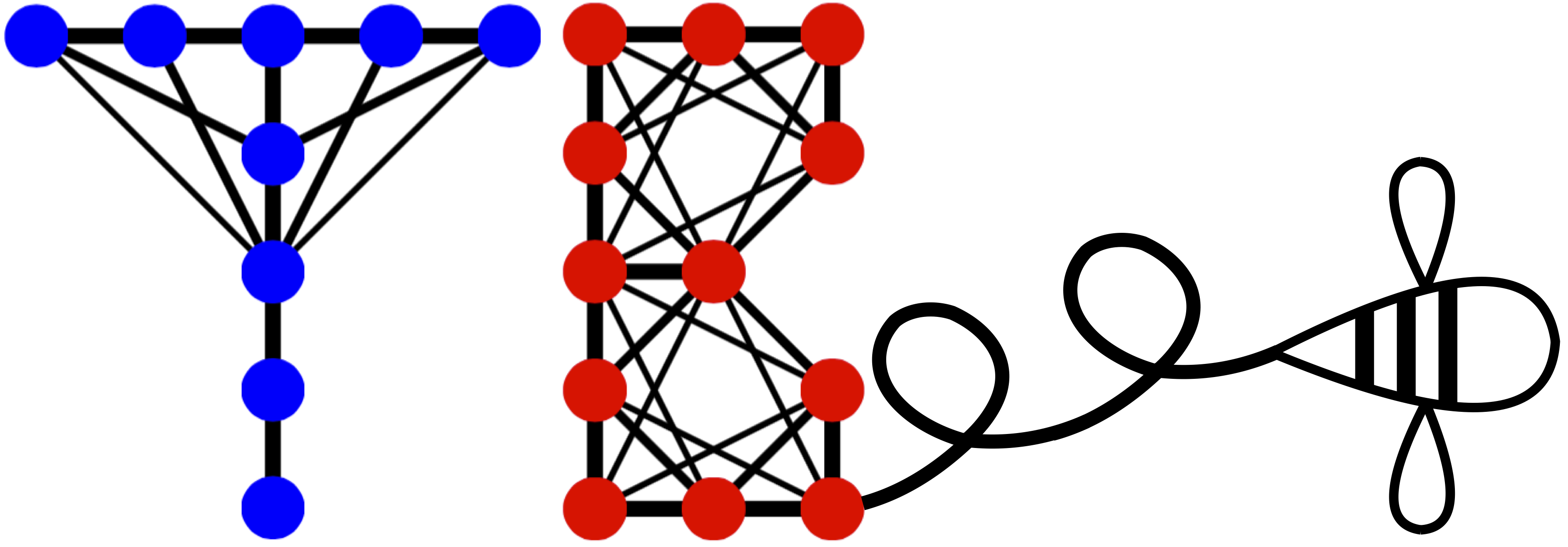
tbkit is a Python package to build and solve Tight-Binding models, written in vectorized NumPy/SciPy. It aims to make the mechanics of Tight-Binding models — lattices, hoppings, Hamiltonians, spectra, band structures — explicit and easy to inspect, so it works as well for teaching as for research prototyping.
Features
- Real space: build arbitrarily complex finite lattices (flakes, ribbons, disordered structures, defects) site by site or via boolean selections (ellipses, half-planes, unions/differences of lattices), then diagonalize the resulting Hamiltonian directly.
- Reciprocal space: build the Bloch Hamiltonian
H(k)of the infinite periodic lattice from a small set of intra-unit-cell hoppings, and compute band structures along a k-path through high-symmetry points. - Topology: Berry curvature and Chern numbers of a group of bands, by the gauge-invariant Fukui-Hatsugai-Suzuki lattice method.
- Spin: optional spin-1/2 degree of freedom on every site, with 2x2 (Pauli-matrix) hoppings/onsite terms, for spin-orbit coupling (Rashba, Kane-Mele) and Zeeman splitting.
- Edge states: cut a ribbon (periodic in one direction, finite in the other) out of any periodic model, to see edge/surface physics.
- Density of states, Gaussian- or Lorentzian-broadened, from either a real-space spectrum or a Brillouin-zone mesh.
- A small library of ready-made lattices (chain, square, triangular, honeycomb, kagome, Lieb).
- Complex-valued onsite energies and hoppings; Hermitian and non-Hermitian Tight-Binding Hamiltonians.
- Multiple sublattices, with hoppings addressed by neighbor order (1st, 2nd, 3rd-nearest neighbor, ...), by angle, or by sublattice-pair tag.
- Built-in patterns for onsite disorder, hopping disorder, dimerization, strain, and an orbital magnetic field (Peierls substitution).
- Time propagation of a wavepacket under the Tight-Binding Hamiltonian (Crank-Nicolson).
tbkit is organized as a small set of composable classes and modules:
| Class / module | Purpose |
|---|---|
tbkit.Lattice |
Define and manipulate site positions and sublattices. |
tbkit.System |
Build the real-space Hamiltonian from a Lattice and solve it. |
tbkit.KSpace |
Build and solve the Bloch Hamiltonian of a periodic Lattice; bands, Berry curvature/Chern numbers, ribbons, DOS. |
tbkit.Plot |
Plot lattices, spectra, eigenstates, and the density of states. |
tbkit.Propagation |
Time-evolve a wavepacket. |
tbkit.Save |
Save figures/animations to disk. |
tbkit.lattices |
Ready-made common lattices. |
tbkit.dos |
Broadened density of states from a set of eigenenergies. |
Install
Requires Python >= 3.10.
pip install tbkit
or, for an editable install from a clone (e.g. to run the test suite or work on tbkit itself):
git clone https://github.com/cpoli/tbkit
cd tbkit
pip install -e .
or, to also install the tools needed to run the test suite:
pip install -e ".[test]"
pytest tests/
The test suite has 100% line coverage of the tbkit package; see the
HTML coverage report.
Quick start
Real-space flake, nearest-neighbor square lattice:
from tbkit.lattice import Lattice
from tbkit.system import System

lat = Lattice(unit_cell=[{'tag': 'a', 'r0': (0., 0.)}],
                       prim_vec=[(1., 0.), (0., 1.)])
lat.get_lattice(n1=10, n2=10)

sys = System(lat)
sys.set_hopping([{'n': 1, 't': 1.}])
sys.get_ham()
sys.get_eig()
print(sys.en)
Graphene band structure (reciprocal space):
import numpy as np
from tbkit.lattice import Lattice
from tbkit.kspace import KSpace, reciprocal_vectors

DX, DY = 0.5 * 3 ** 0.5, 0.5
unit_cell = [{'tag': 'a', 'r0': (0., 0.)}, {'tag': 'b', 'r0': (DX, DY)}]
prim_vec = [(2 * DX, 0.), (DX, 1.5)]
lat = Lattice(unit_cell=unit_cell, prim_vec=prim_vec)

gra = KSpace(lat)
gra.set_hopping([{'i': 0, 'j': 1, 'R': (0, 0), 't': 1.},
                        {'i': 0, 'j': 1, 'R': (-1, 0), 't': 1.},
                        {'i': 0, 'j': 1, 'R': (0, -1), 't': 1.}])

b1, b2 = (np.array(v) for v in reciprocal_vectors(prim_vec))
Gamma, K, M = np.zeros(2), (b1 - b2) / 3, b1 / 2
gra.k_path([Gamma, K, M, Gamma], nk=60)
fig = gra.plot_bands(node_labels=[r'$\Gamma$', 'K', 'M', r'$\Gamma$'])
fig.savefig('graphene_bands.png')
A magnetic field is added with System.set_magnetic_field (uniform field) or
System.set_peierls_phase (arbitrary vector potential), applied to the
hoppings after set_hopping/set_hopping_manual:
sys.set_hopping_manual(hop_dict)
sys.set_magnetic_field(alpha=0.01)  # flux quanta per unit area
sys.get_ham()
See examples/magnetic_field/plot_magnetic_field.py for a full
worked example (an Aharonov-Bohm ring, reproducing the textbook result that
the spectrum is periodic in the enclosed flux with period one flux quantum).
A Chern number is the Berry curvature of a group of bands, integrated over the Brillouin zone:
chern = gra.chern_number(bands=[0], nk=40) # ~0 for plain graphene
See examples/topology/plot_haldane_topology.py for the
Haldane model (the first Chern insulator), reproducing its topological
phase transition (Chern number 1 -> 0) and Berry-curvature map.
A spin-1/2 degree of freedom is added with KSpace(lat, spin=True); onsite
values and hoppings then also accept 2x2 (Pauli) matrices:
from tbkit.kspace import KSpace, PAULI

kmele = KSpace(lat, spin=True)
kmele.set_hopping([{'i': 0, 'j': 0, 'R': (1, 0), 't': 1j*lam*PAULI['z']}])  # intrinsic SOC
A ribbon -- periodic in one direction, finite in the other, the standard
way to see edge states -- is cut out of a periodic model with
tbkit.kspace.ribbon:
from tbkit.kspace import ribbon

rib = ribbon(lat, list_hop, width=30, direction=1)   # 30 unit cells wide
fig = rib.plot_bands()
See examples/topology/plot_edge_states.py for the zigzag
graphene ribbon's zero-energy edge band, and the Kane-Mele ribbon's helical
edge states crossing a spin-orbit gap.
Examples
examples/ is organized as a Sphinx-Gallery
source tree, one topic per subfolder, each with a README.rst blurb. Every
plot_*.py script is self-contained and runnable directly
(python examples/<section>/<script>.py), and checks its own key numeric
claims with assert before plotting -- nothing is asserted in the docs
that isn't also verified in code. Building the docs (pip install -e ".[docs]"
then cd docs && make html) renders these same scripts into an executed,
thumbnailed example gallery under docs/source/api/gallery/.
| Script | What it shows |
|---|---|
tight_binding/plot_square_lattice_bands.py |
The square lattice: Bloch's theorem at its simplest, bands along Gamma-X-M-Gamma, the nested Fermi surface, and the van Hove singularity. |
tight_binding/plot_graphene_bands.py |
Real-space flake + reciprocal-space band structure; graphene's Dirac point and Wallace's 1947 linear dispersion. |
tight_binding/plot_visualizing_a_model.py |
tbkit.plot.Plot: lattice, spectrum with sublattice polarization, density of states, eigenstate intensity. |
magnetic_field/plot_magnetic_field.py |
Peierls substitution; an Aharonov-Bohm ring's flux-periodic spectrum. |
magnetic_field/plot_hofstadter_butterfly.py |
The fractal spectrum of a lattice threaded by a continuously swept flux. |
magnetic_field/plot_landau_levels.py |
Landau levels: a square lattice's non-relativistic ladder vs. graphene's relativistic sqrt(n) ladder and zero mode. |
topology/plot_ssh_model.py |
The SSH model: bulk gap closing and topologically protected edge states. |
disorder/plot_anderson_localization.py |
Anderson localization: IPR vs. disorder strength, extended vs. localized states. |
topology/plot_haldane_topology.py |
The Haldane model: Berry curvature, Chern number, topological phase transition. |
flat_bands/plot_flat_bands.py |
Exactly flat bands on the kagome and Lieb lattices. |
topology/plot_kagome_chern_band.py |
Gapping the kagome flat band into a Chern insulator (C=-1) with complex nearest-neighbor hopping. |
topology/plot_edge_states.py |
Zigzag graphene ribbon edge band; Kane-Mele helical edge states. |
dynamics/plot_bloch_oscillations.py |
Wannier-Stark ladder, its localization, and Bloch oscillations under a uniform tilt. |
topology/plot_thouless_pump.py |
The Rice-Mele model as a Thouless quantum pump: quantized Chern number and polarization winding. |
strain/plot_pseudo_magnetic_field.py |
Triaxial strain as a gauge field: pseudo-Landau levels in graphene from a purely real Hamiltonian. |
non_hermitian/plot_pt_symmetry.py |
PT symmetry, exceptional points, the Petermann factor, and a selectively amplified topological edge mode. |
The examples/ directory also has five older Jupyter notebooks (graphene
flakes, kagome/Lieb/dumbbell lattices, disorder, strain, time propagation)
predating the 0.2 API refresh below.
Documentation
Rendered docs (tutorial, API reference, example gallery): https://cpoli.github.io/tbkit/
docs/source/tutorial.rst-- a narrative walkthrough of the package, from building a lattice through topology, spin-orbit coupling, and edge states.docs/source/history.rst-- a chronology of the breakthroughs behind Tight-Binding theory (Bloch's theorem through the Kane-Mele model), each one linked to the corresponding tbkit functionality and example above.docs/source/tbkit.rst-- the API reference (auto-generated from docstrings).
Build the HTML docs with cd docs && make html (output in docs/build/html).
A note on the API
Version 0.2 modernized the package to run on current Python/NumPy/SciPy and cleaned up the API:
- Sublattice tags are plain one-character strings (
'a') rather than byte strings (b'a'). - Classes are named in
PascalCase(Lattice,System, ...) rather than lowercase names identical to their module (lattice.lattice,system.system, ...), which used to makeimport tbkit.lattice as latticesilently bind the wrong object.
For continuity, the pre-0.2 lowercase class names (lattice, system,
plot, propagation, save) remain available as aliases of the new
classes, so from tbkit.lattice import lattice still works. Example
notebooks predating 0.2 still use byte-string tags (b'a') and will need
that one mechanical change to run on the current version.
License
BSD 3-Clause, see LICENSE.
1 maintainer

Release files for tbkit 0.3.0
For a detailed explanation of source distributions (sdists) and built distributions (wheels), please see the package formats documentation.
Source distribution (sdist)
| File | Size | Uploaded | |
|---|---|---|---|
| tbkit-0.3.0.tar.gz | 65.8 kB | Details |
Built distribution (wheel)
| File | Interpreter | ABI | Platform | Reset |
|---|---|---|---|---|
| tbkit-0.3.0-py3-none-any.whl | Python 3 | none | any | Details |
Total release size: 112.0 kB
Release files / tbkit-0.3.0.tar.gz
| Download URL | tbkit-0.3.0.tar.gz |
|---|---|
| Size | 65.8 kB |
| Tags | Source |
|
SHA-256 checksum How to use checksums |
079354d319c4cf4438263530f0d43859906f4bb8317f7618c6af843f52d6d008
|
|
BLAKE2b-256 checksum How to use checksums |
baec4a4da980198b08c174f3993184ce5d6c6484926189dfc2f6cdbf728320dc
|
| Upload date | |
|
Uploaded using Trusted Publishing? What is trusted publishing? |
No |
| Uploaded via |
twine/7.0.0 CPython/3.14.7
|
Release files / tbkit-0.3.0-py3-none-any.whl
| Download URL | tbkit-0.3.0-py3-none-any.whl |
|---|---|
| Size | 46.2 kB |
| Tags | Python 3 |
|
SHA-256 checksum How to use checksums |
34149fa7666de43565abfaab272e9001014c32597a8d31a6210dfb9063584225
|
|
BLAKE2b-256 checksum How to use checksums |
9c03a466bbf34085631fe7d7fe54b0b25d8315bea6d4263f7215512bb91e6717
|
| Upload date | |
|
Uploaded using Trusted Publishing? What is trusted publishing? |
No |
| Uploaded via |
twine/7.0.0 CPython/3.14.7
|














