
A library to sample temporal walks from an in-memory temporal graph

This project has been archived.
The maintainers of this project have marked this project as archived. No new releases are expected.
Project description
Temporal Walk


A modified implementation of temporal walk algorithm from "Continuous-Time Dynamic Network Embeddings" paper.
Introduction
This project enables the construction of large temporal networks in memory, from which temporal walks can be sampled. Temporal walks are invaluable in graph neural networks (GNNs) for learning network dynamics.
This library facilitates the creation of temporal graphs and the incremental sampling of temporal walks based on the current graph state, making it especially useful for training GNNs. PyBind is interfaced which let's the functions to be called from Python. For convenience the walks are returned as numpy arrays.
The library also supports the creation of continuous graphs with a maximum time capacity, where edges with timestamps older than the current time minus the maximum capacity are automatically deleted.
Definitions
A temporal network represents a dynamic system where edges or interactions between nodes vary over time. In contrast to static networks, temporal networks capture changes and sequences in connectivity, which is essential in understanding real-world phenomena like social interactions, information spread, and transportation flows over time.
A temporal walk is a path through a temporal network that respects the order of timestamps on edges, ensuring causality. Temporal walks are particularly useful for applications in graph neural networks (GNNs), where learning temporal dependencies enhances the model's ability to predict or understand evolving network structures.
Example
For a given temporal network with following edges (upstream node, downstream node, timestamp),
[
    (4, 5, 71),
    (3, 5, 82),
    (1, 3, 19),
    (4, 2, 34),
    (4, 3, 79),
    (2, 5, 19),
    (2, 3, 70),
    (5, 4, 97),
    (4, 6, 57),
    (6, 4, 27),
    (2, 6, 80),
    (6, 1, 42),
    (4, 6, 98),
    (1, 4, 17),
    (5, 4, 32)
]
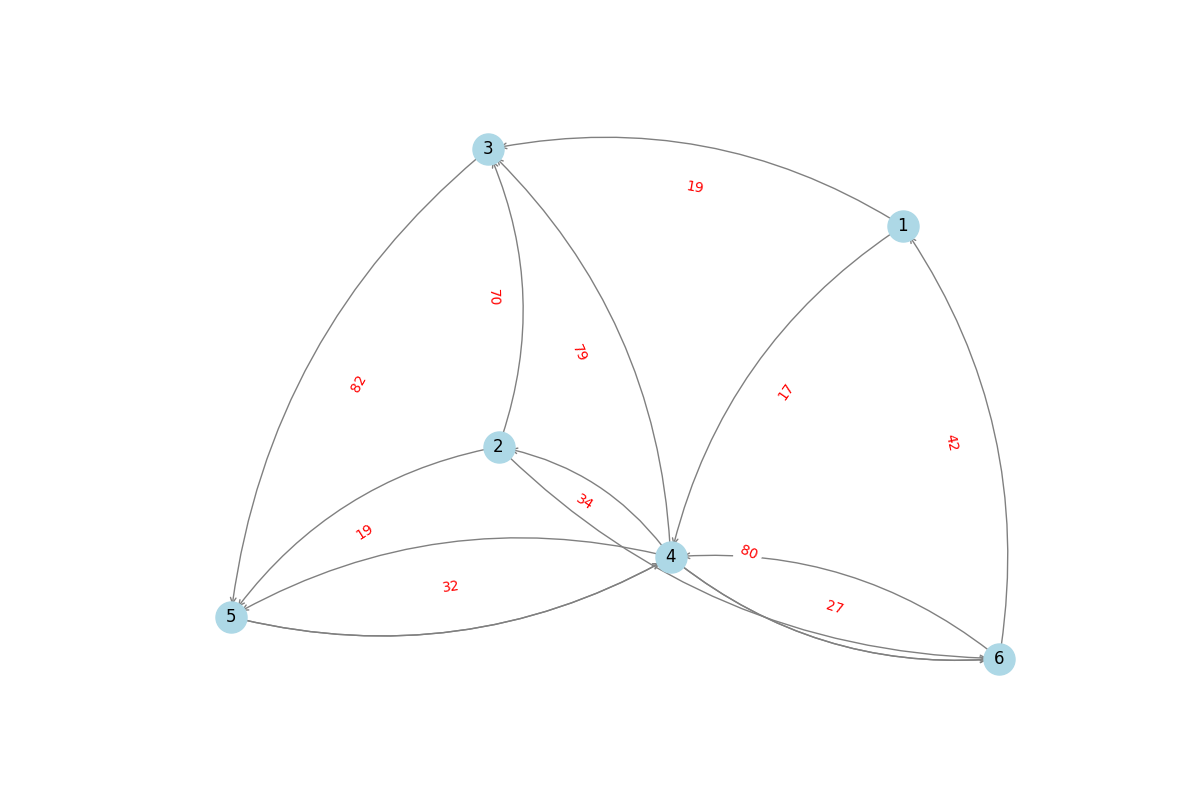
Some forward walks (past to future),
(2, -9223372036854775808), (5, 19), (4, 32), (5, 71), (4, 97), (6, 98)
(1, -9223372036854775808), (3, 19), (5, 82), (4, 97), (6, 98)
(6, -9223372036854775808), (4, 27), (3, 79), (5, 82), (4, 97), (6, 98)
(1, -9223372036854775808), (4, 17), (2, 34), (3, 70), (5, 82), (4, 97), (6, 98)
(1, -9223372036854775808), (5, 19), (4, 32), (3, 79), (5, 82), (4, 97), (6, 98)
Some reverse walks (Future to past and then reversed),
(6, 27), (4, 79), (3, 82), (5, 97), (4, 9223372036854775807)
(2, 19), (5, 32), (4, 57), (6, 9223372036854775807)
(2, 19), (5, 32), (4, 34), (2, 80), (6, 9223372036854775807)
(6, 27), (4, 98), (6, 9223372036854775807)
(2, 19), (5, 32), (4, 79), (3, 82), (5, 97), (4, 98), (6, 9223372036854775807)
Installation
This project can be installed using pip.
pip install temporal-walk
Functions
TemporalWalk class contains the public facing functions.
Constructor
TemporalWalk(int64_t max_time_capacity=-1);
Initializes a TemporalWalk object with the maximum time capacity of the graph. The default value of max_time_capacity is -1, which means unlimited capacity. If set then edges older than max_time_capacity from the latest timestamp are deleted automatically.
add_multiple_edges
void add_multiple_edges(const std::vector<EdgeInfo>& edge_infos);
Adds multiple edges to the temporal graph based on the provided vector of EdgeInfo structures, where each structure contains the source node u, destination node i, and timestamp t.
get_random_walks
std::vector<std::vector<int>> get_random_walks(
        int max_walk_len,
        const RandomPickerType* walk_bias,
        long num_cw=-1,
        int num_walks_per_node=-1,
        const RandomPickerType* initial_edge_bias=nullptr,
        WalkDirection walk_direction=WalkDirection::Forward_In_Time,
        WalkInitEdgeTimeBias walk_init_edge_time_bias=WalkInitEdgeTimeBias::Bias_Earliest_Time,
        int context_window_len=-1,
        float p_walk_success_threshold=0.01);
Generates temporal random walks similar to get_random_walks_with_times but returns only the node IDs without timestamps.
Parameters:
- max_walk_len: Maximum length of each random walk
- walk_bias: Type of bias for selecting next edges during walk (Uniform, Linear, or Exponential)
- num_cw: Number of context windows to generate. If -1, calculated using num_walks_per_node
- num_walks_per_node: Number of walks per node. Used only if num_cw is -1
- initial_edge_bias: Optional bias type for selecting initial edges (Uniform, Linear, or Exponential). If nullptr, uses walk_bias
- walk_direction: Direction of temporal walks (Forward_In_Time or Backward_In_Time)
- walk_init_edge_time_bias: Bias for initial edge selection (Bias_Earliest_Time or Bias_Latest_Time)
- context_window_len: Minimum length of walks. Default is 2 if -1 provided
- p_walk_success_threshold: Minimum required success rate for walk generation (default 0.01)
Returns:
A vector of walks, where each walk is a vector of node IDs representing the temporal path through the network.
get_random_walks_with_times
std::vector<std::vector<NodeWithTime>> get_random_walks_with_times(
        int max_walk_len,
        const RandomPickerType* walk_bias,
        long num_cw=-1,
        int num_walks_per_node=-1,
        const RandomPickerType* initial_edge_bias=nullptr,
        WalkDirection walk_direction=WalkDirection::Forward_In_Time,
        WalkInitEdgeTimeBias walk_init_edge_time_bias=WalkInitEdgeTimeBias::Bias_Earliest_Time,
        int context_window_len=-1,
        float p_walk_success_threshold=0.01);
Generates temporal random walks where each step contains both node ID and timestamp. Each walk respects temporal ordering based on the specified direction and biases.
Parameters:
- max_walk_len: Maximum length of each random walk
- walk_bias: Type of bias for selecting next edges during walk (Uniform, Linear, or Exponential)
- num_cw: Number of context windows to generate. If -1, calculated using num_walks_per_node
- num_walks_per_node: Number of walks per node. Used only if num_cw is -1
- initial_edge_bias: Optional bias type for selecting initial edges (Uniform, Linear, or Exponential). If nullptr, uses walk_bias
- walk_direction: Direction of temporal walks (Forward_In_Time or Backward_In_Time)
- walk_init_edge_time_bias: Bias for initial edge selection (Bias_Earliest_Time or Bias_Latest_Time)
- context_window_len: Minimum length of walks. Default is 2 if -1 provided
- p_walk_success_threshold: Minimum required success rate for walk generation (default 0.01)
Returns:
A vector of temporal walks, where each walk is a vector of NodeWithTime pairs containing node IDs and their corresponding timestamps.
get_edge_count
size_t get_edge_count();
Returns the total number of directed edges in the temporal graph.
get_node_count
size_t get_node_count();
Returns the total number of nodes present in the temporal graph.
get_node_ids
std::vector<int> get_node_ids();
Returns a vector containing the IDs of all nodes in the temporal graph.
clear
void clear();
Clears and reinitiates the underlying temporal graph, removing all edges and nodes.
Python Interfaces
The Python bindings for the TemporalWalk class provide a seamless way to interact with the C++ implementation from Python. The bindings are created using the pybind11 library, enabling easy access to the functionality of the TemporalWalk class.
Constructor
TemporalWalk(max_time_capacity: int=-1):
Initializes a TemporalWalk object with the maximum time capacity of the graph.
add_multiple_edges
def add_multiple_edges(edge_infos: List[Tuple[int, int, int64_t]]):
Adds multiple directed edges to the temporal graph based on the provided list of tuples. Each tuple should contain three elements: the source node u, the destination node i, and the timestamp t.
get_random_walks
get_random_walks(
    max_walk_len: int,
    walk_bias: str,
    num_cw: Optional[int] = None,
    num_walks_per_node: Optional[int] = None,
    initial_edge_bias: Optional[str] = None,
    walk_direction: str = "Forward_In_Time",
    walk_init_edge_time_bias: str = "Bias_Earliest_Time",
    context_window_len: Optional[int] = None,
    p_walk_success_threshold: float = 0.01
) -> List[List[int]]:
Generates temporal random walks from the graph using parallel processing with hardware concurrency.
Parameters
-
max_walk_len - Maximum length of each random walk
-
walk_bias - Type of bias for selecting next edges during walk:
- "Uniform": Equal probability for all valid edges
- "Linear": Linear decay based on time
- "Exponential": Exponential decay based on time
-
num_cw - Number of context windows to generate. If None, calculated using num_walks_per_node
-
num_walks_per_node - Number of walks per node. Used only if num_cw is None
-
initial_edge_bias - Optional bias type for selecting initial edges. Uses walk_bias if None
-
walk_direction - Direction of temporal walks:
- "Forward_In_Time": Walks progress from past to future
- "Backward_In_Time": Walks progress from future to past
-
walk_init_edge_time_bias - Bias for initial edge selection:
- "Bias_Earliest_Time": Prioritize earlier timestamps
- "Bias_Latest_Time": Prioritize later timestamps
-
context_window_len - Minimum length of walks (default 2 if None provided)
-
p_walk_success_threshold - Minimum required success rate for walk generation (default 0.01)
Returns
List of walks, where each walk is a list of node IDs representing the temporal path through the network.
get_random_walks_with_times
get_random_walks_with_times(
    max_walk_len: int,
    walk_bias: str,
    num_cw: Optional[int] = None,
    num_walks_per_node: Optional[int] = None,
    initial_edge_bias: Optional[str] = None,
    walk_direction: str = "Forward_In_Time",
    walk_init_edge_time_bias: str = "Bias_Earliest_Time",
    context_window_len: Optional[int] = None,
    p_walk_success_threshold: float = 0.01
) -> List[List[Tuple[int, int64_t]]]:
Similar to get_random_walks but includes timestamps with each node in the walks. Uses parallel processing with hardware concurrency.
Parameters
-
max_walk_len - Maximum length of each random walk
-
walk_bias - Type of bias for selecting next edges during walk:
- "Uniform": Equal probability for all valid edges
- "Linear": Linear decay based on time
- "Exponential": Exponential decay based on time
-
num_cw - Number of context windows to generate. If None, calculated using num_walks_per_node
-
num_walks_per_node - Number of walks per node. Used only if num_cw is None
-
initial_edge_bias - Optional bias type for selecting initial edges. Uses walk_bias if None
-
walk_direction - Direction of temporal walks:
- "Forward_In_Time": Walks progress from past to future
- "Backward_In_Time": Walks progress from future to past
-
walk_init_edge_time_bias - Bias for initial edge selection:
- "Bias_Earliest_Time": Prioritize earlier timestamps
- "Bias_Latest_Time": Prioritize later timestamps
-
context_window_len - Minimum length of walks (default 2 if None provided)
-
p_walk_success_threshold - Minimum required success rate for walk generation (default 0.01)
Returns
List of walks, where each walk is a list of tuples containing (node_id, timestamp) pairs, representing the temporal path through the network with corresponding timestamps.
get_node_count
get_node_count() -> int:
Returns the total number of nodes present in the temporal graph.
get_edge_count
get_edge_count() -> int:
Returns the total number of directed edges in the temporal graph.
get_node_ids
get_node_ids() -> np.ndarray:
Returns a numpy array containing the IDs of all nodes in the temporal graph.
clear
clear():
Clears and reinitiates the underlying temporal graph, removing all edges and nodes.
add_edges_from_networkx
add_edges_from_networkx(nx_graph: nx.DiGraph):
Adds edges from a NetworkX directed graph to the current TemporalWalk object. The NetworkX graph must have a 'timestamp' attribute for each edge.
to_networkx
to_networkx() -> nx.DiGraph:
Exports the current temporal graph to a NetworkX DiGraph object. Each edge in the resulting graph will have a 'timestamp' attribute containing the temporal information.
Nguyen, Giang Hoang et al. “Continuous-Time Dynamic Network Embeddings.” Companion Proceedings of the The Web Conference 2018 (2018).
Release history Release notifications | RSS feed


Download files
Download the file for your platform. If you're not sure which to choose, learn more about installing packages.
Source Distributions
Built Distributions
Filter files by name, interpreter, ABI, and platform.
If you're not sure about the file name format, learn more about wheel file names.
Copy a direct link to the current filters
File details
Details for the file temporal_walk-0.4.5-cp312-cp312-macosx_14_0_arm64.whl.
File metadata
- Download URL: temporal_walk-0.4.5-cp312-cp312-macosx_14_0_arm64.whl
- Upload date:
- Size: 251.3 kB
- Tags: CPython 3.12, macOS 14.0+ ARM64
- Uploaded using Trusted Publishing? No
- Uploaded via: twine/6.0.1 CPython/3.12.7
File hashes
| Algorithm | Hash digest | |
|---|---|---|
| SHA256 |
74f0a2647aac8d0c9b06b5fdf13d401dd3d93c6de4cba089587956cd77babe5a
|
|
| MD5 |
8490fd9e2459f4dc7649f92795d498a9
|
|
| BLAKE2b-256 |
39057dcf32df9d36448d617d19c58dd95a72423982b5c17dc09c638c1899780f
|
File details
Details for the file temporal_walk-0.4.5-cp311-cp311-macosx_14_0_arm64.whl.
File metadata
- Download URL: temporal_walk-0.4.5-cp311-cp311-macosx_14_0_arm64.whl
- Upload date:
- Size: 252.2 kB
- Tags: CPython 3.11, macOS 14.0+ ARM64
- Uploaded using Trusted Publishing? No
- Uploaded via: twine/6.0.1 CPython/3.12.7
File hashes
| Algorithm | Hash digest | |
|---|---|---|
| SHA256 |
bdc65404648e1ca959dfd76a76c973ab2fe2890f4ea442bb475435d3fa647cd5
|
|
| MD5 |
756b6f5feea4351e3f9175407d7af8f4
|
|
| BLAKE2b-256 |
71d789a7bed07b5ec36c56b9471061aacd03105eace75e96d8f5d589e9854a04
|
File details
Details for the file temporal_walk-0.4.5-cp310-cp310-macosx_14_0_arm64.whl.
File metadata
- Download URL: temporal_walk-0.4.5-cp310-cp310-macosx_14_0_arm64.whl
- Upload date:
- Size: 251.6 kB
- Tags: CPython 3.10, macOS 14.0+ ARM64
- Uploaded using Trusted Publishing? No
- Uploaded via: twine/6.0.1 CPython/3.12.7
File hashes
| Algorithm | Hash digest | |
|---|---|---|
| SHA256 |
743c0de89b3b7c3d81c77aa04a1021028a52b9e73e477d19f4945fadf303db35
|
|
| MD5 |
6ac61fbd29cd02c2383e698c4f9b7aa1
|
|
| BLAKE2b-256 |
565294a388430597a4b78399e61ddf4e8cc9a88b3ab409f62093be547d3f8839
|
File details
Details for the file temporal_walk-0.4.5-cp38-cp38-macosx_13_0_arm64.whl.
File metadata
- Download URL: temporal_walk-0.4.5-cp38-cp38-macosx_13_0_arm64.whl
- Upload date:
- Size: 251.5 kB
- Tags: CPython 3.8, macOS 13.0+ ARM64
- Uploaded using Trusted Publishing? No
- Uploaded via: twine/6.0.1 CPython/3.12.7
File hashes
| Algorithm | Hash digest | |
|---|---|---|
| SHA256 |
a6a108494b3f8001dbf2fe01c972f2db0cdb0ed031362bdf4d48e972881e1205
|
|
| MD5 |
f665be0b675e582732b076f2cb76d498
|
|
| BLAKE2b-256 |
d3e65d301e188eb5c5bd0540d19ace1125069e40940ee520b2df6e62342709ae
|






