
High-performance zero-copy tensor protocol

Project description
Tenso
Up to 35x faster than Apache Arrow on deserialization. 46x less CPU than SafeTensors.
Zero-copy, SIMD-aligned tensor protocol for high-performance ML infrastructure.



Why Tenso?
Most serialization formats are designed for general data or disk storage. Tenso is focused on network tensor transmission where every microsecond matters.
The Problem
Traditional formats waste CPU cycles during deserialization:
- SafeTensors: 37.1% CPU usage (great for disk, overkill for network)
- Pickle: 40.9% CPU usage + security vulnerabilities
- Arrow: Faster on serialization, but up to 32x slower on deserialization for large tensors
The Solution
Tenso achieves true zero-copy with:
- Minimalist Header: Fixed 10-byte header eliminates JSON parsing overhead.
- 64-byte Alignment: SIMD-ready padding ensures the data body is cache-line aligned.
- Direct Memory Mapping: The CPU points directly to existing buffers without copying.
Result: 0.8% CPU usage vs >40% for SafeTensors/Pickle.
Benchmarks
System: Python 3.12.9, NumPy 2.3.5, 12 CPU cores, M4 Pro
1. In-Memory Serialization (LLM Layer - 64MB)
| Format | Size | Serialize | Deserialize | Speedup (Deser) |
|---|---|---|---|---|
| Tenso | 64.00 MB | 3.51 ms | 0.004 ms | 1x |
| Arrow | 64.00 MB | 7.06 ms | 0.011 ms | 2.8x slower |
| SafeTensors | 64.00 MB | 8.14 ms | 2.39 ms | 597x slower |
| Pickle | 64.00 MB | 2.93 ms | 2.71 ms | 677x slower |
| MsgPack | 64.00 MB | 10.44 ms | 3.05 ms | 763x slower |
Note: Tenso (Vect) variant is even faster with 0.000 ms deserialize time.
2. Disk I/O (256 MB Matrix)
| Format | Write | Read |
|---|---|---|
| Tenso | 29.41 ms | 36.28 ms |
| NumPy .npy | 24.83 ms | 43.08 ms |
| Pickle | 49.90 ms | 24.24 ms |
3. Stream Reading (95 MB Packet)
| Method | Time | Throughput | Speedup |
|---|---|---|---|
| Tenso read_stream | 7.68 ms | 12,417 MB/s | 1x |
| Optimised Loop | 13.89 ms | 7,396 MB/s | 1.9x slower |
4. CPU Usage (Efficiency)
| Format | Serialize CPU% | Deserialize CPU% |
|---|---|---|
| Tenso | 117.3% | 0.8% |
| Arrow | 57.1% | 1.0% |
| SafeTensors | 67.1% | 37.1% |
| Pickle | 44.0% | 40.9% |
5. Arrow vs Tenso (Comparison)
| Size | Tenso Ser | Arrow Ser | Tenso Des | Arrow Des | Speedup |
|---|---|---|---|---|---|
| Small | 0.130ms | 0.056ms | 0.009ms | 0.035ms | 4.1x |
| Medium | 0.972ms | 0.912ms | 0.020ms | 0.040ms | 2.0x |
| Large | 3.166ms | 3.655ms | 0.019ms | 0.222ms | 11.8x |
| XLarge | 19.086ms | 28.726ms | 0.023ms | 0.733ms | 32.0x |
6. Network Performance
- Packet Throughput: 89,183 packets/sec (over localhost TCP)
- Latency: 11.2 µs/packet
- Async Write Throughput: 88,397 MB/s (1.4M tensors/sec)
When should I use Tenso?
Tenso is built for one pattern: serialize once, deserialize many times, over the network or between processes. Reading data back is effectively free (a zero-copy memory view), so the more often your tensors are read, the more Tenso wins.
Reach for Tenso when
- You serve models over a network or RPC. Inference nodes spend ~0.8% CPU decoding tensors instead of ~40%, leaving the cores for actual compute.
- You pass tensors between machines or processes — gradients/activations in distributed training (native Ray integration), or zero-copy hand-offs via shared memory (
TensoShm). - Latency is critical — real-time inference, robotics, sensor fusion (single-digit-µs reads).
- You stream many tensors — high-throughput pipelines (1.4M tensors/sec), with
write_streamsending straight from the array's own memory. - You feed GPUs from the network or disk with minimal host involvement.
- You want integrity without overhead — optional 64-bit XXH3 checksums.
Consider an alternative when
- You store model weights on disk and rarely reload them → SafeTensors is purpose-built for that.
- You need columnar analytics or a data ecosystem (filters, Parquet, query engines) → Apache Arrow.
- You're serializing arbitrary Python objects, not tensors →
pickle(but never on untrusted input). - You only ever write and never read back — Tenso's edge is on the read side, so the payoff is smaller.
Note on writes:
dumps()returns a freshbytesobject, so it pays a one-time buffer-allocation cost like any format that does. For write-heavy or networked paths, preferwrite_stream/iter_dumps, which send the tensor's own memory with zero body copy.
How it compares
| vs. | Built for | Where Tenso pulls ahead |
|---|---|---|
| Pickle | Arbitrary Python objects | ~600x faster reads, ~50x less CPU, and no arbitrary-code-execution risk |
| SafeTensors | Safe on-disk weight storage | ~600x faster reads — 0.8% vs 37% CPU, built for the wire, not the disk |
| Apache Arrow | Columnar data ecosystems | Up to 32x faster deserialization on large tensors, with a tiny header instead of a full columnar runtime |
NumPy .npy |
Saving arrays to disk | Faster reads/writes plus streaming, integrity checks, and multi-tensor bundles |
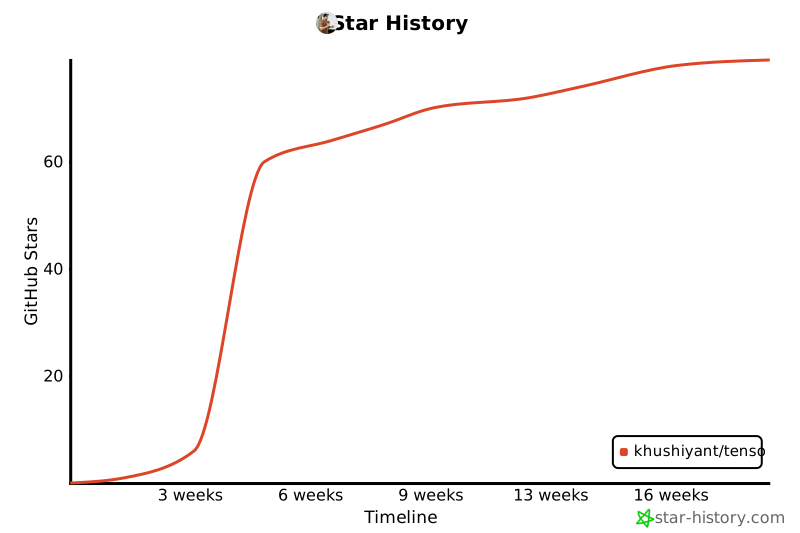
Star History
Installation
pip install tenso
Optional extras:
pip install tenso[api]    # gRPC, FastAPI, Ray integration
pip install tenso[gpu]    # GPU acceleration (CuPy/PyTorch/JAX)
Quick Start
Basic Serialization
import numpy as np
import tenso

# Create tensor
data = np.random.rand(1024, 1024).astype(np.float32)

# Serialize
packet = tenso.dumps(data)

# Deserialize (Zero-copy view)
restored = tenso.loads(packet)
Async I/O
import asyncio
import tenso

async def handle_client(reader, writer):
    # Asynchronously read a tensor from the stream
    data = await tenso.aread_stream(reader)

    # Process and write back
    await tenso.awrite_stream(data * 2, writer)
FastAPI Integration
from fastapi import FastAPI
import numpy as np
from tenso.fastapi import TensoResponse

app = FastAPI()

@app.get("/tensor")
async def get_tensor():
    data = np.ones((1024, 1024), dtype=np.float32)
    return TensoResponse(data) # Zero-copy streaming response
Advanced Features
Ray Integration (Distributed Computing)
Replace pickle-based serialization in Ray with Tenso for 46x less CPU overhead on tensor operations. Works transparently with ray.put(), ray.get(), remote functions, and actors.
import ray
import numpy as np
from tenso.ray import register

ray.init()
register()  # Register Tenso as the serializer for numpy arrays

# All ray.put/get operations now use Tenso
ref = ray.put(np.zeros((1000, 1000)))
arr = ray.get(ref)  # Deserialized via Tenso

# Works transparently with remote functions
@ray.remote
def process(tensor):
    return tensor.mean()

ray.get(process.remote(np.random.randn(1000, 1000)))
Optional support for PyTorch and JAX tensors:
register(include_torch=True, include_jax=True)
Quantized Tensors (4-bit & 8-bit)
Native support for quantized representations to reduce memory footprint with minimal accuracy loss.
from tenso.quantize import QuantizedTensor
import numpy as np

data = np.random.randn(1024, 1024).astype(np.float32)

# Quantize to 8-bit (per-tensor scheme)
qt = QuantizedTensor.quantize(data, dtype="qint8", scheme="per_tensor")
print(qt)  # QuantizedTensor(dtype=qint8, shape=(1024, 1024), ...)

# Serialize/deserialize with Tenso
import tenso
packet = tenso.dumps(qt)
restored = tenso.loads(packet)

# Dequantize back to float32
result = restored.dequantize()
Supported dtypes: qint8, quint8, qint4, quint4
Supported schemes: per_tensor, per_channel, per_group
Inter-Process Communication (Shared Memory)
Transfer tensors between local processes with single-digit microsecond latency using Shared Memory. This avoids socket overhead entirely by passing memory handles.
from tenso import TensoShm
import numpy as np

# Process A: Write to Shared Memory
data = np.random.randn(1024, 1024).astype(np.float32)
# Automatically sizes and creates the SHM segment
with TensoShm.create_from("shared_tensor_01", data) as shm:
    print("Tensor is in SHM. Waiting for reader...")
    input() # Keep process alive

# Process B: Read from Shared Memory (Zero-Copy)
with TensoShm("shared_tensor_01") as shm:
    # Instant view of the data without copying
    array = shm.get()
    print(f"Received: {array.shape}")
GPU Acceleration (Direct Transfer)
Supports fast transfers between Tenso streams and device memory for CuPy, PyTorch, and JAX using pinned host memory.
import tenso.gpu as tgpu

# Read directly from a stream into a GPU tensor
torch_tensor = tgpu.read_to_device(stream, device_id=0)
bfloat16 Support
Native support for bfloat16 dtype, commonly used in ML training. Works with NumPy 2.1+ natively or falls back to ml_dtypes.
import numpy as np
import tenso

# Serialize bfloat16 tensors directly
data = np.ones((512, 512), dtype=np.float32)  # or bfloat16 if available
packet = tenso.dumps(data)
Sparse Formats & Bundling
Tenso natively supports complex data structures beyond simple dense arrays:
- Sparse Matrices: Direct serialization for COO, CSR, and CSC formats.
- Dictionary Bundling: Pack multiple tensors into a single nested dictionary packet.
- LZ4 Compression: Optional high-speed compression for sparse or redundant data.
Data Integrity (XXH3)
Protect your tensors against network corruption with ultra-fast 64-bit checksums:
# Serialize with 64-bit checksum footer
packet = tenso.dumps(data, check_integrity=True)

# Verification is automatic during loads()
restored = tenso.loads(packet)
gRPC Integration
Tenso provides built-in support for gRPC, allowing you to pass tensors between services with minimal overhead.
from tenso.grpc import tenso_msg_pb2, tenso_msg_pb2_grpc
import tenso

# In your Servicer
def Predict(self, request, context):
    data = tenso.loads(request.tensor_packet)
    result = data * 2
    return tenso_msg_pb2.PredictResponse(
        result_packet=bytes(tenso.dumps(result))
    )
Protocol Design
Tenso uses a minimalist structure designed for direct memory access:
┌─────────────┬──────────────┬──────────────┬────────────────────────┬──────────────┐
│   HEADER    │    SHAPE     │   PADDING    │    BODY (Raw Data)     │    FOOTER    │
│   10 bytes  │  Variable    │   0-63 bytes │   C-Contiguous Array   │   8 bytes*   │
└─────────────┴──────────────┴──────────────┴────────────────────────┴──────────────┘
                                                                        (*Optional)
The v4 header is 10 bytes: magic (TNSO, 4) + version (1) + flags (u16, 2) + dtype (1) + ndim (1) + reserved (1). Tenso writes v4 packets and still reads legacy v3 packets (which use an 8-byte header with a 1-byte flags field), and the widened u16 flags field enables the StringTensor and RaggedArray formats.
The padding ensures the body starts at a 64-byte boundary, enabling AVX-512 vectorization and zero-copy memory mapping.
Use Cases
- Model Serving APIs: Up to 35x faster deserialization with 46x less CPU saves massive overhead on inference nodes.
- Distributed Training: Efficiently pass gradients or activations between nodes with native Ray integration.
- GPU-Direct Pipelines: Stream data from network cards to GPU memory with minimal host intervention.
- Real-time Robotics: 10.2 µs latency for high-frequency sensor fusion (LIDAR, Radar).
- High-Throughput Streaming: 89K packets/sec network transmission for real-time data pipelines.
Contributing
Contributions are welcome! We are currently looking for help with:
- C++ / JavaScript Clients: Extending the protocol to other ecosystems.
License
Apache License 2.0 - see LICENSE file.
Citation
@software{tenso2025,
  author = {Khushiyant},
  title = {Tenso: High-Performance Zero-Copy Tensor Protocol},
  year = {2025},
  url = {https://github.com/Khushiyant/tenso}
}
Release history Release notifications | RSS feed


Download files
Download the file for your platform. If you're not sure which to choose, learn more about installing packages.
Source Distribution
Built Distributions
Filter files by name, interpreter, ABI, and platform.
If you're not sure about the file name format, learn more about wheel file names.
Copy a direct link to the current filters
File details
Details for the file tenso-0.23.0.tar.gz.
File metadata
- Download URL: tenso-0.23.0.tar.gz
- Upload date:
- Size: 165.8 kB
- Tags: Source
- Uploaded using Trusted Publishing? Yes
- Uploaded via: twine/6.1.0 CPython/3.13.12
File hashes
| Algorithm | Hash digest | |
|---|---|---|
| SHA256 |
12b8974693034641b3fe8c62dfa32bb29d6a4a26ec0e200fbc9f6b8fd1f6dfc0
|
|
| MD5 |
c3c49383052db7864280001825feac2a
|
|
| BLAKE2b-256 |
98f479bf6da6eb564a63659e1c4df63e0c747791885b7b09b1e31134f8ed8384
|
Provenance
The following attestation bundles were made for tenso-0.23.0.tar.gz:
Publisher:
release.yml on Khushiyant/tenso
-
Statement:
-
Statement type:
https://in-toto.io/Statement/v1 -
Predicate type:
https://docs.pypi.org/attestations/publish/v1 -
Subject name:
tenso-0.23.0.tar.gz -
Subject digest:
12b8974693034641b3fe8c62dfa32bb29d6a4a26ec0e200fbc9f6b8fd1f6dfc0 - Sigstore transparency entry: 1871828557
- Sigstore integration time:
-
Permalink:
Khushiyant/tenso@380c9bac246c5a5149120883ff7b0ec4437dc603 -
Branch / Tag:
refs/heads/main - Owner: https://github.com/Khushiyant
-
Access:
public
-
Token Issuer:
https://token.actions.githubusercontent.com -
Runner Environment:
github-hosted -
Publication workflow:
release.yml@380c9bac246c5a5149120883ff7b0ec4437dc603 -
Trigger Event:
push
-
Statement type:
File details
Details for the file tenso-0.23.0-cp311-abi3-win_amd64.whl.
File metadata
- Download URL: tenso-0.23.0-cp311-abi3-win_amd64.whl
- Upload date:
- Size: 232.3 kB
- Tags: CPython 3.11+, Windows x86-64
- Uploaded using Trusted Publishing? Yes
- Uploaded via: twine/6.1.0 CPython/3.13.12
File hashes
| Algorithm | Hash digest | |
|---|---|---|
| SHA256 |
5aa99c21f2a518b4d4e28421f60a7fbe967fdf8ac30fd9445bc438eccb87b5cc
|
|
| MD5 |
220c8628e6a4d49f2c395314f8a8b4fa
|
|
| BLAKE2b-256 |
f42b51101b197546d6ade607fd5d423f1fc37c45cdfbb306a231959e4f14c2e2
|
Provenance
The following attestation bundles were made for tenso-0.23.0-cp311-abi3-win_amd64.whl:
Publisher:
release.yml on Khushiyant/tenso
-
Statement:
-
Statement type:
https://in-toto.io/Statement/v1 -
Predicate type:
https://docs.pypi.org/attestations/publish/v1 -
Subject name:
tenso-0.23.0-cp311-abi3-win_amd64.whl -
Subject digest:
5aa99c21f2a518b4d4e28421f60a7fbe967fdf8ac30fd9445bc438eccb87b5cc - Sigstore transparency entry: 1871829099
- Sigstore integration time:
-
Permalink:
Khushiyant/tenso@380c9bac246c5a5149120883ff7b0ec4437dc603 -
Branch / Tag:
refs/heads/main - Owner: https://github.com/Khushiyant
-
Access:
public
-
Token Issuer:
https://token.actions.githubusercontent.com -
Runner Environment:
github-hosted -
Publication workflow:
release.yml@380c9bac246c5a5149120883ff7b0ec4437dc603 -
Trigger Event:
push
-
Statement type:
File details
Details for the file tenso-0.23.0-cp311-abi3-manylinux_2_17_x86_64.manylinux2014_x86_64.whl.
File metadata
- Download URL: tenso-0.23.0-cp311-abi3-manylinux_2_17_x86_64.manylinux2014_x86_64.whl
- Upload date:
- Size: 379.9 kB
- Tags: CPython 3.11+, manylinux: glibc 2.17+ x86-64
- Uploaded using Trusted Publishing? Yes
- Uploaded via: twine/6.1.0 CPython/3.13.12
File hashes
| Algorithm | Hash digest | |
|---|---|---|
| SHA256 |
3435ad9d43b8cf8f99ed2b2a3d183695ce2e196556b3e88d2ae27ebb9c52b01d
|
|
| MD5 |
b9587ed51225aacb36c337ca0dc897d8
|
|
| BLAKE2b-256 |
f2f62013d7347024872f9fa5f02a913c4a1c019656bae6cd702cf4e083cd8842
|
Provenance
The following attestation bundles were made for tenso-0.23.0-cp311-abi3-manylinux_2_17_x86_64.manylinux2014_x86_64.whl:
Publisher:
release.yml on Khushiyant/tenso
-
Statement:
-
Statement type:
https://in-toto.io/Statement/v1 -
Predicate type:
https://docs.pypi.org/attestations/publish/v1 -
Subject name:
tenso-0.23.0-cp311-abi3-manylinux_2_17_x86_64.manylinux2014_x86_64.whl -
Subject digest:
3435ad9d43b8cf8f99ed2b2a3d183695ce2e196556b3e88d2ae27ebb9c52b01d - Sigstore transparency entry: 1871828708
- Sigstore integration time:
-
Permalink:
Khushiyant/tenso@380c9bac246c5a5149120883ff7b0ec4437dc603 -
Branch / Tag:
refs/heads/main - Owner: https://github.com/Khushiyant
-
Access:
public
-
Token Issuer:
https://token.actions.githubusercontent.com -
Runner Environment:
github-hosted -
Publication workflow:
release.yml@380c9bac246c5a5149120883ff7b0ec4437dc603 -
Trigger Event:
push
-
Statement type:
File details
Details for the file tenso-0.23.0-cp311-abi3-manylinux_2_17_aarch64.manylinux2014_aarch64.whl.
File metadata
- Download URL: tenso-0.23.0-cp311-abi3-manylinux_2_17_aarch64.manylinux2014_aarch64.whl
- Upload date:
- Size: 379.0 kB
- Tags: CPython 3.11+, manylinux: glibc 2.17+ ARM64
- Uploaded using Trusted Publishing? Yes
- Uploaded via: twine/6.1.0 CPython/3.13.12
File hashes
| Algorithm | Hash digest | |
|---|---|---|
| SHA256 |
9766a7224a8c81812b40dc83d5cbfd27ac44197856cdefec0971ba6902b2544d
|
|
| MD5 |
0862ecfcb5b046ec0901c8041bd213d5
|
|
| BLAKE2b-256 |
36f2cf6f11c7e889ca0ff360b7919685f175231f394f10368a18452b376ba4a1
|
Provenance
The following attestation bundles were made for tenso-0.23.0-cp311-abi3-manylinux_2_17_aarch64.manylinux2014_aarch64.whl:
Publisher:
release.yml on Khushiyant/tenso
-
Statement:
-
Statement type:
https://in-toto.io/Statement/v1 -
Predicate type:
https://docs.pypi.org/attestations/publish/v1 -
Subject name:
tenso-0.23.0-cp311-abi3-manylinux_2_17_aarch64.manylinux2014_aarch64.whl -
Subject digest:
9766a7224a8c81812b40dc83d5cbfd27ac44197856cdefec0971ba6902b2544d - Sigstore transparency entry: 1871828976
- Sigstore integration time:
-
Permalink:
Khushiyant/tenso@380c9bac246c5a5149120883ff7b0ec4437dc603 -
Branch / Tag:
refs/heads/main - Owner: https://github.com/Khushiyant
-
Access:
public
-
Token Issuer:
https://token.actions.githubusercontent.com -
Runner Environment:
github-hosted -
Publication workflow:
release.yml@380c9bac246c5a5149120883ff7b0ec4437dc603 -
Trigger Event:
push
-
Statement type:
File details
Details for the file tenso-0.23.0-cp311-abi3-macosx_11_0_arm64.whl.
File metadata
- Download URL: tenso-0.23.0-cp311-abi3-macosx_11_0_arm64.whl
- Upload date:
- Size: 340.6 kB
- Tags: CPython 3.11+, macOS 11.0+ ARM64
- Uploaded using Trusted Publishing? Yes
- Uploaded via: twine/6.1.0 CPython/3.13.12
File hashes
| Algorithm | Hash digest | |
|---|---|---|
| SHA256 |
d5351efac1c412bfcbdf8bd18254238b236c8f20b11439b08f03fc71408fe418
|
|
| MD5 |
06b53f209cd1f4add14f394e0b8b7728
|
|
| BLAKE2b-256 |
cf3f5f5065f025c68d9988d7aa7c3b61e068bc3e4fa70c361470233fd6d8e4b6
|
Provenance
The following attestation bundles were made for tenso-0.23.0-cp311-abi3-macosx_11_0_arm64.whl:
Publisher:
release.yml on Khushiyant/tenso
-
Statement:
-
Statement type:
https://in-toto.io/Statement/v1 -
Predicate type:
https://docs.pypi.org/attestations/publish/v1 -
Subject name:
tenso-0.23.0-cp311-abi3-macosx_11_0_arm64.whl -
Subject digest:
d5351efac1c412bfcbdf8bd18254238b236c8f20b11439b08f03fc71408fe418 - Sigstore transparency entry: 1871828848
- Sigstore integration time:
-
Permalink:
Khushiyant/tenso@380c9bac246c5a5149120883ff7b0ec4437dc603 -
Branch / Tag:
refs/heads/main - Owner: https://github.com/Khushiyant
-
Access:
public
-
Token Issuer:
https://token.actions.githubusercontent.com -
Runner Environment:
github-hosted -
Publication workflow:
release.yml@380c9bac246c5a5149120883ff7b0ec4437dc603 -
Trigger Event:
push
-
Statement type:






