
Interactive local editor for building tensor networks and generating Python code.

Project description

Tensor Network Editor




tensor-network-editor is a local Python package for drawing tensor networks,
saving them as versioned JSON, and generating readable Python code for several
backends.
It is useful when you want a visual editor without losing the things that make scientific Python workflows practical: plain data objects, files you can version, offline use, and generated code you can inspect.
Screenshots
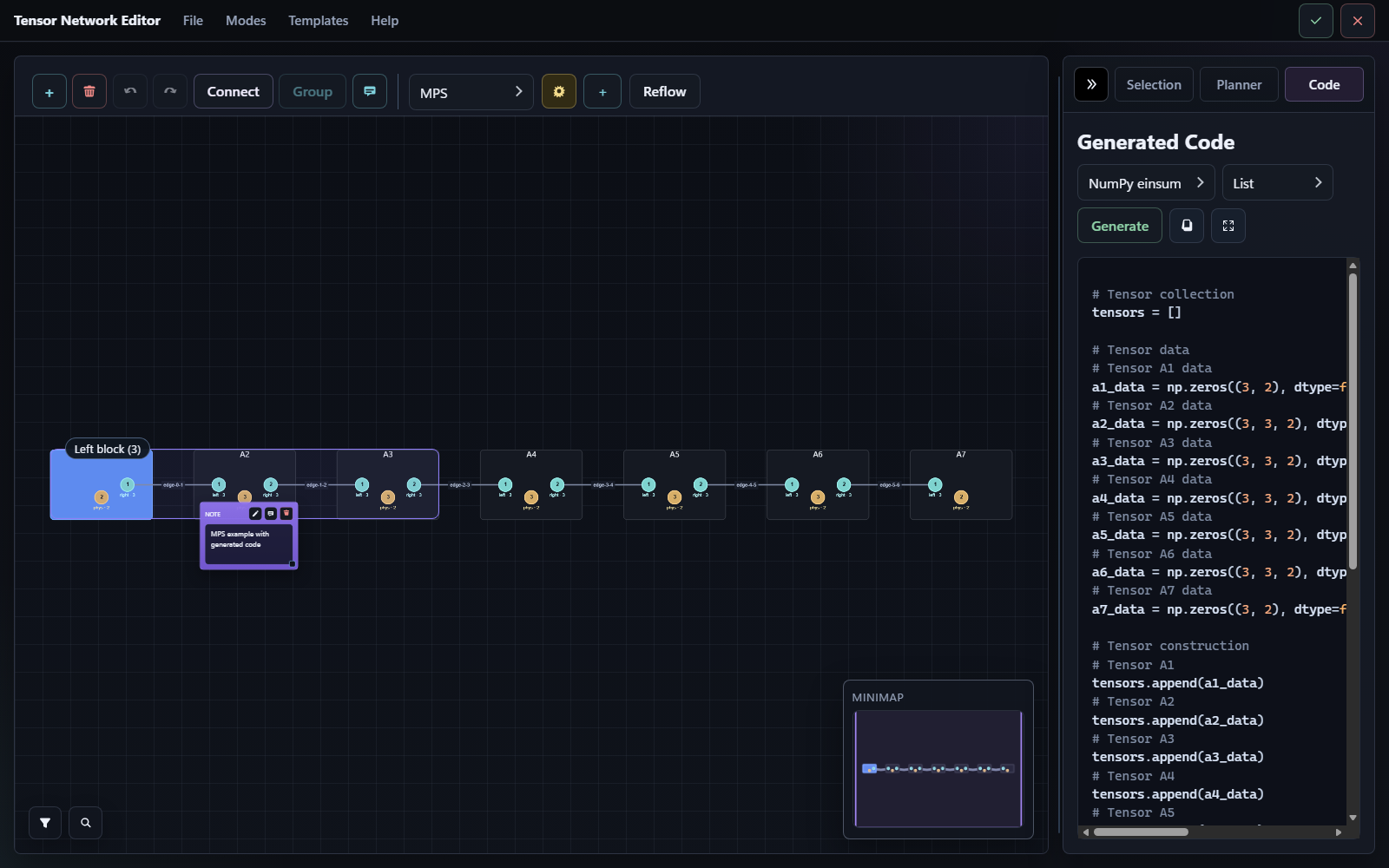
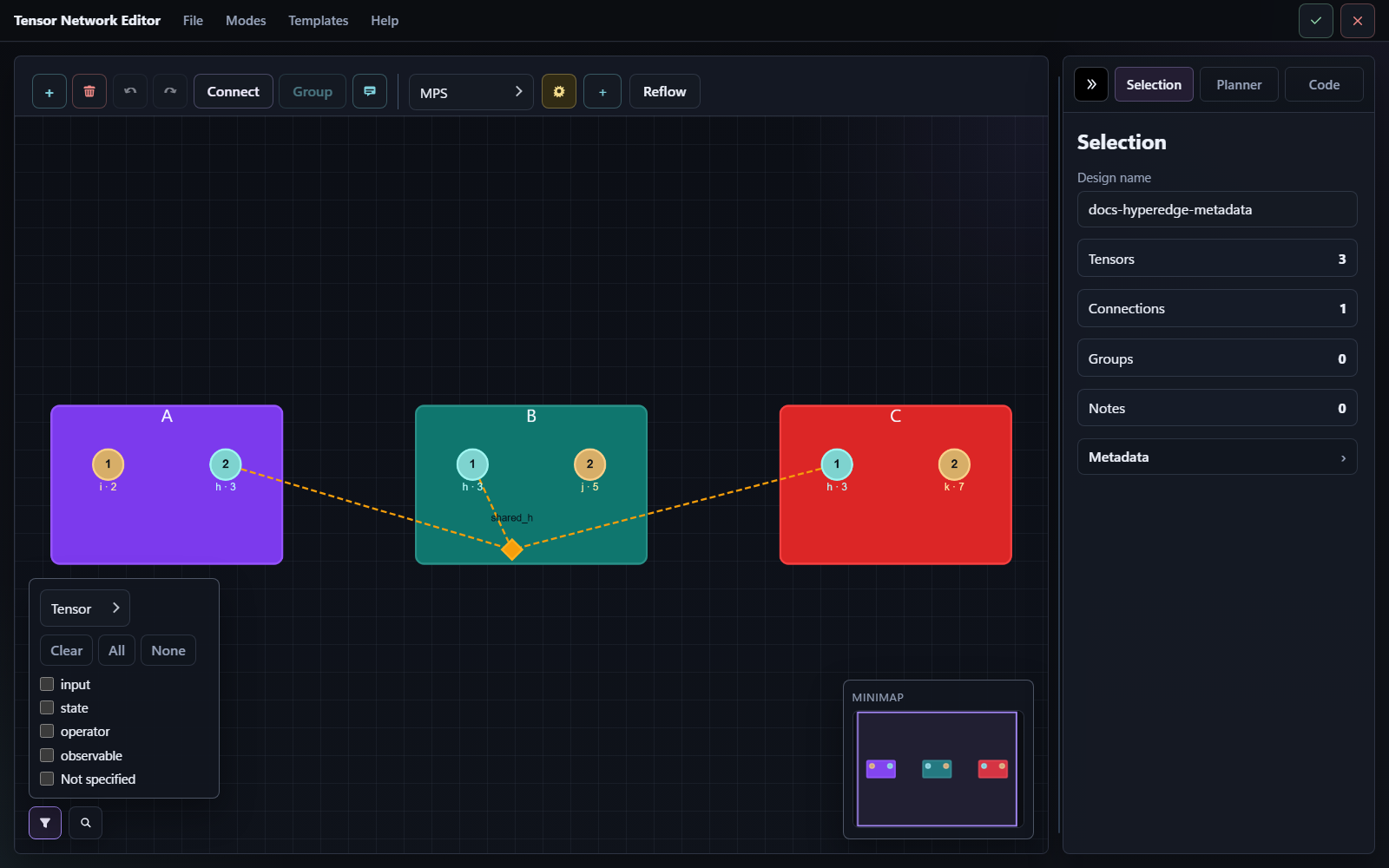
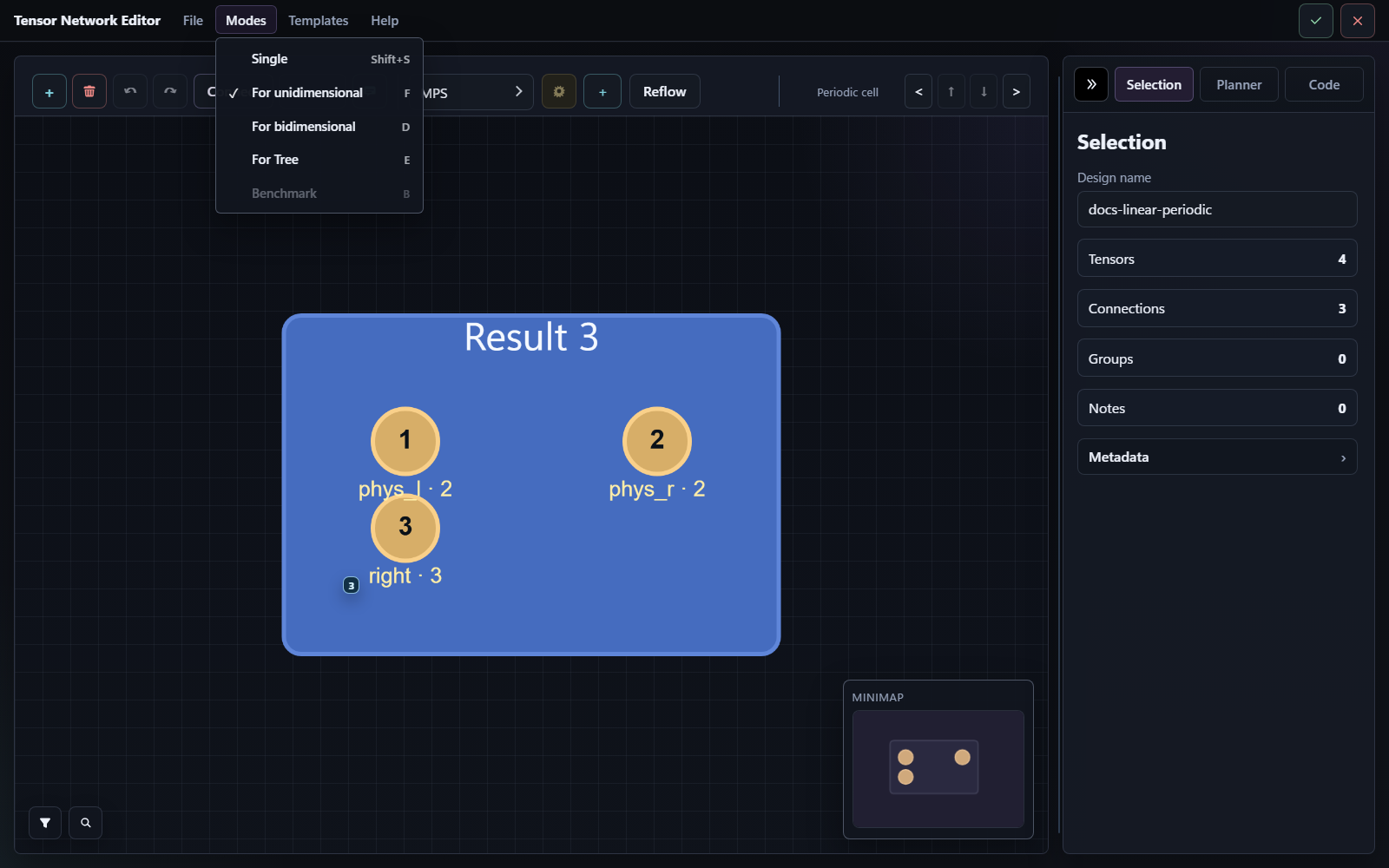
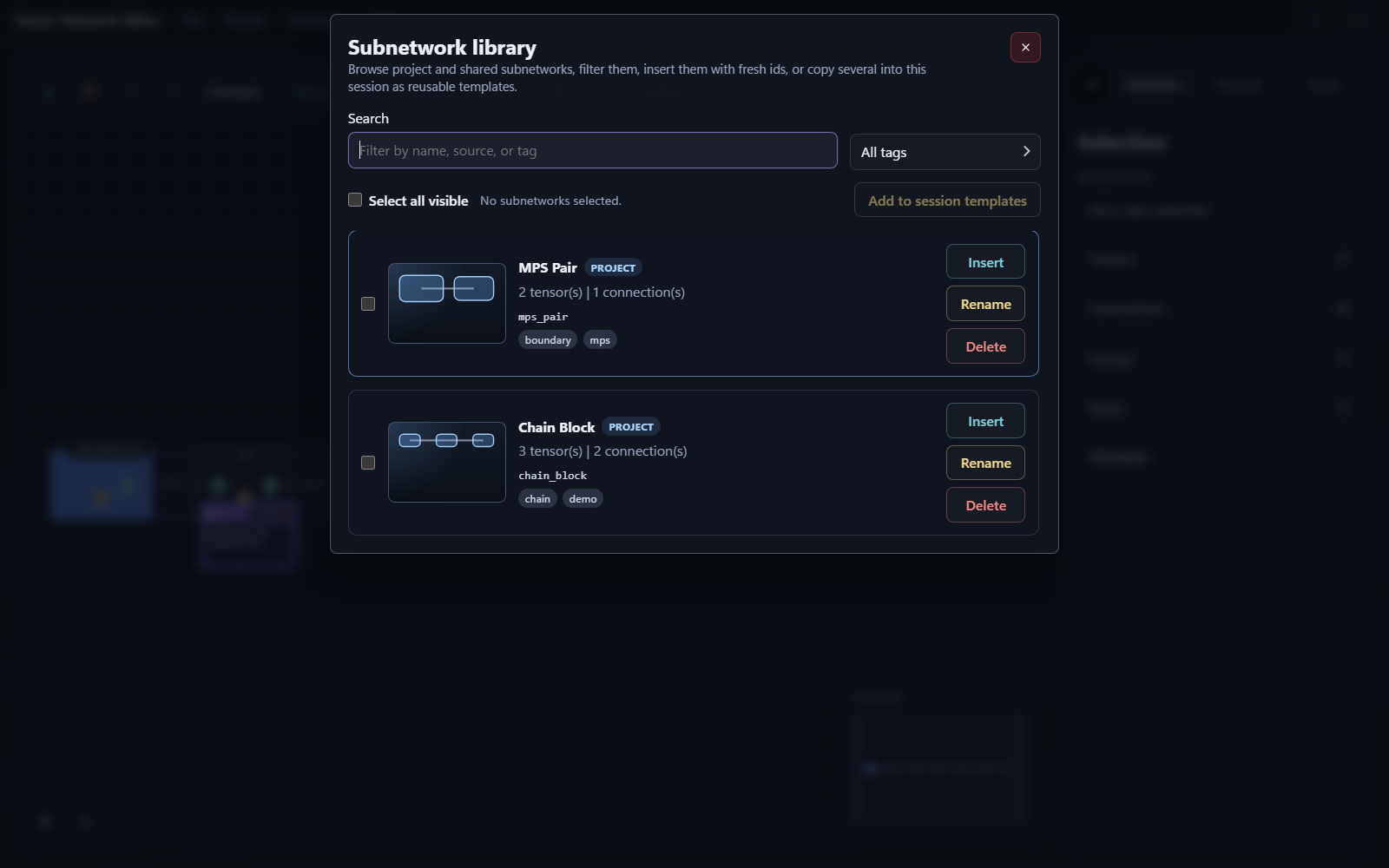
Why This Project
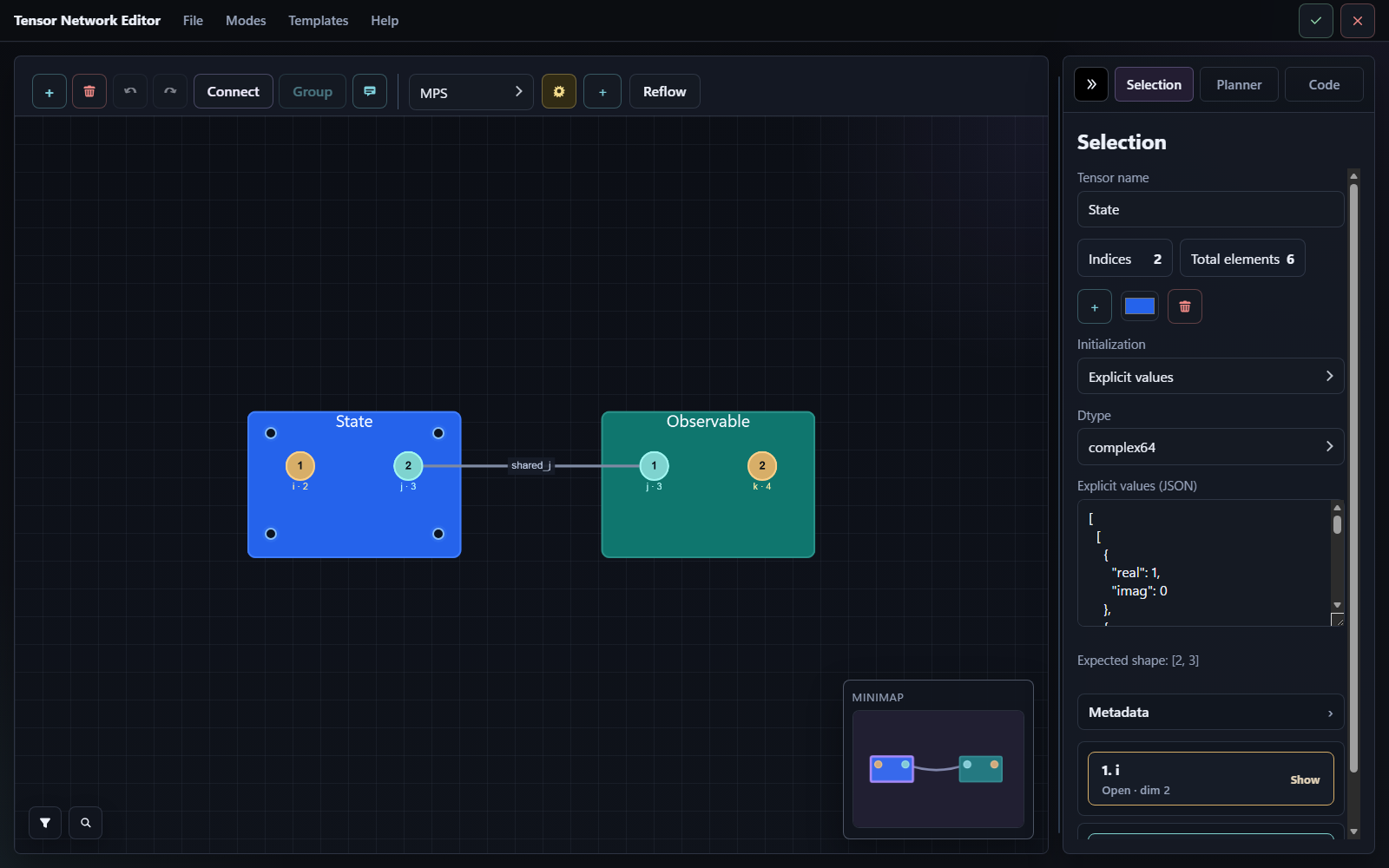
- Draw tensor-network diagrams in a local browser session.
- Save and reload backend-independent JSON designs.
- Generate code for
tensornetwork,quimb,tensorkrowch,einsum_numpy, andeinsum_torch. - Import supported Python network layouts from generated exports plus simple
quimb,tensornetwork, andeinsum/opt_einsumsource files, or run explicit live imports forquimbandtensornetworkobjects in a subprocess. - Edit tensor initializers in the sidebar with generated zeros, ones, fill values, or explicit numeric JSON literals that round-trip through saved designs and supported generated Python.
- Create first-class hyperedges in normal mode, reposition their virtual hubs in the editor, and let exports lower them automatically into copy tensors plus binary edges for backend code.
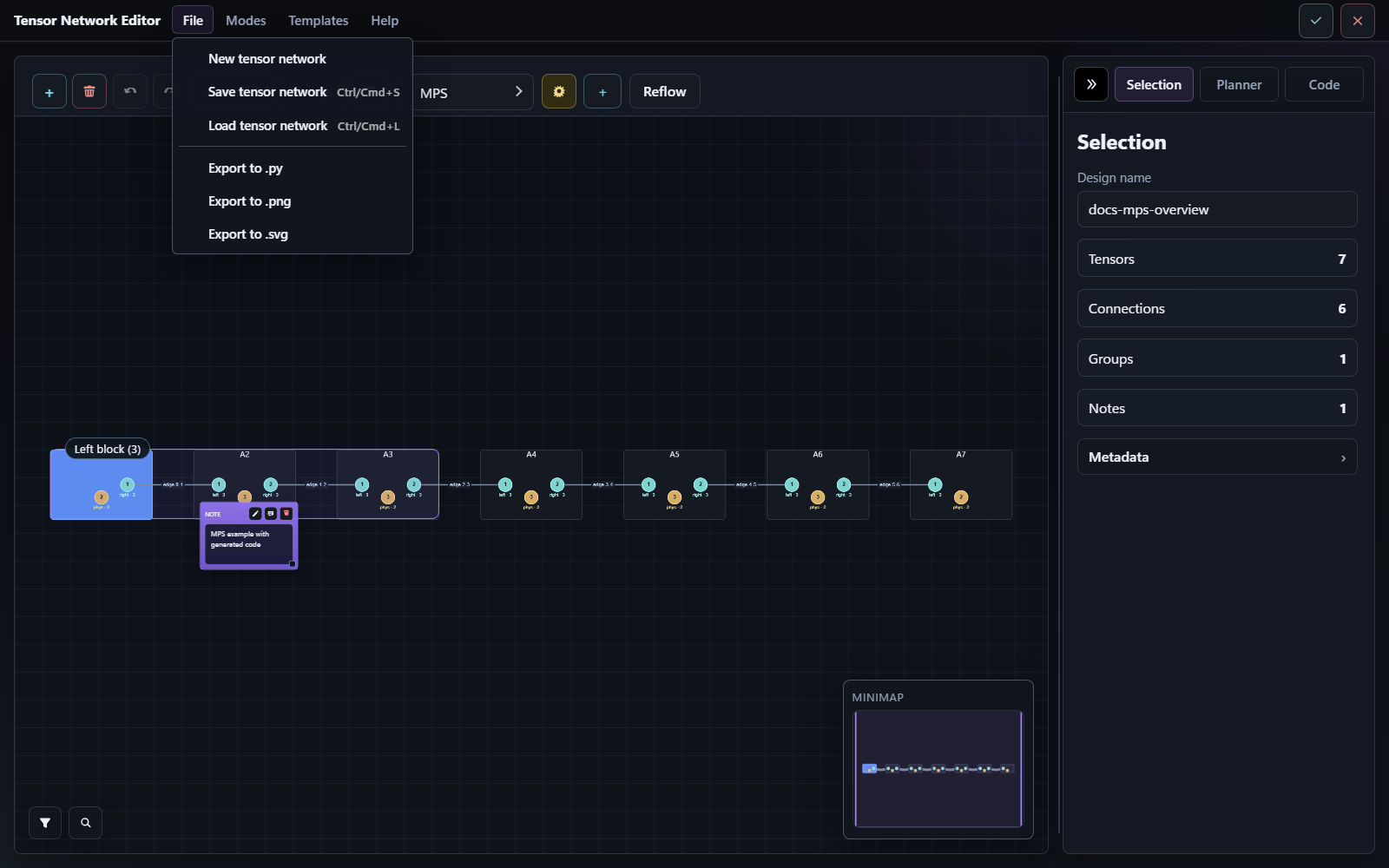
- Use built-in templates for MPS, MPO, PEPS, MERA, and binary-tree layouts.
- Save reusable subnetworks into project or shared catalogs and reinsert them later with fresh ids, tags, and quick previews.
- Annotate tensors and indices with tags, guided metadata, and free-form JSON, then use metadata filters to inspect larger designs.
- Edit dimensions for one index or a multi-index selection from the sidebar or compact context menus.
- Work with linear, grid, and tree periodic modes and export them with any bundled backend.
- Reflow the current selection or the whole graph with
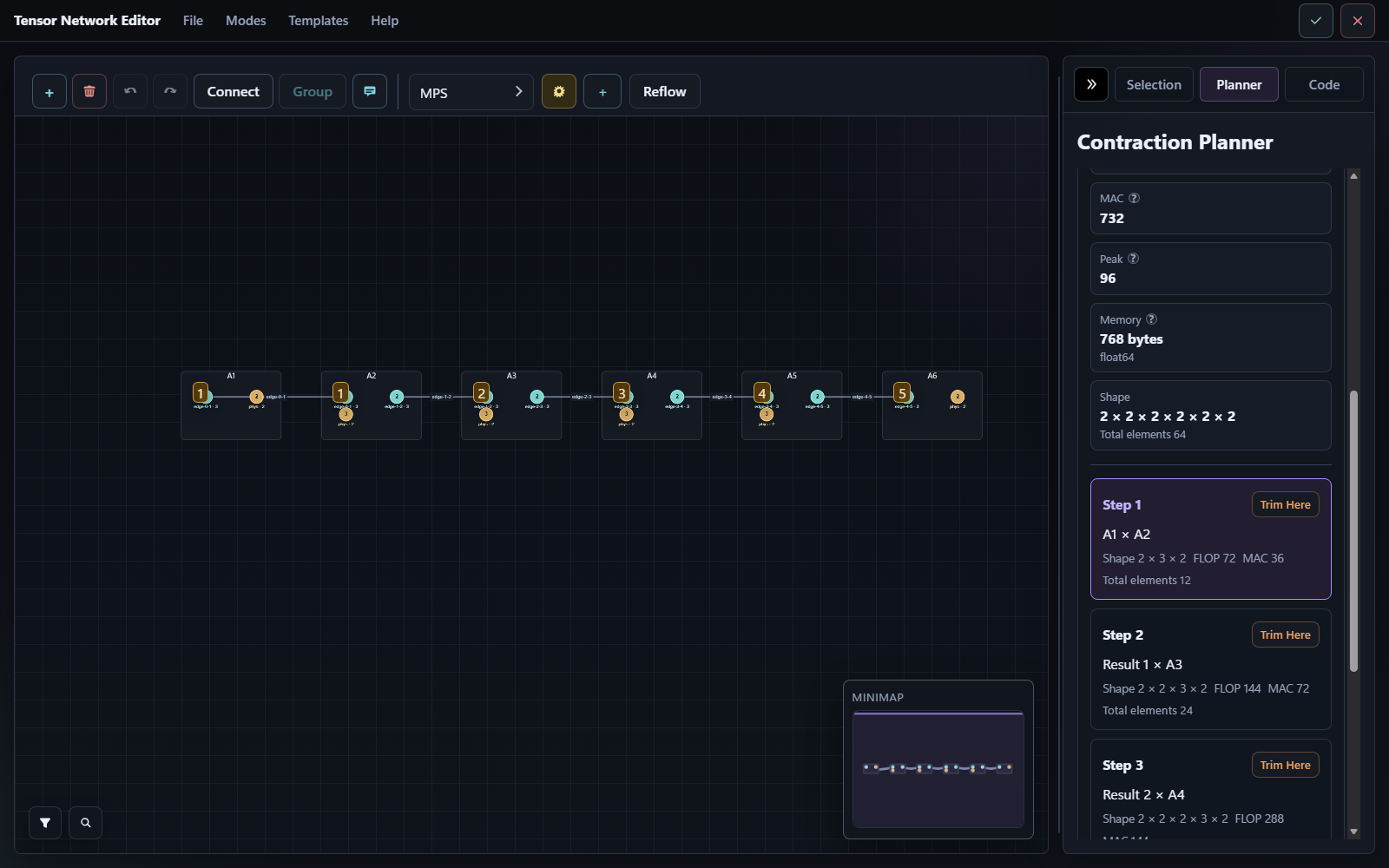
Auto layoutwhen imported or irregular networks need a cleaner arrangement. - Inspect manual contraction paths and optional planner suggestions.
- Benchmark manual and automatic contraction variants from the editor or the CLI, with reproducible CSV/TXT/LaTeX-style tables.
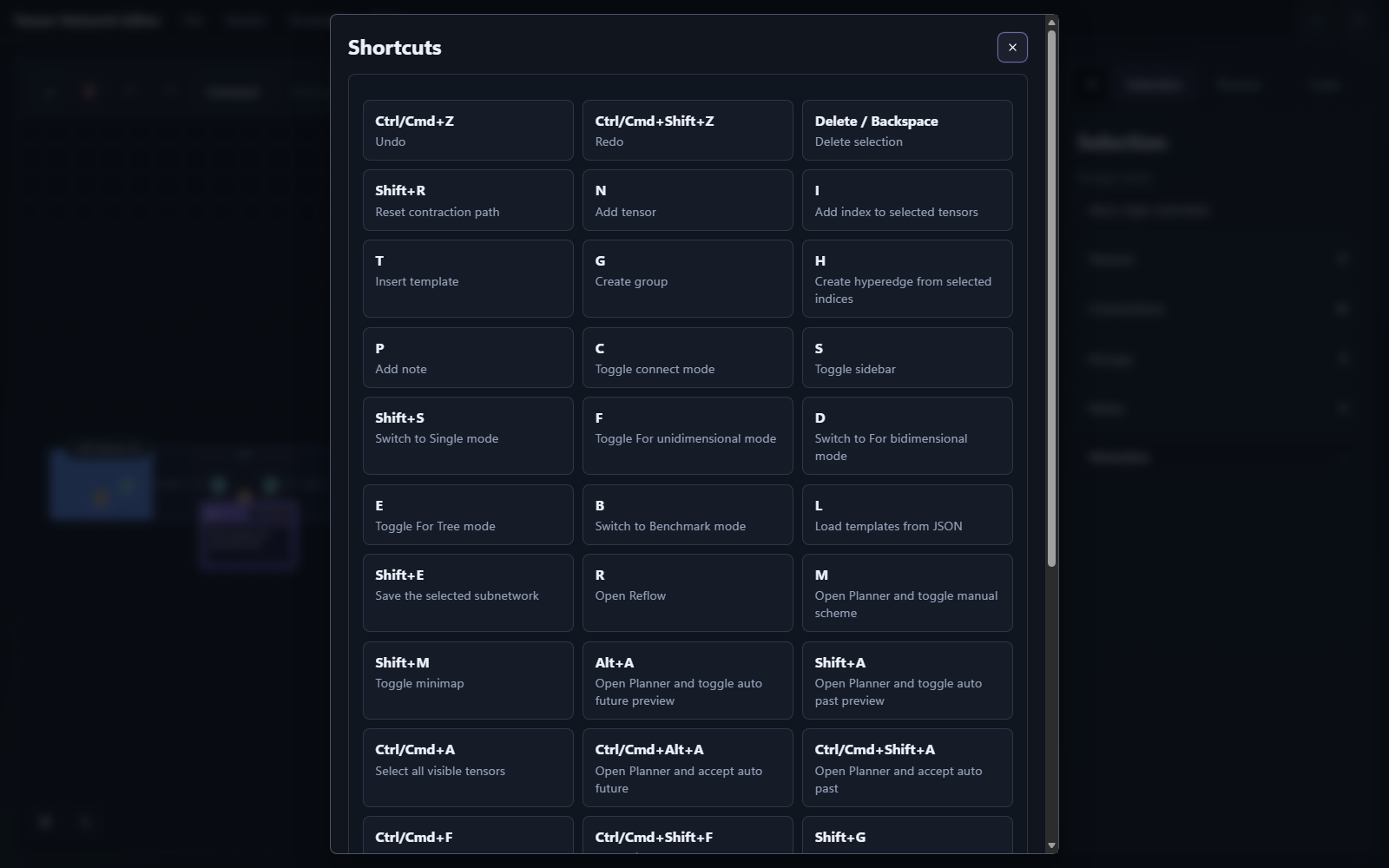
- Use shortcut-driven editing for common actions such as adding tensors, adding indices, opening Reflow, moving between periodic cells, saving subnetworks, and confirming the session.
- Get structural analysis with FLOP and MAC cost summaries.
- Use the package from the CLI or directly from Python.
The editor opens in your browser, but the server runs locally on your own machine. No Node runtime or cloud service is needed for normal use.
Minimal Installation
The PyPI package name is tensor-network-editor. The Python import package is
tensor_network_editor.
PowerShell:
python -m venv .venv
.\.venv\Scripts\Activate.ps1
python -m pip install -U pip
python -m pip install tensor-network-editor
Bash:
python3 -m venv .venv
source .venv/bin/activate
python -m pip install -U pip
python -m pip install tensor-network-editor
For backend extras, planner support, source installs, and development setup, read docs/installation.md.
Basic Use
Launch the visual editor:
tensor-network-editor edit
This command starts a local server and waits until you press Done or
Cancel in the browser session.
Open an existing design and save generated code when the session is confirmed:
tensor-network-editor edit --load my_network.json --engine quimb --save-code generated_network.py
Generate a reproducible benchmark table from one saved design:
tensor-network-editor benchmark my_network.json
tensor-network-editor benchmark my_network.json --dtype float32 --format csv --output benchmark.csv
Use the editor from Python:
from tensor_network_editor import open_editor


def main() -> None:
    result = open_editor()
    if result is None:
        print("Editor cancelled.")
        return

    print(f"Design name: {result.spec.name}")
    if result.codegen is not None:
        print(result.codegen.code)


if __name__ == "__main__":
    main()
Generate code without opening the editor:
from tensor_network_editor import EngineName, generate_code, load_spec


spec = load_spec("my_network.json")
result = generate_code(spec, engine=EngineName.EINSUM_NUMPY)
print(result.code)
Load a live quimb or tensornetwork object from Python source:
from tensor_network_editor import PythonLoadOptions, load_python_spec


spec = load_python_spec(
    python_source,
    python=PythonLoadOptions(
        import_mode="live",
        object_name="network",
    ),
)
This live mode executes the source in a subprocess with the active Python
interpreter from your .venv, auto-detects one supported runtime object when
possible, and falls back to python_object_name when several compatible
globals exist.
Python imports also expose an explicit reconstruction contract through
PythonLoadOptions(reconstruction_level="auto" | "simple" | "best_available"):
autokeeps the richest supported result for the selected profilegeneratedresolvesautotobest_available, which preserves supported manual contraction steps- external static profiles and live imports resolve
autotosimple, which rebuilds only the portable network structure
When import_mode="live" is requested for generated source but the generated
backend package is missing from the active .venv, the loader falls back to the
static parser and reports that fallback as a warning instead of failing the
whole load immediately.
Documentation
- Documentation index: where to go for each topic.
- Installation: full setup instructions.
- Getting started: first useful workflow.
- User guide: editor workflow, templates, reusable subnetworks, auto layout, planner, tips, benchmark mode, periodic modes, and limits.
- Python API: public functions and practical examples.
- Data models:
NetworkSpec, tensors, edges, hyperedges, groups, notes, contraction plans, and periodic-mode payloads. - CLI: terminal commands, subnetwork catalogs, benchmark/export workflows, and JSON output.
- Troubleshooting: common problems and fixes.
Current Limits
- Hyperedges are supported only in normal mode. They are lowered to generated copy tensors for export, re-imported generated Python stays in that lowered binary form, and planner/manual contraction editing plus benchmark mode are disabled while hyperedges exist in the design.
- Python import is intentionally conservative. It supports the package's own
generated exports plus static AST patterns for simple
quimb,tensornetwork, andeinsum/opt_einsumsources. It also offers an explicit live-import mode forquimbandtensornetworkruntime objects, with static-parser fallback for generated sources when live imports fail because backend modules are unavailable. External and live imports still do not recover editor layout/groups/notes, rebuild manual contraction plans, or load periodic-mode Python back into editable specs. PythonLoadOptions(reconstruction_level="best_available")is currently only supported for the package's owngeneratedPython profile. External static profiles and live imports use the portablesimplereconstruction contract instead.- Browser-based live import from the editor works best for self-contained
scripts or imports already resolvable from the active
.venv. If a Python file depends on sibling modules or path-sensitive imports, prefer the Python API or CLI with the real file path. - Tensor values in the visual editor are currently limited to generated zeros,
ones, fill values, and explicit numeric JSON literals. Symbolic
initializers, random initializers, and direct
.npy/.ptimports are not supported yet. - TenPy code generation is not included.
- Linear, grid, and tree periodic code generation work with all bundled backends.
- Manual outer-product steps still cannot be exported safely to
tensorkrowch. - Planner/manual contraction editing is more limited in
For bidimensionalandFor Treethan in normal or linear-periodic workflows.
Project Links
- Source code: github.com/DOKOS-TAYOS/Tensor-Network-Editor
- Changelog: CHANGELOG.md
- Example script: examples/basic_usage.py
- Issue tracker: github.com/DOKOS-TAYOS/Tensor-Network-Editor/issues
- License: LICENSE
- Third-party notices: THIRD_PARTY_LICENSES


Download files
Download the file for your platform. If you're not sure which to choose, learn more about installing packages.
Source Distribution
Built Distribution
Filter files by name, interpreter, ABI, and platform.
If you're not sure about the file name format, learn more about wheel file names.
Copy a direct link to the current filters
File details
Details for the file tensor_network_editor-0.4.0.tar.gz.
File metadata
- Download URL: tensor_network_editor-0.4.0.tar.gz
- Upload date:
- Size: 531.2 kB
- Tags: Source
- Uploaded using Trusted Publishing? No
- Uploaded via: twine/6.2.0 CPython/3.12.10
File hashes
| Algorithm | Hash digest | |
|---|---|---|
| SHA256 |
2cf323abed2462163c0be1067068e06989e87d43a711ae986f3543ff0447fdb4
|
|
| MD5 |
337b585ee5f8b8e654d81edb8a076a05
|
|
| BLAKE2b-256 |
463f582c44235e4eb8d80b731253077326b52b66ec36d405ddd791a0fcd64437
|
File details
Details for the file tensor_network_editor-0.4.0-py3-none-any.whl.
File metadata
- Download URL: tensor_network_editor-0.4.0-py3-none-any.whl
- Upload date:
- Size: 679.6 kB
- Tags: Python 3
- Uploaded using Trusted Publishing? No
- Uploaded via: twine/6.2.0 CPython/3.12.10
File hashes
| Algorithm | Hash digest | |
|---|---|---|
| SHA256 |
fe62a912a96d36b6fbe740639b4afbe739e793df595f2e5692e908283d1992b4
|
|
| MD5 |
648332b2a9643be04599a8b500979413
|
|
| BLAKE2b-256 |
147b4874d0e50cc684ef7746602cc8e0fd8cd0c90b8500c56d3382414b8ed375
|






