
Open source deep learning framework that focuses on aerospace objects (rockets, planes, UAVs)

Project description
🚀 TensorAeroSpace









Open-source aerospace simulation toolkit + adaptive control catalogue
Pure-NumPy 6-DoF dynamics · Gymnasium-native envs · Classical / ADP / Deep RL agents
📖 Documentation • 🚀 Quickstart • 💡 Examples • 🤝 Contributing
📑 Contents
- 🌟 Overview
- 📊 How it compares
- 🧭 Application areas
- 🚀 Quickstart
- 🤖 Supported algorithms
- ✈️ Aircraft & spacecraft library
- 🎮 Simulation environments
- 📚 Examples & guides
- ⚠️ Known limitations
- 🛠️ Development
- 🎓 How to cite
- 📖 Documentation
- 🤝 Community & support
- ⭐ Star history
- 📄 License
🌟 Overview
TensorAeroSpace ships 12+ aircraft and spacecraft models (7 of them as full nonlinear 6-DoF airframes with peer-reviewed source data), 20+ control algorithms spanning classical PID/MPC through the full incremental-ADP family to modern deep RL, and 100+ runnable example notebooks covering trim, cruise, coordinated turns, in-flight damage and fault recovery — all glued together by the standard Gymnasium API.
Why it stands out:
- 🎯 Real airframes, not toys. B-747 transcribed from NASA CR-2144, X-15 from NASA TM X-1669, Skywalker X8 from CEAS Aeronautical Journal 2025, B-737 from JSBSim + Roskam, RQ-7 Shadow from Beard & McLain. Trim-points reach machine precision.
- ⚡ Pure NumPy core. No proprietary simulators, no MATLAB licence, no compiled binaries — lightweight for control-synthesis sweeps with no startup overhead or XML parsing.
- 🧠 Unique adaptive-control catalogue. Standard RL stack (PPO, SAC, DDPG, DQN, A2C, A3C, GAIL) plus the full incremental-ADP family (IHDP, IM-GDHP, ET-DHP, iADP, AA-INDI, AIDI) — rarely co-located in a single OSS package.
- 💥 Damage subsystem built-in. Per-surface effectiveness loss, hard-overs, jam events, asymmetric-thrust engine-out, flap-jam configuration override — all composable into
DamageProfileinstances. - 🧪 Locked down by regression coverage. Trim convergence, surface-deflection sign conventions, propellant burnout times — all under unit tests.
- 🤗 Hugging Face Hub native. All PyTorch agents inherit
from_pretrained/publish_to_hubfromtensoraerospace.agent.base— pretrained checkpoints live at huggingface.co/TensorAeroSpace.
📊 How it compares
How TensorAeroSpace positions against the tools control engineers and RL researchers usually reach for:
| TensorAeroSpace | JSBSim | MATLAB / Simulink | Stable-Baselines3 | Gymnasium | |
|---|---|---|---|---|---|
| License | MIT (open-source) | LGPL (open-source) | Commercial | MIT (open-source) | MIT (open-source) |
| Core language | Python (pure NumPy) | C++ + XML | Proprietary + C | Python (PyTorch) | Python |
| 6-DoF airframes bundled | 7 peer-reviewed | 30+ | None bundled | None | None |
| Damage / FTC subsystem | ✅ built-in (mass, CG, inertia, surfaces, engines) | Partial (failure scripts) | Manual (Stateflow) | ❌ | ❌ |
| Classical control (PID/MPC) | ✅ with autotuning | ❌ | ✅ (Toolboxes) | ❌ | ❌ |
| Adaptive Dynamic Programming | ✅ IHDP, IM-GDHP, ET-DHP, iADP, AA-INDI, AIDI | ❌ | ❌ (manual) | ❌ | ❌ |
| Deep RL agents | ✅ PPO, SAC, DSAC, DDPG, DQN, A2C, A3C, GAIL | ❌ | ❌ (Reinforcement Learning Toolbox separate) | ✅ | ❌ (API only) |
| Gymnasium env API | ✅ native | Indirect | Custom | Consumer | ✅ definition |
| Hugging Face Hub integration | ✅ from_pretrained / publish_to_hub |
❌ | ❌ | ❌ | ❌ |
| Best fit | Adaptive flight control + FTC research | High-fidelity flight simulation | Industrial control prototyping | General RL benchmarks | RL environment standard |
Pick TensorAeroSpace when you need a single Python package that ships realistic airframes and the controllers to fly them — including online adaptive critics rarely co-located in any other OSS toolkit.
🧭 Application areas
- Automatic flight control — stabilisation, trajectory tracking, attitude control for aircraft, UAVs, experimental vehicles.
- Rocket / spacecraft control — launch vehicles, satellites in different orbital classes, ascent-trajectory optimisation.
- Hybrid control synthesis — designing and tuning loops that combine classical and intelligent methods.
- Algorithm benchmarking — automated hyperparameter search, head-to-head comparisons, metric visualisation.
- Simulator integration — game engines (Unity ML-Agents), CAD/CAE (Simulink, SimInTech), bidirectional model exchange.
- Reliability and FTC research — failure-mode studies, controller-reconfiguration assessment, dataset preparation.
Each area has working examples and documentation (see 📚 Examples & guides).
🚀 Quickstart
💡 Interactive walkthrough: open
quickstart.ipynbto run a SAC benchmark on the B-747 end-to-end in Jupyter / VS Code.
✅ System requirements
| Component | Minimum | Recommended |
|---|---|---|
| OS | Linux x86_64, Windows 10, macOS 13 | Ubuntu 22.04 LTS / Windows 11 |
| CPU | 4 cores, AVX | 8+ cores, AVX2/FMA |
| RAM | 8 GB | 16–32 GB for RL/Simulink |
| GPU | Optional | NVIDIA RTX with ≥8 GB VRAM for SAC/DSAC/PPO, CUDA ≥ 12.0 |
| Python | 3.10–3.13 | 3.11/3.12 |
| Optional | Git, Poetry or pip, Docker | MATLAB/Simulink R2022b+ (Simulink examples), Unity 2021.3.5f1/2023.2.20f1 |
📦 Installation
Poetry (recommended)
git clone https://github.com/tensoraerospace/tensoraerospace.git
cd tensoraerospace
poetry install
poetry shell        # activate the venv
poetry run pytest   # quick smoke test
pip
pip install tensoraerospace                  # core (NumPy, gymnasium, PyTorch)
pip install 'tensoraerospace[ray]'           # + Ray RLlib for distributed training
Additional development environments are exposed as Poetry groups (used when working from a clone):
| Group | Purpose | Install |
|---|---|---|
dev |
linters, mypy, pytest plugins, mkdocs | poetry install --with dev |
test |
extra fixtures and CI helpers | poetry install --with test |
jupyter |
nbconvert, kernels, notebook execution |
poetry install --with jupyter |
Combine groups:
poetry install --with dev,jupyterreproduces the CI environment used bynotebooks-smoke.yml.
🐳 Docker
Image launches JupyterLab by default (see Dockerfile).
docker pull ghcr.io/tensoraerospace/tensoraerospace:latest
docker run --rm -it -p 8888:8888 \
  -v "$(pwd)/projects:/workspace/projects" \
  ghcr.io/tensoraerospace/tensoraerospace:latest

# GPU (NVIDIA Container Toolkit)
docker run --rm -it --gpus all -p 8888:8888 \
  -v "$(pwd)/projects:/workspace/projects" \
  ghcr.io/tensoraerospace/tensoraerospace:latest
🏃♂️ Quick example — PID + linear F-16
import gymnasium as gym
import numpy as np
from tensoraerospace.agent.pid import PID
from tensoraerospace.utils import generate_time_period
from tensoraerospace.signals.standard import unit_step

dt = 0.01
tp = generate_time_period(tn=10, dt=dt)
N = len(tp)
reference = unit_step(degree=5, tp=tp, time_step=100, output_rad=True).reshape(1, -1)

env = gym.make('LinearLongitudinalF16-v0',
               number_time_steps=N, initial_state=[[0], [0]],
               reference_signal=reference, use_reward=False)
pid = PID(env, kp=-14.290, ki=-8.240, kd=-1.299, dt=dt)
# Tip: skip the magic numbers and let the autotuner find them
#      pid = PID(env, dt=dt); pid.tune_matlab_style()

obs, _ = env.reset()
for t in range(N - 1):
    u = pid.select_action(reference[0, t], float(obs[0]))
    obs, *_ = env.step(np.array([[float(u)]], dtype=np.float32))
💥 In-flight damage modelling
Compose damage events declaratively, run any controller — agent sees a different plant the moment the event fires.
import numpy as np
from tensoraerospace.aerospacemodel.f16.nonlinear.damage import WING_STRIKE_LEFT_TIP
from tensoraerospace.envs.f16.nonlinear_angular import NonlinearAngularF16

env = NonlinearAngularF16(
    initial_state=np.zeros(14),
    number_time_steps=2000,
    damage_profile=WING_STRIKE_LEFT_TIP,  # left-tip loss at t=10s
    split_stab=True,                      # split stabilator into left/right halves for asymmetric damage
)
obs, _ = env.reset()
for _ in range(2000):
    obs, r, term, trunc, info = env.step(np.zeros(4))
    if info.get("damage_events_triggered"):
        print(info["damage_events_triggered"])  # → ['left_tip_full_loss']
What's modelled: section loss (mass / S / b / MAC / c.g. / inertia tensor / aero coefficients all recomputed via Huygens-Steiner), surface failure (jam / efficiency loss / lost), engine flameout (partial / full thrust scaling), structural events (payload drop, icing, Δm / Δc.g. / ΔJ).
📖 Aircraft damage modelling guide
🤖 Supported algorithms
Classical control
| Algorithm | Description |
|---|---|
| PID | Proportional-Integral-Derivative with anti-windup and MATLAB-style autotuning. Strong baseline for state-space tasks; the autotuner extracts the env's (A,B,C,D) matrices and optimises gains via differential evolution against the step-response criterion. |
| MPC | Model-Predictive Control with three swappable plant-model variants — MLP, NARX, Transformer — over a QP / numerical receding-horizon optimisation. Use when the plant is known or can be learned from data. |
Deep RL — on-policy
| Algorithm | Description |
|---|---|
| PPO | Proximal Policy Optimization. Stable and easy to tune; the standard "just works" starting point for continuous and discrete tasks. |
| A2C | Advantage Actor-Critic — synchronous on-policy. Simpler than PPO, useful as a clean reference. |
| A2C-NARX | A2C with a NARX critic instead of MLP — better captures temporal structure. |
| A3C | Asynchronous Advantage Actor-Critic — multiple workers, shared global network. Great for CPU-parallel distributed training (Unity envs). |
Deep RL — off-policy
| Algorithm | Description |
|---|---|
| SAC | Soft Actor-Critic — off-policy, maximum-entropy. Data-efficient default for continuous control. |
| DSAC | Distributional SAC with quantile (IQN-style) twin critics + CAPS regularisation. Better tracking dynamics than vanilla SAC under sensor noise / multi-modal cost. |
| DDPG | Deep Deterministic Policy Gradient — foundational; SAC outperforms it in most cases but DDPG remains useful for quiet low-frequency tasks. |
| DQN | Deep Q-Learning — value-based for discrete action spaces; used here for Unity envs with discrete control. |
Imitation learning
| Algorithm | Description |
|---|---|
| GAIL | Generative Adversarial Imitation Learning — learn from expert demonstrations without explicit reward. Useful for cloning a pre-built PID/MPC trajectory before fine-tuning with an RL critic. |
Adaptive Dynamic Programming (model-based critics)
| Algorithm | Description |
|---|---|
| HDP | Heuristic Dynamic Programming — actor-critic with a pre-trained offline plant network providing the policy gradient via ∂f/∂u. |
| ADHDP | Action-Dependent HDP — value function depends on (state, action); no explicit model gradient required. |
| ADP | Base Adaptive Dynamic Programming — value-iteration-style adaptive control without an explicit plant model. |
| IHDP | Incremental HDP — actor-critic with online incremental linearisation of the plant. Adaptive without a pre-trained plant network. Strong baseline for online flight control. |
| NARX | Nonlinear AutoRegressive network — used both as MPC plant model and as the critic in A2C-NARX. |
Online adaptive critics for fault-tolerant flight
| Algorithm | Description |
|---|---|
| iADP | Incremental Approximate Dynamic Programming — online RLS identification of a local incremental model (F̃, G̃) plus closed-form quadratic policy. Recovers from plant change in tens of milliseconds; no fault-detector required. |
| IM-GDHP | Incremental-Model GDHP — online RLS plant identifier paired with a GDHP critic. Lightweight (no plant network), interpretable, with explicit (F, G) matrices. |
| ET-DHP | Event-Triggered Dual HDP — Lipschitz event-trigger fires actor/critic updates only when the tracking error crosses a threshold. Bandwidth-aware, embedded-friendly. |
| AIDI | Adaptive Incremental Dynamic Inversion — INDI with per-channel VFF-RLS adapting a multiplicative scaling Θ of a known on-board control-effectiveness matrix. Fault-tolerant, model-agnostic. |
| AA-INDI | Adaptive Augmented INDI — incremental nonlinear dynamic inversion with online RLS adaptation; designed for asymmetric actuator faults and flying-wing layouts with coupled control surfaces. |
✈️ Aircraft & spacecraft library
🛩️ Fixed-wing (nonlinear 6-DoF, peer-reviewed source data)
| Airframe | Class | Aerodynamic source | Speciality |
|---|---|---|---|
| F-16 Fighting Falcon | Fighter | NASA / Stevens-Lewis | Cubic-spline aero, full damage subsystem (linear longitudinal · nonlinear longitudinal · 6-DoF angular) |
| Boeing 747-100 | Heavy transport | NASA CR-2144 (Heffley & Jewell) | Per-engine asymmetric thrust + flap jam (3 configurations: NOMINAL, POWER_APPROACH, LANDING) |
| Boeing 737-100/800 | Mid-size transport | JSBSim + Roskam Vol VI | Coordinated-turn benchmarks, JT8D / CFM56-7B engines |
| X-15 | Hypersonic research | NASA TM X-1669 + Thompson 2000 | Mach 0.4–6.7 tabulated, XLR99 rocket, variable mass |
| Skywalker X8 | Small UAV (3.4 kg) | CEAS Aeronautical Journal 2025 | Peer-reviewed flight-test ID, flying-wing |
| AAI RQ-7 Shadow | Class-II UAV (170 kg) | Beard & McLain + NASA TM-2014-218686 | V-tail mixed control, 4-channel |
🪶 Linear longitudinal models
- F-4C Phantom II (
LongitudinalF4C) — military fighter-bomber, Roskam-derived linear longitudinal channel + improved env wrapper. - Other linear plants —
LongitudinalF16,LongitudinalB747,LongitudinalX15,LongitudinalUAV,LongitudinalCessna170,LongitudinalSuperSonic— live alongside their nonlinear counterparts; see 📊 State-space matrices for classical synthesis.
🚁 UAVs and drones
- LAPAN LSU-05 — Indonesian surveillance UAV
- Ultrastick-25e — RC airplane model
- Generic UAV — customisable state-space dynamics
- Quadrotor — full nonlinear 6-DoF + per-rotor damage subsystem + X-config allocator
🚀 Rockets and satellites
- ELV (Expendable Launch Vehicle) — booster dynamics
- Generic missile — customisable simulation
- GeoSat — geostationary orbital mechanics
- ComSat — communication-satellite dynamics and control
🎮 Simulation environments
🎯 Unity ML-Agents integration

- 🎮 3D visualisation in real time
- 🔄 Realistic training — agents learn in physics-rich scenes
- 📊 Sensor suite — camera, LiDAR, physical sensors
- 🌍 Custom scenarios — author your own aerospace tasks
📁 Example environment: UnityAirplaneEnvironment
🔧 MATLAB / Simulink integration (experimental)

What ships today:
- 📦 Reference Simulink models under
tensoraerospace/aerospacemodel/simulinkModel/— F-4C and X-15 plant models in.slxformat for cross-validating Python implementations. - 🎛️ MATLAB-style PID autotuning — the
PID.tune_matlab_style()API extracts(A, B, C, D)from any linear env and runs differential-evolution gain optimisation. Seeexample/pid_controllers/pid_matlab_tuning.ipynb. - 📚 Hands-on lessons — Lesson 4: MATLAB scripting and Lesson 5: Simulink models walk through the import / validation workflow.
Status: Simulink interop is community-maintained — model parsing helpers live in the lessons rather than being a turnkey importer. PRs welcome.
📊 State-space matrices for classical synthesis
Linear plant models expose (A, B, C, D) for direct use with classical-control workflows:
- 🧮
LongitudinalF16(f16/linear/longitudinal/) — F-16 short-period + phugoid - 🪶
LongitudinalF4C,LongitudinalB747,LongitudinalX15,LongitudinalUAV,LongitudinalCessna170,LongitudinalSuperSonic— extra peer-validated linear plants undertensoraerospace/aerospacemodel/ - 🎛️
PID.tune_matlab_style(env)— autotunes gains against the env's state-space matrices via differential-evolution against a step-response criterion
📚 Examples & guides
The example/ directory ships 100+ runnable notebooks, organised by controller class. The folder was recently restructured for predictable navigation — see example/README.md for the full map.
| Category | Folder | Highlights |
|---|---|---|
| 🚀 Quickstart | quickstart.ipynb |
Minimal end-to-end pipeline |
| 🎮 Environments | environments/ |
All bundled aircraft envs (no agent) |
| 🎛️ Classical | pid_controllers/, mpc_controllers/ |
PID + MPC (MLP / NARX / Transformer) |
| 🧠 Classical ADP | dynamic_programming/ |
HDP, DHP, GDHP, AD-HDP, AD-GDHP, AD-DHP |
| 🔄 Online ADP | reinforcement_learning/incremental_adp/ |
IHDP, IM-GDHP, ET-DHP, iADP, AA-INDI, AIDI |
| 🤖 Deep RL | reinforcement_learning/deep_rl/ |
A2C, A3C, PPO, DQN, SAC, DSAC, DDPG, GAIL |
| 📊 Comparison | comparison/ |
PID vs RL head-to-head benchmarks |
| 💥 Failure demos | failure_demos/ |
F-16 dogfight with damage, IHDP failure recovery |
| 📖 Cookbook | cookbook/ |
Step-by-step recipes from "hello world" to FTC |
| 🔧 Optimization | optimization/ |
Optuna hyperparameter search |
🌟 Featured examples
| Example | Aircraft | Result |
|---|---|---|
| ET-DHP heading hold under engine flameout | B-747 | ψ-error 0.28° vs open-loop −85.5° |
| MIMO IHDP 90° coordinated turn | B-737 | Final ψ-error 0.98°, max sideslip 0.11° |
| IHDP θ-step tracking on nonlinear B-747 | B-747 | Late-half MAE 0.043° |
| PPO on X-15 (improved env) | X-15 | End-to-end deep-RL training on the variable-mass hypersonic plant |
Quick run commands
# Run pretrained SAC on B-747
poetry run python example/reinforcement_learning/deep_rl/sac-b747-render.py --render --dt 0.1

# Run pretrained DDPG
poetry run python example/reinforcement_learning/deep_rl/ddpg-b747-render.py --repo TensorAeroSpace/ddpg-b747

# Train DSAC step-response
poetry run python example/reinforcement_learning/deep_rl/train_dsac_b747_step_response.py
📖 Detailed walkthroughs:
- Example SAC F-16
- B-737 coordinated turn (IHDP)
- B-747 engine-out heading hold (ET-DHP)
- Optuna optimisation
- Unity guide
⚠️ Known limitations
We are deliberate about scope — calling out what's intentionally not modelled prevents users wasting time on edge cases the project does not yet cover.
- 🚀 X-15 — atmospheric envelope (M = 0.4–6.7, h ≤ 250 kft) only. Exoatmospheric attitude control via peroxide RCS thrusters is not modelled.
- ✈️ B-737 — clean cruise envelope only. High-lift devices (flaps, slats, gear) have coefficient hooks but values are not yet applied.
- 💥 Damage subsystem coverage:
- F-16 nonlinear — fully covered (sections, surfaces, engine, structural).
- B-747 nonlinear — engine flameout + flap-jam events; no section-loss or icing.
- Other airframes (B-737, X-15, Skywalker X8, AAI Shadow, Quadrotor) — engine / per-rotor failures only; no aero / mass / inertia recomputation.
- 🔧 Simulink interop — community-maintained: reference
.slxplants ship for cross-validation, but there is no turnkey Simulink → Python importer yet. - 🛰️ Spacecraft envs (ELV, GeoSat, ComSat, Generic missile) — basic dynamics only; no atmospheric re-entry, no orbit perturbations beyond two-body.
- 🎮 Unity ML-Agents bridge — lives in a separate repo and requires manual scene setup; no automated CI for that interaction layer.
PRs filling any of these gaps are warmly welcome — see CONTRIBUTING.md.
🛠️ Development
git clone https://github.com/tensoraerospace/tensoraerospace.git
cd tensoraerospace
poetry install --with dev
poetry run pytest                      # full suite
poetry run pytest tests/aerospacemodel # specific category
poetry run mkdocs serve -a 0.0.0.0:8000 # docs preview
See CONTRIBUTING.md for guidelines.
🎓 How to cite
If TensorAeroSpace contributed to your research or product, please cite it:
@software{tensoraerospace,
  title  = {TensorAeroSpace: Open-source aerospace simulation toolkit and adaptive control catalogue},
  author = {{TensorAeroSpace contributors}},
  year   = {2026},
  url    = {https://github.com/TensorAeroSpace/TensorAeroSpace},
  note   = {Pure-NumPy 6-DoF dynamics, Gymnasium-native environments, classical / ADP / Deep RL agents}
}
Plain-text form: TensorAeroSpace contributors. (2026). TensorAeroSpace: Open-source aerospace simulation toolkit and adaptive control catalogue. https://github.com/TensorAeroSpace/TensorAeroSpace
📖 Documentation
- 📚 Full docs: tensoraerospace.readthedocs.io
- 🚀 API reference: detailed module-by-module
- 📝 16-recipe cookbook: from hello-world to FTC under damage
- 💡 11-lesson tutorial: state-space → controllability → RL fundamentals → XFLR5 / Simulink hands-on
- 🤗 Pretrained agents on Hugging Face: huggingface.co/TensorAeroSpace — SAC / DDPG / PPO checkpoints. Load via
Agent.from_pretrained("TensorAeroSpace/<repo>")in Python, or pass--repo TensorAeroSpace/<name>to the bundled render scripts (e.g.ddpg-b747-render.py). - ❓ Q&A: DeepWiki AI assistant
🤝 Community & support
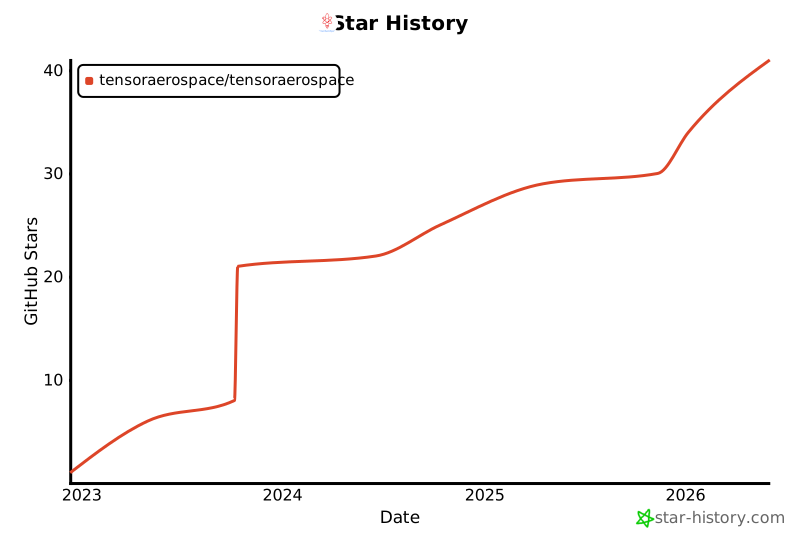
⭐ Star history
📄 License
MIT — see LICENSE.
🙏 Acknowledgements
- The Gymnasium / OpenAI Gym team for the canonical RL environment API
- The Unity ML-Agents team for 3D simulation infrastructure
- The aerospace research community for decades of open published derivative data (sources cited inline in the aircraft library)
- Every contributor who has made this project possible
Release history Release notifications | RSS feed


Download files
Download the file for your platform. If you're not sure which to choose, learn more about installing packages.
Source Distribution
Built Distribution
Filter files by name, interpreter, ABI, and platform.
If you're not sure about the file name format, learn more about wheel file names.
Copy a direct link to the current filters
File details
Details for the file tensoraerospace-0.3.16.tar.gz.
File metadata
- Download URL: tensoraerospace-0.3.16.tar.gz
- Upload date:
- Size: 3.3 MB
- Tags: Source
- Uploaded using Trusted Publishing? No
- Uploaded via: twine/6.2.0 CPython/3.10.20
File hashes
| Algorithm | Hash digest | |
|---|---|---|
| SHA256 |
08f2588752dde56c48305478f64b85a59c755e9f7b316459138743e7cdd7b1f4
|
|
| MD5 |
8c19616b9f91a2ccf963785fbece83a9
|
|
| BLAKE2b-256 |
078c5a34edbe4c2fa85a6166576e9b9d2cda98b0ef67b11e43c3b16169f7777d
|
File details
Details for the file tensoraerospace-0.3.16-py3-none-any.whl.
File metadata
- Download URL: tensoraerospace-0.3.16-py3-none-any.whl
- Upload date:
- Size: 3.6 MB
- Tags: Python 3
- Uploaded using Trusted Publishing? No
- Uploaded via: twine/6.2.0 CPython/3.10.20
File hashes
| Algorithm | Hash digest | |
|---|---|---|
| SHA256 |
798b83d2c9373fb2c034494b59f9933aaa4d23b80bd81f956c727d7ade7c5d6c
|
|
| MD5 |
48186013a7640f6458960bb431b25e52
|
|
| BLAKE2b-256 |
eb247d05cd79455cc3b3496e2eb328fad593cd2f3228435e957fe081acbb3cbd
|






