
Tessera


Tessera is an open-source, telescope-agnostic engine for gravitational-wave follow-up. It turns an LVK HEALPix sky map into ranked host galaxies and feasible, validated observing schedules for your telescopes. Every result comes with a reproducibility manifest.
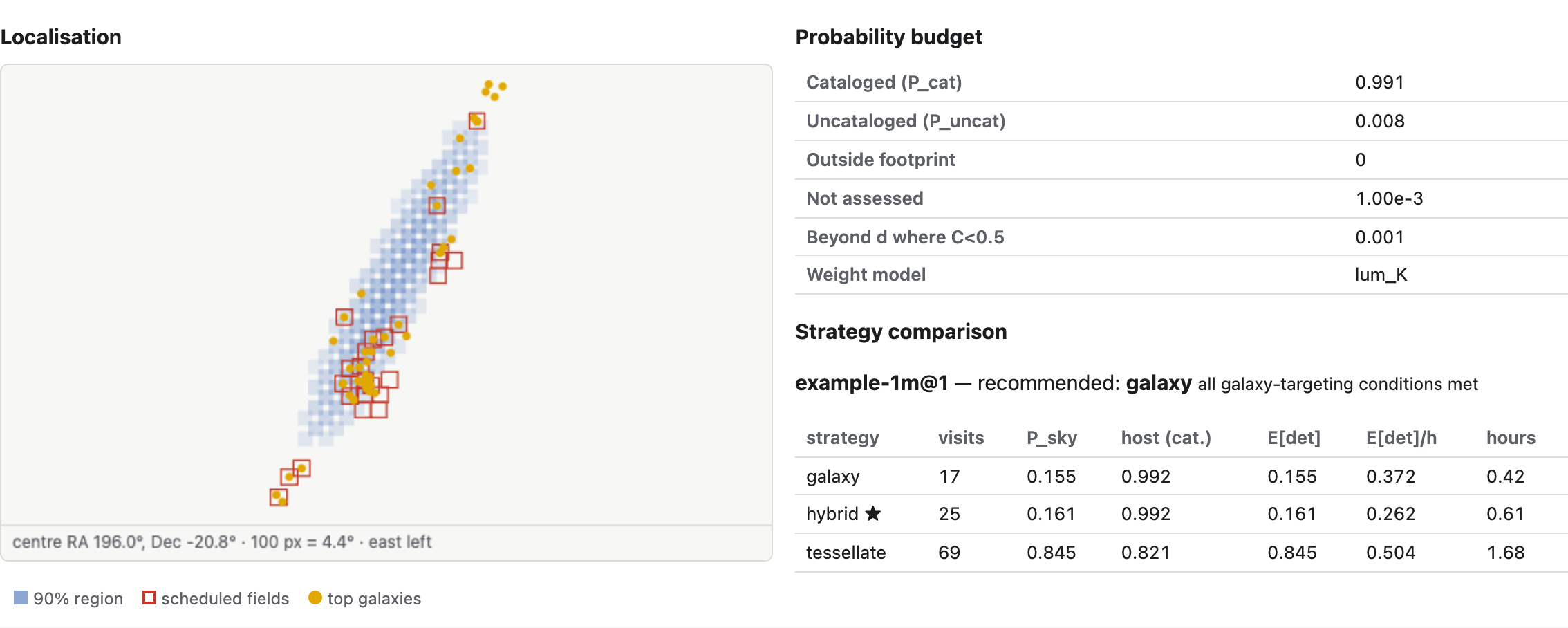
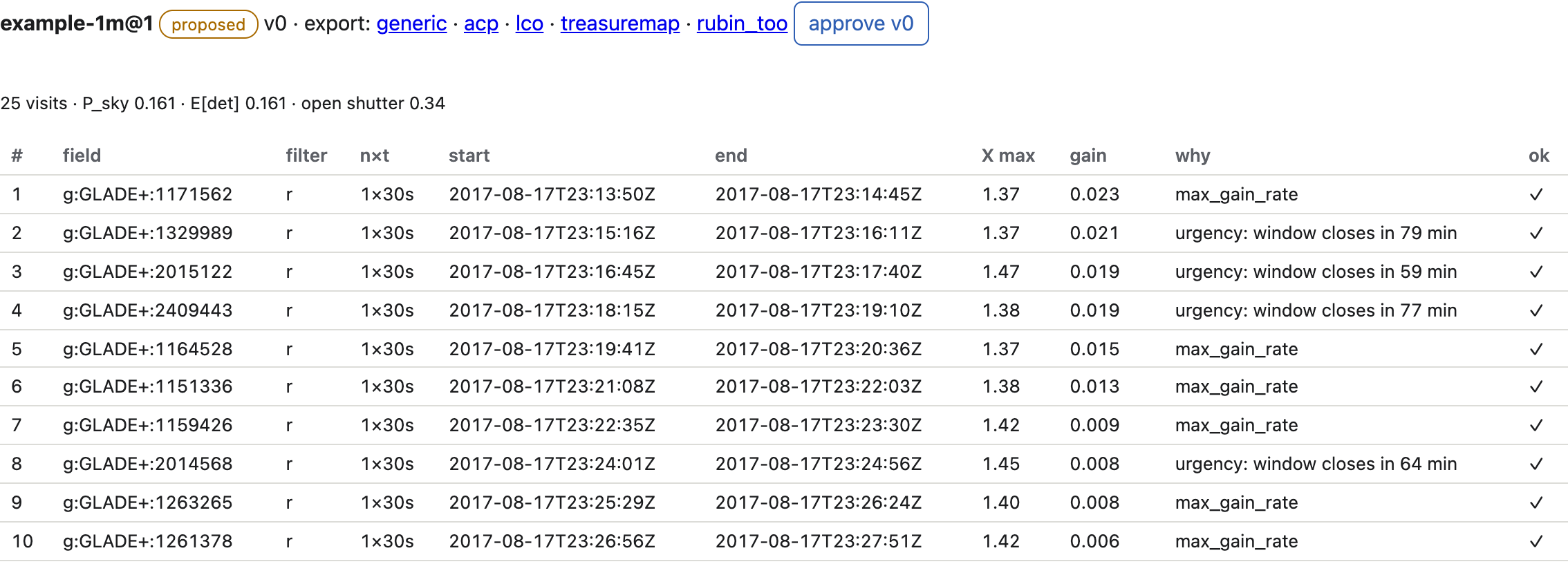
GW170817 planned with the public GWTC-1 sky map, a GLADE+ excerpt, and an example 1 m telescope profile. NGC 4993 ranks first, and its field is observed on the sixth visit, 10.7 h after merger.
What Tessera does
- Ranks host galaxies transparently. Every score component is shown: sky density
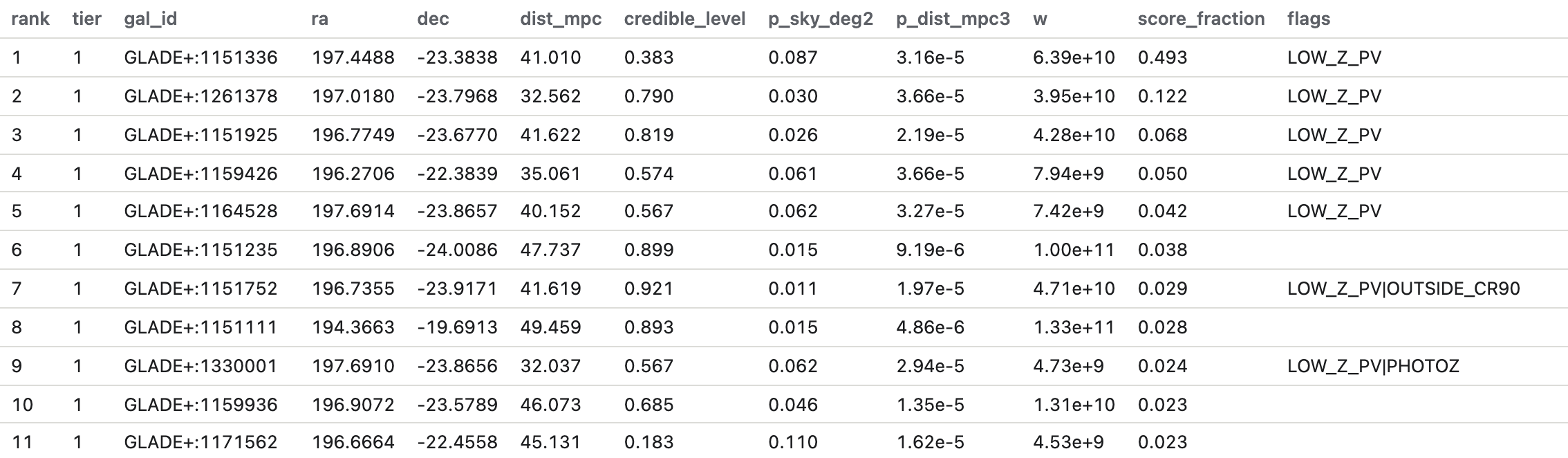
p_sky, the distance termp_dist, the astrophysical weightw, the credible level, the distance z-score and data-quality flags.Sis a ranking score, not a host probability. The opt-inhost-posteriorstrategy gives normalised probabilities under a stated generative model. - Reports what the catalog cannot explain. The probability budget shows how much is cataloged
(
P_cat), how much is uncataloged, how much lies outside the footprint, and how much lies beyond reliable depth. - Builds schedules that can actually be executed. Hard constraints come from astroplan: twilight, airmass, horizon mask, Moon, hour-angle limits and operational windows. Slews and filter changes are modelled per axis. A deterministic greedy optimiser records why each visit was chosen, and an independent validator rechecks every visit at 10 s resolution. Infeasible schedules cannot be exported.
- Makes runs reproducible. Each run records a
plan_key, input checksums, the catalog snapshot ID, profile hashes, the full config, and software and IERS versions.tessera rerunandtessera comparediff any two runs.
Screenshots
Start a plan: upload a sky map (or give a GraceDB URL), pick a catalog, preset and telescopes.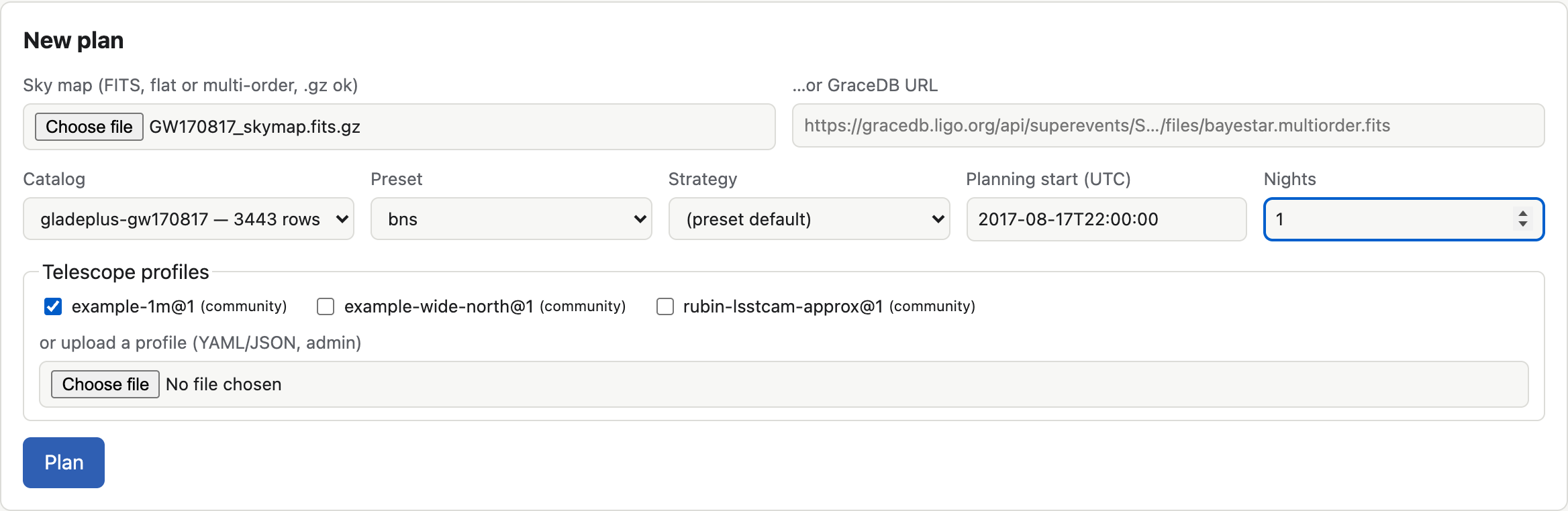 |
REST API: versioned /v1 endpoints with OpenAPI docs.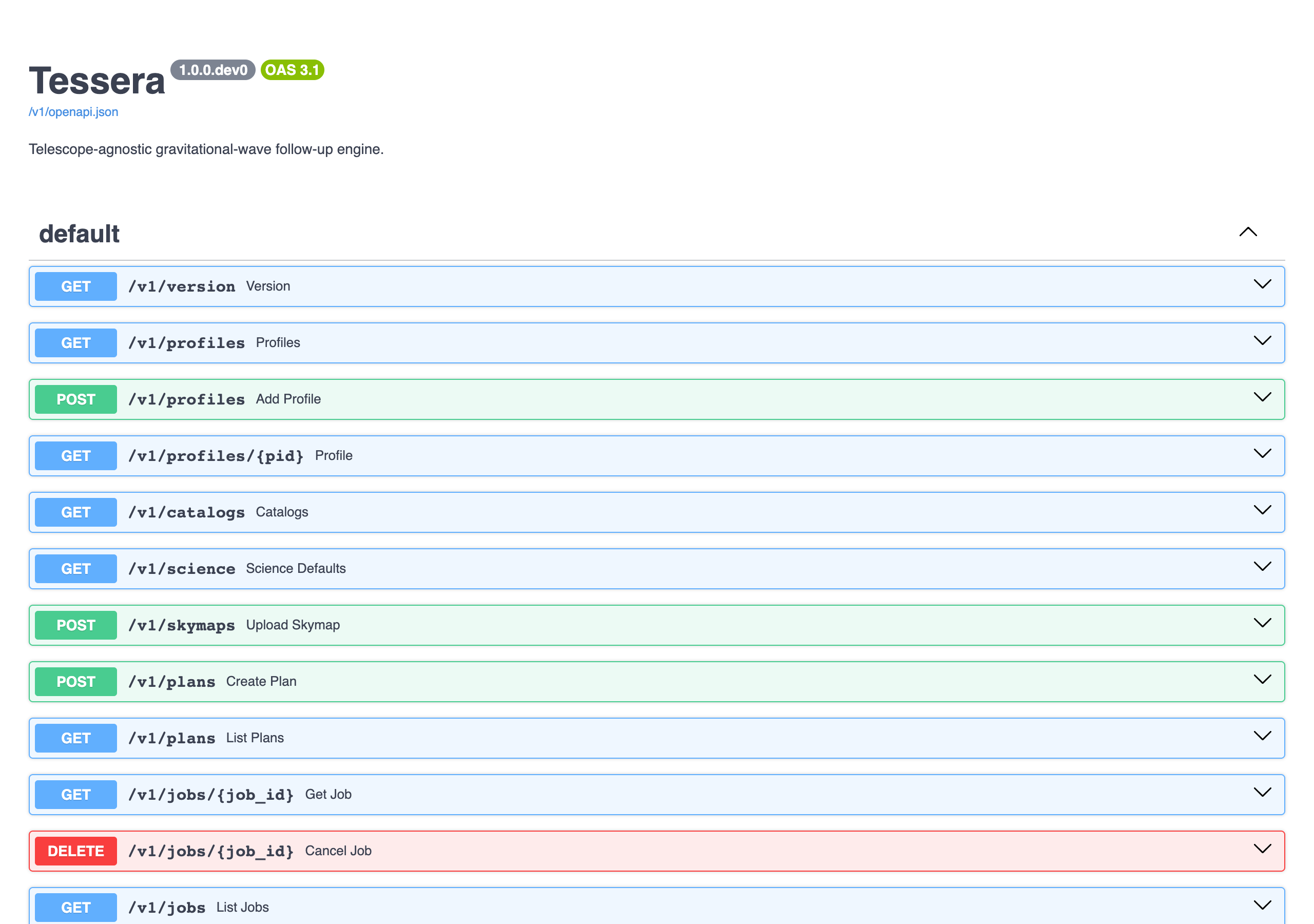 |
Ranked host galaxies, with every score component and flag (downloadable as CSV, ECSV, JSON, Parquet or VOTable):
A validated schedule, with the decision behind each visit and a per-visit feasibility check.
The schedule stays proposed until a person approves one exact version. It exports to generic
JSON/CSV, ACP, LCO, Treasure Map, or a Rubin ToO package:
Quick start
git clone https://github.com/bibinthomas123/Tessera.git && cd Tessera
python -m venv .venv && .venv/bin/pip install -e ".[dev]"

# 1. build a versioned catalog snapshot (here: the GLADE+ excerpt shipped for tests)
.venv/bin/tessera ingest-catalog glade+ tests/data/glade_plus_gw170817.tsv \
    --out catalogs/glade-excerpt --upstream-version 2022-10-31

# 2. plan GW170817 for an example 1 m telescope
.venv/bin/tessera plan --skymap tests/data/GW170817_skymap.fits.gz --catalog catalogs/glade-excerpt \
    --profile example-1m --preset bns --nights 1 --t-start 2017-08-17T22:00:00 --out out/gw170817

# 3. re-check feasibility independently, and export for an ACP-controlled telescope
.venv/bin/tessera validate-schedule "out/gw170817/schedules/example-1m@1.json"
.venv/bin/tessera export "out/gw170817/schedules/example-1m@1.json" --adapter acp
As a library, inside an existing pipeline:
from tessera import plan, PlanConfig

r = plan("bayestar.multiorder.fits", "catalogs/gladeplus-2022.10", ["example-1m"],
         PlanConfig(preset="bns"), t_start="2017-08-17T22:00:00")
r.galaxies[:10]            # ranked galaxies (astropy Table)
r.budget["p_cat"]          # share of probability the catalog can explain
r.schedules["example-1m@1"]["visits"]
r.write("out/")            # all outputs + manifest.json
Running the service
cp .env.example .env      # then set POSTGRES_PASSWORD (e.g. openssl rand -hex 24)
docker compose up -d      # api, worker, alert listener, PostgreSQL
docker compose exec api tessera keys create --name ops --scopes read,plan,approve
The UI is at http://localhost:8000/ui/ and the API docs at /v1/docs. For a multi-user deployment
behind an institutional gateway, there is a Helm chart in deploy/helm/tessera, and the service
supports OIDC and gateway authentication; see docs/deployment.md. Live LVK alerts
arrive from GCN Kafka, SCiMMA or GraceDB. New sky maps are treated as revisions of the same event, and
retractions withdraw schedules automatically.
Validation
tessera benchmark regenerates docs/benchmark-report.md:
| Check | Result |
|---|---|
| NGC 4993 rank for GW170817 (3D scoring with luminosity weight / sky position only) | 1st / 14th |
| Top-10 host recovery, 200 synthetic injections (3D / 2D baseline) | 0.43 / 0.07 |
| Catalog-completeness prediction vs truth (randomly halved catalog) | within 0.01 |
| Greedy scheduler vs provable optimum (MILP upper bound) | ≥ 0.91 |
p_sky and credible levels vs ligo.skymap crossmatch |
agree to 1e-12 |
| Scheduled visits passing the independent validator | 100% |
| Deterministic outputs; malformed and oversized inputs rejected with typed errors | yes |
There are 97 tests, covering service integration, alert revision handling and a GW170817 golden regression. CI runs them on Python 3.10, 3.11 and 3.12 and builds the Docker image.
Installing
The PyPI distribution name is tessera-gw, because the name tessera on PyPI belongs to an
unrelated project. The Python package and the command are both tessera. Optional extras:
[service], [postgres], [alerts], [rubin], [validation].
Data and caveats
- Test data is public. It includes the GWTC-1 GW170817 sky map (LIGO DCC P1800381), the GraceDB BAYESTAR maps for S190425z and S200105ae, and a GLADE+ excerpt from VizieR VII/291 (Dalya et al. 2022; please cite it). The AT2017gfo light curve is derived from Villar et al. 2017, Table 3.
- Telescope profiles shipped here are illustrative or approximate, not facility-validated.
- Science model 1.1.0. The light curve and the B- and K-band densities are sourced. The stellar-mass density is an upper limit whose IMF match to GLADE+ masses is unverified, and the kilonova diversity σ_M = 0.5 mag is an assumption.
- Adapters.
- The Rubin adapter is checked against
rubin-scheduler. - LCO is checked against the open-source Observation Portal.
- Treasure Map is checked against its official client.
- ACP is unverified.
- Each facility must confirm the format before submission is enabled. See docs/adapters.md.
- The Rubin adapter is checked against
Further reading: science model · API · validation protocol · contributing · roadmap. Licensed under BSD-3-Clause.
1 maintainer

Metadata
1 maintainer
Release files for tessera-gw 1.0.1
For a detailed explanation of source distributions (sdists) and built distributions (wheels), please see the package formats documentation.
Source distribution (sdist)
| File | Size | Uploaded | Provenance | |
|---|---|---|---|---|
| tessera_gw-1.0.1.tar.gz | 154.0 kB | With provenance | Details |
Built distribution (wheel)
| File | Interpreter | ABI | Platform | Reset |
|---|---|---|---|---|
| tessera_gw-1.0.1-py3-none-any.whl | Python 3 | none | any | Details |
Total release size: 330.7 kB
Release files / tessera_gw-1.0.1.tar.gz
| Download URL | tessera_gw-1.0.1.tar.gz |
|---|---|
| Size | 154.0 kB |
| Tags | Source |
|
SHA-256 checksum How to use checksums |
b9451bbda3fd0d0f1b80aec4d935f24ba113f8d29e846cfcada458c31bebcab9
|
|
BLAKE2b-256 checksum How to use checksums |
c9311f2bebd8e70e7b1d3fb5344f55450954f8f5512dff0e4fbddbf61ff61af4
|
| Upload date | |
|
Uploaded using Trusted Publishing? What is trusted publishing? |
Yes |
| Uploaded via |
twine/7.0.0 CPython/3.13.16
|
Provenance
Provenance describes where a file came from. On PyPI, provenance is shared via attestations, which provide a verifiable record of the build or publishing details. View details, limitations and caveats.


PyPI Publish Attestation
PyPI verified that this artifact, at this checksum, originated from the publisher listed below.
Signed by GitHub Actions, verified by PyPI on Oct 24, 2026.
Transparency logRelease files / tessera_gw-1.0.1-py3-none-any.whl
| Download URL | tessera_gw-1.0.1-py3-none-any.whl |
|---|---|
| Size | 176.7 kB |
| Tags | Python 3 |
|
SHA-256 checksum How to use checksums |
5539324bd6924f9af30ba4c06003527fbc03f98e8aacd2d464782e17fac813b8
|
|
BLAKE2b-256 checksum How to use checksums |
41a87ba9bb926a761afc890a919bd83836984aaa9f8ab217d40c7f6dd1cb2ba8
|
| Upload date | |
|
Uploaded using Trusted Publishing? What is trusted publishing? |
Yes |
| Uploaded via |
twine/7.0.0 CPython/3.13.16
|
Provenance
Provenance describes where a file came from. On PyPI, provenance is shared via attestations, which provide a verifiable record of the build or publishing details. View details, limitations and caveats.
PyPI Publish Attestation
PyPI verified that this artifact, at this checksum, originated from the publisher listed below.
Signed by GitHub Actions, verified by PyPI on Oct 24, 2026.
Transparency logSecurity for tessera-gw 1.0.1
Provenance
Provenance describes where a file came from. On PyPI, provenance is shared via attestations, which provide a verifiable record of the build or publishing details. View details, limitations and caveats.
Full provenance
All 2 files in this release have been uploaded with provenance metadata.
Attestation for tessera_gw-1.0.1.tar.gz
PyPI Publish Attestation
PyPI verified that this artifact, at this checksum, originated from the publisher listed below.
Signed by GitHub Actions, verified by PyPI on Oct 24, 2026.
Transparency logA note on package security
PyPI is a repository for distributing packages, not a service for auditing them. While third-party security researchers and our staff do their best to detect and remove malicious packages, PyPI cannot guarantee the quality, security or suitability of any given package.
To learn more about protecting yourself from malicious actors, visit our package security documentation.














