
This release is a pre-release and may not be stable for production use.

Testence
Agent-first browser testing with evidence-backed verdicts.
Agents author and investigate. A deterministic runner proves what happened.





English docs · Документация на русском · Demo contract · Benchmark protocol
Supported Python versions, operating systems and dependency floors are listed in the machine-readable support matrix.
Testence turns a product claim into a reviewable PlanSpec, deterministic browser
test, structured evidence pack and typed verdict. Routine replay contains no LLM call
and no provider lock-in. The agent does the work that benefits from reasoning; the
runner does the work that must be fast and reproducible.
feature or risk
      │
      ▼
agent plans ──► writes ordinary pytest ──► deterministic replay
                                                   │
                                                   ▼
human/policy ◄── reviewable repair ◄── evidence pack + verdict
Why Testence
| Traditional E2E | Interactive browser agent | Testence | |
|---|---|---|---|
| Authoring | Human-heavy | Agent-driven | Agent-driven |
| Routine replay | Deterministic | Model-driven | Deterministic |
| Failure output | Logs and screenshots | Conversation | Versioned evidence pack |
| Healing | Manual or opaque | Session-local | Reviewable proposed diff |
| Model dependency in CI | None | Usually required | None |
| Verdict contract | Ad hoc | Prose | Typed and evidence-bound |
The key distinction is not “AI writes tests.” Many tools can do that. Testence makes the complete agent workflow auditable: plan, claim, evidence, verdict and repair are explicit contracts that another agent, a reviewer or policy can verify.
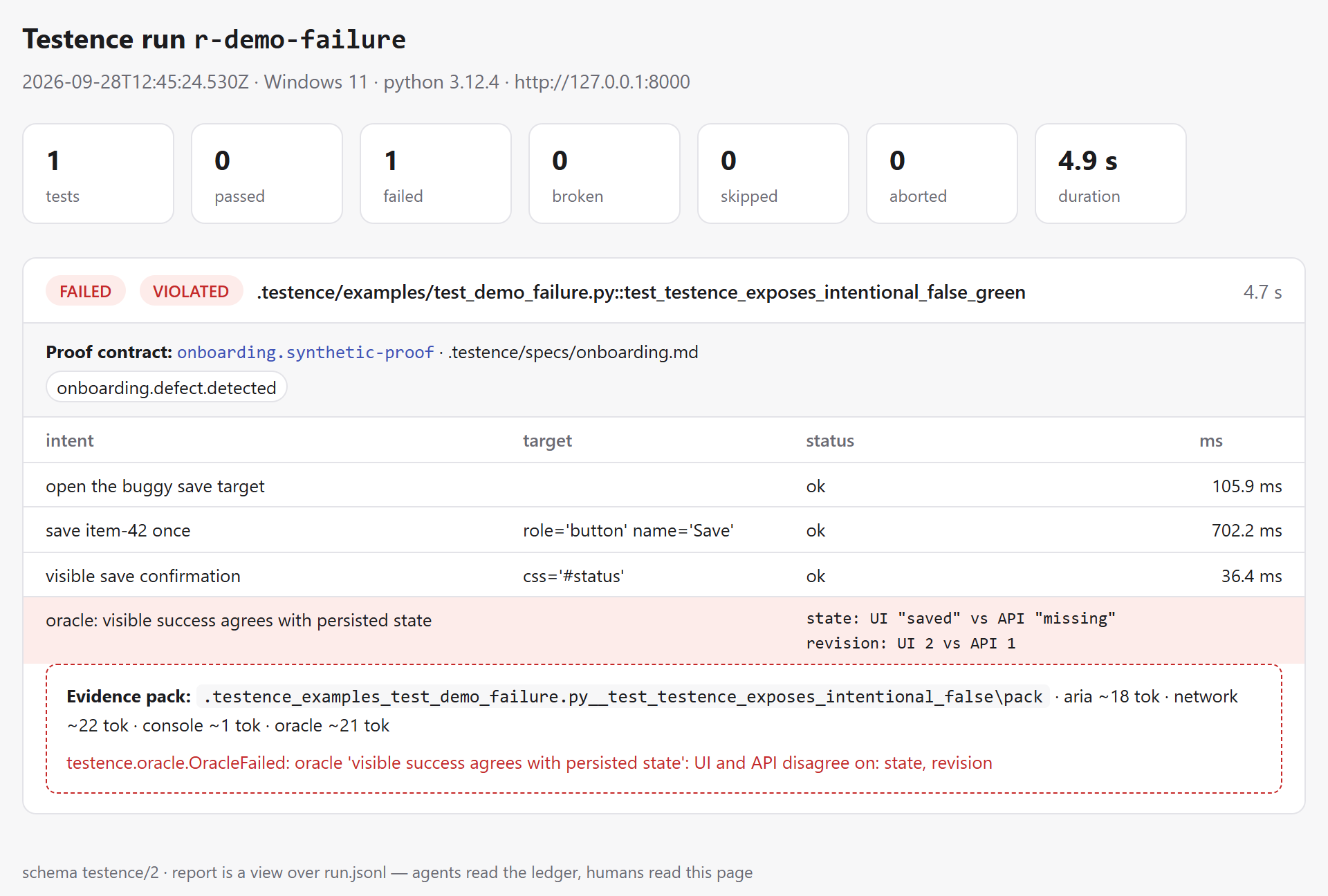
The UI said "saved"; the same-session API read said "missing". A UI-only check passes
here; Testence fails it and keeps the evidence. This is testence report for the
r-demo-failure run of the quick start below. Results export to Allure and Allure
TestOps, JUnit and CTRF (reporting),
and a copy-paste GitHub Actions workflow is in CI.
Quick start
pip install testence
python -m playwright install chromium   # skip with system Chrome/Edge: TESTENCE_BROWSER_CHANNEL=chrome|msedge

testence doctor
testence init .
testence plan prepare .testence/specs/onboarding.md --project .
testence run --project . --run-id r-onboarding
testence inspect runs/r-onboarding

# see it catch a false green: the UI says saved, the API disagrees
testence run --project . --run-id r-demo-failure -- .testence/examples/test_demo_failure.py -q
testence report runs/r-demo-failure
Testing your own app first? Your first test needs no plan file, and the glossary explains verified, unverified and the other words in a report.
testence init writes testence.json and a .testence/ scaffold: one synthetic plan and
the tests that prove the loop. The scaffold is deliberately kept out of your existing
pytest paths, so initialization never opts your current suite into Testence. Conflicting
files are left untouched.
Render the run as a single self-contained HTML file, or run the complete green/failure demo and both reports with one command:
testence report runs/r-onboarding
testence demo run --project testence-demo --json
Every command that takes --json also prints a readable summary without it.
testence doctor --target also reaches your app's base_url, checks the credentials and
tries the login once. doctor exits 2 when a check fails, plan prepare exits 3 when a scenario is blocked and 2 when
the plan or configuration is invalid.
From a clone
git clone git@github.com:kiselas/testence.git
cd testence
uv sync --locked --extra dev --extra parallel
uv run playwright install chromium

uv run testence plan validate examples/specs/target-page.md --json
uv run pytest examples -q --testence-headless
plan prepare is the fail-fast gate before browser discovery. It checks each scenario's
engine capabilities, required oracle adapters and project prerequisites once, then returns
ready or explicit blockers with phase timings. Configure reusable, read-only checks in
testence.json:
{
  "project_id": "shop",
  "base_url": "https://qa.example.test",
  "readiness": {
    "schema": "testence/readiness/1",
    "oracle_adapters": ["api", "custom"],
    "checks": [
      {"id": "credentials", "type": "env", "variables": ["TESTENCE_USER", "TESTENCE_PASSWORD"]},
      {
        "id": "seed",
        "type": "http",
        "path": "/api/qa/seed",
        "json_pointer": "/ready",
        "equals": true,
        "fix": {"argv": ["python", "scripts/seed_qa.py"], "timeout_ms": 120000}
      }
    ],
    "scenarios": {"checkout": ["credentials", "seed"]}
  }
}
Supported checks are env, project-relative file, and read-only http. HTTP checks
may assert a status and a JSON Pointer value. Secret values are never included in the
report. A blocked result exits with status 3; invalid plans or configuration exit with 2.
After reviewing a blocked report, plan prepare --apply-fixes runs only the explicitly
configured argument arrays without a shell and checks the failed prerequisites again.
Command output is discarded from the receipt so credentials cannot leak through tool logs.
Every generated file is bound by a scaffold manifest, and the machine-readable form of
each command above is available with --json.
Every failed test produces a bounded evidence pack containing the page's accessibility
tree, network and console signals, intent-bearing steps, independent oracle observations
and a verdict template. A screenshot is added once the project opts in with
"capture_policy": {"screenshots": true} — testence init does; a screenshot cannot be
redacted, so a hand-written testence.json leaves it off
(configuration).
Render a standalone report with:
testence report runs/<run-id>
To integrate a real application, define a target profile in testence.json, keep
credentials in environment variables or .env.local, and run ordinary pytest:
TESTENCE_PROFILE=staging uv run pytest tests_e2e -q
Follow Testing a UI feature for the full workflow.
Fast agent authoring
Start with the short authoring loop: locate the consumer
project (including older Exhibit/stf_autotests pilots), map one page with
testence explore, scope duplicate controls with Target(..., within=...), and run
one exact pytest node before the full suite.
Keep the authenticated browser alive and attach short runs over CDP:
# terminal 1
uv run python -m testence.dev_browser --profile staging

# terminal 2: rerun on save without restarting Python or pytest
uv run testence watch --warm \
  -w tests_e2e -w src -- \
  python -m pytest tests_e2e/test_widget.py -k created_widget \
  --testence-profile staging-attached -q
Warm mode retains the Playwright/CDP engine connection while creating a new pytest session, fixtures, auth context, run id and evidence writer on every iteration. Fresh processes remain the required path for CI and release validation.
On the maintained production-built React profile, warm engine reuse reduced bootstrap p50 from 2,808 ms to 447 ms (−84.1%) and whole-run p50 from 3,447 ms to 1,133 ms (−67.1%). See the result snapshot, machine-readable budget and ADR-0018. Numbers are local engineering evidence, not a cross-machine performance promise.
Evidence, not runtime magic
A verdict is a versioned document bound to the plan, claims and captured run:
{
  "schema": "testence/verdict/2",
  "project_id": "widgets",
  "case_id": "create-widget",
  "variant_id": "default",
  "attempt_id": "attempt-controller-1",
  "run_id": "r-20260906-120000-abc123",
  "proof_id": "proof-0123456789abcdef0123",
  "plan_digest": "sha256:aaaaaaaaaaaaaaaaaaaaaaaaaaaaaaaaaaaaaaaaaaaaaaaaaaaaaaaaaaaaaaaa",
  "test_digest": "sha256:bbbbbbbbbbbbbbbbbbbbbbbbbbbbbbbbbbbbbbbbbbbbbbbbbbbbbbbbbbbbbbbb",
  "policy_digest": "sha256:cccccccccccccccccccccccccccccccccccccccccccccccccccccccccccccccc",
  "pack_digest": "sha256:dddddddddddddddddddddddddddddddddddddddddddddddddddddddddddddddd",
  "plan_id": "widgets.create",
  "verdict": "real_bug",
  "test_id": "test_created_widget_is_visible",
  "confidence": 0.96,
  "summary": "POST succeeded, but the new row never appeared in the UI",
  "claim_results": [
    {
      "claim_id": "widgets.create.persisted",
      "status": "failed",
      "reason": "The persisted row is absent from the rendered collection",
      "evidence": ["oracle.json#/0"]
    }
  ]
}
When evidence is insufficient, the agent must abstain and state what is missing. Locator healing follows the same rule: it creates a proposed patch with provenance and confidence; it never silently changes the selector during execution.
Agent-native by design
The package ships portable skills for four bounded jobs:
testence-plan— turn a feature or risk into claims and a PlanSpec;testence-author— create deterministic tests and independent oracles;testence-triage— classify failures from bounded evidence;testence-repair— propose a reviewable change and prove it safely.
The same versioned skill pack is designed for Codex/ChatGPT, Claude Code, OpenCode and
other Agent Skills clients. Client adapters stay thin; the contracts remain portable.
Start from AGENTS.md, the shared entry point for any coding agent.
Optional testence[visual] adds digest-pinned viewport comparisons and manifested
expected/actual/diff evidence. The client simulation
exercises two adapter layouts from an installed wheel, including visual defects
and harmless controls.
See Agent Skills and the
agent workflow.
Architecture
flowchart LR
    A[Agent control plane<br/>plan · author · triage · repair]
    V[Verification plane<br/>pytest · DSL · Playwright/CDP]
    T[Trust plane<br/>ledger · evidence · verdict · policy]
    A -->|versioned contracts| V
    V -->|append-only events| T
    T -->|reviewable proposal| A
src/testence/contracts— PlanSpec and verdict schemas with claim traceability;src/testence/engine— replaceable execution protocol and Playwright/CDP backend;src/testence/dsl— intent-bearing actions and exact-by-default assertions;src/testence/evidence— append-onlytestence/2ledger and bounded artifacts;src/testence/triage— evidence packs, verdicts and reviewable healing proposals;src/testence/agent— packaged, versioned, client-neutral skills;benchandcorpus— real-React latency gates and seeded correctness defects.
Important decisions are recorded as bilingual ADRs with measurable tripwires: English · Русский.
Proof before claims
Testence keeps benchmark inputs, budgets and raw result snapshots in the repository. The current proof surface includes:
- a production-built React latency gate for navigation, controlled inputs and mutation synchronization;
- a shared-browser and warm-runner benchmark for the authoring loop;
- a seeded mutation corpus for false-green, false-red and healing quality;
- a competitive replay protocol with frozen scenarios and environment disclosure.
Start with the launch protocol and benchmark corpus. A number without its command, environment and failure criteria is deliberately not treated as a product claim.
Project status
Testence is in alpha: the workflow is complete, and APIs may still change between releases. See the changelog and the roadmap.
Evidence is redacted before it is written and again when it is exported; screenshot masks and PII redaction are configured per project (configuration). Review an evidence pack before sharing it outside your team. See SECURITY.md and CONTRIBUTING.md.
License
Apache-2.0. Runtime dependencies are restricted to permissive licenses. The runner contains no LLM SDK and makes no call to a model provider during ordinary replay.
For short authoring iterations, use testence status --json to locate the active installation and testence debug tests/test_case.py::test_case --json for one guarded replay with failure ARIA and phase timings. Exhibit is the previous name. See authoring loop.
1 maintainer

Metadata
1 maintainer
Release files for testence 0.1.0a2
For a detailed explanation of source distributions (sdists) and built distributions (wheels), please see the package formats documentation.
Source distribution (sdist)
| File | Size | Uploaded | |
|---|---|---|---|
| testence-0.1.0a2.tar.gz | 442.8 kB | Details |
Built distribution (wheel)
| File | Interpreter | ABI | Platform | Reset |
|---|---|---|---|---|
| testence-0.1.0a2-py3-none-any.whl | Python 3 | none | any | Details |
Total release size: 779.6 kB
Release files / testence-0.1.0a2.tar.gz
| Download URL | testence-0.1.0a2.tar.gz |
|---|---|
| Size | 442.8 kB |
| Tags | Source |
|
SHA-256 checksum How to use checksums |
ed68c413b75fc8fefa3685f7d14afb556136a4886ff671d59048248b6dbb8283
|
|
BLAKE2b-256 checksum How to use checksums |
c49916d3ed4ca1b4586ff21793c88d3541b85042f06fb522f17d9efbd41a5133
|
| Upload date | |
|
Uploaded using Trusted Publishing? What is trusted publishing? |
Yes |
| Uploaded via |
twine/7.0.0 CPython/3.13.14
|
Provenance
Provenance describes where a file came from. On PyPI, provenance is shared via attestations, which provide a verifiable record of the build or publishing details. View details, limitations and caveats.


PyPI Publish Attestation
PyPI verified that this artifact, at this checksum, originated from the publisher listed below.
Signed by GitHub Actions, verified by PyPI on Oct 12, 2026.
Transparency logRelease files / testence-0.1.0a2-py3-none-any.whl
| Download URL | testence-0.1.0a2-py3-none-any.whl |
|---|---|
| Size | 336.7 kB |
| Tags | Python 3 |
|
SHA-256 checksum How to use checksums |
39fe8b54acb492e624428d436b0c923d57d93abde96294e4e461dc18ebf63aad
|
|
BLAKE2b-256 checksum How to use checksums |
cbb6264fa19ff342d480186772bccc1b769d917ee4b3f49f88389f56d46b30bf
|
| Upload date | |
|
Uploaded using Trusted Publishing? What is trusted publishing? |
Yes |
| Uploaded via |
twine/7.0.0 CPython/3.13.14
|
Provenance
Provenance describes where a file came from. On PyPI, provenance is shared via attestations, which provide a verifiable record of the build or publishing details. View details, limitations and caveats.
PyPI Publish Attestation
PyPI verified that this artifact, at this checksum, originated from the publisher listed below.
Signed by GitHub Actions, verified by PyPI on Oct 12, 2026.
Transparency log













