
python-tetracorder
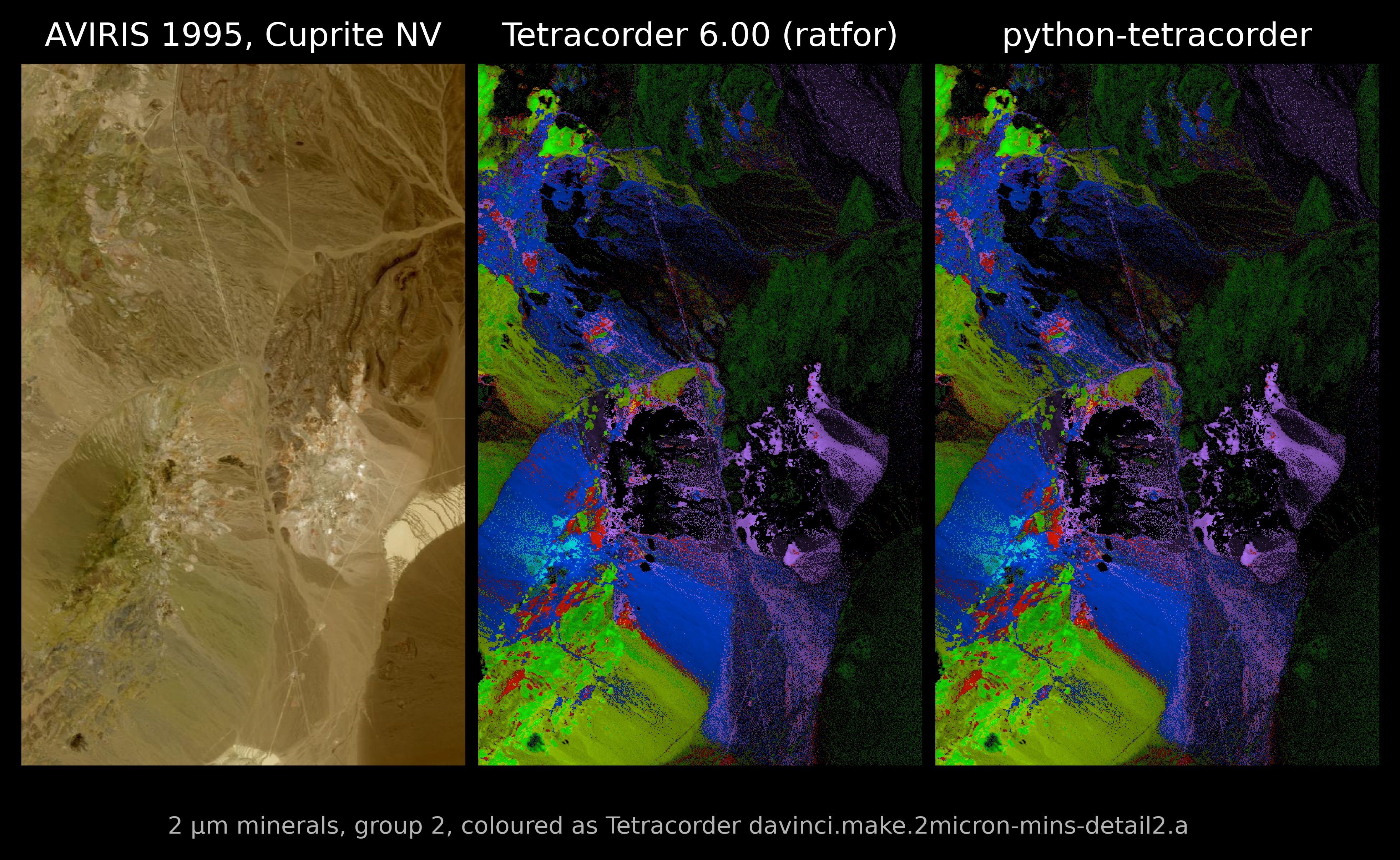
A port of the rules and evaluation logic of the Tetracorder algorithm to pure Python - with no guarantee or warranty! This is merely a translation of the expertise encoded in the phenomenal Tetracorder expert system. All citation and credit should go to: Roger N. Clark, Gregg A. Swayze, K. Eric Livo, Raymond F. Kokaly, Steve J. Sutley, J. Brad Dalton, Robert R. McDougal and Carol A. Gent, 2003, Imaging spectroscopy: Earth and planetary remote sensing with the USGS Tetracorder and expert systems, Journal of Geophysical Research, Vol 108.
This project is an independent Python reimplementation of parts of the Tetracorder spectral identification system.
The original Tetracorder and spectroscopy software was written by Roger N. Clark and colleagues and is Copyright ©
1975-2026 Roger N. Clark, Planetary Science Institute (PSI), and contributors named in the original code. The original
software is distributed under the GNU General Public License and requires redistributions to retain its copyright
notice, conditions and disclaimer; recodings into other languages must also make the translation and source code
freely available. This project is not endorsed by Roger N. Clark, PSI, or the original contributors. The original
Tetracorder software and licensing terms are available from the PSI
spectroscopy-tetracorder repository.
Contents
- Installation
- Usage
- Outputs
- Scene size and run time
- Rules, materials and reference spectra
- Fidelity
- Development history
- Scope, Disclaimer, License
Installation
pip install tetracorderp
or, from a checkout of this repository:
pip install -e .
The package installs as tetracorderp and depends only on NumPy, SciPy, Numba, Pillow and Matplotlib. The rule set,
the reference spectra database and the post-processing lookups are bundled with it.
Usage
GroupEvaluator is the entry point. Constructing it runs the full rule evaluation; the methods then write the results.
from tetracorderp import GroupEvaluator

# cube: (lines, samples, bands) reflectance; wavelengths, fwhm: µm, one entry per band
run = GroupEvaluator(
    cube, wavelengths, fwhm,
    mode="default",                  # threshold preset, see tetracorderp.config.VARIABLE_PRESETS
    target_valid_bands=valid_bands,  # optional (bands,) bool, True = usable band
    masked_pixels=bad_pixels,        # optional (lines, samples) bool, True = skip this pixel
)
# Evaluation runs inside __init__: run.group_winners and run.case_winners are populated on return.

run.write_npz("scene.npz")                                    # everything, reloadable without the cube
run.write_like_tetracorder("outputs")                         # native-style .fit.gz / .depth.gz / .fd.gz
run.write_all_themes("outputs", cube_id_prefix="scene")       # colour theme maps
run.write_all_themes_display("outputs", cube_id_prefix="scene")  # theme maps with base image and key
run.write_geological_theme_images("outputs", cube_id_prefix="scene")

run = GroupEvaluator.from_npz("scene.npz")                    # later, without re-evaluating
run.export_for_qgis("qgis_outputs", cube_id_prefix="scene")
Other arguments:
temperature,pressure:(min, max)of the scene in Kelvin and bar. Materials whose declared limits exclude the range are disabled, as native'sapplygtpconstraints.r.disabled_groups,disabled_cases,disabled_materials: group and case numbers, or rule ids, to skip.reference_file,rules_file: your own reference database or rule set, in place of the bundled ones.blocking(defaultTrue): evaluate in strips of about 40k pixels. Results are identical to whole-cube evaluation, and it is faster and uses far less memory, so there is little reason to turn it off.
Masked pixels
masked_pixels follows the numpy.ma convention used by the EMIT and EnMAP quality flags: True means skip.
Masked pixels are not evaluated and come out as no winner, with zero fit and depth. Within each strip the unmasked
pixels are gathered, evaluated and scattered back, so a cloudy or partly empty scene costs only its valid pixels. The
mask is saved in the npz and restored by from_npz.
For example, with the EMIT L2A aggregate flag (band 7 of the mask product, 1 = flagged):
masked_pixels = mask[..., 7] != 0
and with EnMAP L2A, combining the cloud layer with pixels that are no-data in every band:
masked_pixels = (cloud != 0) | (raw == nodata).all(axis=0)
Flat spectra, shape (n, bands), are evaluated too. The image writers need an image, so reload a flat run with
GroupEvaluator.from_npz(path, shape=(lines, samples)).
Outputs
| Output | Method | Native equivalent |
|---|---|---|
| Frozen run record | write_npz, reloaded with from_npz |
none |
| 8-bit fit, depth and fd per material | write_like_tetracorder |
<group or case dir>/<name>.{fit,depth,fd}.gz |
| Colour theme maps | theme_map, write_all_themes |
color.results/*.png |
| Theme maps with base image and key | write_all_themes_display |
color.results+labels/*+labels.png |
| Classification and material group images | geological_theme_images, write_geological_theme_images |
geologic-classifications/, geologic-groups/ |
| Tetracorder for QGIS layout | export_for_qgis |
a native run directory with geology on |
Outputs.md traces every native product to its source, describes each python output, and lists what is
not implemented and why. The colour themes, material classes and geological lookups in postprocessing_lookups.json
were transcribed and in places completed by us; see the lookups section of Outputs.md.
They are not representative of the logic contained in the authoritative Tetracorder.
Scene size and run time
python-tetracorder is slower than native. Indicative times on a single desktop machine:
| Scene | Pixels evaluated | Time |
|---|---|---|
| Cuprite95, AVIRIS (972 × 614), all enabled groups and cases | 596,808 | ~390 s |
| Drill core box scan (Specim SWIR) | 180,016 | ~120 s |
EMIT L2A, emit_c mode, cloud-masked |
966,895 of 1,589,760 | 702 s |
| EnMAP L2A full cube, unmasked | 1,402,440 | 1,873 s |
Time scales with the number of pixels evaluated, so masking clouds and empty borders pays off directly.
The cube must fit in memory, as a float32 array or smaller: the evaluation converts one strip at a time and never copies the whole cube. A scene too large for RAM, such as a full AVIRIS-NG or AVIRIS-3 flight line, should be cut into tiles outside the package and the results stitched back together. Every pixel is evaluated independently, so tiling does not change the results.
Rules, materials and reference spectra
Rules
The project is based on published/released Tetracorder rule definitions and attempts to reproduce their evaluation behaviour independently in Python. The most recent expert system ruleset is cmd.lib.setup.t6.00a6. These rules have been parsed into JSON, with some manual editing, resulting in a dataset that is read by the Python implementation.
Reference spectra
Tetracorder rules reference spectra from USGS spectral libraries. The most recent version of the USGS spectral library is available here. However, the Tetracorder rules refer to specific reference spectra from a previous version of this library, and mapping between them is not straightforward.
The SQLite reference spectra database in this package is derived from the libraries in the Tetracorder repo. It holds the native-resolution libraries, not the convolved variants, with the bandpass of every sample, and the spectra are convolved to the sensor's bands at run time using the convolver vendored from tetracorder-lite.
Fidelity
Tetracorder 6.00 Cuprite95 validation tests
Native Tetracorder run
The reference run for these tests was performed in a tetracorder-lite docker container. Tetracorder-lite vendors the entire authoritative Tetracorder and Specpr ratfor build, with marginal difference to the original cmd files (a renamed material, and some different comments).
The native run consumes the Cuprite95 AVIRIS cube using the Tetracorder 6.00 command/rule configuration and writes separate output products for the enabled material groups and cases. The setup, physical conditions, disabled groups etc. are all faithfully reproduced from the testrun in the original Tetracorder, except that this run used expert system 6.0 and the hosted run results use 5.26e1.
The following native Tetracorder internals are all recorded:
- the Cuprite95 input image cube;
- the DN offset, scale factor and deleted-data value recorded in the native run history;
- the AVIRIS95 wavelength record from the native
s06av95aSPECpr library; - the native
[DELETPTS]channel mask; - the native temperature and pressure settings;
- any groups or cases explicitly disabled by the native run;
- the native SPECpr-convolved
s06av95a/r06av95areference spectra; - the native group and case output images used for comparison.
Python runs
Cube preparation
The Python test runs were performed on the same cube, using the same preparation as the Tetracorder internals:
- the native integer DN values are converted to float32 with exactly the native Tetracorder scaling
cube = (dn.astype(np.float32) + np.float32(offset)) * np.float32(scale); - pixels whose raw DN equals the native deleted-data sentinel are replaced by NaN,
cube[dn == deleted_dn] = np.nan; - the native AVIRIS95 wavelength vector is read from
s06av95a record 6,
and the native
[DELETPTS]mask is recreated.
This ensures that python-tetracorder is supplied with the same cube, wavelengths, valid-band mask, physical conditions and rules used by the native run.
Library
The first test, establishing algorithmic fidelity, passed in the native convolved reference spectra. It is documented here.
The second test used the convolver vendored from tetracorder-lite on the SQLite database derived from the Tetracorder repository. As the vendored convolver requires FWHM data per reference, the database was updated to include that information in the samples table, and the Python code adjusted to handle the new database format. This test established the fidelity of the vendored convolver and the internal SQLite library. Its results are documented here.
All further tests use the bundled database and rules, through the test script here. It needs the native run and the Tetracorder repository, so it cannot be run from the package alone. The latest report, for this release, is tests/fidelity_test_refactor-20261002-2.md.
Comparison
Native Tetracorder writes separate 8-bit products for each material, including:
<material>.fit.gz<material>.depth.gz<material>.fd.gz
GroupEvaluator.write_like_tetracorder() emulates this output style, so the comparison evaluates both implementations
in the same output space, comparing native uint8 output directly.
Classification agreement is measured from pixels where the fit image is non-zero, while fit and depth agreement is assessed directly from the corresponding 8-bit values.
Results
Summary statistics are calculated for each group and case. The complete comparison output is in this file; only the summary is presented here.
| Group | Materials | Native only | Python only | Native pixels | Python pixels | Jaccard | Fit exact |
|---|---|---|---|---|---|---|---|
| case.ep-cal-chl | 13 | 0 | 0 | 45,759 | 45,759 | 1.0000 | 1.0000 |
| case.red-edge | 2 | 0 | 0 | 528,969 | 528,969 | 1.0000 | 0.9996 |
| case.veg.type | 15 | 0 | 0 | 466,554 | 466,554 | 1.0000 | 1.0000 |
| group.1.5um-broad | 48 | 0 | 1 | 401,157 | 401,157 | 1.0000 | 1.0000 |
| group.1um | 140 | 0 | 0 | 573,079 | 573,079 | 1.0000 | 0.9999 |
| group.2um | 227 | 0 | 1 | 596,794 | 596,794 | 1.0000 | 1.0000 |
| group.2um-broad | 35 | 0 | 0 | 7,265 | 7,265 | 1.0000 | 1.0000 |
| group.ch4gas-2.3um | 29 | 0 | 0 | 6,178 | 6,178 | 1.0000 | 1.0000 |
| group.co2gas-2um | 29 | 0 | 0 | 107,050 | 107,050 | 1.0000 | 0.9997 |
| group.ree | 41 | 0 | 0 | 17,727 | 17,727 | 1.0000 | 0.9987 |
| group.ree_g21 | 40 | 0 | 0 | 17,726 | 17,726 | 1.0000 | 0.9987 |
| group.ree_samar | 29 | 0 | 0 | 6,178 | 6,178 | 1.0000 | 1.0000 |
| group.veg | 7 | 0 | 0 | 1,958,033 | 1,958,033 | 1.0000 | 0.9999 |
While there is minor degradation from the algorithmic fidelity test, incorporating the SQLite database and the tetracorder-lite convolver has had no impact on the material classification per pixel. The differences in fit exact (and depth exact) are attributed to floating point rounding and order of accumulation variations in the codebase, exacerbated by the uint8 quantisation.
Native disables materials at setup and creates no output files for them (creatoutfiles.r:76), listing them in
AAA.info/disabled-materials.txt. python-tetracorder reaches the same state during evaluation: a feature whose windows
have no usable channels returns invalid, takes zero weight, and rejects the material if it is weak or must-have. Two
materials - wollastonite_hs348.3b and potassium_nitrate - therefore appear as empty Python outputs with no native
counterpart.
Every change described in Development history, including the packaging of this release, was checked against this test and reproduced the table above exactly.
Development history
Performance pass 1 - 900+ s to ~390 s
Timings are for the full Cuprite95 fidelity run on the same machine. Each step reproduced the fidelity summary table exactly.
| Step | Run time |
|---|---|
| Before this pass | 900+ s |
| Caching and clean-up (@kevinhaoaus) | 781 s |
Numba kernel for _window_mean |
723 s |
numpy.ma removed from the evaluation path |
466 s |
| Evaluating the full cube in blocks | 382 s |
| Release clean-up: float32 strips, masked pixels, output writers | 389-397 s |
The last row is unchanged within run-to-run variation: that work was about memory, masking and the outputs, not speed.
Caching, packaging and clean-up - contributed by @kevinhaoaus in his fork. Thanks Kevin!
- Packaging fix:
pyproject.tomldeclaredpackages = ["TetracorderP"], which didn't match the lowercasetetracorderp/package directory. That goes unnoticed on case-insensitive filesystems such as Windows, but the install fails on Linux and macOS. Also added the previously undeclaredmatplotlibdependency. - Bug fixes: removed two leftover debug
print()calls inmaterial_evaluation.py, and fixed a brokenfrom src.config import ...intests/test_package_native_inputs_native_refs.py. - Caching (no numerical change):
MaterialEvaluator.__init__called_prepare_rules()twice; the duplicate call is removed._native_not_source()is memoized per(target_spectra, source_rule_id, source_feature_id), so materials that veto against the same source material no longer re-evaluate it._wtochbin(), a pure window-to-channel lookup, is memoized by(wavelengths, w1, w2).
- He also re-benchmarked the vectorised
_window_meanthat was already commented out intetracorder_ops.py, and confirmed it is slower than the channel-by-channel loop for realistic window sizes. - Docs: added the first Usage section.
Numba kernel for _window_mean
- The continuum window means are now computed by a small
@njitkernel that sums each pixel's channels in channel order in REAL*4, as the Fortran DO loop does, so results are bit-identical to the previous loop.error_model="numpy"keeps an empty window giving NaN (deleted) rather than raisingZeroDivisionError. - The gain was small (about 7%): the old loop was already vectorised across pixels, so most of the time was in the full-size temporary arrays around it rather than the loop itself.
numpy.ma removed from the evaluation path
Masked arrays allocate a data array and a mask array for every operation, and their round trips (masked_invalid,
filled, masked_where) copied the full pixels x channels arrays several times per feature.
- A deleted pixel is now represented by
NaNthroughouttetracorder_ops.pyandmaterial_evaluation.py, andnp.ma.filled(x, 0.0)is replaced by an explicit NaN-to-zero step at the same points. Unmasked values were always finite (the tp1mat fit and continuum checks require it), so NaN marks exactly the pixels the mask did. - The nvres continuum-window means reproduce
MaskedArray.mean's arithmetic exactly (float32 sum, then float64 division by the count), so the red-edge case is unchanged. - Removed six continuum-shape and band-bottom calculations from
characterise_featurewhose results were never read;resolve_feature_testsrecomputes these from the current depth. - One behavioural note: for a
relativeNOT whose relative-to feature has been deleted at a pixel, the denominator now takes the 1e-13 floor, matching native tp1mat (which zeroes a deleted feature). Previously it used a stale pre-deletion depth. This changed no pixels on Cuprite95.
Cube evaluated in blocks
GroupEvaluator evaluates the cube in strips of whole lines (blocking=True by default) and stitches the results back
together along the line axis.
- Every step of the pipeline is per pixel, so each strip gives exactly that strip's final answers and the stitched
result is identical to a whole-cube evaluation.
evaluate()takes the spectra as an argument and is run once per strip;blocking=Falseevaluates the whole cube in one call. - Groups appear in every strip. A case only appears in strips where some pixel's group winner triggered it, so strips without it are filled with nothing detected when the results are stitched.
- The gain (466 s to 382 s, about 18%) comes from memory behaviour, not arithmetic: the per-feature pixels x channels temporaries and the per-material results held until group resolution are strip-sized, small enough to stay in CPU cache, instead of cube-sized.
- Each strip repeats the static per-feature work (window checks, reference continuum, feature weights), which offsets part of the gain.
The NOT-source cache was reworked to be safe with more than one set of spectra:
- It was keyed on
id(target_spectra), and Python reuses the ids of freed arrays, so a later strip could silently receive an earlier strip's NOT results. MaterialEvaluator.evaluate()now takessame_target=Falseby default and clears the cache first, so direct calls are always safe.GroupEvaluatorpassessame_target=Truewithin a strip and callscache_clear()between strips. The key is now just(source_rule_id, source_feature_id).
The full fidelity report for this pass is in tests/fidelity_test_blocking.md.
Release clean-up
- Strip size: strips were 64 lines; they are now about 40k pixels (
40000 // sampleslines), so wide scenes such as EMIT and EnMAP get strips of a similar memory size to Cuprite's. - float32 strips: each strip is converted once to a contiguous float32 array, so a float64 or integer-scaled cube is never copied whole, and the evaluation always runs in float32 as native does.
- Masked pixels:
masked_pixelsadded; see Masked pixels. On EMIT it gives output identical to evaluating the valid pixels as a flat array and scattering them back by hand. - Outputs: the theme maps, display composites with rendered keys, geological theme images and QGIS export were
added, built on the cached 8-bit planes of
scale_like_tetracorder; see Outputs. - Packaging: the rules, reference database and lookups now ship inside the package as
tetracorderp/resources/, found throughimportlib.resources;GroupEvaluatoris exported from the top level.
After this release
- Performance: evaluating strips in parallel threads is the most promising next step. Fusing more of the linear feature fit into Numba is estimated to give only a few per cent, as it would replace NumPy's own compiled loops.
- The geological origins images: origin vectors for the materials we added are still to be filled in.
Scope
This repository is not currently intended to be:
- a drop-in replacement for the complete Tetracorder software package;
- a reproduction of its graphical tools;
- a validated operational mineral-mapping product;
- an authoritative implementation of every historical Tetracorder behaviour;
- a substitute for expert spectral interpretation.
It is an independent Python reimplementation of the parts of the algorithm required to understand, test, and reproduce the published rule-based spectral evaluation workflow.
Disclaimer
This software is provided for research and development purposes.
There is no guarantee or warranty that the implementation is:
- scientifically equivalent to the original Tetracorder implementation,
- complete,
- correct,
- or suitable for any particular application.
Do not use results from this repository as the sole basis for scientific, commercial, exploration, environmental, safety, or other consequential decisions.
License
python-tetracorder is licensed under the GNU General Public License, version 3 only (GPL-3.0-only); see
LICENSE.
Third-party components keep their own licenses (details in NOTICE):
| Component | Where | License |
|---|---|---|
| Spectral convolution, from tetracorder-lite | tetracorderp/convolve.py |
Apache-2.0 (Caltech/JPL), modified; see licenses/LICENSE-APACHE-2.0 |
| Tetracorder command files and algorithm, from spectroscopy-tetracorder | rule source, tetracorderp/resources/ |
GPL-3.0 + PSI conditions |
| USGS splib06 / sprlb06 reference spectra | tetracorderp/resources/ |
as distributed with Tetracorder |
1 maintainer

Metadata
1 maintainer
Release files for tetracorderp 1.0.0
For a detailed explanation of source distributions (sdists) and built distributions (wheels), please see the package formats documentation.
Source distribution (sdist)
| File | Size | Uploaded | Provenance | Actions |
|---|---|---|---|---|
| tetracorderp-1.0.0.tar.gz | 14.7 MB | Without provenance | Details for tetracorderp-1.0.0.tar.gz |
Built distribution (wheel)
| File | Interpreter | ABI | Platform | Actions Reset |
|---|---|---|---|---|
| tetracorderp-1.0.0-py3-none-any.whl | Python 3 | none | any | Details for tetracorderp-1.0.0-py3-none-any.whl |
Total release size: 29.4 MB
Release files / tetracorderp-1.0.0.tar.gz
| Download URL | tetracorderp-1.0.0.tar.gz |
|---|---|
| Size | 14.7 MB |
| Tags | Source |
|
SHA-256 checksum How to use checksums |
6d402801a6fa99f5f39e4a0e64b61d65ae357c9be26185cc0631704d2d905e0a
|
|
BLAKE2b-256 checksum How to use checksums |
5d3c8fe57956b31f13ca6699d61b07a7fe1ac1e9ab569bc6ecdc833f0fbec76e
|
| Upload date | |
|
Uploaded using Trusted Publishing? What is trusted publishing? |
No |
| Uploaded via |
twine/7.0.0 CPython/3.13.13
|
Release files / tetracorderp-1.0.0-py3-none-any.whl
| Download URL | tetracorderp-1.0.0-py3-none-any.whl |
|---|---|
| Size | 14.7 MB |
| Tags | Python 3 |
|
SHA-256 checksum How to use checksums |
7d1cf6603da3c4523fe2bcc89a60cef260ea7dfc5dbf80424b3f89b0f8943a94
|
|
BLAKE2b-256 checksum How to use checksums |
4391ffaf7ca6976b36db5f2c20aea09917867f4c0bc365cda43b6e7159215e7a
|
| Upload date | |
|
Uploaded using Trusted Publishing? What is trusted publishing? |
No |
| Uploaded via |
twine/7.0.0 CPython/3.13.13
|
Security for tetracorderp 1.0.0
Provenance
Provenance describes where a file came from. On PyPI, provenance is shared via attestations, which provide a verifiable record of the build or publishing details. View details, limitations and caveats.
No provenance found
None of the files in this release were uploaded with provenance metadata.
A note on package security
PyPI is a repository for distributing packages, not a service for auditing them. While third-party security researchers and our staff do their best to detect and remove malicious packages, PyPI cannot guarantee the quality, security or suitability of any given package.
To learn more about protecting yourself from malicious actors, visit our package security documentation.














