
Text-to-SQL Evaluation Toolkit
A modular framework for evaluating natural language to SQL systems
Supports execution-based metrics, multiple ground truths, LLM-as-judge, and rich error analysis.
Text-to-SQL systems aim to translate natural language questions into executable SQL queries, enabling intuitive access to structured data. While recent advances in large language models have significantly improved generation quality, evaluating these systems remains a complex and critical challenge.
Why an Evaluation Toolkit?
Assessing the correctness and utility of generated SQL queries requires more than simple string matching—it demands a flexible, rigorous framework that accounts for semantic equivalence, execution behavior, and real-world variability in query formulation. This toolkit was designed to address key limitations in existing approaches and provide a comprehensive solution for researchers and developers.
Key Challenges in Evaluation
- SQL Semantics Are Subtle: Minor syntactic differences can lead to major semantic changes—or none at all. Traditional string-based metrics often fail to capture this nuance.
- Execution-Based Validation Is Inconsistent: Existing implementations often expect exact column sets, even when the question allows flexibility. For example, a query asking for a list of customers might return IDs, names, or both—all valid answers, yet not always recognized as such.
- Lack of Unified Standards: There is no widely adopted, unified implementation for execution-based evaluation, leading to fragmented and sometimes misleading results.
- Multiple Valid SQLs: Many questions have more than one correct SQL formulation. This toolkit supports multiple ground truth queries to reflect that reality.
- LLM-as-Judge Support: In cases where ground truth is unavailable or traditional metrics fall short, the toolkit enables using LLMs as judges—a surprisingly reliable method for assessing query correctness and relevance.
- Error Analysis and Visualization: Understanding why a model fails is just as important as knowing that it fails. The toolkit includes scripts and notebooks for summarizing results, visualizing performance, and performing detailed error analysis.
What This Toolkit Offers
- Modular components for inference, execution, evaluation, profiling, and analysis
- Support for multiple benchmarks and flexible configurations
- Extensible metrics and evaluation strategies
- Tools for debugging and improving model performance
- A practical framework for both academic research and production-level benchmarking
Whether you're building new models, comparing existing ones, or diagnosing performance bottlenecks, this toolkit provides the resources needed to evaluate text-to-SQL systems with rigor and clarity.
Documentation
- Documentation site — the guide (installation, the five stages, the data model, benchmarks, models, LLM-as-judge, the CLI and configuration) and the API reference for every exported function and class.
- docs/dashboard/ — the evaluation dashboard: features, shareable links, the query index, capability tiers, and deployment.
- data/benchmarks/README.md — benchmark definitions and configuration.
- data/benchmarks/dbs/README.md — database setup for each benchmark.
- CONTRIBUTING.md — toolchain, tests, and coding standards.
Components
- Evaluation (
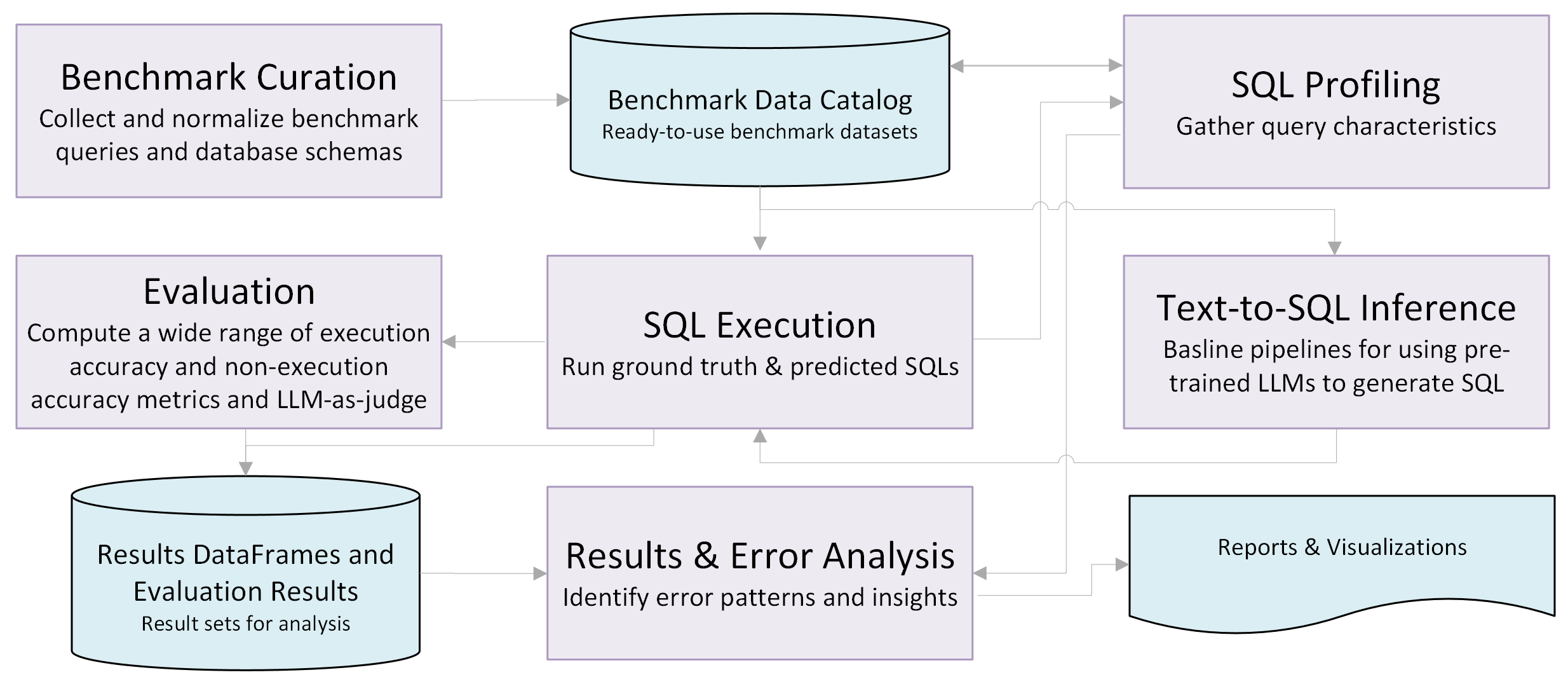
scripts/evaluation/src/evaluation.py): Includes a script and library for evaluating text-to-SQL model outputs using various metrics. Seescripts/evaluation/README.mdfor details. - Text-to-SQL Inference (
scripts/inference): Provides a simple LLM inference pipeline for generating SQL queries from natural language inputs. Runpython scripts/inference/run_inference.py -hfor more information. - SQL Execution (
scripts/execution): Runs the ground truth and predicted SQLs for a given benchmark and saves the dataframes for evaluation and error analysis. Runpython scripts/execution/run_execution.py -hfor more information. - Results and Error Analysis (
scripts/analysis): Contains scripts and utilities for analyzing evaluation results, identifying common error patterns, and generating summary statistics and visualizations. Useful for debugging and improving model performance. - SQL Profiling (
scripts/profiling) tools to profile SQL queries to gather query characteristics to facilitate better analysis of results and errors. - Evaluation Dashboard (
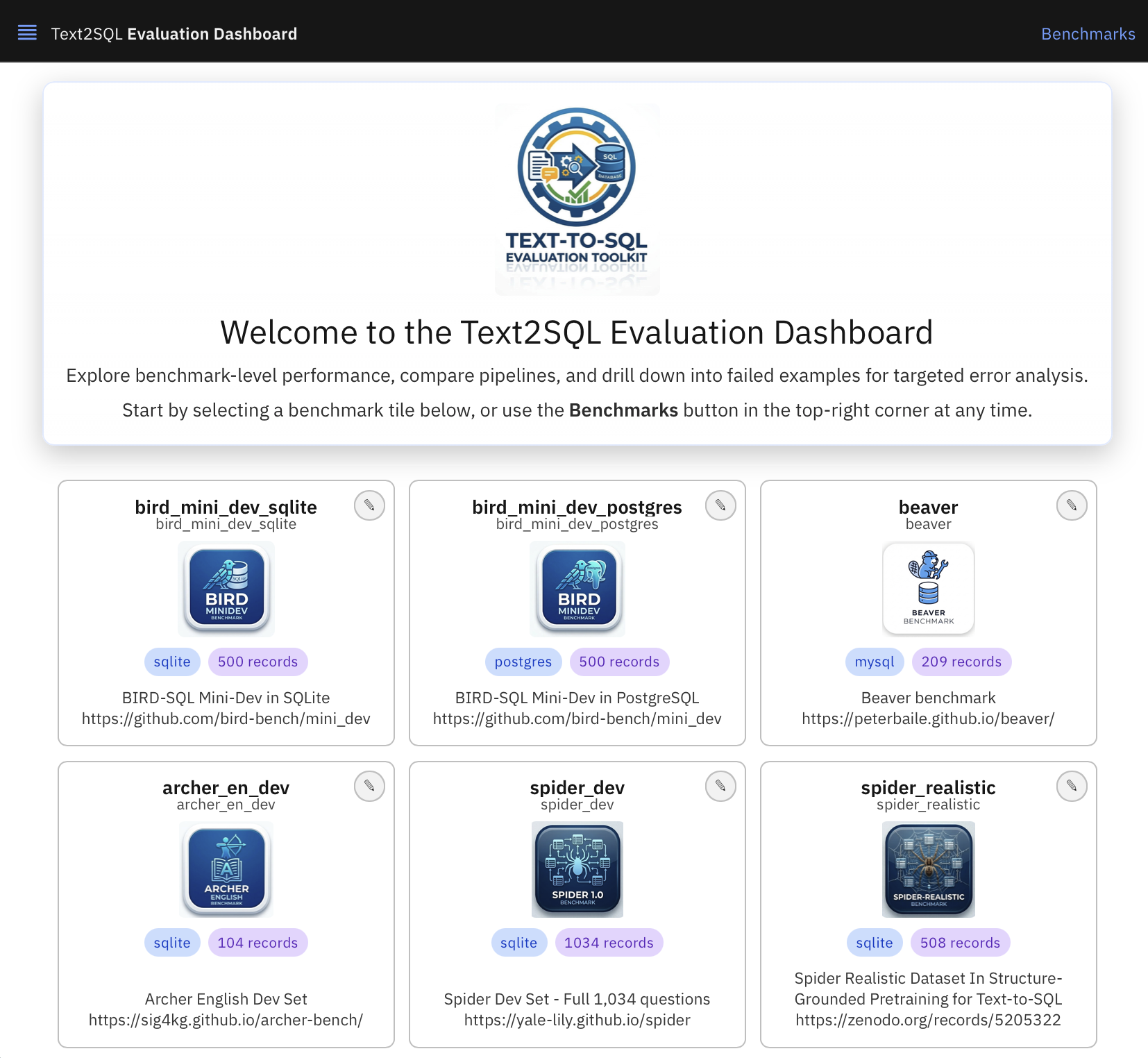
dashboard): Optional FastAPI + React web UI for browsing benchmarks and pipeline metrics, error analysis (search, filters, cross-pipeline disagreement), side-by-side comparison of result summaries, editing LLM-as-judge YAML, and launching evaluations with job status. See docs/dashboard/ for features, deployment, and development.
Setup
Prerequisites
- Python 3.11 or higher
- UV package manager (recommended) or pip/conda
Installing UV (Recommended)
UV is a fast Python package manager that makes setup much quicker:
# macOS/Linux
curl -LsSf https://astral.sh/uv/install.sh | sh

# Or using pip
pip install uv

# Or using Homebrew (macOS)
brew install uv
Pre-computed results
Zero-shot and agentic baseline results for all packaged benchmarks are
hosted on the Hugging Face Hub.
To download them (~4 GB) into ${TEXT2SQL_DATA_ROOT:-./data}/results/:
text2sql-eval-toolkit results fetch
After this completes, the dashboard and analysis scripts will work against the downloaded artefacts. See docs/dashboard/ to launch the UI.
To fetch only a specific benchmark:
text2sql-eval-toolkit results fetch --benchmarks bird_mini_dev_sqlite
To list what is available without downloading:
text2sql-eval-toolkit results list
Installation
From PyPI
pip install text2sql-eval-toolkit

# Optional: install database-specific extras
pip install "text2sql-eval-toolkit[mysql,presto,db2]"
From source (recommended for development)
Using UV:
# Clone the repository
git clone https://github.com/IBM/text2sql-eval-toolkit.git
cd text2sql-eval-toolkit

# Create virtual environment and install dependencies
uv venv
source .venv/bin/activate  # On Windows: .venv\Scripts\activate

# Install the package in editable mode
uv pip install -e .

# Optional: Install with database-specific dependencies
uv pip install -e ".[mysql,presto,db2]"
Using pip/conda:
# Create conda environment (or use venv)
conda create -n evaltoolkit python=3.12
conda activate evaltoolkit

# Clone and install
git clone https://github.com/IBM/text2sql-eval-toolkit.git
cd text2sql-eval-toolkit
pip install -e .
Additional Requirements
To use features that rely on LLM inference, you need to set the required environment variables for the relevant services. For watsonx.ai, this includes setting the following environment variables: WATSONX_APIKEY, WATSONX_API_BASE, and WATSONX_PROJECTID. See env.example for all available configuration options.
Benchmarks
The toolkit comes with pre-defined public benchmarks including BIRD-SQL, Spider, Beaver, and Archer. These benchmarks require initial setup such as downloading databases or configuring connection strings. The toolkit also includes smaller test benchmarks (subsets of the full benchmarks) for quick validation and CI/CD pipelines.
📚 See data/benchmarks/README.md for complete benchmark details, setup instructions, and configuration.
Usage
Using the library API
After installation you can import the toolkit and use both low-level and high-level evaluation APIs:
Evaluate a single prediction record in memory
from text2sql_eval_toolkit import evaluate_prediction, parse_dataframe, get_gt_sqls

# record comes from a benchmark JSON entry, prediction from your model
record = {
    "id": "q1",
    "sql": "SELECT * FROM customers",
    "gt_df": some_serialized_dataframe,  # JSON in pandas orient='split' format
}
prediction = {
    "predicted_sql": "SELECT * FROM customers",
    "predicted_df": some_serialized_dataframe,  # same format
}

result = evaluate_prediction(record, prediction)
print(result["subset_non_empty_execution_accuracy"])
Evaluate a predictions JSON file
from text2sql_eval_toolkit import evaluate_predictions

data, summary_df = evaluate_predictions(
    input_file="data/results/my-benchmark-predictions.json",
)
print(summary_df.head())
Run evaluation for a known benchmark ID
from text2sql_eval_toolkit import get_available_benchmarks, run_evaluation

print(get_available_benchmarks())  # uses packaged benchmark metadata
data, summary_df = run_evaluation("bird_mini_dev_sqlite")
print(summary_df[["subset_non_empty_execution_accuracy_avg"]])
Run SQL execution for a benchmark before evaluation
from text2sql_eval_toolkit import run_execution

# Requires appropriate DB connection env vars (e.g., POSTGRES_CONNECTION_STRING)
run_execution("bird_mini_dev_postgres")
Use the inference pipelines
from text2sql_eval_toolkit import LLMSQLGenerationPipeline, AgenticSQLGenerationPipeline

pipeline = LLMSQLGenerationPipeline()
pipeline.run_pipeline(
    benchmark_id="bird_mini_dev_sqlite",
    model_name="wxai:ibm/granite-34b-code-instruct",
    model_parameters={"max_new_tokens": 512},
)

agentic = AgenticSQLGenerationPipeline()
agentic.run_pipeline(
    benchmark_id="bird_mini_dev_sqlite",
    model_name="wxai:ibm/granite-34b-code-instruct",
    model_parameters={"max_new_tokens": 512},
    max_attempts=3,
)
Every exported function and class is documented in the API reference, generated from the docstrings.
Running Experiments
Single Benchmark:
python scripts/run_experiment.py [benchmark_name]
This will initialize a pipeline, perform inference to generate SQLs and output dataframes, and run the evaluation script to gather accuracy metrics. Benchmark names and configurations are defined in data/benchmarks.json (for full benchmarks) or data/test-benchmarks.json (for test benchmarks). See data/benchmarks/README.md for more details. Run python scripts/run_experiment.py -h for details on how to set different input arguments for the script.
Multiple Benchmarks:
# Run all test benchmarks (recommended for quick validation)
python scripts/run_all_benchmarks.py --test

# Run all full benchmarks
python scripts/run_all_benchmarks.py

# Run with all baselines (standard + 6 agentic variants)
python scripts/run_all_benchmarks.py --test --run_all_baselines
The run_all_benchmarks.py script supports separate model configurations for standard and agentic baselines to optimize runtime. See data/benchmarks/README.md for detailed configuration options.
Running Individual Components
To run evaluation only:
python scripts/evaluation/run_evaluation.py [-h] [--output_file OUTPUT_FILE] [--summary_file SUMMARY_FILE] [--csv_summary_file CSV_SUMMARY_FILE] [--use_llm_judge] input_file
See scripts/evaluation/README.md for details.
To run inference only:
# Standard baseline inference
python scripts/inference/run_inference.py benchmark_id [--model_names MODEL1 MODEL2 ...]

# Agentic pipeline inference with default models
python scripts/inference/run_inference.py benchmark_id --pipeline_type agentic

# Agentic pipeline with custom models
python scripts/inference/run_inference.py benchmark_id --pipeline_type agentic \
  --agentic_models "wxai:openai/gpt-oss-120b" "wxai:meta-llama/llama-3-3-70b-instruct"

# Additional options
python scripts/inference/run_inference.py benchmark_id \
  --pipeline_type agentic \
  --agentic_version v2 \
  --max_attempts 5 \
  --max_new_tokens 1024
Like run_experiment.py and run_all_benchmarks.py, the inference script supports separate model configurations via --model_names (for standard baseline) and --agentic_models (for agentic pipeline). Run python scripts/inference/run_inference.py -h for all options.
To run execution only:
python scripts/execution/run_execution.py [-h] benchmark_id
To produce the results dashboard along with results summary and error analysis Markdown files for all the benchmarks defined in the data/benchmarks.json file, run:
python scripts/analysis/make_summary_report.py
The output will be written to data/results/README.md.
Evaluation dashboard
A web UI for browsing results, comparing pipelines and doing error analysis:
uv pip install -e ".[dashboard]"
text2sql-eval-dashboard --open-browser
Every view has its own URL, so a benchmark, pipeline, filtered query or individual record can be linked to directly.
The dashboard runs as a local tool with every capability enabled, or as a shared read-only site with optional sign-in for a small allowlist. See docs/dashboard/ for features, the URL scheme, the query index, capability tiers, and deployment.
Project Structure
text2sql-eval-toolkit
├── docs/                       # Dashboard guides, deployment, development history
├── deploy/                     # Container, Compose stack, and data provisioning
├── dashboard/                  # React frontend (production build committed to dist/)
├── tests/                      # Test suite
├── notebooks/                  # Jupyter notebooks showcasing the use of the toolkit functions
├── data/                       # Benchmark datasets and evaluation results
│   ├── benchmarks/             # Benchmark data and schema files
│   │   ├── README.md           # Detailed benchmark documentation
│   │   ├── test_benchmarks/    # Test benchmark data files
│   │   └── dbs/                # Database files and setup instructions
│   ├── benchmarks.json         # Full benchmarks configuration
│   ├── test-benchmarks.json    # Test benchmarks configuration (smaller datasets)
│   └── results/                # Evaluation outputs
│           └── README.md       # Summary of results
├── scripts/                    # Scripts for running experiments
│   ├── analysis/               # Results and error analysis scripts and utilities
│   ├── curation/               # Benchmark data curation and preprocessing scripts
│   ├── evaluation/             # Evaluation pipeline script
│   ├── execution/              # Scripts for SQL execution
│   ├── inference/              # Inference pipeline (baseline) script
│   ├── profiling/              # SQL query profiling script
├── src/                        # Source code for the toolkit
│   └── text2sql_eval_toolkit/  # Core modules
│       ├── analysis/           # Results and error analysis module
│       ├── evaluation/         # Evaluation module
│       ├── execution/          # SQL execution module
│       ├── inference/          # LLM inference (baseline) module
│       ├── indexing/           # SQLite query index over the result artifacts
│       ├── profiling/          # SQL profiling module
│       └── ui/                 # Dashboard backend (FastAPI)
├── pyproject.toml              # Build system and project metadata
├── uv.lock                     # Resolved dependency set (`uv export` for a pinned file)
├── README.md                   # Project documentation
└── LICENSE                     # License file
Contributing
We welcome external contributions! If you have an itch, please feel free to scratch it.
To contribute code or documentation, please submit a pull request.
A good way to familiarize yourself with the codebase and contribution process is to look for and tackle low-hanging fruit in the issue tracker.
Note: We appreciate your effort, and want to avoid a situation where a contribution requires extensive rework (by you or by us), sits in backlog for a long time, or cannot be accepted at all!
For detailed contribution guidelines, please see CONTRIBUTING.md.
Pull Request Process
- Fork the repo
- Create your feature branch (
git checkout -b my-new-feature) - Commit your changes (
git commit -am 'Added some feature') - Push to the branch (
git push origin my-new-feature) - Create new Pull Request
License
This project is licensed under the Apache License 2.0. See the LICENSE file for more details.
Citation
If you use this toolkit in research, please cite:
@article{HassanzadehPPKZVGSPR26,
  title   = {Text-to-{SQL} Evaluation Toolkit},
  volume  = {19},
  url     = {https://doi.org/10.14778/3827998.3828071},
  doi     = {10.14778/3827998.3828071},
  number  = {12},
  journal = {Proc. VLDB Endow.},
  author  = {Hassanzadeh, Oktie and Perlitz, Yotam and Pham, Nhan and Kaple, Tanvi and \.{Z}r\'{o}bek, Karolina and Vu, Long and Glass, Michael and Subramanian, Dharmashankar and Pourreza, Mohammadreza and Rafiei, Davood},
  year    = {2026},
  pages   = {4582--4585},
}
Additional Resources
- CODE_OF_CONDUCT.md - Community guidelines
- SECURITY.md - Security policy and vulnerability reporting
- MAINTAINERS.md - Project maintainers
- CHANGELOG.md - Project changelog
1 maintainer

Metadata
1 maintainer
Release files for text2sql-eval-toolkit 1.6.0
For a detailed explanation of source distributions (sdists) and built distributions (wheels), please see the package formats documentation.
Source distribution (sdist)
| File | Size | Uploaded | Provenance | |
|---|---|---|---|---|
| text2sql_eval_toolkit-1.6.0.tar.gz | 4.2 MB | With provenance | Details |
Built distribution (wheel)
| File | Interpreter | ABI | Platform | Reset |
|---|---|---|---|---|
| text2sql_eval_toolkit-1.6.0-py3-none-any.whl | Python 3 | none | any | Details |
Total release size: 8.3 MB
Release files / text2sql_eval_toolkit-1.6.0.tar.gz
| Download URL | text2sql_eval_toolkit-1.6.0.tar.gz |
|---|---|
| Size | 4.2 MB |
| Tags | Source |
|
SHA-256 checksum How to use checksums |
b17bca8e3da29309edc1c1c17c313d64d06982829b42571fa44ae82b4e29dd8a
|
|
BLAKE2b-256 checksum How to use checksums |
918dd7bdfe4fd033e89d585bfb659f1de106db2177780eff09a20fd8dae6fd33
|
| Upload date | |
|
Uploaded using Trusted Publishing? What is trusted publishing? |
Yes |
| Uploaded via |
twine/7.0.0 CPython/3.13.14
|
Provenance
Provenance describes where a file came from. On PyPI, provenance is shared via attestations, which provide a verifiable record of the build or publishing details. View details, limitations and caveats.


PyPI Publish Attestation
PyPI verified that this artifact, at this checksum, originated from the publisher listed below.
Signed by GitHub Actions, verified by PyPI on Sep 21, 2026.
Transparency logRelease files / text2sql_eval_toolkit-1.6.0-py3-none-any.whl
| Download URL | text2sql_eval_toolkit-1.6.0-py3-none-any.whl |
|---|---|
| Size | 4.2 MB |
| Tags | Python 3 |
|
SHA-256 checksum How to use checksums |
1b0a2a745bb7aaf4fee3e10d727005634b5124b38460d0a9852cd05d324914c9
|
|
BLAKE2b-256 checksum How to use checksums |
23aeef3d7f5f3563852abe39f1af2eea7cb8ad9fd2feb2742e150a45c6c57de6
|
| Upload date | |
|
Uploaded using Trusted Publishing? What is trusted publishing? |
Yes |
| Uploaded via |
twine/7.0.0 CPython/3.13.14
|
Provenance
Provenance describes where a file came from. On PyPI, provenance is shared via attestations, which provide a verifiable record of the build or publishing details. View details, limitations and caveats.
PyPI Publish Attestation
PyPI verified that this artifact, at this checksum, originated from the publisher listed below.
Signed by GitHub Actions, verified by PyPI on Sep 21, 2026.
Transparency logSecurity for text2sql-eval-toolkit 1.6.0
Provenance
Provenance describes where a file came from. On PyPI, provenance is shared via attestations, which provide a verifiable record of the build or publishing details. View details, limitations and caveats.
Full provenance
All 2 files in this release have been uploaded with provenance metadata.
Attestation for text2sql_eval_toolkit-1.6.0.tar.gz
PyPI Publish Attestation
PyPI verified that this artifact, at this checksum, originated from the publisher listed below.
Signed by GitHub Actions, verified by PyPI on Sep 21, 2026.
Transparency logA note on package security
PyPI is a repository for distributing packages, not a service for auditing them. While third-party security researchers and our staff do their best to detect and remove malicious packages, PyPI cannot guarantee the quality, security or suitability of any given package.














