
This release is a pre-release and may not be stable for production use.

t0 for MLX



Open-weights time-series forecasting foundation model from
The Forecasting Company. t0 is a
transformer-based model that produces probabilistic multi-horizon forecasts
and natively operates on multiple covariates. t0-alpha is our first iteration
of the model.
tfc-t0-mlx is the first-party inference runtime optimized for Apple silicon.
It loads the same original t0-alpha safetensors checkpoint as tfc-t0 and
does not install PyTorch.
The MLX and PyTorch runtimes are developed together in this repository while remaining separate PyPI distributions with independent dependency trees.
You can use t0 on Retrocast, our platform for
forecasting on your own data. You can also compare forecasts across different
open-weight models.
Choose how to run t0-alpha
| Use case | Install or open |
|---|---|
| Local inference on Apple silicon with MLX | pip install tfc-t0-mlx |
| Local inference with PyTorch | pip install tfc-t0 |
| Managed inference without local weights | The Forecasting Company API |
Both local runtimes load the same model repository and offer a closely matched
T0Forecaster.predict() API. MLX compilation is available as an opt-in
optimization for repeated input shapes.
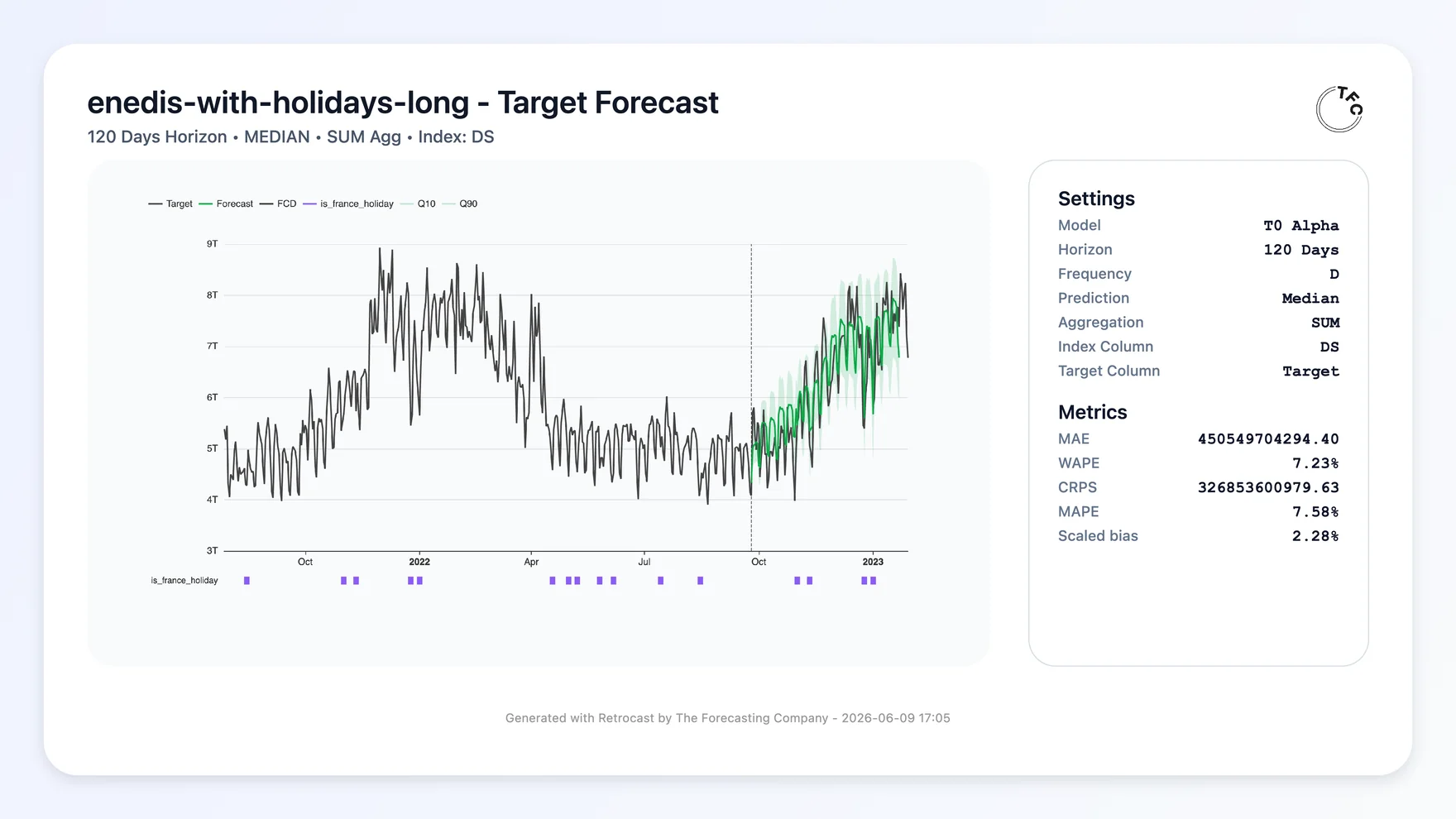
t0 forecasting French national electricity demand in Retrocast. Data:
Enedis open data.
📈 Forecasting with covariates
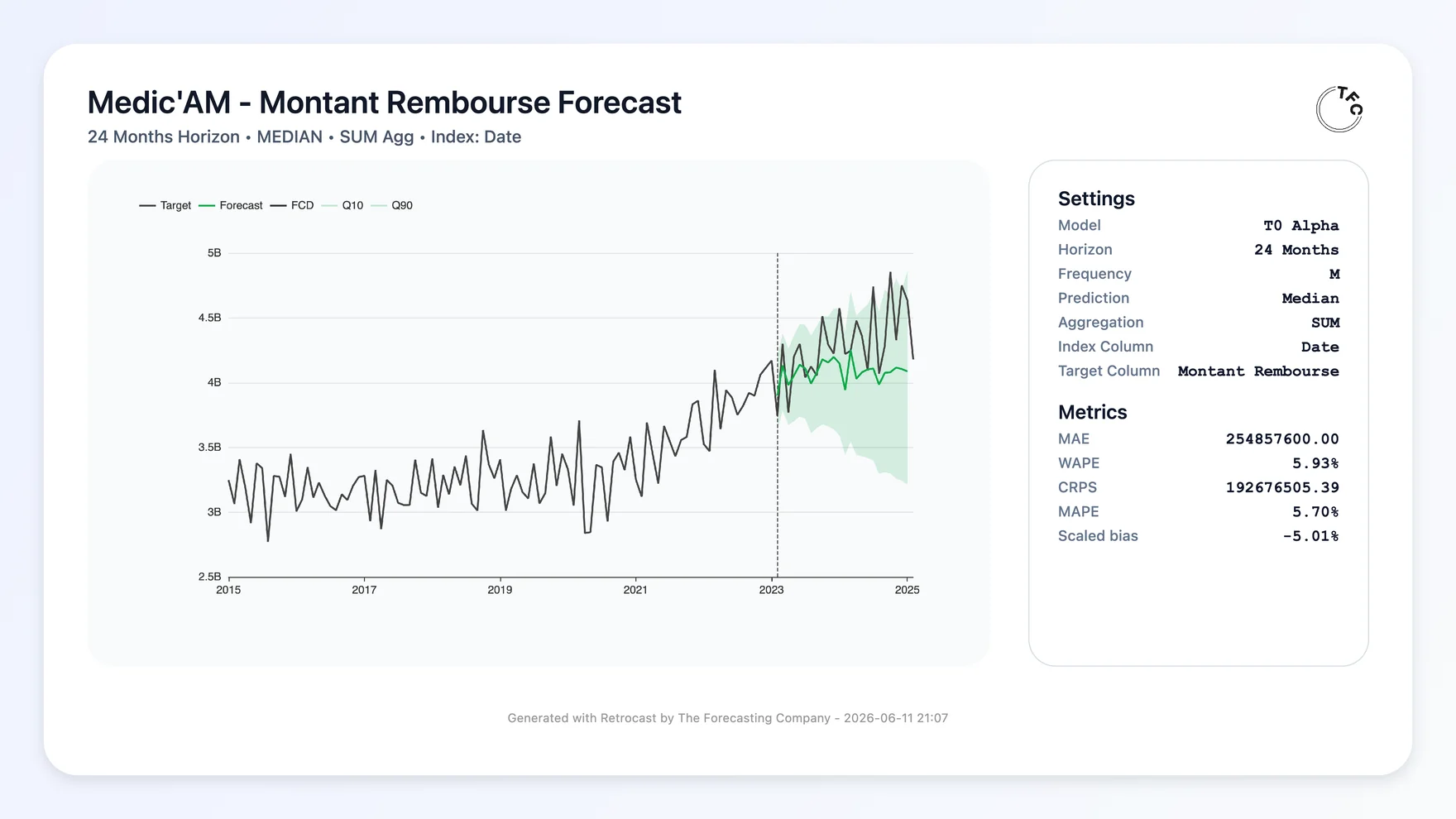
t0 leverages covariate information, in the past and future when available,
to improve its forecast.
| Without covariates | With covariates |
|---|---|
 |
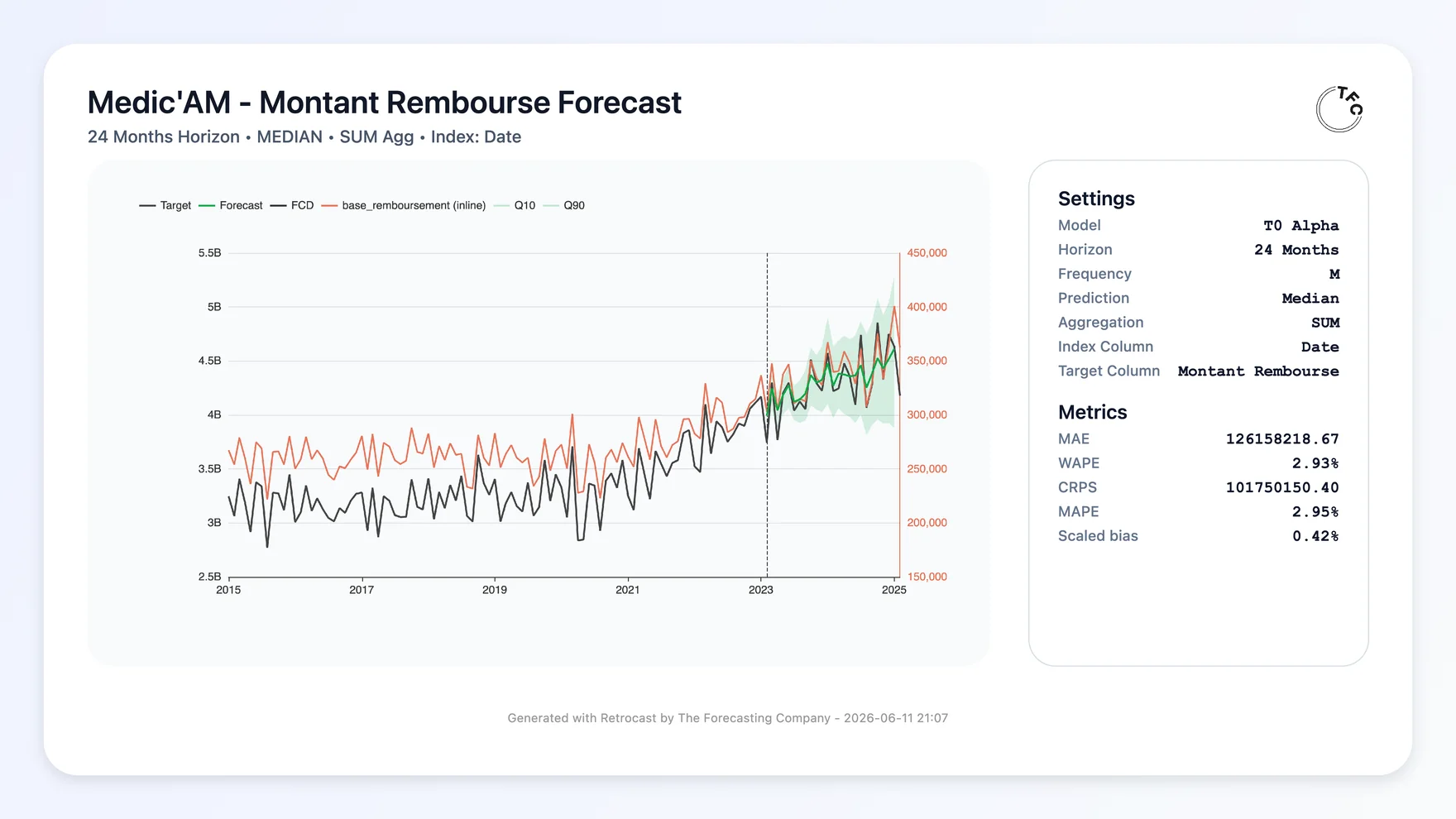 |
Data: Medic'AM, monthly drug reimbursements from the French national health insurance.
The Quickstart below shows the API for both a plain univariate forecast and a multivariate forecast that conditions on historical and known-future covariates.
🚀 Quickstart
tfc-t0-mlx requires Apple silicon, macOS 14 or newer, and a native arm64
Python 3.10 or newer. MLX uses the Apple GPU automatically; there is no
PyTorch-style device selection or .to("mps") step.
pip install tfc-t0-mlx
The model repository is gated. Accept its terms on
Hugging Face and run
hf auth login before the first download.
The simplest path is a univariate forecast through predict:
import numpy as np
from t0_mlx import T0Forecaster

model = T0Forecaster.from_pretrained("theforecastingcompany/t0-alpha").eval()

context = np.random.randn(4, 512).astype(np.float32)  # 4 series, 512 past timesteps
out = model.predict(context, horizon=64, quantiles=[0.1, 0.5, 0.9])
out.quantiles.shape  # (4, 64, 3)
out.median.shape     # (4, 64)
predict accepts NumPy and MLX arrays. One-dimensional contexts are
automatically promoted to a single-row batch. NaN in the context is read as a
missing observation; to say that some cells are padding instead, pass a mask
— see batched inference.
For a shape that will be called repeatedly, compilation is opt-in:
model.compile()
out = model.predict(context, horizon=64)
Forecasting with covariates
Anything you know over the past goes in context — alongside the target,
extra variates attend to it and are forecast together. Anything you know over
the future (calendar features, planned promotions, weather forecasts) goes
in future_covariates, shaped [B, F, context + horizon]; the model conditions
on it but does not forecast it.
import numpy as np
from t0_mlx import T0Forecaster

model = T0Forecaster.from_pretrained("theforecastingcompany/t0-alpha").eval()

context = np.random.randn(2, 512).astype(np.float32)
future_covariates = np.random.randn(2, 3, 512 + 64).astype(np.float32)

out = model.predict(
    context,
    horizon=64,
    quantiles=[0.1, 0.5, 0.9],
    future_covariates=future_covariates,
)
out.quantiles.shape  # (2, 64, 3)
out.median.shape     # (2, 64)
Batched inference
import numpy as np
from t0_mlx import T0Forecaster, batch_series

model = T0Forecaster.from_pretrained("theforecastingcompany/t0-alpha").eval()

daily = np.random.randn(180)    # one series, 180 past timesteps
store = np.random.randn(2, 96)  # one series of 2 variates, 96 past timesteps
hourly = np.random.randn(1024)  # one series, 1024 past timesteps

context, mask, group_ids = batch_series([daily, store, hourly])
context.shape  # (4, 1024) — variates stacked, right-aligned to the longest
group_ids      # [0, 1, 1, 2] — `store`'s two variates are forecast jointly

out = model.predict(
    context,
    horizon=24,
    quantiles=[0.1, 0.5, 0.9],
    mask=mask,
    group_ids=group_ids,
)
out.quantiles.shape  # (4, 24, 3)
out.median[0]        # the 24-step median forecast for `daily`
For efficient inference at scale, look at Retrocast.
🏗️ Architecture
t0 is a decoder-style patch transformer that alternates time and covariate
attention layers. It predicts 5 quantiles (0.1, 0.25, 0.5, 0.75, 0.9), decoding
multiple horizons in parallel — up to 1024 timesteps in one forward pass — and
falling back on autoregressive rollout for longer horizons.
| Parameters | ~102M |
| Layers | 24 |
| Embedding dim | 512 |
| Feedforward dim | 2048 |
| Attention heads | 8 |
| Patch size | 32 |
| Quantile levels | 0.1, 0.25, 0.5, 0.75, 0.9 |
Performance
On an Apple M1 Pro, compiled MLX was 3.37–3.59x faster than PyTorch MPS and 5.23–6.86x faster than PyTorch CPU across three representative workloads. MLX eager was 2.61–2.67x faster than PyTorch MPS. These measurements exclude model loading and the compiled path's shape-dependent first call.
See the complete benchmark for the reproducible script, environment, methodology, raw timings, and compilation caveats.
🧬 Lineage
t0 builds on ideas — and in places, code — from open-source forecasting
models. We gratefully acknowledge:
- Toto by Datadog (repo) and Chronos-2 by Amazon (repo) — factorizing attention in the time and variates dimensions.
- TiRex by NXAI (repo) — contiguous patch masking.
- rotary-embedding-torch by Phil Wang (repo) — rotary position embedding behavior.
Code-level attributions are listed in NOTICE, under their
respective open-source licenses. This MLX implementation is based on the
first-party PyTorch architecture and checkpoint.
🧰 Public API
The top-level API mirrors tfc-t0:
T0Forecaster— MLXnn.Modulewithfrom_pretrained,save_pretrained, opt-incompile/uncompile, and the user-facingpredict(context, horizon, quantiles, future_covariates, mask, group_ids).Forecast— the object returned by the model.T0Config— the configuration of the model;T0Config.medium()is the published one.MaskType— the reason a time step is masked out, includingPADandMISSING.batch_series— utility to batch time series of potentially different lengths.
The runtime supports univariate and multivariate inputs, missing values,
explicit groups, known-future covariates, requested-quantile interpolation,
and arbitrary positive horizons. Forecasts beyond the native 1024-step pass
continue autoregressively, matching tfc-t0.
Development
From the repository root:
cd mlx
uv sync
uv run pytest
uv run ruff check .
To run checkpoint-backed parity tests, point them at a local directory holding
the original config.json and model.safetensors. The checked release record
is in PARITY.md:
T0_MLX_CHECKPOINT=/path/to/t0-alpha uv run --extra parity pytest
The MLX parameter tree has the same tensor names, shapes, dtypes, and
linear-layer orientation as the original checkpoint, so no numerical weight
conversion or separate MLX checkpoint is required.
tools/validate_checkpoint.py validates this contract without copying or
rewriting the weights.
📚 Citation
If our model is useful, please use the following citation and star our repo!
@misc{tfc-t0,
  title  = {t0: A time-series forecasting foundation model},
  author = {The Forecasting Company},
  year   = {2026},
  url    = {https://huggingface.co/theforecastingcompany/t0-alpha},
}
⚖️ License
Metadata
Release files for tfc-t0-mlx 0.1.0a1
For a detailed explanation of source distributions (sdists) and built distributions (wheels), please see the package formats documentation.
Source distribution (sdist)
| File | Size | Uploaded | Provenance | |
|---|---|---|---|---|
| tfc_t0_mlx-0.1.0a1.tar.gz | 37.5 kB | With provenance | Details |
Built distribution (wheel)
| File | Interpreter | ABI | Platform | Reset |
|---|---|---|---|---|
| tfc_t0_mlx-0.1.0a1-py3-none-any.whl | Python 3 | none | any | Details |
Total release size: 64.2 kB
Release files / tfc_t0_mlx-0.1.0a1.tar.gz
| Download URL | tfc_t0_mlx-0.1.0a1.tar.gz |
|---|---|
| Size | 37.5 kB |
| Tags | Source |
|
SHA-256 checksum How to use checksums |
3dff078a38f63e33ebd66265dc5f4e377407992748512e214d5f184f10fd8057
|
|
BLAKE2b-256 checksum How to use checksums |
34a9860f0f8eb9003789e1b77a8108483e06cf41b215699a3859a294c4807751
|
| Upload date | |
|
Uploaded using Trusted Publishing? What is trusted publishing? |
Yes |
| Uploaded via |
twine/7.0.0 CPython/3.13.14
|
Provenance
Provenance describes where a file came from. On PyPI, provenance is shared via attestations, which provide a verifiable record of the build or publishing details. View details, limitations and caveats.


PyPI Publish Attestation
PyPI verified that this artifact, at this checksum, originated from the publisher listed below.
Signed by GitHub Actions, verified by PyPI on Sep 5, 2026.
Transparency logRelease files / tfc_t0_mlx-0.1.0a1-py3-none-any.whl
| Download URL | tfc_t0_mlx-0.1.0a1-py3-none-any.whl |
|---|---|
| Size | 26.7 kB |
| Tags | Python 3 |
|
SHA-256 checksum How to use checksums |
14da0eee3671a8c228515d862e232bb4f6ac6f0972f81b549c39bfa11e7ebb93
|
|
BLAKE2b-256 checksum How to use checksums |
48915f0d2094620c43af70dea100d0c310d5c2bd25c7a2d87c3821023a784d85
|
| Upload date | |
|
Uploaded using Trusted Publishing? What is trusted publishing? |
Yes |
| Uploaded via |
twine/7.0.0 CPython/3.13.14
|
Provenance
Provenance describes where a file came from. On PyPI, provenance is shared via attestations, which provide a verifiable record of the build or publishing details. View details, limitations and caveats.
PyPI Publish Attestation
PyPI verified that this artifact, at this checksum, originated from the publisher listed below.
Signed by GitHub Actions, verified by PyPI on Sep 5, 2026.
Transparency logSecurity for tfc-t0-mlx 0.1.0a1
Provenance
Provenance describes where a file came from. On PyPI, provenance is shared via attestations, which provide a verifiable record of the build or publishing details. View details, limitations and caveats.
Full provenance
All 2 files in this release have been uploaded with provenance metadata.
Attestation for tfc_t0_mlx-0.1.0a1.tar.gz
PyPI Publish Attestation
PyPI verified that this artifact, at this checksum, originated from the publisher listed below.
Signed by GitHub Actions, verified by PyPI on Sep 5, 2026.
Transparency logA note on package security
PyPI is a repository for distributing packages, not a service for auditing them. While third-party security researchers and our staff do their best to detect and remove malicious packages, PyPI cannot guarantee the quality, security or suitability of any given package.
To learn more about protecting yourself from malicious actors, visit our package security documentation.













