
Sentence-transformers-style embeddings for tabular foundation models (TabICL, TabPFN, ...)
Verified details
These details have been verified by PyPIProject links
GitHub Statistics
Maintainers

Project description
tfm-embeddings
SentenceTransformers, but for tables.
Embeddings, similarity search, and retrieval for tabular data —
powered by tabular foundation models.



Tabular foundation models like TabICL,
TabPFN, and
TabFM compute rich per-row
representations internally as part of in-context learning. tfm-embeddings
exposes them behind the familiar encode/similarity API from
sentence-transformers, for similarity search,
retrieval, clustering, visualization, and feature extraction on tabular data.
[!WARNING]
Experimental Code Notice
This project is experimental and early-stage. APIs may change without notice.
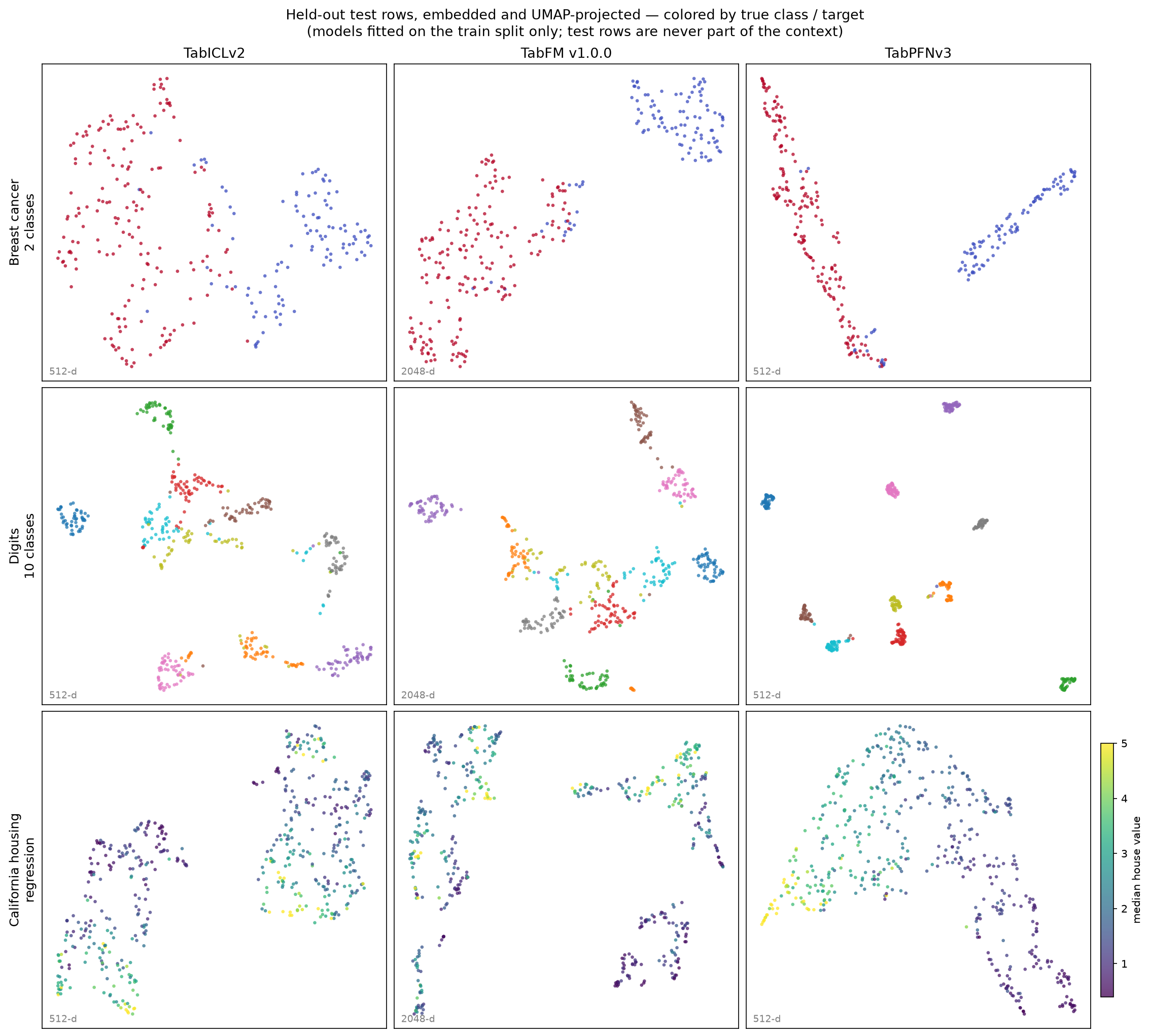
Held-out test rows embedded by each backend (columns) on three datasets
(rows: binary classification, 10-class classification, regression), then
UMAP-projected and colored by the true class or target. Every panel uses the
same two lines of code: model.fit(X_train, y_train) then
model.encode(X_test) — and the test rows are never part of the context, so
the visible structure is genuinely inferred. Reproduce with
examples/embedding_gallery.py.
✨ Highlights
- One API, three foundation models — TabICL, TabPFN, and TabFM
behind the same
fit/encode/similarity/searchinterface. - Retrieval built in — top-k nearest-row search over your context table, RAG-style.
- Leakage-aware by design — rows are always embedded as unseen test rows,
and
fit_transform_oofprovides out-of-fold embeddings for downstream training. - Ensemble control — mean, concatenated, or raw per-member embeddings.
- scikit-learn compatible — drop it in a
Pipelineas a transformer step.
Installation
pip install tfm-embeddings[tabicl]   # TabICL backend
pip install tfm-embeddings[tabpfn]   # TabPFN backend
pip install tfm-embeddings[tabfm]    # TabFM backend (Python >= 3.11)
pip install tfm-embeddings[all]      # everything
Usage
from tfm_embeddings import TabularEmbedder

# 1. Load a tabular foundation model
model = TabularEmbedder("tabicl")

# 2. Set the context table — all embeddings are conditioned on it
model.fit(X_corpus, y_corpus)  # y is optional

# 3. Calculate embeddings by calling model.encode()
embeddings = model.encode(X_corpus)
print(embeddings.shape)
# (469, 512)

# 4. Calculate the embedding similarities
query_embeddings = model.encode(X_query)
similarities = model.similarity(query_embeddings, embeddings)

# 5. Or retrieve the most similar corpus rows directly
indices, scores = model.search(X_query, top_k=5)
How this differs from sentence embeddings
Sentence embeddings are context-free: a sentence always maps to the same vector. Tabular foundation model embeddings are context-dependent — a row's vector is conditioned on the entire context table (column distributions and, for target-aware models, the labels). This has three practical consequences:
fitcomes first. The context table is part of the model state. Everyencodecall embeds rows against it as unseen test rows.- Embeddings are only comparable within one fitted model. There is no shared embedding space across tables, contexts, or backends.
- Labels shape the space. With
yprovided, similarity is task-aware: rows that the model treats similarly for predictingyend up close. Withy=None, a pseudo-target is synthesized for approximately unsupervised embeddings (experimental).
Rows passed to encode are always embedded as test rows, so their own labels are
never visible to the model — embedding your corpus does not leak its labels.
Backends
| Backend | Model string | Embedding source | Requires |
|---|---|---|---|
| TabICL | "tabicl" or "tabicl/<checkpoint>" |
Row representations after column-wise embedding + row-wise interaction (pre-ICL), extracted via forward hook | tabicl>=2.1 |
| TabPFN | "tabpfn" or "tabpfn/<model_path>" |
Per-row transformer outputs via the public get_embeddings API |
tabpfn>=2.0 (local, not the API client); downloading weights requires license authentication (TABPFN_TOKEN) |
| TabFM | "tabfm" or "tabfm/<checkpoint_path>" |
Row representations before the in-context learning transformer (row_interactor_2), extracted via forward hook |
tabfm[pytorch]>=1.0.0, Python >= 3.11 |
Backend-specific options are passed through the constructor:
model = TabularEmbedder("tabicl", n_estimators=4, device="cpu", random_state=0)
Do I need y?
All three backends are supervised in-context learners: the context table must contain a target. TabICL's and TabFM's column/cell embedders are target-aware, and TabPFN attends over labeled context tokens — none of them has a truly unsupervised mode.
fit therefore never skips the target; it resolves it:
| You pass | What happens | Embedding space |
|---|---|---|
Discrete y |
Classification checkpoint | Shaped by the classification task |
Continuous y |
Regression checkpoint | Shaped by the regression task |
No y |
Regression checkpoint with a pseudo-target (standard-normal noise, seeded by random_state) |
Approximately task-neutral (experimental) |
This behavior is identical across all backends. The pseudo-target makes the
context labels uninformative so the embeddings mostly reflect feature
structure, but this strategy is unvalidated — if you have a meaningful target,
pass it. Note that with no y, changing random_state changes the noise and
therefore the embeddings.
Ensemble aggregation
All backends ensemble over multiple views of the table (e.g. feature shuffles),
and each ensemble member produces embeddings in its own space. aggregate
controls how they are combined:
"mean"(default): average across members →(n_rows, dim)"concat": concatenate members →(n_rows, n_members * dim)"none": raw members →(n_members, n_rows, dim)
Using embeddings as features (out-of-fold)
For retrieval and visualization, fit + encode is all you need. But when
embeddings become features for training a downstream model, there is a
subtle trap: encode(X_train) after fit(X_train, y_train) embeds every
training row with an identical, labeled copy of itself in the context, so
each embedding partially encodes its own label. Held-out evaluation stays
honest, but the downstream model learns to rely on a signal that is absent
for genuinely unseen rows.
fit_transform_oof removes that self-influence with out-of-fold embedding
(following A Closer Look at TabPFN v2):
the data is split into folds, each fold is embedded by a model fitted on the
other folds, and a final full-data model is fitted for embedding unseen
rows:
model = TabularEmbedder("tabicl")

train_embeds = model.fit_transform_oof(X_train, y_train, n_fold=5)  # leakage-free
test_embeds = model.encode(X_test)                                  # full-data model

clf = LogisticRegression().fit(train_embeds, y_train)
clf.score(test_embeds, y_test)
Three things to know:
encodenever returns out-of-fold embeddings. It always uses the final full-data model, somodel.encode(X_train)afterwards gives different (self-influenced) vectors than the OOF ones. Keep the return value offit_transform_oof.- Non-independent rows need
groups=. If the same entity appears in multiple rows (duplicated records, repeated measurements per patient), plain K-fold can place its copies in different folds and the label leaks back in through the copy. Passgroups=to keep an entity's rows in one fold — only you know your data's grouping structure. - Cost is
n_fold + 1fits and encodes. Splits are stratified for classification targets.
TabularEmbedder also implements the scikit-learn transformer API
(transform / fit_transform / get_params), so it works directly in a
pipeline:
from sklearn.pipeline import make_pipeline

pipe = make_pipeline(TabularEmbedder("tabicl"), LogisticRegression())
pipe.fit(X_train, y_train).score(X_test, y_test)
Note that a pipeline's fit embeds training rows with themselves in the
context (the self-influence described above) — convenient, but for the most
honest training features use fit_transform_oof outside a pipeline.
Examples
See examples/:
breast_cancer_retrieval.py— fit a corpus, embed queries, retrieve the most similar rows.embedding_gallery.py— the gallery figure above: three datasets × three backends.visualize_test_embeddings.py— single-dataset comparison of all backends on a held-out test split.umap_visualization.py— minimal full-dataset UMAP.
Roadmap
- More backends as they expose embeddings
- Benchmarks for the
y=Nonepseudo-target strategy
Related work
TabPFNEmbeddingin tabpfn-extensions — embedding extraction for TabPFN with out-of-fold support.- TabICL PR (in progress) adding native
get_row_embeddings()support, which will replace the hook-based extraction used here.
License
MIT
Project details
Verified details
These details have been verified by PyPIProject links
GitHub Statistics
Maintainers
Release history Release notifications | RSS feed

Download files
Download the file for your platform. If you're not sure which to choose, learn more about installing packages.
Source Distribution
Built Distribution
Filter files by name, interpreter, ABI, and platform.
If you're not sure about the file name format, learn more about wheel file names.
Copy a direct link to the current filters
File details
Details for the file tfm_embeddings-0.1.0.tar.gz.
File metadata
- Download URL: tfm_embeddings-0.1.0.tar.gz
- Upload date:
- Size: 536.4 kB
- Tags: Source
- Uploaded using Trusted Publishing? Yes
- Uploaded via: uv/0.11.26 {"installer":{"name":"uv","version":"0.11.26","subcommand":["publish"]},"python":null,"implementation":{"name":null,"version":null},"distro":{"name":"Ubuntu","version":"24.04","id":"noble","libc":null},"system":{"name":null,"release":null},"cpu":null,"openssl_version":null,"setuptools_version":null,"rustc_version":null,"ci":true}
File hashes
| Algorithm | Hash digest | |
|---|---|---|
| SHA256 |
b11441e70e5ccf55593c5c500def8ebb85e71884f9855f8027ba08daa9aff026
|
|
| MD5 |
feb0c7d316ff4113902275cc2b9e7da1
|
|
| BLAKE2b-256 |
607eb3ecf4715a9265e52dd76b7bf66ae64993116d11cb7f2bf00717e8441e79
|
File details
Details for the file tfm_embeddings-0.1.0-py3-none-any.whl.
File metadata
- Download URL: tfm_embeddings-0.1.0-py3-none-any.whl
- Upload date:
- Size: 19.2 kB
- Tags: Python 3
- Uploaded using Trusted Publishing? Yes
- Uploaded via: uv/0.11.26 {"installer":{"name":"uv","version":"0.11.26","subcommand":["publish"]},"python":null,"implementation":{"name":null,"version":null},"distro":{"name":"Ubuntu","version":"24.04","id":"noble","libc":null},"system":{"name":null,"release":null},"cpu":null,"openssl_version":null,"setuptools_version":null,"rustc_version":null,"ci":true}
File hashes
| Algorithm | Hash digest | |
|---|---|---|
| SHA256 |
d2eb724bcadd5b3319892800deaf1ee97133bae8a44dceb3351e2f8f98db18fb
|
|
| MD5 |
ca4fc503cf7dfa6a33c3907aef3309a8
|
|
| BLAKE2b-256 |
7ab46c7dc55dff58de6c5945b4bae9f97c45ce96979060d6bc2b4b347b9afc4a
|






