

TF-MINDI: Transcription Factor Motif Instance Neighborhood Decomposition and Interpretation


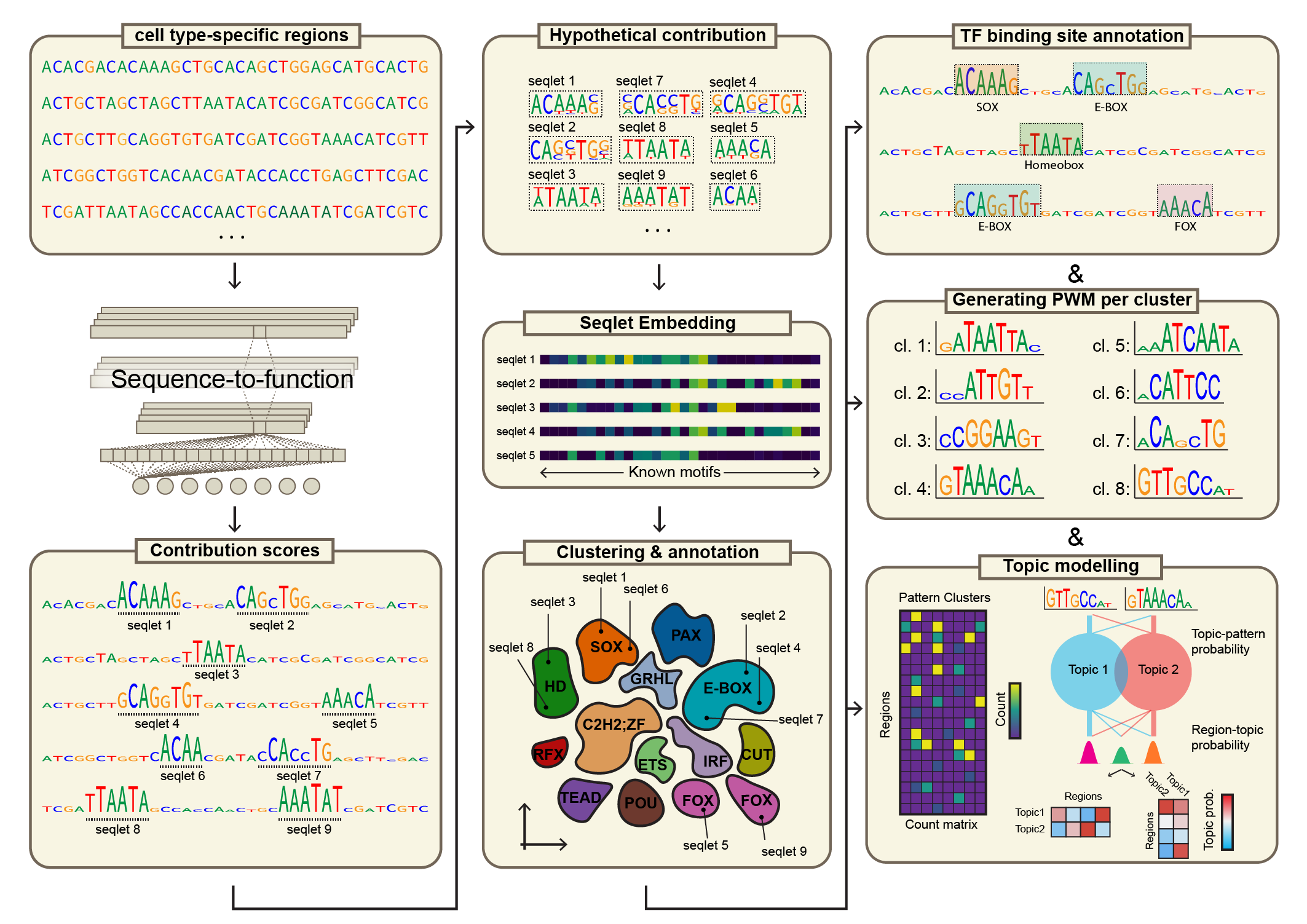
TF-MINDI is a Python package for analyzing transcription factor binding patterns from deep learning model attribution scores. It identifies and clusters sequence motifs from contribution scores, maps them to DNA-binding domains, and provides comprehensive visualization tools for regulatory genomics analysis.
Getting Started
Please refer to the documentation for detailed tutorials and examples, in particular, the API documentation and Tutorials
Key Features
- Seqlet Extraction: Identifies important sequence regions from contribution scores using recursive seqlet calling from
tangermeme - Motif Similarity Analysis: Compares extracted seqlets to known motif databases using TomTom
- Clustering & Dimensionality Reduction: Groups similar seqlets using Leiden clustering and t-SNE visualization
- DNA-Binding Domain Annotation: Maps seqlet clusters to transcription factor families
- Pattern Generation: Creates consensus motifs from clustered seqlets with alignment
- Comprehensive Visualization: Region-level contribution plots, t-SNE embeddings, motif logos, and heatmaps
Installation
tfmindi is compatible with python version 3.10-3.12.
CPU Version (Default)
pip install tfmindi
GPU-Accelerated Version (Recommended for large datasets)
# Requires CUDA-compatible GPU (CUDA 12.X)
pip install tfmindi[gpu]
The GPU version provides significant speedups for:
- PCA computation
- Neighborhood graph construction
- t-SNE embedding
- Leiden clustering
We're still working on making the tfmindi package as GPU-compatible as possible.
If tfmindi can't find the GPU, try importing rapids_singlecell directly in python and see what errors you get.
You might have to explicitly set your LD_LIBRARY_PATH for cuml as described here.
Quick Start
TF-MINDI follows a scanpy-inspired workflow:
- Preprocessing (
tm.pp): Extract seqlets, calculate motif similarities, and create an Anndata object - Tools (
tm.tl): Cluster seqlets and create consensus patterns - Plotting (
tm.pl): Visualize results
import tfmindi as tm

# Optional: Check GPU availability and set backend
print(f"GPU available: {tm.is_gpu_available()}")
print(f"Current backend: {tm.get_backend()}")
# tm.set_backend('gpu')  # Force GPU backend
# tm.set_backend('cpu')  # Swap back to CPU backend

# Extract seqlets from contribution scores
seqlets_df, seqlet_matrices = tm.pp.extract_seqlets(
    contrib=contrib_scores,  # (n_examples, 4, length)
    oh=one_hot_sequences,    # (n_examples, 4, length)
    threshold=0.05
)

# Calculate motif similarity
motif_collection = tm.load_motif_collection(
    tm.fetch_motif_collection()
)
similarity_matrix = tm.pp.calculate_motif_similarity(
    seqlet_matrices,
    motif_collection,
    chunk_size=10000
)

# Create AnnData object for analysis
adata = tm.pp.create_seqlet_adata(
    similarity_matrix,
    seqlets_df,
    seqlet_matrices=seqlet_matrices,
    oh_sequences=one_hot_sequences,
    contrib_scores=contrib_scores,
    motif_collection=motif_collection
)

# Cluster seqlets and annotate with DNA-binding domains
tm.tl.cluster_seqlets(adata, resolution=3.0)

# Generate consensus logos for each cluster
patterns = tm.tl.create_patterns(adata)

# Visualize results
tm.pl.tsne(adata, color_by="cluster_dbd")
tm.pl.region_contributions(adata, example_idx=0)
tm.pl.dbd_heatmap(adata)
Release Notes
See the changelog.
Contact
If you found a bug, please use the issue tracker.
Citation
1 maintainer

Metadata
1 maintainer
Release files for tfmindi 1.2.0
For a detailed explanation of source distributions (sdists) and built distributions (wheels), please see the package formats documentation.
Source distribution (sdist)
| File | Size | Uploaded | |
|---|---|---|---|
| tfmindi-1.2.0.tar.gz | 6.2 MB | Details |
Built distribution (wheel)
| File | Interpreter | ABI | Platform | Reset |
|---|---|---|---|---|
| tfmindi-1.2.0-py3-none-any.whl | Python 3 | none | any | Details |
Total release size: 6.3 MB
Release files / tfmindi-1.2.0.tar.gz
| Download URL | tfmindi-1.2.0.tar.gz |
|---|---|
| Size | 6.2 MB |
| Tags | Source |
|
SHA-256 checksum How to use checksums |
b9b0f3711a370f9639ea1f779b64d426a702170222ab62fd43e0be562989308a
|
|
BLAKE2b-256 checksum How to use checksums |
390d164d848f75cc4fb0d04a996c870ccb23fb428b8e3f2bd07923ae16faa0b0
|
| Upload date | |
|
Uploaded using Trusted Publishing? What is trusted publishing? |
Yes |
| Uploaded via |
twine/6.1.0 CPython/3.13.7
|
Provenance
Provenance describes where a file came from. On PyPI, provenance is shared via attestations, which provide a verifiable record of the build or publishing details. View details, limitations and caveats.


PyPI Publish Attestation
PyPI verified that this artifact, at this checksum, originated from the publisher listed below.
Signed by GitHub Actions, verified by PyPI on Jan 16, 2026.
Transparency logRelease files / tfmindi-1.2.0-py3-none-any.whl
| Download URL | tfmindi-1.2.0-py3-none-any.whl |
|---|---|
| Size | 66.6 kB |
| Tags | Python 3 |
|
SHA-256 checksum How to use checksums |
3a7d2fbb9ec4e3616ae7922e72def90622209a9ee6b1e1901df693e6ccc08c21
|
|
BLAKE2b-256 checksum How to use checksums |
24ef74ef976c29ea750a88069a0ff79d19ef29a663ba6a7164acf464c43130ec
|
| Upload date | |
|
Uploaded using Trusted Publishing? What is trusted publishing? |
Yes |
| Uploaded via |
twine/6.1.0 CPython/3.13.7
|
Provenance
Provenance describes where a file came from. On PyPI, provenance is shared via attestations, which provide a verifiable record of the build or publishing details. View details, limitations and caveats.
PyPI Publish Attestation
PyPI verified that this artifact, at this checksum, originated from the publisher listed below.
Signed by GitHub Actions, verified by PyPI on Jan 16, 2026.
Transparency log













