
A framework for building agentic systems with large language models.

Project description
TFrameX: The Extensible Task & Flow Orchestration Framework for LLMs


TFrameX empowers you to build sophisticated, multi-agent LLM applications with unparalleled ease and flexibility. Move beyond simple prompt-response interactions and construct complex, dynamic workflows where intelligent agents collaborate, use tools, and adapt to intricate tasks.
Find our Agent Builder Framework Here: Tesslate Studio Agent Builder
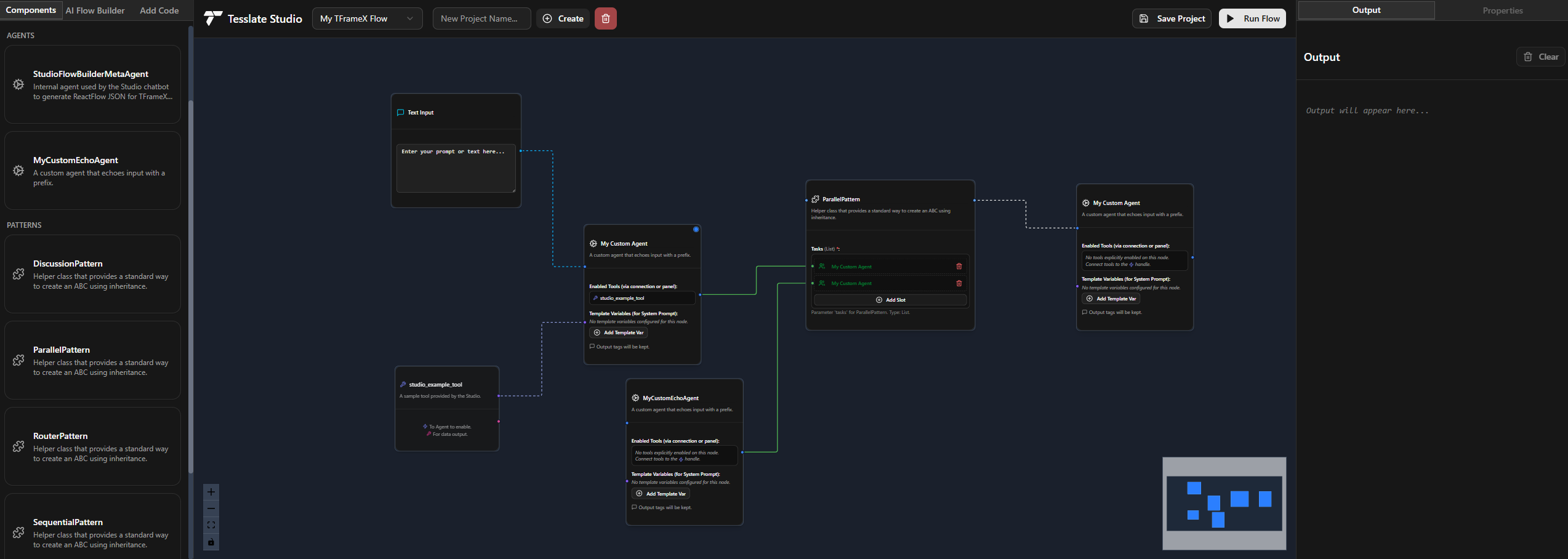
✨ Why TFrameX?
-
🧠 Intelligent Agents, Simplified: Define specialized agents with unique system prompts, tools, and even dedicated LLM models.
-
🛠️ Seamless Tool Integration: Equip your agents with custom tools using a simple decorator. Let them interact with APIs, databases, or any Python function.
-
🌊 Powerful Flow Orchestration: Design complex workflows by chaining agents and predefined patterns (Sequential, Parallel, Router, Discussion) using an intuitive
FlowAPI. -
🧩 Composable & Modular: Build reusable components (agents, tools, flows) that can be combined to create increasingly complex applications.
-
🚀 Agent-as-Tool Paradigm: Elevate your architecture by enabling agents to call other agents as tools, creating hierarchical and supervised agent structures.
-
🎨 Fine-Grained Control: Customize agent behavior with features like per-agent LLMs and
<think>tag stripping for cleaner outputs. -
💬 Interactive Debugging: Quickly test your flows and agents with the built-in interactive chat.
-
🔌 Pluggable LLMs: Start with
OpenAIChatLLM(compatible with OpenAI API and many local server UIs like Ollama) and extend to other models easily.
💡 Core Concepts
TFrameX is designed to orchestrate complex agent interactions using its powerful Flow system, which controls the sequence and logic of operations.
Within a Flow, you define reusable collaboration structures called Patterns—such as SequentialPattern, RouterPattern, or DiscussionPattern. These patterns can be nested inside one another. For example, a ParallelPattern may contain several SequentialPatterns, enabling hierarchical task breakdowns.
TFrameX also supports the agent-as-tool paradigm: LLMAgents can directly call other registered agents. This enables supervisor-worker relationships and task delegation between agents.
Together, nested patterns and inter-agent calling allow for sophisticated designs—including recursive or cyclical flows. For example, a DiscussionPattern creates a controlled loop of interaction. However, to avoid infinite loops, flows must be carefully structured with clear termination conditions or managed by moderator agents.
These entire Flows—along with their patterns and agent configurations—can be defined declaratively in YAML files. This makes it easy to version, share, and modify agent behaviors programmatically, giving you maximum flexibility in building adaptive, interconnected agent systems.
TFrameX revolves around a few key concepts:
- 🌟 Agents (
BaseAgent,LLMAgent,ToolAgent):
-
The core actors in your system.
-
LLMAgent: Leverages an LLM to reason, respond, and decide when to use tools or call other agents. -
ToolAgent: A stateless agent that directly executes a specific tool (useful for simpler, direct tool invocations within a flow). -
Can have their own memory, system prompts, and a dedicated LLM instance.
-
Support for
strip_think_tags: Automatically remove internal "thinking" steps (e.g.,<think>...</think>) from the final output for cleaner user-facing responses.
- 🔧 Tools (
@app.tool):
-
Python functions (sync or async) that agents can call to perform actions or retrieve information from the outside world (APIs, databases, file systems, etc.).
-
Schemas are automatically inferred from type hints or can be explicitly defined.
- 🌊 Flows (
Flow):
-
Define the sequence or graph of operations.
-
A flow consists of steps, where each step can be an agent or a Pattern.
-
Orchestrate how data (as
Messageobjects) and control pass between agents.
- 🧩 Patterns (
SequentialPattern,ParallelPattern,RouterPattern,DiscussionPattern):
-
Reusable templates for common multi-agent interaction structures:
-
SequentialPattern: Executes a series of agents/patterns one after another. -
ParallelPattern: Executes multiple agents/patterns concurrently on the same input. -
RouterPattern: Uses a "router" agent to decide which subsequent agent/pattern to execute. -
DiscussionPattern: Facilitates a multi-round discussion between several agents, optionally moderated.
- 🤝 Agent-as-Tool (Supervisor Agents):
- A powerful feature where one
LLMAgentcan be configured to call other registered agents as if they were tools. This allows for creating supervisor agents that delegate tasks to specialized sub-agents.
- 🤖 LLMs (
BaseLLMWrapper,OpenAIChatLLM):
-
Pluggable wrappers for LLM APIs.
OpenAIChatLLMprovides out-of-the-box support for OpenAI-compatible APIs (including many local model servers like Ollama or LiteLLM). -
Agents can use a default LLM provided by the app, or have a specific LLM instance assigned for specialized tasks.
- 💾 Memory (
InMemoryMemoryStore):
- Provides agents with conversation history.
InMemoryMemoryStoreis available by default, and you can implement custom stores by inheriting fromBaseMemoryStore.
Getting Started
-
Installation:
To use TFrameX in your project, install it via pip:
pip install tframex
Core dependencies (like
httpx,pydantic,PyYAML,python-dotenv,openai) are listed inpyproject.tomland should be installed automatically. If you plan to run specific examples from the TFrameX repository, you might need additional packages likeaiohttp(for the Reddit tool example) orFlask(for the web app example). You can install these separately:pip install aiohttp Flask.For Developers (Contributing to TFrameX or running all examples from source):
If you're developing TFrameX itself or want to run examples directly from a cloned repository, we recommend setting up a dedicated virtual environment. You can use
uvfor its speed, orpipwithvenv.Setting up with
uv(Recommended): First, installuvby following the instructions at astral.sh/uv. Then, in your cloned TFrameX repository:# Clone the repository (if you haven't already) # git clone https://github.com/TesslateAI/TFrameX.git # cd TFrameX # Create and activate a virtual environment uv venv source .venv/bin/activate # On macOS/Linux # For Windows PowerShell: .venv\Scripts\Activate.ps1 # Install TFrameX in editable mode with optional dependencies # For core development and running most examples: uv pip install -e ".[examples]" # To include development tools (linters, formatters): # uv pip install -e ".[examples,dev]"
This approach uses the
pyproject.tomlfile for precise dependency management.Setting up with
pipandvenv(Alternative): In your cloned TFrameX repository:# Clone the repository (if you haven't already) # git clone https://github.com/TesslateAI/TFrameX.git # cd TFrameX # Create and activate a virtual environment python -m venv .venv source .venv/bin/activate # On macOS/Linux # For Windows Command Prompt: .venv\Scripts\activate.bat # Install TFrameX in editable mode with optional dependencies # For core development and running most examples: pip install -e ".[examples]" # To include development tools: # pip install -e ".[examples,dev]"
-
Set up your LLM Environment: Ensure your environment variables for your LLM API are set (e.g.,
OPENAI_API_KEY,OPENAI_API_BASE). Create a.envfile in your project root (TFrameX usespython-dotenvto load this):# Example for Ollama (running locally) OPENAI_API_BASE="http://localhost:11434/v1" OPENAI_API_KEY="ollama" # Placeholder, as Ollama doesn't require a key by default OPENAI_MODEL_NAME="llama3" # Or your preferred model served by Ollama # Example for OpenAI API # OPENAI_API_KEY="your_openai_api_key" # OPENAI_MODEL_NAME="gpt-3.5-turbo" # OPENAI_API_BASE="https://api.openai.com/v1" # (Usually default if not set)
-
Your First TFrameX App:
import asyncio

import os

from dotenv import load_dotenv

from tframex import TFrameXApp, OpenAIChatLLM, Message


load_dotenv() # Load .env file


# 1. Configure your LLM

# TFrameX will use environment variables for OPENAI_API_BASE, OPENAI_API_KEY, OPENAI_MODEL_NAME by default if available

# You can explicitly pass them too:

my_llm = OpenAIChatLLM(

model_name=os.getenv("OPENAI_MODEL_NAME", "gpt-3.5-turbo"),

api_base_url=os.getenv("OPENAI_API_BASE"), # Can be http://localhost:11434/v1 for Ollama

api_key=os.getenv("OPENAI_API_KEY") # Can be "ollama" for Ollama

)


# 2. Initialize TFrameXApp

app = TFrameXApp(default_llm=my_llm)


# 3. Define a simple agent

@app.agent(

name="GreeterAgent",

system_prompt="You are a friendly greeter. Greet the user and mention their name: {user_name}."

)

async  def  greeter_agent_func(): # The function body can be pass; TFrameX handles logic for LLMAgent

pass


# 4. Run the agent

async  def  main():

async  with app.run_context() as rt: # Creates a runtime context

user_input = Message(role="user", content="Hello there!")

response = await rt.call_agent(

"GreeterAgent",

user_input,

# You can pass template variables to the system prompt

template_vars={"user_name": "Alex"}

)

print(f"GreeterAgent says: {response.content}")


if  __name__ == "__main__":

# Basic check for LLM configuration

if  not my_llm.api_base_url:

print("Error: LLM API base URL not configured. Check .env or OpenAIChatLLM instantiation.")

else:

asyncio.run(main())
🛠️ Building with TFrameX: Code In Action
Let's explore how to use TFrameX's features with concrete examples.
🤖 Defining Agents
Agents are the heart of TFrameX. Use the @app.agent decorator.
# In your app setup (app = TFrameXApp(...))


@app.agent(

name="EchoAgent",

description="A simple agent that echoes the user's input.",

system_prompt="Repeat the user's message verbatim."

)

async  def  echo_agent_placeholder(): # Function body is a placeholder for LLMAgents

pass


# An agent that uses a specific, more powerful LLM and strips <think> tags

special_llm_config = OpenAIChatLLM(

model_name=os.getenv("SPECIAL_MODEL_NAME", "gpt-4-turbo"), # A different model

api_base_url=os.getenv("OPENAI_API_BASE_SPECIAL", os.getenv("OPENAI_API_BASE")),

api_key=os.getenv("OPENAI_API_KEY_SPECIAL", os.getenv("OPENAI_API_KEY"))

)


@app.agent(

name="CreativeWriterAgent",

description="A creative writer using a specialized LLM.",

system_prompt=(

"You are a highly creative writer. Generate a short, imaginative story based on the user's prompt. "

"You might use <think>...</think> tags for your internal monologue before the final story. "

"The final story should be engaging and whimsical."

),

llm=special_llm_config, # Assign a specific LLM instance

strip_think_tags=True  # Remove <think>content</think> from final output

)

async  def  creative_writer_placeholder():

pass
-
System Prompts: Guide the LLM's behavior and persona. You can use f-string like template variables (e.g.,
{user_name}) that are filled at runtime. -
Per-Agent LLM: Assign
llm=your_llm_instanceto give an agent a specific model, different from the app's default. -
strip_think_tags=True: If your agent's system prompt encourages it to "think out loud" using<think>...</think>tags (a common technique for complex reasoning), setting this toTruewill remove those blocks before the final response is returned, keeping the output clean for the end-user.
🔧 Defining Tools
Equip your agents with tools to interact with the world.
@app.tool(description="Gets the current weather for a specific location.")

async  def  get_current_weather(location: str, unit: str = "celsius") -> str:

# In a real app, this would call a weather API

if  "tokyo"  in location.lower():

return  f"The current weather in Tokyo is 25°{unit.upper()[0]} and sunny."

if  "paris"  in location.lower():

return  f"The current weather in Paris is 18°{unit.upper()[0]} and cloudy."

return  f"Weather data for {location} is currently unavailable."


# Agent that uses the tool

@app.agent(

name="WeatherAgent",

description="Provides weather information using the 'get_current_weather' tool.",

system_prompt=(

"You are a Weather Assistant. Use your 'get_current_weather' tool to find the weather. "

"If the user asks about something other than weather, politely state your purpose. "

"Tool details: {available_tools_descriptions}"  # TFrameX injects this

),

tools=["get_current_weather"] # List tool names available to this agent

)

async  def  weather_agent_placeholder():

pass
TFrameX automatically generates the necessary schema for the LLM to understand how to call your tools based on function signatures and type hints. The {available_tools_descriptions} placeholder in the system prompt will be dynamically replaced with the names and descriptions of the tools available to that specific agent.
🌊 Orchestrating with Flows
Flows define how agents and patterns are connected to achieve complex tasks.
from tframex import Flow, SequentialPattern, ParallelPattern, RouterPattern, DiscussionPattern


# --- Assume Agents are defined (e.g., EchoAgent, UpperCaseAgent, WeatherAgent, CityInfoAgent, SummarizerAgent) ---


# 1. Sequential Flow: Steps execute one after another

sequential_flow = Flow(

flow_name="SequentialEchoUpper",

description="Echoes, then uppercases input."

)

sequential_flow.add_step("EchoAgent").add_step("UpperCaseAgent")

app.register_flow(sequential_flow)


# 2. Parallel Flow: Tasks run concurrently, results are aggregated

@app.agent(name="SummarizerAgent", description="Summarizes input text.", system_prompt="Provide a concise summary of the input text.")

async  def  summarizer_agent_placeholder(): pass


parallel_flow = Flow(

flow_name="ParallelInfoSummarize",

description="Gets weather & city info in parallel, then summarizes."

)

parallel_flow.add_step(

ParallelPattern(

pattern_name="GetInfoInParallel",

tasks=["WeatherAgent", "CityInfoAgent"] # Agent names to run in parallel

)

)

parallel_flow.add_step("SummarizerAgent") # Summarizes the combined output

app.register_flow(parallel_flow)


# 3. Router Flow: An agent decides the next step

# First, define a router agent:

@app.agent(

name="TaskRouterAgent",

description="Classifies query for RouterPattern: 'weather', 'city_info', or 'general'.",

system_prompt="Analyze user query. Respond with ONE route key: 'weather', 'city_info', or 'general'. NO OTHER TEXT."

)

async  def  task_router_placeholder(): pass


@app.agent(name="GeneralQA_Agent", system_prompt="You are a helpful assistant. Answer general questions to the best of your ability.")

async  def  general_qa_placeholder(): pass


router_flow = Flow(flow_name="SmartRouterFlow", description="Routes task using TaskRouterAgent.")

router_flow.add_step(

RouterPattern(

pattern_name="MainTaskRouter",

router_agent_name="TaskRouterAgent", # This agent's output (e.g., "weather") is the route key

routes={

"weather": "WeatherAgent",

"city_info": "CityInfoAgent", # Assuming CityInfoAgent is defined

"general": "GeneralQA_Agent"

},

default_route="GeneralQA_Agent"  # Fallback if route key doesn't match

)

)

app.register_flow(router_flow)


# 4. Discussion Flow: Multiple agents discuss a topic

@app.agent(name="OptimistAgent", system_prompt="You are the Optimist. Find positive aspects.")

async  def  optimist_placeholder(): pass

@app.agent(name="PessimistAgent", system_prompt="You are the Pessimist. Point out downsides.")

async  def  pessimist_placeholder(): pass

@app.agent(name="DiscussionModeratorAgent", system_prompt="Summarize the discussion round, identify key themes, and pose a follow-up question to keep the discussion going.")

async  def  moderator_placeholder(): pass


discussion_flow = Flow(flow_name="TeamDebateFlow", description="Agents debate a topic.")

discussion_flow.add_step(

DiscussionPattern(

pattern_name="TechDebate",

participant_agent_names=["OptimistAgent", "PessimistAgent"],

discussion_rounds=2,

moderator_agent_name="DiscussionModeratorAgent"  # Optional moderator

)

)

app.register_flow(discussion_flow)


# --- Running a Flow ---

async  def  main_flow_runner():

async  with app.run_context() as rt:

# Example: Run the sequential flow

initial_msg = Message(role="user", content="hello world")

flow_context = await rt.run_flow("SequentialEchoUpper", initial_msg)

print(f"Sequential Flow Output: {flow_context.current_message.content}")

# Expected: Something like "HELLO WORLD" (after echo then uppercase, if agents are so defined)


# Example: Run the router flow with a weather query

weather_query = Message(role="user", content="What's the weather in Tokyo?")

flow_context_route = await rt.run_flow("SmartRouterFlow", weather_query)

print(f"Router Flow (Weather) Output: {flow_context_route.current_message.content}")

# Expected: WeatherAgent's response for Tokyo


# Example: Run discussion flow

topic = Message(role="user", content="Let's discuss the future of remote work.")

discussion_context = await rt.run_flow("TeamDebateFlow", topic)

print(f"Discussion Flow Output:\n{discussion_context.current_message.content}")


if  __name__ == "__main__":

# Ensure app and all agents (EchoAgent, UpperCaseAgent, WeatherAgent, CityInfoAgent,

# SummarizerAgent, TaskRouterAgent, GeneralQA_Agent, OptimistAgent, PessimistAgent,

# DiscussionModeratorAgent) are defined and registered with 'app' before running.

# Also ensure 'my_llm' and 'special_llm_config' are initialized.

# This is a simplified main guard; a full example would have all definitions.

if  'app'  in  globals() and app.default_llm: # Basic check

asyncio.run(main_flow_runner())

else:

print("Please ensure 'app' and its 'default_llm' are initialized, and all agents are defined.")
🤝 Agent-as-Tool: Building Supervisor Agents
One of TFrameX's most powerful features is allowing an LLMAgent to call other registered agents as if they were tools. This enables hierarchical agent structures where a "supervisor" agent can delegate sub-tasks to specialized "worker" agents.
# Assuming WeatherAgent and CityInfoAgent are already defined and registered...


@app.agent(

name="SmartQueryDelegateAgent",

description="Supervises WeatherAgent and CityInfoAgent, calling them as tools.",

system_prompt=(

"You are a Smart Query Supervisor. Your goal is to understand the user's complete request and "

"delegate tasks to specialist agents. You have the following specialist agents available:\n"

"{available_agents_descriptions}\n\n"  # TFrameX populates this!

"When the user asks a question, first determine if it requires information from one or more specialists. "

"For each required piece of information, call the appropriate specialist agent. The input to the specialist "

"agent should be the specific part of the user's query relevant to that agent, passed as 'input_message'. "

"After gathering all necessary information from the specialists, synthesize their responses into a single, "

"comprehensive answer for the user. If the user's query is simple and doesn't need a specialist, "

"answer it directly."

),

callable_agents=["WeatherAgent", "CityInfoAgent"] # List names of agents this agent can call

)

async  def  smart_query_delegate_placeholder():

pass


# A flow that uses this supervisor agent

smart_delegate_flow = Flow(flow_name="SmartDelegateFlow", description="Uses SmartQueryDelegateAgent for complex queries.")

smart_delegate_flow.add_step("SmartQueryDelegateAgent")

app.register_flow(smart_delegate_flow)


# --- Running this flow ---

async  def  main_supervisor():

async  with app.run_context() as rt:

# This query might require both CityInfoAgent and WeatherAgent

query = Message(role="user", content="Tell me about the attractions in Paris and what the weather is like there today.")

flow_context = await rt.run_flow("SmartDelegateFlow", query)

print(f"Supervisor Agent Output:\n{flow_context.current_message.content}")


if  __name__ == "__main__":

# ... (ensure app, WeatherAgent, CityInfoAgent, SmartQueryDelegateAgent are defined and registered)

# This is a simplified main guard.

if  'app'  in  globals() and app.default_llm:

asyncio.run(main_supervisor())

else:

print("Please ensure 'app', its 'default_llm', and relevant agents are initialized.")
When you specify callable_agents, TFrameX makes these agents available to the SmartQueryDelegateAgent as functions it can invoke (via the LLM's tool/function calling mechanism). The {available_agents_descriptions} template variable in the system prompt will automatically be populated with the names and descriptions of these callable agents, guiding the supervisor LLM on how and when to use them. The supervisor agent will then receive their responses as tool results and can synthesize a final answer.
💬 Interactive Chat
Test your flows quickly using the built-in interactive chat mode.
async  def  main_interactive():

async  with app.run_context() as rt:

# If you have multiple flows, it will ask you to choose one.

# Or, you can specify a default flow to start with:

# await rt.interactive_chat(default_flow_name="SmartDelegateFlow")

await rt.interactive_chat()


if  __name__ == "__main__":

# ... (ensure app, agents, and flows are defined and registered before running)

# This is a simplified main guard.

if  'app'  in  globals() and app.default_llm:

asyncio.run(main_interactive())

else:

print("Please ensure 'app' and its 'default_llm' are initialized for interactive chat.")
🌟 Use Cases
TFrameX is ideal for a wide range of applications:
-
Complex Task Decomposition: Break down large tasks (e.g., "research the impact of AI on healthcare, find three key papers, summarize them, and draft a blog post") into smaller, manageable sub-tasks handled by specialized agents coordinated by a supervisor.
-
Multi-Agent Collaboration:
-
Simulate debates (Optimist vs. Pessimist vs. Realist).
-
Collaborative problem-solving teams (e.g., Developer Agent, QA Agent, ProductManager Agent working on a feature).
-
Creative writing ensembles where different agents contribute different parts of a story.
-
Tool-Augmented LLM Applications:
-
Customer support bots that can query databases, CRM systems, or knowledge bases.
-
Data analysis agents that can execute Python code (via a tool) or fetch real-time financial data.
-
Personal assistants that manage calendars, send emails, or control smart home devices.
-
A Reddit chatbot that can fetch top posts, analyze sentiment, and engage in discussions (see
examples/redditchatbotfor inspiration). -
Dynamic Chatbots: Create chatbots that can intelligently route user queries to the most appropriate agent or tool based on context and conversation history.
-
Automated Content Generation Pipelines: Chain agents for drafting, revising, fact-checking, and formatting content for various platforms.
-
Educational Tutors: Agents specializing in different subjects collaborating to provide comprehensive explanations.
🔬 Advanced Concepts
-
TFrameXRuntimeContext(rt): -
Created when you use
async with app.run_context() as rt:. -
Manages the lifecycle of agent instances and LLM clients for a given execution scope.
-
Provides methods like
rt.call_agent(),rt.run_flow(),rt.call_tool(). -
Can have its own LLM override, distinct from the app's default or agent-specific LLMs, useful for setting a context-wide LLM for all operations within that
withblock unless an agent has its own override. -
FlowContext: -
Passed between steps in a
Flow. -
Holds
current_message(the output of the last step),history(all messages exchanged in the current flow execution, including intermediate agent calls), andshared_data(a dictionary for patterns/steps to pass arbitrary data or control signals likeSTOP_FLOW). -
Template Variables in Prompts & Flows:
-
System prompts for agents can include placeholders like
{variable_name}. -
When calling an agent directly or running a flow, you can pass a
template_vars(forcall_agent) orflow_template_vars(forrun_flow) dictionary:
# For call_agent

await rt.call_agent(

"MyAgentWithTemplates",

input_msg,

template_vars={"user_name": "Alice", "current_date": "2024-07-15"}

)


# For run_flow

await rt.run_flow(

"MyFlowWithTemplates",

initial_msg,

flow_template_vars={"project_id": "XYZ123", "target_audience": "developers"}

)
- These variables are made available during system prompt rendering for all agents invoked within that specific call or flow execution, enhancing dynamic behavior and context-awareness. The
system_prompt_templatein an agent's definition (e.g.,@app.agent(system_prompt="Hello {user_name}")) will be formatted using these variables.
🤝 Contributing
Contributions are welcome! We're excited to see how the community extends and builds upon TFrameX. Please feel free to open an issue for discussions, bug reports, or feature requests, or submit a pull request.
📜 License
This project is licensed under the MIT License. See the LICENSE file for details.


Download files
Download the file for your platform. If you're not sure which to choose, learn more about installing packages.
Source Distribution
Built Distribution
Filter files by name, interpreter, ABI, and platform.
If you're not sure about the file name format, learn more about wheel file names.
Copy a direct link to the current filters
File details
Details for the file tframex-0.1.3.tar.gz.
File metadata
- Download URL: tframex-0.1.3.tar.gz
- Upload date:
- Size: 51.4 kB
- Tags: Source
- Uploaded using Trusted Publishing? No
- Uploaded via: twine/6.1.0 CPython/3.12.6
File hashes
| Algorithm | Hash digest | |
|---|---|---|
| SHA256 |
13d380ebc9d8f5ceccef69f6c4d9547d198fe593c7af4070ddab20141269350b
|
|
| MD5 |
526830ff9720e27c8d29e04704a7fa3f
|
|
| BLAKE2b-256 |
6b4b6dbf9d3836955733d01493cda1cbcc266bb521b6b043d8f25d389c2d94ec
|
File details
Details for the file tframex-0.1.3-py3-none-any.whl.
File metadata
- Download URL: tframex-0.1.3-py3-none-any.whl
- Upload date:
- Size: 47.4 kB
- Tags: Python 3
- Uploaded using Trusted Publishing? No
- Uploaded via: twine/6.1.0 CPython/3.12.6
File hashes
| Algorithm | Hash digest | |
|---|---|---|
| SHA256 |
b1f41358801a94ebd853dd7f8dd0bce5927fe4bc516e14fb61b8234f7008cad0
|
|
| MD5 |
938764fdf9bc47a50301334db704b219
|
|
| BLAKE2b-256 |
1f9e4d5ea7da464d09571c4f5e7e40d4e15839811763d9fb02574d6b01d503dc
|






