

Thanks ants!
Thants
Multi-agent and multi-team reinforcement-learning environment modelling ant foraging
Introduction
Thants is a rl environment library based on models of ant colonies foraging for food, also supporting environments with multiple competing colonies.
Thants is implemented using JAX, allowing the environments to be run on GPU enabling large scale performant simulation, and the ability to run environments alongside JAX and Pytorch ML tools.
The environment is implemented using the Jumanji RL environment API, with some modification for the multi-colony case.
Usage
Installation
Thants can be installed from pypi using
pip install thants
Examples
Single Colony
The single colony environment follows the Jumanji environment API, with actions provided as an array of individual actions:
from thants.envs import ThantsMono
import jax

env = ThantsMono(dims=(50, 50))
key = jax.random.PRNGKey(101)
state, obs = env.reset(key)
state_history = [state]

for _ in range(50):
    key, action_key = jax.random.split(key, 2)
    actions = jax.random.choice(
        action_key, env.num_actions, (env.num_agents,)
    )
    state, obs = env.step(state, actions)
    state_history.append(state)

env.animate(state_history, 100, "mono_colony.gif")
Multi-Colony
In the multi-colony case each colony is treated independently (and can be different sizes), so actions, observations, timesteps are list/tuples of arrays/structs:
from thants.envs import Thants
import jax
import jax.numpy as jnp

env = Thants((50, 100))
key = jax.random.PRNGKey(101)
state, obs = env.reset(key)
state_history = [state]

for _ in range(50):
    key, k1, k2 = jax.random.split(key, 3)
    # List of action arrays per colony
    actions = [
        jax.random.choice(k1, env.num_actions, (env.num_agents[0],)),
        jax.random.choice(k2, env.num_actions, (env.num_agents[1],)),
    ]
    state, obs = env.step(state, actions)
    state_history.append(state)

env.animate(state_history, 100, "multi_colony.gif")
Preset simple environments can be imported from thants.envs.ThantsDual and
thants.envs.ThantsQuad with 2 and 4 colonies respectively.
Environment
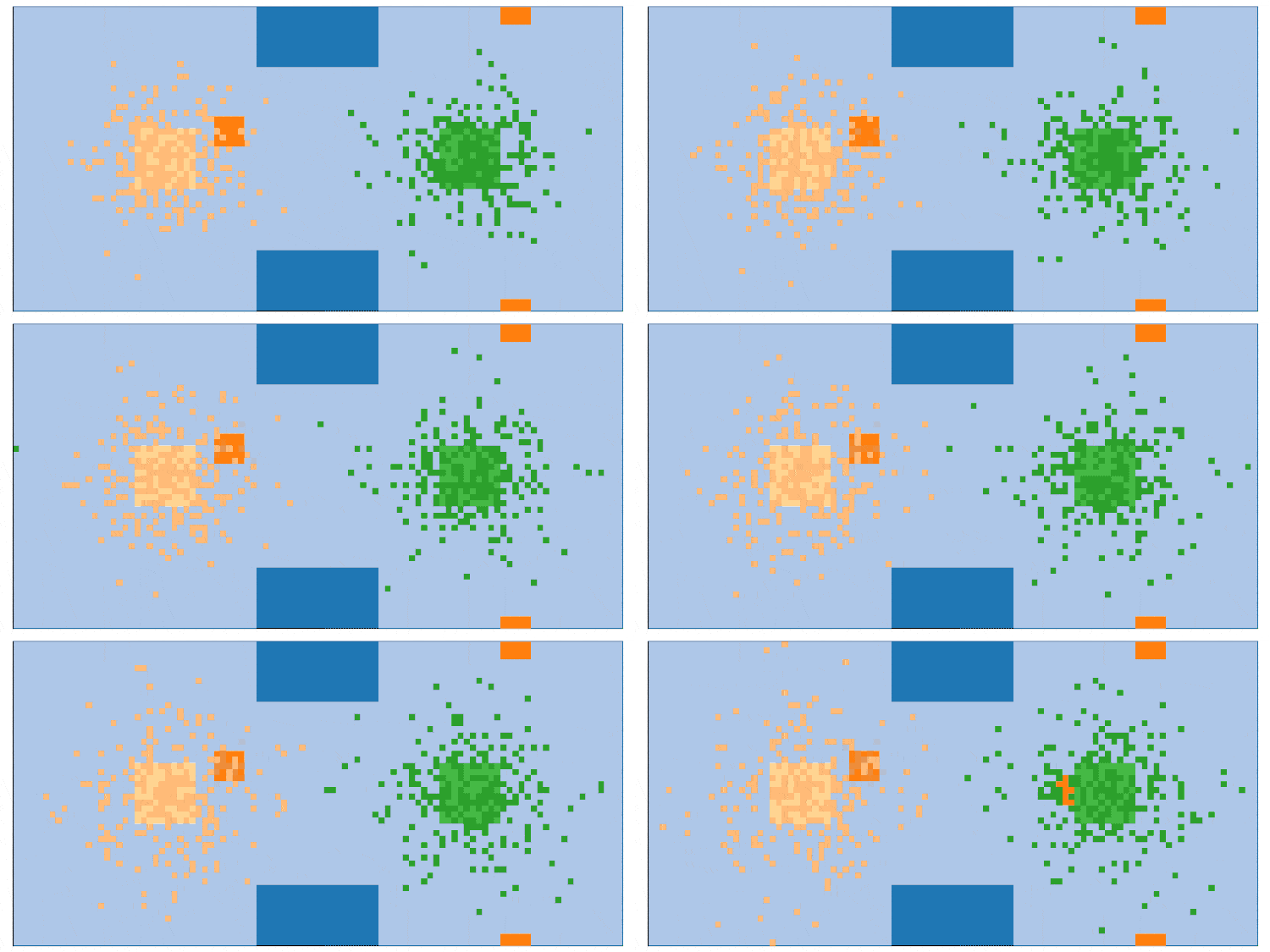
A Thants environment with two competing colonies.
The environment is modelled as a grid, wrapped at the boundaries. Ants (the agents) occupy individual cells on the grid (and cannot overlap). Ants can pick up, carry, and deposit food, or deposit persistent signals that can be observed by other ants in the same colony.
State
Colonies
The state of the ant colonies is represented by a single struct:
- Ants: Individual ants themselves have several components:
- Positions: 2d indices of ant positions on the environment grid.
- Carrying: The amount of food being carried by each ant.
- Health: Ant health (currently unused).
- Colony Index: The index of the colony each ant belongs to
- Nests: 2d array indicating the index of the colony each cell belongs to
(
0in the case a cell is not the nest of any colony). - Signals: 4d array of signal deposits at each cell for each colony. Signals have multiple channels to facilitate communication between ants (i.e. the 2nd dimension of the array is the signal channel).
Environment
The state of the environment then consists of the colonies and state shared by all the colonies
- Colonies: Ant colonies state
- Food: 2d array representing the amount of food deposited at each cell
- Terrain: 2d array of flags indicating if a cell can be occupied by an ant. This allows obstacles to be placed on the environment.
Updates
Each step of the environment performs the following update to the state:
- Convert integer action choices into state updates
- Apply ant position updates
- Apply food pick-up and deposit actions
- Drop any new food deposits
- Dissipate and propagate signals
- Apply signal deposit actions
- Clear any food that has been deposited on a nest (i.e. the food is consumed by the colony)
The behaviour of the dynamics of signals can be customised by implementing the
thants.signals.SignalPropagator base class and
passing it when initialising the environment.
State Generators
The initialisation of the environment can be customised by implementing the relevant base class and passing them to the environment.
Actions
Ants can select from several discrete actions, indicated by an integer value:
0: Null action (i.e. no change to the environment)1 - 4: Move in one of the four ordinal directions (if possible)5: Take a fixed amount of food from the ants location (if possible)6: Deposit a fixed amount of food from the ants location (if possible)7+: Deposit a fixed amount of signal at the ants location
Note that actions can be selected, but may not be possible e.g. attempting to move to an occupied cell, or taking food from an empty cell. In this case there will be no change in state due to the chosen action.
Observations
Individual agent observations also consist of several components. Observations are individually made for the local neighbourhood of each ant, i.e. the surrounding cells on the environment grid, and their own cell:
ants: Flag indicating if a cell in the neighbourhood is occupied by an ant, with the shape[n-ants, n-colonies, 9]where the second dimensions indicates the individual colonies. The ants from the same colony will always be on the first row.signals: Signal deposits in the neighbourhood (across all channels), signals are observed individually for each colony.food: Food deposits within the neighbourhood.nest: Flag indicating if a neighbouring cell is designated as a nest for the ants colony.terrain: Flag indicating if a neighbouring cell can be occupied.carrying: Amount of food currently being carried by each ant.
the number of local cells observed by each agent can be customised with the view_distance
environment parameter.
Rewards
By default, rewards are granted to ants when they deposit food on their colonies nest.
Reward signals can be customised by implementing the respective base class
thants.rewards.RewardFn.
1 maintainer

Metadata
1 maintainer
Release files for thants 0.3.4
For a detailed explanation of source distributions (sdists) and built distributions (wheels), please see the package formats documentation.
Source distribution (sdist)
| File | Size | Uploaded | Provenance | Actions |
|---|---|---|---|---|
| thants-0.3.4.tar.gz | 19.8 kB | With provenance | Details for thants-0.3.4.tar.gz |
Built distribution (wheel)
| File | Interpreter | ABI | Platform | Actions Reset |
|---|---|---|---|---|
| thants-0.3.4-py3-none-any.whl | Python 3 | none | any | Details for thants-0.3.4-py3-none-any.whl |
Total release size: 46.0 kB
Release files / thants-0.3.4.tar.gz
| Download URL | thants-0.3.4.tar.gz |
|---|---|
| Size | 19.8 kB |
| Tags | Source |
|
SHA-256 checksum How to use checksums |
f3d3551a829de463700d30f15a40cc25c97aa7177048dc7dae4db034a6803094
|
|
BLAKE2b-256 checksum How to use checksums |
822bb8d1104d5416ab556241be90aff41ca1281e4a67264b6c5c296bf274c012
|
| Upload date | |
|
Uploaded using Trusted Publishing? What is trusted publishing? |
Yes |
| Uploaded via |
twine/6.1.0 CPython/3.13.7
|
Provenance
Provenance describes where a file came from. On PyPI, provenance is shared via attestations, which provide a verifiable record of the build or publishing details. View details, limitations and caveats.


PyPI Publish Attestation
PyPI verified that this artifact, at this checksum, originated from the publisher listed below.
Signed by GitHub Actions, verified by PyPI on Nov 15, 2025.
Transparency logRelease files / thants-0.3.4-py3-none-any.whl
| Download URL | thants-0.3.4-py3-none-any.whl |
|---|---|
| Size | 26.2 kB |
| Tags | Python 3 |
|
SHA-256 checksum How to use checksums |
8368748fe91a9eebeafd93a12d4ca0ae920649909bd135b371bf8ebc6ae53b0e
|
|
BLAKE2b-256 checksum How to use checksums |
76d967ea871813810f359a02a53dc154c1446a147f2e86a572e4e90cdca3718a
|
| Upload date | |
|
Uploaded using Trusted Publishing? What is trusted publishing? |
Yes |
| Uploaded via |
twine/6.1.0 CPython/3.13.7
|
Provenance
Provenance describes where a file came from. On PyPI, provenance is shared via attestations, which provide a verifiable record of the build or publishing details. View details, limitations and caveats.
PyPI Publish Attestation
PyPI verified that this artifact, at this checksum, originated from the publisher listed below.
Signed by GitHub Actions, verified by PyPI on Nov 15, 2025.
Transparency logSecurity for thants 0.3.4
Provenance
Provenance describes where a file came from. On PyPI, provenance is shared via attestations, which provide a verifiable record of the build or publishing details. View details, limitations and caveats.
Full provenance
All 2 files in this release have been uploaded with provenance metadata.
Attestation for thants-0.3.4.tar.gz
PyPI Publish Attestation
PyPI verified that this artifact, at this checksum, originated from the publisher listed below.
Signed by GitHub Actions, verified by PyPI on Nov 15, 2025.
Transparency logA note on package security
PyPI is a repository for distributing packages, not a service for auditing them. While third-party security researchers and our staff do their best to detect and remove malicious packages, PyPI cannot guarantee the quality, security or suitability of any given package.
To learn more about protecting yourself from malicious actors, visit our package security documentation.














