Audio steganography methods, attacks, and speech-quality evaluation metrics.
Project description
The A-Files
_______ _ ______ _ _
|__ __| | /\ | ____(_) |
| | | |__ ___ / \ ______ | |__ _| | ___ ___
| | | '_ \ / _ \ / /\ \ |______| | __| | | |/ _ \/ __|
| | | | | | __/ / ____ \ | | | | | __/\__ \
|_| |_| |_|\___| /_/ \_\ |_| |_|_|\___||___/
The A-Files is a powerful audio steganography software that allows users to embed secret data within an audio signal, measure speech quality metrics, and test the audio signal's robustness against different types of attacks.
With The A-Files, users can ensure that their sensitive information remains private and protected.
Table of contents
- About
- Package structure
- Publishing
- Migration note
- Steganography algorithms
- Metrics
- Attacks
- Diagram
- References
- Licence
- Authors
About
The A-Files project contains:
- Audio watermarking methods
- Speech quality metrics
- Audio attacks
Loading
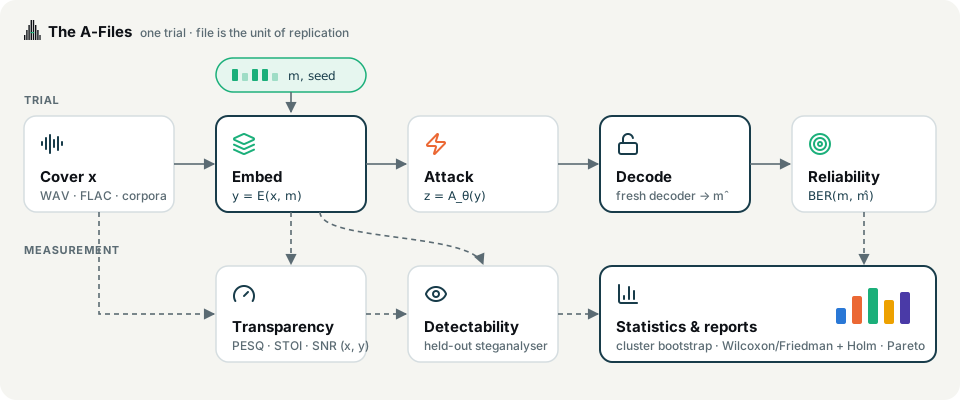
The A-Files is an audio steganography software that allows users to hide secret data within an audio signal. To do this, users can load both the audio file and the data they want to hide into the software. The A-Files supports several types of audio files, such as WAV or FLAC. Once the audio file and the secret data are loaded, the software can embed the data within the audio signal.
Capacity
The A-Files offers several techniques for embedding secret data within an audio signal, such as LSB (Least Significant Bit) insertion, phase coding, and echo hiding. Each technique has its own strengths and weaknesses, and users can choose the technique that best fits their application's requirements.
Transparency
The A-Files includes tools for measuring speech quality metrics, such as PESQ (Perceptual Evaluation of Speech Quality), SNR (Signal-to-Noise Ratio) and STOI (Short-time objective intelligibility) metric. By measuring these metrics, users can ensure that the audio signal has not been degraded during the process of embedding secret data.
Robustness
The A-Files provides tools for testing the audio signal's robustness against different types of attacks. Attackers may attempt to remove the hidden data or alter the audio signal to render the hidden data useless. The A-Files includes tools for testing the audio signal's robustness against various types of attacks, such as noising, frequency cutting, and filtering. By testing the audio signal's robustness, users can determine the effectiveness of the audio steganography technique and make any necessary adjustments to improve the technique's strength and resilience.
Powered by some great GitHub repositories
Package structure
The canonical Python package now lives under src/taf/.
Repository layout:
src/taf/contains the importable library code.src/taf/resources/contains packaged resources such as example audio, bundled sample datasets, and shipped model files.tests/contains import- and behavior-level tests.Documentation/remains outside the package as a project asset.
For local development, install the package in editable mode:
python -m pip install -e .[dev]
Publishing
Packaging and release instructions are in docs/publishing.md. The PyPI distribution name is the-a-files; the import package remains taf.
SRMRpy is vendored under src/srmrpy/ because it is required by the SRMR metric and is not published as a standard PyPI dependency.
Packaged resources
Runtime assets that must work from source, tests, editable installs, and built distributions live under src/taf/resources/.
Use this layout:
src/taf/resources/audio/for standalone example WAV files.src/taf/resources/datasets/for the bundledVCTKandLibriSpeechsample corpora used by the smoke workflow.src/taf/resources/models/for packaged model weights such as.h5.
Example usage:
from taf.models.WavFile import WavFile
from taf.resources.paths import example_wav_path, mosnet_model_path, packaged_dataset_audio_paths
with example_wav_path() as wav_path:
wav_file = WavFile.load(wav_path)
with mosnet_model_path() as model_path:
print(model_path)
with packaged_dataset_audio_paths() as dataset_paths:
print(len(dataset_paths["vctk"]))
Migration note
The main packaging change is the introduction of a src/ layout so the core library is imported as taf instead of relying on the repository root being on PYTHONPATH.
The implementation modules were copied into src/taf/ with their existing internal layout preserved to avoid algorithm changes. The legacy top-level TAF/ tree was left in place for now because a direct filesystem move was blocked on this checkout, so the new canonical code lives in src/taf/ and future work should target that package.
Steganography algorithms
List of implemented methods:
| Class name | Description [Reference] |
|---|---|
LsbMethod.py |
Standard LSB coding [1] |
EchoMethod.py |
Echo Hiding technique with single echo kernel [1] |
PhaseCodingMethod.py |
Phase coding technique [1] |
ImprovedPhaseCodingMethod.py |
Improved Phase Coding technique [19] |
DctDeltaLsbMethod.py |
DCT Delta LSB [1] |
DwtLsbMethod.py |
DWT LSB based [1] |
DctB1Method.py |
First band of DCT coefficients (DCT-b1) [2] |
PatchworkMultilayerMethod.py |
Patchwork-Based multilayer [3] |
NormSpaceMethod.py |
Norm space method [4] |
FsvcMethod.py |
Frequency Singular Value Coefficient Modification (FSVC) [5] |
DsssMethod.py |
Direct Sequence Spread Spectrum technique [6] |
BlindSvdMethod.py |
Blind SVD-based using entropy and log-polar transformation method [20] |
PrimeFactorInterpolatedMethod.py |
Prime Factor Interpolated method [21] |
LwtMethod.py |
LWT method [22] |
ForegroundBackgroundSegmentationMethod.py |
Foreground-Background Segmentation LSB (FBS-LSB) [23] |
FgasMethod.py |
Fixed-decoder network with adversarial perturbation generation (FGAS) [24] |
AacStcMethod.py |
Adaptive +-1 LSB via AAC perceptual residual and Syndrome-Trellis Codes [25] |
Each method extend abstract class SteganographyMethod
from abc import abstractmethod, ABC
from typing import List
import numpy as np
class SteganographyMethod(ABC):
@abstractmethod
def encode(self, data: np.ndarray, message: List[int]) -> np.ndarray:
...
@abstractmethod
def decode(self, data_with_watermark: np.ndarray, watermark_length: int) -> List[int]:
...
@abstractmethod
def type(self) -> str:
...
Metrics
AI Based
- MOSNet: Deep Learning based Objective Assessment for Voice Conversion [16]
Speech Reverberation
Speech Intelligibility
- Coherence and speech intelligibility index (CSII) [7]
- Normalized-covariance measure (NCM) [7]
- Short-time objective intelligibility (STOI) [9]
Speech Quality
- Signal - to - Noise Ratio (SNR) [12]
- Mel-cepstral distance measure for objective speech quality assessment [11]
- Segmental Signal-to-Noise Ratio (SNRseg) [7]
- Frequency-weighted Segmental SNR (fwSNRseg) [7]
- Cepstrum Distance Objective Speech Quality Measure (CD) [7]
- Log - likelihood Ratio (LLR) [7]
- Weighted Spectral Slope (WSS) [7]
- Perceptual Evaluation of Speech Quality (PESQ) [8]
- Speech Enhancement Metrics (Csig, Covl, Cbak, Composite) [13]
- Weighted Spectro-Temporal Modulation Index (wSTMI) [14]
- Spectro-Temporal Glimpsing Index (STGI) [15]
- Scale-invariant SDR(SISDR) [17]
- BSSEval v4 [18]
Each metric extend abstract class Metric
from abc import ABC, abstractmethod
from numbers import Number
import numpy as np
class Metric(ABC):
@abstractmethod
def calculate(self,
samples_original: np.ndarray,
samples_processed: np.ndarray,
fs: int,
frame_len: float = 0.03,
overlap: float = 0.75) -> Number | np.ndarray:
...
@abstractmethod
def name(self) -> str:
...
Attacks
List of attack on audio samples:
- Low pass filter
- Additive noise
- Frequency filter
- Flip random samples
- Cut random samples
- Resample (downsampling, upsampling)
- Amplitude scaling
- Pitch shift
- Time stretch
References
Articles
[1] Alsabhany, Ahmed A., Ahmed Hussain Ali, Farida Ridzuan, A. H. Azni, and Mohd Rosmadi Mokhtar. Digital Audio
Steganography: Systematic Review, Classification, and Analysis of the Current State of the Art. Computer Science
Review
38 (2020): 100316. https://doi.org/10.1016/j.cosrev.2020.100316
[2] Hu, Hwai Tsu, and Ling Yuan Hsu. Robust, Transparent and High-Capacity Audio Watermarking in DCT Domain. Signal
Processing 109 (2015): 226–35. https://doi.org/10.1016/j.sigpro.2014.11.011
[3] Natgunanathan, Iynkaran, Yong Xiang, Guang Hua, Gleb Beliakov, and John Yearwood. Patchwork-Based Multilayer Audio
Watermarking. IEEE/ACM Transactions on Audio Speech and Language Processing 25, no. 11 (2017):
2176–87. https://doi.org/10.1109/TASLP.2017.2749001
[4] Saadi, Slami, Ahmed Merrad, and Ali Benziane. Novel Secured Scheme for Blind Audio/Speech Norm-Space Watermarking
by Arnold Algorithm. Signal Processing 154 (2019): 74–86. https://doi.org/10.1016/j.sigpro.2018.08.011
[5] Zhao, Juan, Tianrui Zong, Yong Xiang, Longxiang Gao, Wanlei Zhou, and Gleb Beliakov. Desynchronization Attacks
Resilient Watermarking Method Based on Frequency Singular Value Coefficient Modification. IEEE/ACM Transactions on
Audio Speech and Language Processing 29 (2021): 2282–95. https://doi.org/10.1109/TASLP.2021.3092555
[6] Nugraha, Rizky M. Implementation of Direct Sequence Spread Spectrum Steganography on Audio Data. Proceedings of
the 2011 International Conference on Electrical Engineering and Informatics, ICEEI 2011, no. July (
2011). https://doi.org/10.1109/ICEEI.2011.6021662
[7] Philipos C. Loizou. Speech Enhancement. Theory and Practice, Second Edition CRC Press (
2013). https://doi.org/10.1201/b14529
[8] Miao Wang, Christoph Boeddeker, Rafael G. Dantas and ananda seelan. PESQ (Perceptual Evaluation of Speech Quality)
Wrapper for Python Users Zenodo 2022. https://doi.org/10.5281/zenodo.6549559
[9] C.H.Taal, R.C.Hendriks, R.Heusdens, J.Jensen A Short-Time Objective Intelligibility Measure for Time-Frequency
Weighted Noisy Speech, ICASSP 2010, Texas, Dallas. https://doi.org/10.1109/ICASSP.2010.5495701
[10] Tiago H. Falk, Chenxi Zheng, and Way-Yip Chan. A Non-Intrusive Quality and Intelligibility Measure of Reverberant
and Dereverberated Speech, IEEE Trans Audio Speech Lang Process, Vol. 18, No. 7, pp. 1766-1774,
Sept.2010. https://doi.org/10.1109/TASL.2010.2052247
[11] R. Kubichek, Mel-cepstral distance measure for objective speech quality assessment, Proceedings of IEEE Pacific
Rim Conference on Communications Computers and Signal Processing, Victoria, BC, Canada, 1993, pp. 125-128
vol.1, https://doi.org/10.1109/PACRIM.1993.407206.
[12] https://en.wikipedia.org/wiki/Signal-to-noise_ratio
[13] Yi Hu and Philipos C. Loizou, Evaluation of Objective Quality Measures for Speech Enhancement, IEEE
TRANSACTIONS
ON AUDIO, SPEECH, AND LANGUAGE PROCESSING, VOL. 16, NO. 1, 229, JANUARY 2008, https://doi.org/10.1109/TASL.2007.911054
[14] A. Edraki, W.-Y. Chan, J. Jensen, & D. Fogerty, Speech Intelligibility Prediction Using Spectro-Temporal
Modulation Analysis. IEEE/ACM Trans. Audio, Speech, & Language Processing, vol. 29, pp. 210-225,
2021, https://doi.org/10.1109/taslp.2020.3039929
[15] A. Edraki, W.-Y. Chan, J. Jensen, & D. Fogerty, A Spectro-Temporal Glimpsing Index (STGI) for Speech
Intelligibility Prediction, Proc. Interspeech, 5 pages, Aug 2021, http://dx.doi.org/10.21437/Interspeech.2021-605
[16] Lo, Chen-Chou and Fu, Szu-Wei and Huang, Wen-Chin and Wang, Xin and Yamagishi, Junichi and Tsao, Yu and Wang,
Hsin-Min, MOSNet: Deep Learning based Objective Assessment for Voice Conversion, arXiv preprint arXiv:1904.08352,
2019, https://arxiv.org/abs/1904.08352
[17] Roux, Jonathan Le and Wisdom, Scott and Erdogan, Hakan and Hershey, John R, SDR – Half-baked or Well Done?,
ICASSP 2019 - 2019 IEEE International Conference on Acoustics, Speech and Signal Processing (ICASSP),
2019, https://dx.doi.org/10.1109/ICASSP.2019.8683855
[18] Stöter, Fabian-Robert and Liutkus, Antoine and Ito, Nobutaka, The 2018 Signal Separation Evaluation Campaign,
Latent Variable Analysis and Signal Separation: 14th International Conference, LVA/ICA 2018, Surrey, UK, 2018, pp.
293–305, https://doi.org/10.5281/zenodo.3376621
[19] Yang, Guang, An Improved Phase Coding Audio Steganography Algorithm,arXiv preprint arXiv:2408.13277,
2024, https://doi.org/10.48550/arXiv.2408.13277
[20] Dhar, Pranab Kumar, and Shimamura, Tetsuya, Blind SVD-based audio watermarking using entropy and log-polar
transformation, Journal of Information Security and Applications, Volume 20, 2015, Pages
74-83, https://doi.org/10.1016/j.jisa.2014.10.007.
[21] Adhiyaksa, F. A., Ahmad, T., Shiddiqi, A. M., Jati Santoso, B., Studiawan, H., & Pratomo, B. A. (2022). Reversible
Audio Steganography using Least Prime Factor and Audio Interpolation. In 2021 International Seminar on Machine Learning,
Optimization, and Data Science (ISMODE) (pp. 97–102). IEEE. https://doi.org/10.1109/ISMODE53584.2022.9743066
[22] Mushtaq, S., Mehraj, S., & Parah, S. A. (2024). Blind and Robust Watermarking Framework for Audio Signals. In 2024
11th International Conference on Reliability, Infocom Technologies and Optimization (Trends and Future Directions) (
ICRITO) (pp. 1–5). IEEE. https://doi.org/10.1109/ICRITO61523.2024.10522195
[23] Wang, J., & Wang, K. (2025). A novel audio steganography based on the segmentation of the foreground and background
of audio. Computers & Electrical Engineering, 117, 109247. https://doi.org/10.1016/j.compeleceng.2024.109247
[24] Yan, J., Cheng, Y., Yin, Z., Zhang, X., Wang, S., Sun, T., & Jiang, X. (2025). FGAS: Fixed Decoder Network-Based
Audio Steganography with Adversarial Perturbation Generation. arXiv preprint
arXiv:2505.22266. https://arxiv.org/abs/2505.22266
[25] Luo, W., Zhang, Y., & Li, H. (2017). Adaptive Audio Steganography Based on Advanced Audio Coding and
Syndrome-Trellis Coding. In C. Kraetzer et al. (Eds.), Digital Forensics and Watermarking, IWDW 2017, Lecture Notes
in Computer Science, vol 10431, pp. 177-186. Springer.
https://doi.org/10.1007/978-3-319-64185-0_14
[26] Yan, Y., Li, Y., Xiao, Q., & Ren, Y. (2026). PRoADS: Provably Secure and Robust Audio Diffusion Steganography
with Latent Optimization and Backward Euler Inversion. arXiv preprint arXiv:2603.10314 (ICASSP
2026). https://arxiv.org/abs/2603.10314
Links
[1] https://github.com/kosta-pmf/audio-watermarking
[2] https://github.com/ktekeli/audio-steganography-algorithms
[3] https://github.com/schmiph2/pysepm
[4] https://github.com/ludlows/PESQ
[5] https://github.com/mpariente/pystoi
[6] https://github.com/jfsantos/SRMRpy
[7] https://github.com/jasminsternkopf/mel_cepstral_distance
[8] https://github.com/nglehuy/semetrics
[9] https://github.com/aminEdraki/py-intelligibility
[10] https://github.com/aliutkus/speechmetrics
[11] https://github.com/sigsep/sigsep-mus-eval
Licence
The A-Files is an open source software under GPLv3 license.
Dependencies
PESQ requires Microsoft Visual C++ 14.0 or later. You can install it via Microsoft C++ Build Tools: https://visualstudio.microsoft.com/visual-cpp-build-tools/
In some cases, you may also need FFmpeg: https://ffmpeg.org/
Authors
- Paweł Kaczmarek (@pawel-kaczmarek) - Military University of Technology, Faculty of Electronics
- Zbigniew Piotrowski - Military University of Technology, Faculty of Electronics
Project details
Release history Release notifications | RSS feed
Download files
Download the file for your platform. If you're not sure which to choose, learn more about installing packages.
Source Distribution
Built Distribution
Filter files by name, interpreter, ABI, and platform.
If you're not sure about the file name format, learn more about wheel file names.
Copy a direct link to the current filters
File details
Details for the file the_a_files-0.1.0.tar.gz.
File metadata
- Download URL: the_a_files-0.1.0.tar.gz
- Upload date:
- Size: 18.7 MB
- Tags: Source
- Uploaded using Trusted Publishing? Yes
- Uploaded via: twine/6.1.0 CPython/3.13.12
File hashes
| Algorithm | Hash digest | |
|---|---|---|
| SHA256 |
a3f0ca5b1d6123158100f2533f7a5cebb5572cb263e014166a3b37cb01d9dd03
|
|
| MD5 |
157ff67fc442bde2d6c8f2667b75b22e
|
|
| BLAKE2b-256 |
712e21dd98f1d6eba109ac7d47d1d5ee875d14745d0a95709848d6a700496278
|
Provenance
The following attestation bundles were made for the_a_files-0.1.0.tar.gz:
Publisher:
ci.yml on pawel-kaczmarek/The-A-Files
-
Statement:
-
Statement type:
https://in-toto.io/Statement/v1 -
Predicate type:
https://docs.pypi.org/attestations/publish/v1 -
Subject name:
the_a_files-0.1.0.tar.gz -
Subject digest:
a3f0ca5b1d6123158100f2533f7a5cebb5572cb263e014166a3b37cb01d9dd03 - Sigstore transparency entry: 1608524500
- Sigstore integration time:
-
Permalink:
pawel-kaczmarek/The-A-Files@278f86726178e2e449c6febe0f13ef4238c3f461 -
Branch / Tag:
refs/tags/v0.1.0 - Owner: https://github.com/pawel-kaczmarek
-
Access:
public
-
Token Issuer:
https://token.actions.githubusercontent.com -
Runner Environment:
github-hosted -
Publication workflow:
ci.yml@278f86726178e2e449c6febe0f13ef4238c3f461 -
Trigger Event:
push
-
Statement type:
File details
Details for the file the_a_files-0.1.0-py3-none-any.whl.
File metadata
- Download URL: the_a_files-0.1.0-py3-none-any.whl
- Upload date:
- Size: 18.7 MB
- Tags: Python 3
- Uploaded using Trusted Publishing? Yes
- Uploaded via: twine/6.1.0 CPython/3.13.12
File hashes
| Algorithm | Hash digest | |
|---|---|---|
| SHA256 |
c88bb661f82b417b6d92b95c84db920864eb6cef0003962c61d87b1ec0850628
|
|
| MD5 |
62a3478218244162af029a798e076ce3
|
|
| BLAKE2b-256 |
8e30ee5847250b09747d1b716ddd2ad191a5e454bd0c6d933a4236320f1d1eb7
|
Provenance
The following attestation bundles were made for the_a_files-0.1.0-py3-none-any.whl:
Publisher:
ci.yml on pawel-kaczmarek/The-A-Files
-
Statement:
-
Statement type:
https://in-toto.io/Statement/v1 -
Predicate type:
https://docs.pypi.org/attestations/publish/v1 -
Subject name:
the_a_files-0.1.0-py3-none-any.whl -
Subject digest:
c88bb661f82b417b6d92b95c84db920864eb6cef0003962c61d87b1ec0850628 - Sigstore transparency entry: 1608524626
- Sigstore integration time:
-
Permalink:
pawel-kaczmarek/The-A-Files@278f86726178e2e449c6febe0f13ef4238c3f461 -
Branch / Tag:
refs/tags/v0.1.0 - Owner: https://github.com/pawel-kaczmarek
-
Access:
public
-
Token Issuer:
https://token.actions.githubusercontent.com -
Runner Environment:
github-hosted -
Publication workflow:
ci.yml@278f86726178e2e449c6febe0f13ef4238c3f461 -
Trigger Event:
push
-
Statement type: