

A simple Python library with a wordlist for use with hangman featuring easy, medium and hard words!
Usage
First install the package:
$ pip install the-hangman-wordlist
or
$ pip3 install the-hangman-wordlist
Then you could use it like the following example code which generates words endlessly:
from the_hangman_wordlist import HangmanWordlist

if __name__ == "__main__":
    wordlist = HangmanWordlist()

    difficulty = ""
    while difficulty not in {"easy", "medium", "hard", "random"}:
        difficulty = input("What difficulty do you want? (easy/medium/hard/random): ").lower()
        difficulty = {
            "e": "easy",
            "m": "medium",
            "h": "hard",
            "r": "random"
        }.get(difficulty, difficulty)

    script_version, wordlist_version = wordlist.version()
    print(f"Script v{script_version} and wordlist v{wordlist_version}.")

    while True:
        print(f"\n{difficulty.capitalize()} difficulty word: '{wordlist.pull_word(difficulty)}'\n")
        if input("Press Enter to generate a word or type 'exit' to quit... ").lower() == "exit":
            break
Functions
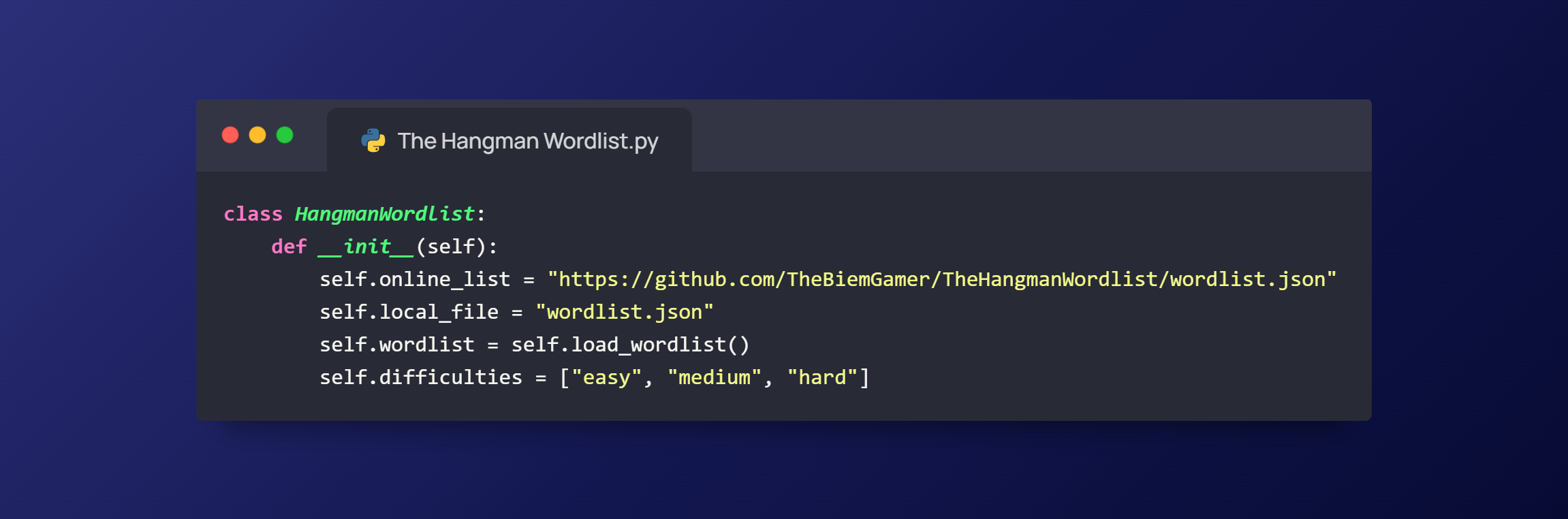
def __init__():
    # Loads when HangmanWordlist is imported, sets the variables and loads the wordlist with the load_wordlist() function.

def fetch_online_wordlist():
    # Fetches the wordlist online and returns it as json.

def load_wordlist():
    # Checks if the user has a copy of the wordlist.json and if it's up to date and then downloads it if necessary with the save_wordlist() function.

def save_wordlist(wordlist):
    # Saves the passed wordlist to wordlist.json

def pull_word(difficulty):
    # Checks if the difficulty passed is a correct option if not it chooses a random difficulty and then it returns a random word from the chosen difficulty.

def version():
    # Simply returns the current script version and wordlist version as a list like this:
    # ('script_version', 'wordlist_version')
Only the pull_word() and version() functions were made to be called by the user the different functions should be called automatically when the script is initialized.
Credits
- Jurriaaaantje (Wordlist words and update wordlist functionality)
- TheBiemGamer (Version check, json functionality and library)
1 maintainer

Metadata
1 maintainer
Release files for the-hangman-wordlist 1.0.5
For a detailed explanation of source distributions (sdists) and built distributions (wheels), please see the package formats documentation.
Source distribution (sdist)
| File | Size | Uploaded | Provenance | Actions |
|---|---|---|---|---|
| the_hangman_wordlist-1.0.5.tar.gz | 5.2 kB | Without provenance | Details for the_hangman_wordlist-1.0.5.tar.gz |
Built distribution (wheel)
| File | Interpreter | ABI | Platform | Actions Reset |
|---|---|---|---|---|
| the_hangman_wordlist-1.0.5-py3-none-any.whl | Python 3 | none | any | Details for the_hangman_wordlist-1.0.5-py3-none-any.whl |
Total release size: 10.1 kB
Release files / the_hangman_wordlist-1.0.5.tar.gz
| Download URL | the_hangman_wordlist-1.0.5.tar.gz |
|---|---|
| Size | 5.2 kB |
| Tags | Source |
|
SHA-256 checksum How to use checksums |
dcf9f9b6fc481ce3d6a2b0db0b723ac3415c2a978016e805a774e9a975c81a3b
|
|
BLAKE2b-256 checksum How to use checksums |
582a1751bf2d879f3e3e72829dd7115d910d475b5830dcff01039c4e1a0d911d
|
| Upload date | |
|
Uploaded using Trusted Publishing? What is trusted publishing? |
No |
| Uploaded via |
twine/5.1.1 CPython/3.12.5
|
Release files / the_hangman_wordlist-1.0.5-py3-none-any.whl
| Download URL | the_hangman_wordlist-1.0.5-py3-none-any.whl |
|---|---|
| Size | 4.9 kB |
| Tags | Python 3 |
|
SHA-256 checksum How to use checksums |
159852f73856dcbb1049d165bacfaee5cd022de23269cd38bafe0a6722edf6f2
|
|
BLAKE2b-256 checksum How to use checksums |
7f1e33b939d7e93e70402b9e711afb6b680a82f5a6c7c253b8f8bbfdc6237c12
|
| Upload date | |
|
Uploaded using Trusted Publishing? What is trusted publishing? |
No |
| Uploaded via |
twine/5.1.1 CPython/3.12.5
|
Security for the-hangman-wordlist 1.0.5
Provenance
Provenance describes where a file came from. On PyPI, provenance is shared via attestations, which provide a verifiable record of the build or publishing details. View details, limitations and caveats.
No provenance found
None of the files in this release were uploaded with provenance metadata.
A note on package security
PyPI is a repository for distributing packages, not a service for auditing them. While third-party security researchers and our staff do their best to detect and remove malicious packages, PyPI cannot guarantee the quality, security or suitability of any given package.
To learn more about protecting yourself from malicious actors, visit our package security documentation.














