
This release is a pre-release and may not be stable for production use.
ConnectorX 


Load data from 

ConnectorX enables you to load data from databases into Python in the fastest and most memory efficient way.
What you need is one line of code:
import connectorx as cx

cx.read_sql("postgresql://username:password@server:port/database", "SELECT * FROM lineitem")
Optionally, you can accelerate the data loading using parallelism by specifying a partition column.
import connectorx as cx

cx.read_sql("postgresql://username:password@server:port/database", "SELECT * FROM lineitem", partition_on="l_orderkey", partition_num=10)
The function will partition the query by evenly splitting the specified column to the amount of partitions. ConnectorX will assign one thread for each partition to load and write data in parallel. Currently, we support partitioning on numerical columns (cannot contain NULL) for SPJA queries.
Experimental: We are now providing federated query support, you can write a single query to join tables from two or more databases!
import connectorx as cx
db1 = "postgresql://username1:password1@server1:port1/database1"
db2 = "postgresql://username2:password2@server2:port2/database2"
cx.read_sql({"db1": db1, "db2": db2}, "SELECT * FROM db1.nation n, db2.region r where n.n_regionkey = r.r_regionkey")
By default, we pushdown all joins from the same data source. More details for setup and configuration can be found here.
Check out more detailed usage and examples here. A general introduction of the project can be found in this blog post.
Installation
pip install connectorx
For AArch64 or ARM64 Linux users, connectorx==0.4.3 & above is only available for distributions using glibc 2.35 and above. Specifically, the re-release for this architecture was tested on Ubuntu 22.04. For older distributions, the latest version available is connectorx==0.2.3 due to dependency limitations.
Check out here to see how to build python wheel from source.
Performance
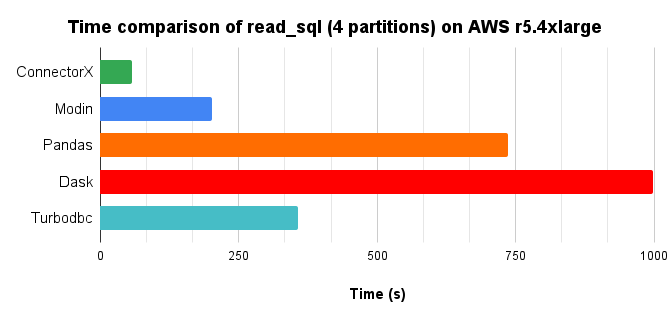
We compared different solutions in Python that provides the read_sql function, by loading a 10x TPC-H lineitem table (8.6GB) from Postgres into a DataFrame, with 4 cores parallelism.
Time chart, lower is better.
Memory consumption chart, lower is better.
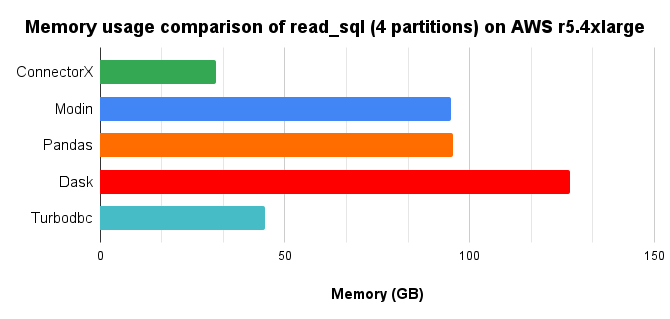
In conclusion, ConnectorX uses up to 3x less memory and 21x less time (3x less memory and 13x less time compared with Pandas.). More on here.
How does ConnectorX achieve a lightning speed while keeping the memory footprint low?
We observe that existing solutions more or less do data copy multiple times when downloading the data. Additionally, implementing a data intensive application in Python brings additional cost.
ConnectorX is written in Rust and follows "zero-copy" principle. This allows it to make full use of the CPU by becoming cache and branch predictor friendly. Moreover, the architecture of ConnectorX ensures the data will be copied exactly once, directly from the source to the destination.
How does ConnectorX download the data?
Upon receiving the query, e.g. SELECT * FROM lineitem, ConnectorX will first get the schema of the result set. Depending on the data source, this process may envolve issuing a LIMIT 1 query SELECT * FROM lineitem LIMIT 1.
Then, if partition_on is specified, ConnectorX will issue SELECT MIN($partition_on), MAX($partition_on) FROM (SELECT * FROM lineitem) to know the range of the partition column.
After that, the original query is split into partitions based on the min/max information, e.g. SELECT * FROM (SELECT * FROM lineitem) WHERE $partition_on > 0 AND $partition_on < 10000.
ConnectorX will then run a count query to get the partition size (e.g. SELECT COUNT(*) FROM (SELECT * FROM lineitem) WHERE $partition_on > 0 AND $partition_on < 10000). If the partition
is not specified, the count query will be SELECT COUNT(*) FROM (SELECT * FROM lineitem).
Finally, ConnectorX will use the schema info as well as the count info to allocate memory and download data by executing the queries normally.
Once the downloading begins, there will be one thread for each partition so that the data are downloaded in parallel at the partition level. The thread will issue the query of the corresponding partition to the database and then write the returned data to the destination row-wise or column-wise (depends on the database) in a streaming fashion.
Supported Sources & Destinations
Example connection string, supported protocols and data types for each data source can be found here.
For more planned data sources, please check out our discussion.
Sources
- Postgres
- Mysql
- Mariadb (through mysql protocol)
- Sqlite
- Redshift (through postgres protocol)
- Clickhouse (through mysql protocol)
- SQL Server
- Azure SQL Database (through mssql protocol)
- Oracle
- Big Query
- Trino
- ODBC (WIP)
- ...
Destinations
- Pandas
- PyArrow
- Modin (through Pandas)
- Dask (through Pandas)
- Polars (through PyArrow)
Documentation
Doc: https://sfu-db.github.io/connector-x/intro.html Rust docs: stable nightly
Next Plan
Checkout our discussion to participate in deciding our next plan!
Historical Benchmark Results
https://sfu-db.github.io/connector-x/dev/bench/
Developer's Guide
Please see Developer's Guide for information about developing ConnectorX.
Supports
You are always welcomed to:
- Ask questions & propose new ideas in our github discussion.
- Ask questions in stackoverflow. Make sure to have #connectorx attached.
Organizations and Projects using ConnectorX



To add your project/organization here, reply our post here
Citing ConnectorX
If you use ConnectorX, please consider citing the following paper:
Xiaoying Wang, Weiyuan Wu, Jinze Wu, Yizhou Chen, Nick Zrymiak, Changbo Qu, Lampros Flokas, George Chow, Jiannan Wang, Tianzheng Wang, Eugene Wu, Qingqing Zhou. ConnectorX: Accelerating Data Loading From Databases to Dataframes. VLDB 2022.
BibTeX entry:
@article{connectorx2022,
  author    = {Xiaoying Wang and Weiyuan Wu and Jinze Wu and Yizhou Chen and Nick Zrymiak and Changbo Qu and Lampros Flokas and George Chow and Jiannan Wang and Tianzheng Wang and Eugene Wu and Qingqing Zhou},
  title     = {ConnectorX: Accelerating Data Loading From Databases to Dataframes},
  journal   = {Proc. {VLDB} Endow.},
  volume    = {15},
  number    = {11},
  pages     = {2994--3003},
  year      = {2022},
  url       = {https://www.vldb.org/pvldb/vol15/p2994-wang.pdf},
}
Contributors





















































1 maintainer

Release files for thealtoclef-connectorx 202507.9.0rc0
For a detailed explanation of source distributions (sdists) and built distributions (wheels), please see the package formats documentation.
Source distribution (sdist)
| File | Size | Uploaded | |
|---|---|---|---|
| thealtoclef_connectorx-202507.9.0rc0.tar.gz | 275.4 kB | Details |
Built distribution (wheel)
| File | Interpreter | ABI | Platform | Reset |
|---|---|---|---|---|
| thealtoclef_connectorx-202507.9.0rc0-cp310-cp310-manylinux_2_28_x86_64.whl | CPython 3.10 | CPython 3.10 | Linux glibc 2.28+ x86-64 | Details |
Total release size: 44.0 MB
Release files / thealtoclef_connectorx-202507.9.0rc0.tar.gz
| Download URL | thealtoclef_connectorx-202507.9.0rc0.tar.gz |
|---|---|
| Size | 275.4 kB |
| Tags | Source |
|
SHA-256 checksum How to use checksums |
164ba1cc4912ef9ed7a69ca38c6d7d8033646fe18c1f581c1f886aa025603914
|
|
BLAKE2b-256 checksum How to use checksums |
717acf5ad57d93f718af4b381cae68715547eb4425c2fb44dc39a682451e6551
|
| Upload date | |
|
Uploaded using Trusted Publishing? What is trusted publishing? |
No |
| Uploaded via |
uv/0.7.19
|
Release files / thealtoclef_connectorx-202507.9.0rc0-cp310-cp310-manylinux_2_28_x86_64.whl
| Download URL | thealtoclef_connectorx-202507.9.0rc0-cp310-cp310-manylinux_2_28_x86_64.whl |
|---|---|
| Size | 43.7 MB |
| Tags | CPython 3.10 Linux glibc 2.28+ x86-64 |
|
SHA-256 checksum How to use checksums |
326ad146ff1313bd518ca9979249d10af3645b2f3d369926a422cad8218d5e6b
|
|
BLAKE2b-256 checksum How to use checksums |
8f5836e60504017f537bee02154bd5b407ae08ca76cd04c68613db7cce4013fa
|
| Upload date | |
|
Uploaded using Trusted Publishing? What is trusted publishing? |
No |
| Uploaded via |
uv/0.7.19
|














