

NNx
Lightweight PyTorch training, evaluation, and visualization with first-class graph neural network support.
Transparent orchestration for durable experiments, with your models and step logic left in your hands.



















NNx is a lightweight PyTorch toolkit for repeatable training, evaluation, and visualization. It owns the routine experiment infrastructure: frozen configuration objects, supervised train/eval/predict orchestration, callbacks, schedulers, metrics, and content-addressed checkpoints that support reliable resume and inspection. Models and per-step logic remain replaceable, so the same loop can serve standard networks, graph neural networks, transformers, diffusion, representation learning, fine-tuning, and multi-optimizer workflows. Focused modules add PEFT, quantization, pruning, model surgery, embeddings, export, and diagnostics without forcing those concerns into the core loop. NNx is aimed at researchers and engineers who want transparent PyTorch code and durable experiments without adopting a larger training platform.
1. Overview
NNx owns the boilerplate around supervised training so you can focus on the model: it builds the network from frozen-dataclass configs, runs the train / eval / predict loop, manages checkpoints under a content-addressed runs/<id>/ directory, dispatches a documented Callback lifecycle, and exposes pluggable extension points for fine-tuning, multi-optimizer training, diffusion, alternative training paradigms, and parameter-efficient fine-tuning.
1.1. Architecture
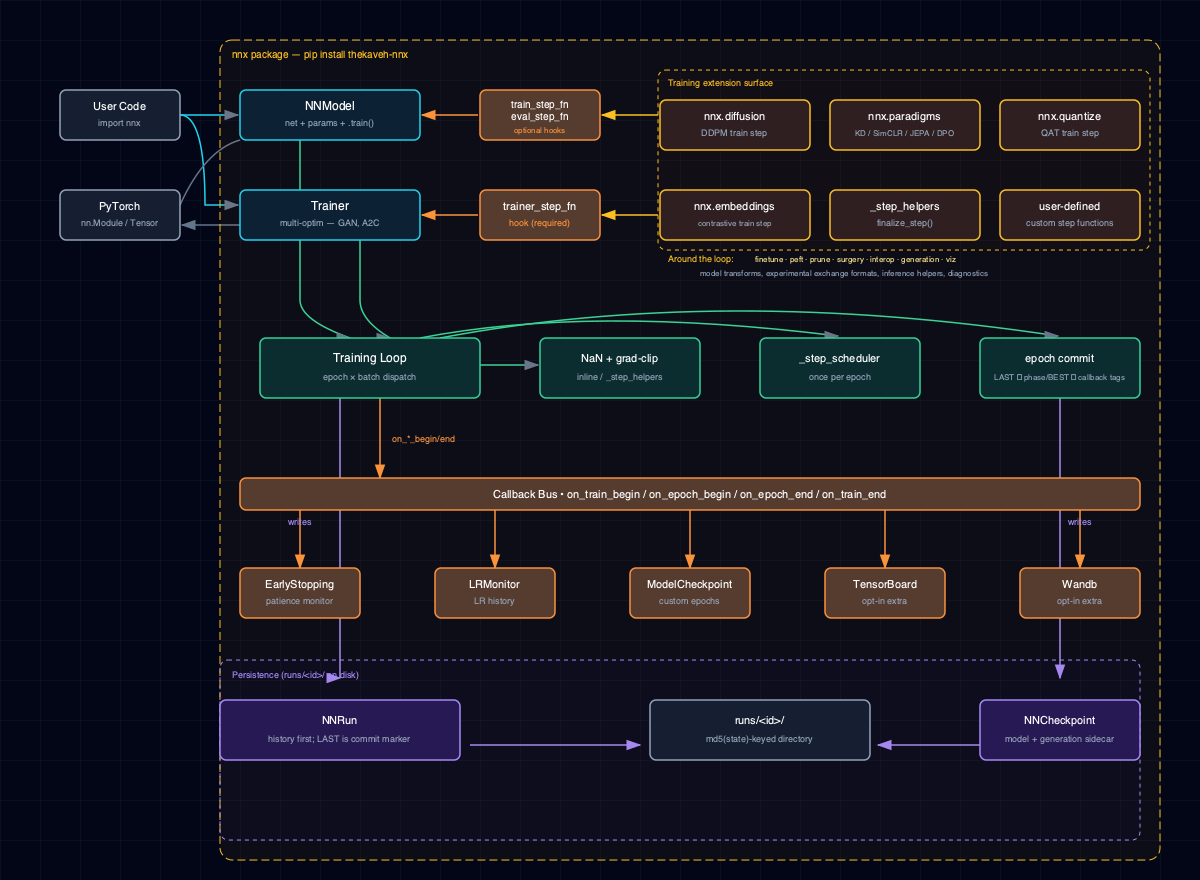
The architecture separates user-facing orchestration, per-batch extension hooks, callback lifecycle, and persisted run artifacts.
Reading the diagram top-to-bottom (summary):
- User code instantiates
NNModel(supervised) orTrainer(multi-optimizer for GAN / actor-critic). - The
train_step_fn/eval_step_fn/trainer_step_fnhooks are the training extension bus.diffusion,paradigms,quantize, andembeddingsprovide hook-compatible factories;_step_helperssupplies shared step finalization. The remaining specialization packages provide model transforms (finetune,peft,prune,surgery), exchange formats (interop), inference utilities (generation), and diagnostics (viz) that compose around the loop rather than injecting hooks. - The Training-loop internals run per-batch step hooks inside the data loop, then
_save_checkpointsonce per completed epoch;_step_schedulersteps each scheduler once per completed epoch by default (clock="epoch"), or once per committed optimizer update withNNSchedulerParams(clock="optimizer_update"). Paradigm/diffusion step factories additionally route throughfinalize_step(NaN guard + grad-clip). - The Callback bus fires
on_train_begin / on_epoch_begin / on_epoch_end / on_train_endto every registered listener (EarlyStopping,LRMonitor,ModelCheckpoint,TensorBoardCallback,WandbCallback). - After
on_epoch_end,NNRunandNNCheckpointcommit durable state in order: history → LAST → phase/BEST → deferred callback checkpoints.
See docs/concepts.md §1 for the full 8-layer breakdown.
1.2. Capabilities at a glance
- Generic training loop — callbacks, early stopping, schedulers (
Schedulersenum:REDUCE_LR_ON_PLATEAU/STEP/COSINE_ANNEALING/ONE_CYCLE/LINEAR_WARMUP_DECAY), an explicit FP32 / FP16 / BF16 precision policy (PrecisionPolicy), gradient clipping, gradient accumulation, seeded reproducibility, custom metrics, declared metrics with one named monitor shared by BEST selection, plateau scheduling and early stopping (MetricSpec/MonitorSpec), and objectives (LossTerms with explicit denominators) over one shared update engine that gives accumulation and clipping toNNModelandTraineralike, plus the precision policy (supervised_objective,kd_objective,diffusion_objective,jepa_objective). - Content-addressed persistence —
NNRunsavesrun.yaml+idps.csv+metadata.yamlunderruns/<id>/(whereidis the md5 ofstate()). LAST is the epoch commit marker: failed LAST writes roll history back, while failures in later ancillary tags retain the committed history/LAST pair.NNRun.load()truncates history newer than LAST after an interrupted process.NNCheckpointsaves FIRST / Q1 / Q2 / Q3 / LAST / BEST with generation-addressed training-state sidecars for warm resume. Opt-inhistory=HistoryJournal(retention, chunk_size)(nnx.history) keeps a bounded window in memory and appends every record once toruns/<id>/history/instead of rewritingidps.csv, with lazy tail reads, CSV export and lineage-aware iteration. - Task adapters — declare
NNModelParams(task=TaskSpec.regression(n))(or.multilabel(n, threshold=...)/.categorical(n, ignore_index=...)) and the default training step,evaluate()andpredict()validate batches before any update, mask NaN / ignored targets out of loss and metrics alike, average the loss over valid targets (exact under uneven batches and gradient accumulation) and reportmse/mae(or subset / element accuracy) without fabricated classification fields. Seeexamples/regression_task.py. - Query-grouped ranking —
nnx.ranking.RankingTasktrains a scorer with a pairwise logistic objective over unequal-relevance pairs within each query and evaluates MRR@k, Recall@k and NDCG@k per complete query (ties broken by candidate id, queries without a relevant candidate excluded and counted), selectable by name withMonitorSpec("ndcg_at_10"). Seeexamples/ranking_offline.py. - Graph-level classification —
nnx.graph_tasksclassifies whole graphs: aGraphCollectionwith stable graph ids, mean / sum pooling, loss and metrics over labeled graphs, and one prediction row per graph keyed by its id through training, prediction and reload. Seeexamples/graph_classification_offline.py. - Link and edge prediction —
nnx.link_taskssplits edges (not nodes) into a replayable manifest, passes messages over training edges only, draws negatives from the graph's complement, reports exact AUROC / AP and refuses a held-out positive in a message graph before any update. Seeexamples/link_prediction_offline.py. train_step_fnhook — swap the per-batch supervised step for any user-supplied function. Unblocks autoencoder / VAE / recommendation / diffusion / KD / SimCLR / Mixup / CutMix paradigms (link prediction is built in:nnx.link_tasks) without modifying NNx internals.- Fine-tuning (transfer learning) —
nnx.finetune.{freeze, unfreeze, load_pretrained, NNParamGroupSpec, build_param_groups}plusNNModel.{freeze, unfreeze, export_state_dict}. Glob-pattern layer freezing, external state-dict loading with optional key remapping, per-layer-group learning rates viaNNOptimParams.param_groups. - Multi-optimizer
Trainer—nnx.trainer.TrainerparallelsNNModel.train()for scenarios that need disjoint optimizers (GAN G/D, actor-critic). Accepts a name-keyed dict ofNNOptimParams(or registeredNNOptimFactoryParams); each entry'sNNParamGroupSpecscopes the optimizer under strict-partition semantics. - Optimizers — built-in SGD / Nesterov SGD / Adam / AMSGrad / AdamW (decoupled weight decay) via
Optims, plus registered optimizer factories (nnx.register_optimizer_factory+NNOptimFactoryParams(OptimizerFactorySpec(id, version, config))) for any othertorch.optim.Optimizer.NNModelandTrainerbuild both through one hook,nnx.build_optimizer, which checks a factory's optimizer owns exactly the resolved parameter groups;run.yamlstores only the factory's id/version/config, so runs reload offline and resume validates the factory identity. See Concepts §3.1. - Diffusion (DDPM) —
nnx.diffusion.{NoiseSchedulers, DiffusionMLP, diffusion_train_step_factory, sample}. LINEAR / COSINE noise schedules, a small conditional MLP denoiser, a DDPM-style training step factory that plugs into thetrain_step_fnhook (ordiffusion_objective, the same loss over the shared update engine, with its own checkpointed generator), and a reverse-diffusion sampler. - Training paradigms —
nnx.paradigms.{kd, feature_kd, simclr, mixup, cutmix, moe, jepa, dpo}_train_step_factoryplusborn_again_train. Hinton-style knowledge distillation (teacher frozen, soft+hard loss mix), FitNets-style feature distillation (feature_kd_train_step_factoryadds an MSE term between named teacher/student intermediate activations via forward hooks, mixed in withbeta), SimCLR contrastive (NT-Xent loss exposed), Mixup and CutMix batch augmentation, sparse top-k Mixture-of-Experts (softmax-gated routing + Switch-style load-balancing aux loss + drop-innnx.MoELinear), I-JEPA self-supervised pretraining (masked patches → latent prediction against an EMA target encoder; ships withJEPAPredictor,build_target_encoder,update_ema,random_block_mask, and a smallViTNNencoder;jepa_objectiveruns it over the shared update engine with one EMA step per committed update), Born-Again Networks (iterated self-distillation across G generations), offline teacher distributions (nnx.paradigms.offline_distillation: distill from stored, permissioned teacher probabilities — no live teacher, no logits, noT²— with records aligned by sample and candidate id and reports that keep teacher agreement apart from labelled quality), and DPO (Rafailov et al. 2023 — preference-pair fine-tuning against a frozen reference policy via the chosen-vs-rejected log-ratio objective). All share an internal_step_helpers.finalize_stepfor grad-clip + NaN guard. - Parameter-efficient fine-tuning (PEFT) — LoRA + DoRA + IA3 + Prefix + Prompt + Adapters —
nnx.peft.{LoRALinear, apply_lora_to, save_lora_weights, load_lora_weights, AdapterLayer, DoRALinear, apply_dora_to, IA3Linear, apply_ia3_to, save_ia3_weights, load_ia3_weights, PrefixTuner, PromptTuner, save_prefix_weights, load_prefix_weights, save_prompt_weights, load_prompt_weights}. LoRA wrapsnn.Linearsubmodules in-place with a frozen base + trainable low-rank residual (B is zero-initialized so output at step 0 equals the pretrained behavior). DoRA (Liu et al., 2024) extends LoRA with a trainable per-output-row magnitude vector using onlyout_featuresextra parameters per layer. IA3 (NeurIPS 2022) is the smallest adapter in the family: a single learned per-output-dim scaling vector applied to a frozen Linear's output. PrefixTuner prepends a learned key/value prefix to every attention layer of a frozenTransformerNN; PromptTuner prepends learned soft-prompt embeddings ahead of the input tokens.save_*_weightspersist only the trainable delta for each method. - Quantization — torchao-based PTQ INT8 weight-only via
nnx.quantize.quantize_int8(model)(one call, no calibration data, no retraining; returns a new instance of the same model class — aGenerativeNNModelkeeps its tokenizer andgenerate— whosenet.Linearweights are stored in int8 per-channel with FP32 activations; the quantized model still ONNX-exports) and QAT 8da4w viannx.quantize.{qat_train_step_factory, QATLifecycleCallback}(Int8DynActInt4WeightQATQuantizer fake-quant during training, real-quant on convert). Opt-in extra:pip install thekaveh-nnx[quantize]. - Pruning —
nnx.prune.magnitude_prune(mask-based unstructured, checkpoint-safe) andnnx.prune.semi_structured_24(2:4 semi-structured via torchao, Ampere+ hardware speedups). - Model surgery — Net2Net + drop + low-rank + embedding —
nnx.surgery.{widen, deepen, drop_layer, low_rank_factorize, expand_embedding}.widenanddeepenare function-preserving Net2Net edits (Chen/Goodfellow/Shlens, ICLR 2016) on validated topologies —widenfor a Linear insidenn.Sequential/FeedFwdNN.layerswith only elementwise ops before its consumer (Softmax/LayerNorm/BatchNorm boundaries, other containers and aliased modules are rejected up front),deepenthrough ReLU — so the surged module's forward output matches the original's before refinement and a freshly describedNNModelcan resume training immediately without an accuracy cliff.low_rank_factorizeis SVD truncation on a Linear (exact at max rank, Eckart-Young-bounded below it).drop_layerreplaces a named layer withnn.Identity;expand_embeddinggrows an Embedding's row count and returns a frozen-mask for the original rows. Every primitive returns a freshnn.Moduleand composes withNNModel.train()for the "refine after surgery" loop. Recorded recipes (nnx.transforms.TransformRecipe: LoRA on explicit Linear targets, SVD low-rank replacement) are validated up front and travel with every checkpoint and Hub save, sofrom_checkpoint/from_pretrainedrebuild the transformed topology without rerunning SVD. - Embeddings — contrastive trainer + FAISS export —
nnx.embeddings.{ContrastiveTextDataset, train_contrastive, embed_texts, text_contrastive_train_step_factory, export_to_faiss, export_to_safetensors}. Train a domain-specific text embedder from(anchor, positive)pairs via the existing NT-Xent machinery, then export to a FAISS index file that any RAG framework (LangChain / LlamaIndex / Haystack / raw FAISS) can consume. NNx's job ends at the FAISS index — chunking / reranking / prompt orchestration live downstream. Optional dep:pip install "thekaveh-nnx[embeddings]"forfaiss-cpu+sentence-transformers. - Networks —
FeedFwdNN,FeedFwdMoENN,ConvNN,GraphConvNN/GraphSageNN/GraphAttNN(all built on the sharedGraphNNBase),TransformerNN(decoder-only LM: RMSNorm + RoPE + SwiGLU + tied embeddings + KV-cache), andViTNN(small ViT encoder used as the I-JEPA backbone;Nets.VITbuilds it fromNNViTParams, andNNModel.from_checkpoint,reconstruct_bundleandNNModel.from_pretrainedrebuild a stored encoder — a JEPA run's withexclude_submodules=("_jepa_predictor",)). - Language modeling (opt-in via
thekaveh-nnx[lm]) —TransformerNN+NNTransformerParams+NNTokenizerParams(HF Rust BPE wrapper) +GenerativeNNModel.generate(prompt, ...)with KV-cache acceleration for autoregressive decoding. A CPU regression test requires cached decoding to be at least 1.2× faster than full recomputation for its fixed 128-token workload; results on other hardware and workloads vary. Pastmax_seq_len, the cache rebuilds per step and converges to full-recompute cost. Greedy / top-k / top-p / repetition-penalty sampling is provided through aLogitsProcessorchain. See docs/lm.md for the full walkthrough;examples/11_tinystories_lm.pyships an end-to-end TinyStories-class training run. - Experimental GGUF export (opt-in via
thekaveh-nnx[gguf-write]) —nnx.interop.write_gguf(model, tokenizer, path)writes a structurally valid GGUF artifact with NNx tensor names andgeneral.architecture=nnx_transformer. Stock llama.cpp, Ollama, and LM Studio do not implement that architecture; use the output for inspection or a reader explicitly patched for NNx. See docs/gguf.md. - HuggingFace Hub (opt-in via
thekaveh-nnx[hub]) —NNModelmixes inPyTorchModelHubMixin:save_pretrained/push_to_hub/from_pretrained, with safetensors as an opt-in checkpoint format viaNNCheckpoint.to_file(format="safetensors"). See docs/hub.md. - Datasets —
NNDataset(torchvisionVisionDatasetwrapper),NNGraphDataset(PyG single-graph wrapper usingNeighborLoader),NNTabularDataset(pandas DataFrame → train/val/test loaders),NNPreferenceDataset(tokenized(prompt, chosen, rejected)preference triples for DPO). - Params — frozen, kw-only, slotted dataclasses for every config knob:
NNParams,NNModelParams,NNTrainParams,NNOptimParams,NNSchedulerParams,NNTrainerParams. Every params object round-trips throughstate()/from_state(). New fields omit themselves fromstate()when at their default so existingrun.idhashes are preserved. - Fluent params construction —
NNSchedulerParams.builder(),NNOptimParams.builder(),NNTransformerParams.builder(), andNNTrainerParams.builder()(the composite, wraps the prior two for the multi-optim Trainer) expose variant-gated.adam(...)/.sgd(...)/.one_cycle(...)/ etc. methods so the user can't construct an invalid kind/field combination.LogitsChain.builder()extends the pattern to the LM-decoding path — chain custom logit processors in any order; the Builder sorts them into NNx's canonical order (matchinggenerate()'s inline-kwargs chain) before decoding runs. When the order itself matters,OrderedLogitsPipelineruns immutable stages exactly as declared (append/prependreturn new pipelines, a zero-temperature stage is terminal, built-in stages round-trip through versioned state) viagenerate(logits_pipeline=...);apply_chainstays the raw list form. All Builders are purely additive; the existing direct-kwarg ctors keep working. The four params Builders branch with.copy()(complete or partial, no cross-talk) and rebuild from an existing value withBuilder.from_params(params)(build()reproduces it exactly, samestate()and run id) — seeexamples/builder_branching.py. - Enums-as-factories —
Nets,Losses,Optims,Schedulers,Activations,Devices,Checkpoints,NoiseSchedulers. Each enum value's__call__constructs the underlying object; adding a new option is a single-place change. - Experiment provenance — opt-in
train(..., provenance=ExperimentManifest(...))records the declared intent (task, labels, model descriptor, data and split identities, objective version) with a canonical SHA-256 fingerprint and a fresh attempt record per fit (status, last committed checkpoint, resume lineage), kept separate fromrun.idand the environment snapshot;nnx.provenance.comparediffs two plans without loading models. - Reproducible splits —
nnx.data_splits.plan_splitplans group, chronological (cutoffs + gap) and stratified splits by sample id into a JSONSplitManifest;NNTabularDataset(split=manifest, id_col=...)replays it on reordered rows withoutrandom_split, and duplicate, missing or unexpected ids or a changed source identity fail before any loader exists. Seeexamples/split_replay.py. - Train-only preprocessing —
nnx.preprocessing.Standardizerfits on an explicit training membership (never a held-out row), reuses its frozen float64 statistics under a declared column / order / dtype schema, and reloads from JSON to serve a model without refitting;NNTabularDataset(standardize=True)fits on the training split, andNNDataset(train_transform=..., eval_transform=...)gives each split its own transform over an untouched base dataset. Seeexamples/preprocessing_offline.py. - Fitted calibration —
nnx.calibration.fit_temperaturefits one scalar temperature on a named calibration split (float64, never the train or test split), returns a failure instead of a NaN calibrator, and binds the result to its label order and model id; the JSON calibrator serves raw and calibrated probabilities side by side and reports held-out NLL, Brier and reliability bins before and after — saying so when calibration made things worse. Seeexamples/calibration_offline.py. - Abstention —
nnx.abstentionpolicies accept a row only when its top probability (or top-two margin) reaches a threshold and abstain otherwise, keeping the prediction, distribution and reason;select_thresholdtunes the threshold on a named validation split against an empirical risk ceiling, and reports give coverage over every row and selective risk over the accepted ones (unavailable, never 0, when nothing is accepted). Seeexamples/abstention_offline.py. - Experiment plans — an immutable
ExperimentPlanbranches a configuration without copying dataclasses (with_epochs,with_seed,with_data, ...). It separates a purevalidate(), which aggregates field-path diagnostics and reads no loader, from an effectfulprobe(batch), which restores the ambient RNG and backend settings, and fromfit(), which compiles to the existingNNModel.trainloop as a distinct attempt with its own run directory. Seeexamples/experiment_plan.py. - Multi-seed summaries and paired comparisons —
nnx.comparisonreports repeated runs as a population, read-only: eachObservationdeclares its metric (name, direction, unit), evaluation split, checkpoint-selection rule, configuration, data and split identity, replicate key and attempt status, andsummarizestratifies incompatible observations instead of pooling them (count, mean, sample standard deviation withn - 1; failed and non-finite attempts stay counted).comparepairs two configurations by declared replicate keys and reports signedB - Adeltas;observations_from_runsreads saved runs without loading a model. Seeexamples/compare_seeds.py. - Typed decisions —
nnx.decisionsasks provider-neutralChoice/Boolean/Scorequestions and returns validated, labelled probabilities;FixedHeadProviderserves a trained classifier's head (exact label space or bijection, capabilities checked before any model call), andNLIProvideris a local label-conditioned baseline that scores candidates supplied at inference with a caller-supplied NLI model (nothing downloaded; scores recorded as uncalibrated);JevProvider(thejevextra) asks hosted Jev models through the TypeSafe SDK, with typed failures and the SDK owning retries.DecisionJobbatches independent questions into the fewest provider calls and chains dependent ones, fail-fast, sync or async.nnx.decisions.benchmarkscores providers on identical samples and replays saved records offline (coverage counts, accuracy, macro-F1, exact NLL, Brier, reliability, grouped bootstrap intervals). See docs/decisions.md,examples/decision_fixed_head.py,examples/decision_nli.py,examples/decision_jev.py,examples/decision_jobs.pyandexamples/decision_benchmark_offline.py. - Your own modules —
NNModelalso trains anytorch.nn.Module: register a factory (register_model_factory,ModelSpec(id, version, config, seed)) for a portable model that rebuilds from checkpoints, safetensors and the Hub, or wrap an instance as is (NNModel(module=m, ...), runtime-only);PositionalInputs/KeywordInputsbatch adapters feed positional or keywordforwards. Seeexamples/custom_module.py. - Callbacks —
Callbackbase class withon_{train,epoch}_{begin,end}hooks. Stock:EarlyStopping,LRMonitor,ModelCheckpoint(custom-epoch tags),TensorBoardCallback(opt-in viathekaveh-nnx[tensorboard]),WandbCallback(opt-in viathekaveh-nnx[wandb]). LegacyCallable[[List[IDP]], None]is still accepted. - Visualization —
VisUtils(and module-level aliases) returns PlotlyFigureobjects:confusion_matrix,classification_report(returns a DataFrame),multi_line_plot,scatter_plot,two_dim_tsne_checkpoint_logits. - Model-internals viz —
nnx.viz.summary(Keras-style parameter table viatorchinfo),nnx.viz.weight_histogram(per-layer Plotly histogram grid),nnx.viz.activation_map(forward-hook activation heatmaps),nnx.viz.attribute(Captum-backed input attribution:integrated_gradients/gradient_shap/deep_lift/saliency/input_x_gradient/occlusion, returns the attribution tensor plus a Plotly heatmap),nnx.viz.gradient_flow(per-layer L2 gradient-norm bar chart for vanishing/exploding diagnostics, call afterloss.backward()), andnnx.viz.netron_export(write the underlying network to a.onnxartifact for Netron). Companion to the existingnnx.vis_utilsrun-output viz; opt-in viapip install thekaveh-nnx[viz](pullstorchinfo+captum+ Plotly; the Netron browser viewer isthekaveh-nnx[viz-interactive]). - Reproducibility + training diagnostics —
nnx.set_seed(seed, strict=False)pins every RNG + cuDNN;nnx.dataloader_worker_init_fnhandles per-worker seeds;NNTrainParams.seedrunsset_seedattrain()entry.nnx.lr_finder(model, train_loader, *, loss_fn, ...)runs a fastai-style exponential LR sweep and returns the Smith-2017 suggested one-cyclemax_lrplus a Plotly figure; the sweep restores model state, every module's train/eval mode, loader generators, and Python/NumPy/PyTorch RNG state on exit. - Type-checked downstream — NNx ships a PEP 561
py.typedmarker so consumers'pyright/mypyhonor the public-surface annotations onNNModel, the params dataclasses, callbacks, and enums (rather than seeing every symbol asAny). - Opt-in
torch.compile, measured —model.train(params, compile=CompileSpec())compiles the built-in step's FP32 forward through a per-fit wrapper besidemodel.net(checkpoints, export and later inference stay eager), records requested vs effective state on the run, checkpoints and provenance, and never guarantees a speedup:nnx.benchmarkingseparates first-call compile cost from warmed latency and profiles with a finitetorch.profilerschedule. Not with DDP or quantization. See Concepts §28. - ONNX export —
NNModel.to_onnx(path, example_input)exports the network via the legacytorch.onnx.export(noonnxscriptdep needed). Passdynamo=True(opt-in viathekaveh-nnx[onnx-dynamo]) to dispatch through PyTorch's newertorch.export-based exporter (default in torch>=2.9; supports >2 GB models via external data; generally faster). Structural validity and numerical parity are separate claims:nnx.export_conformanceexecutes both exporters' FP32 feed-forward profiles in ONNX Runtime on CPU and records every stage and artifact hash (scripts/check_export_conformance.py, extraonnx-runtime); other targets stay structural. See Export conformance.
2. Install
2.1. Runtime
pip install thekaveh-nnx                        # core: training, prediction, persistence (latest release from PyPI)
pip install "thekaveh-nnx[domains]"             # + the vision, graph and plotting stacks (everything core held before 0.4)
The core install is torch, NumPy, pandas, scikit-learn and a few small utilities: import nnx loads no vision, graph or plotting stack. Those are extras — vision (torchvision: NNDataset), graph (PyTorch Geometric: the graph nets, NNGraphDataset, nnx.graph_tasks, nnx.link_tasks) and plots (Plotly: VisUtils, nnx.lr_finder, the NNRun chart) — and using one without its extra raises an ImportError naming it (pip install "thekaveh-nnx[graph]"). domains installs all three.
Python 3.10+ with PyTorch 2.4+ (torchvision 0.19+ with the vision extra) — the oldest pair the full test suite passes on; see the PyTorch support matrix for every tested torch / torchvision / Python combination and which carry real CUDA evidence. Tested on 3.10 through 3.14. Examples in examples/ are runnable on CPU. Optional extras keep their own version constraints (torchao for [quantize] is validated only against the frozen lock, not the floor).
2.2. Optional extras
pip install "thekaveh-nnx[vision]"              # NNDataset (torchvision datasets)
pip install "thekaveh-nnx[graph]"               # graph nets, NNGraphDataset, nnx.graph_tasks, nnx.link_tasks
pip install "thekaveh-nnx[plots]"               # VisUtils, nnx.lr_finder, the NNRun chart (Plotly)
pip install "thekaveh-nnx[domains]"             # vision + graph + plots
pip install "thekaveh-nnx[tensorboard]"         # TensorBoardCallback
pip install "thekaveh-nnx[wandb]"               # WandbCallback
pip install "thekaveh-nnx[onnx]"                # NNModel.to_onnx validation tooling
pip install "thekaveh-nnx[onnx-dynamo]"         # NNModel.to_onnx(dynamo=True) — torch.export-based exporter
pip install "thekaveh-nnx[onnx-runtime]"        # ONNX Runtime CPU execution: nnx.export_conformance parity profiles
pip install "thekaveh-nnx[quantize]"            # nnx.quantize_int8 (torchao PTQ INT8)
pip install "thekaveh-nnx[hub]"                 # safetensors checkpoints + HuggingFace Hub publish/load
pip install "thekaveh-nnx[embeddings]"          # nnx.embeddings: FAISS export + sentence-transformers
pip install "thekaveh-nnx[lm]"                  # TransformerNN + HF tokenizer + generate()
pip install "thekaveh-nnx[gguf-write]"          # experimental NNx GGUF writer
pip install "thekaveh-nnx[viz]"                 # nnx.viz: summary + weight_histogram + activation_map + attribute + gradient_flow + netron_export
pip install "thekaveh-nnx[viz-interactive]"     # adds Netron browser viewer for nnx.viz.netron_export(launch=True)
pip install "thekaveh-nnx[docs]"                # local documentation build toolchain
For a reproducible contributor environment, install with the committed resolver state:
python -m pip install -r requirements-tools.txt
uv sync --all-extras --frozen
For local development (editable install from a git checkout, including the test/lint toolchain), see CONTRIBUTING.md §1.
3. Quickstart
End-to-end CPU example — a tiny random-tensor classification run:
import torch
from torch.utils.data import DataLoader, TensorDataset

from nnx import (
    NNModel, NNParams, NNModelParams, NNTrainParams,
    NNOptimParams, NNSchedulerParams,
    Activations, Devices, Losses, Nets, Optims,
    EarlyStopping,
)

# 1. Data
X_train, y_train = torch.randn(256, 8), torch.randint(0, 3, (256,))
X_val,   y_val   = torch.randn(64, 8),  torch.randint(0, 3, (64,))
train_loader = DataLoader(TensorDataset(X_train, y_train), batch_size=32, shuffle=True)
val_loader   = DataLoader(TensorDataset(X_val,   y_val),   batch_size=32)

# 2. Model
net_params   = NNParams(input_dim=8, output_dim=3, hidden_dims=[32, 16],
                        dropout_prob=0.1, activation=Activations.RELU)
model_params = NNModelParams(net=Nets.FEED_FWD, device=Devices.CPU,
                             loss=Losses.CROSS_ENTROPY)
model = NNModel(net_params=net_params, params=model_params)

# 3. Train
train_params = NNTrainParams(
    n_epochs=10,
    train_loader=train_loader,
    val_loader=val_loader,
    optim=NNOptimParams(name=Optims.ADAM, max_lr=1e-2,
                        momentum=(0.9, 0.999), weight_decay=5e-5),
    scheduler=NNSchedulerParams(min_lr=1e-7, factor=0.5,
                                patience=3, cooldown=1, threshold=1e-3),
)
run = model.train(params=train_params, callbacks=[EarlyStopping(patience=5)])

# 4. Use it
print(f"trained {len(run.idps)} iterations; saved under runs/{run.id}/")
logits, classes = model.predict(X=X_val.numpy())  # returns PredictResult(logits=..., classes=...)

# Opt-in probabilities with an explicit task declaration (predict() is unchanged)
from nnx import ProbabilitySpec
proba = model.predict_proba(X_val.numpy(), ProbabilitySpec(kind="categorical", class_axis=1))
proba.probabilities, proba.decoded, proba.sample_ids  # softmax rows sum to 1; ids align with X_val
4. Advanced patterns
4.1. Switching networks
Change the Nets enum value passed to NNModelParams; NNModel constructs the underlying network for you:
NNModelParams(net=Nets.GRAPH_CONV,  device=Devices.CPU, loss=Losses.CROSS_ENTROPY)
NNModelParams(net=Nets.GRAPH_SAGE,  device=Devices.CPU, loss=Losses.CROSS_ENTROPY)
NNModelParams(net=Nets.GRAPH_ATT,   device=Devices.CPU, loss=Losses.CROSS_ENTROPY)
# Then pass NNParams(..., n_heads=4) for GRAPH_ATT.
# Use NNGraphDataset (PyG NeighborLoader-backed) to feed batches.
See examples/ for runnable end-to-end scripts.
4.2. Reproducibility
from nnx import set_seed, dataloader_worker_init_fn
set_seed(42)                                        # pins torch / numpy / python / cudnn
DataLoader(..., worker_init_fn=dataloader_worker_init_fn)
NNTrainParams(seed=42, ...)                         # pins again at train() entry
4.3. Warm-resume training
run = model.train(params=NNTrainParams(n_epochs=10, ...))

# Build a fresh NNModel and continue from run's LAST checkpoint
# (optimizer topology/state, scheduler, scaler, epoch, loader generators,
# and Python/NumPy/PyTorch CPU/CUDA/MPS RNG state preserved):
NNModel(net_params=..., params=...).train(params=NNTrainParams(
    n_epochs=10,
    resume_from_run_id=run.id,
    resume_from_checkpoint="last",   # or "best" / "first" / "q1" / "q2" / "q3"
    ...
))
Callback and step state continues too: EarlyStopping's patience, the I-JEPA EMA target encoder, the diffusion and JEPA objectives' state (generator; EMA target and counter) and any object passed through train(..., components=[...]) are versioned components (nnx.components), validated before anything is mutated and restored transactionally after the callbacks' reset hooks. resume_mode ("auto" / "stateful" / "weights_only") chooses what is restored, and run.resume_status reports it. resume_epochs="planned" (on an experiment plan, resuming(..., epochs="planned")) continues a run's own plan up to its n_epochs (logical steps, updates and phase tags carried on) — on deterministic single-process training with in-process loaders, a run split at epoch boundaries equals the uninterrupted run bit for bit — and every checkpoint is a generation-stamped, SHA-256-digested resume point, so a torn, mixed or corrupted one is refused with its reason (ResumePointError). The multi-optimizer nnx.trainer.Trainer resumes every named optimizer and scheduler via NNTrainerParams.builder().resume_from(run_id). See Concepts §14.
Scope: Loader and sampler generators are restored by stable seed identity. Exact continuation still requires
train_loader.num_workers=0, because worker-local RNG state cannot be reconstructed. Resume happens at completed-epoch boundaries.
4.4. Custom metrics
NNTrainParams(
    ...,
    extra_metrics={
        # Called as fn(y_true, y_pred): truth first, decoded predictions second.
        "my_metric": lambda y_true, y_pred: float((y_true == y_pred).mean()),
    },
)
# Available on idp.train_edp.extra / idp.val_edp.extra and survives NNRun.load.

# Declared metrics (labels / probabilities / continuous inputs, full-sample values)
# and one monitor for BEST, ReduceLROnPlateau and EarlyStopping:
monitor = MonitorSpec(metric="nll", min_delta=0.01)
NNTrainParams(..., metrics=[MetricSpec("nll"), MetricSpec("brier")], monitor=monitor)
See Concepts §6.4: custom metrics register with nnx.register_metric, training records carry a whole-epoch train_summary and the epoch's monitor selection, and named-monitor runs never claim runs/best.
4.5. Visualization
from nnx import VisUtils
fig = VisUtils.confusion_matrix(y_true, y_pred, class_names=["a","b","c"])
fig.show()
df = VisUtils.classification_report(y_true, y_pred)  # DataFrame
4.6. Auto device detection
from nnx import Devices
NNModelParams(net=Nets.FEED_FWD, device=Devices.get(), loss=Losses.CROSS_ENTROPY)
# Devices.get() picks MPS (Apple) > CUDA > CPU.
4.7. Precision (FP32 / FP16 / BF16)
from nnx import PrecisionPolicy
NNModelParams(..., precision=PrecisionPolicy("bf16"))                   # CPU, or CUDA with bf16 support
NNModelParams(..., precision=PrecisionPolicy("fp16", fallback="fp32"))  # CUDA fp16, else recorded fp32
An unsupported request fails before any run is reserved unless it names a
fallback; run.precision records the requested and effective precision, the
fallback reason and TF32. The legacy mixed_precision=True (CUDA FP16,
silently FP32 elsewhere) keeps its meaning and run id. See
Quickstart §2.2.
4.8. Scheduler choices
By default the scheduler is ReduceLROnPlateau driven by the params dataclass. Pass kind= to switch:
from nnx import Schedulers
NNSchedulerParams(..., kind=Schedulers.COSINE_ANNEALING, T_max=100)
# Or: STEP, ONE_CYCLE, LINEAR_WARMUP_DECAY
4.9. Loading a run
from nnx import NNRun, NNCheckpoint, Checkpoints
run  = NNRun.load(id="<md5>")                              # rehydrate idps + params
ckpt = NNCheckpoint.load(run=run.id, type=Checkpoints.BEST)
model = NNModel.from_checkpoint(checkpoint=ckpt)
from_checkpoint also replays persisted topology transforms before loading weights. In particular, QAT-produced LAST checkpoints record their torchao recipe and reload as converted quantized models without downstream prepare/convert code.
5. Documentation
The documentation below covers the public API, architecture, extension contracts, and runnable examples.
5.1. Conceptual + reference
- Concepts — architecture deep-dive, persistence layout, callback protocol, every specialization in detail. Read this when you want to understand how the pieces fit together (callbacks, params hashing, train_step_fn hook, multi-optim Trainer, paradigms, PEFT).
- Quickstart — paste-runnable example with variations. Read this when you want to copy a working snippet and iterate from there.
- Language modeling — the decoder-only Transformer path:
TransformerNN+ HF tokenizer +GenerativeNNModel.generate()with KV-cache. Read this when you want to train a tiny LM end-to-end on CPU. - Direct Preference Optimization —
dpo_train_step_factoryfor fine-tuning a TransformerNN against(prompt, chosen, rejected)preference pairs via the Rafailov et al. 2023 chosen-vs-rejected log-ratio objective against a frozen reference policy. Read this when you have preference data and want to steer LM behavior post-SFT without reward modeling or RL. - Typed decisions —
nnx.decisions, the inference branch: provider-neutralChoice/Boolean/Scorequestions, validated labelled probabilities, declared provider capabilities, the fixed-head adapter for trained classifiers, the NLI baseline for labels supplied at inference, the Jev adapter for hosted models, deferred decision jobs (batching, continuations, fail-fast, cancellation) and the offline-first provider benchmark. Read this when a caller needs a named, validated answer rather than positional logits. - I-JEPA — Joint Embedding Predictive Architecture: masked-patch → latent-prediction self-supervised pretraining against an EMA target encoder. Read this when you want to pretrain a vision encoder without pixel-reconstruction or strong augmentations.
- Experimental GGUF export —
nnx.interop.write_gguffor producing and inspecting an NNx-tagged GGUF artifact; includes the official llama.cppllama-quantizebuild path and the current stock-runtime limitation. - HuggingFace Hub — safetensors checkpoints +
save_pretrained/push_to_hub/from_pretrainedonNNModel. Read this when you want to publish a trained model to the Hub, load from it, or write checkpoints in a format outside-of-Python tools (ComfyUI, vLLM, AutoGPTQ) can read. - Embeddings + FAISS export — walkthrough for training a domain-specific text embedder via contrastive learning and exporting it to a FAISS index for any RAG stack to consume.
- Model surgery — walkthrough of the
nnx.surgeryprimitives (widen/deepen/drop_layer/low_rank_factorize/expand_embedding), the function-preservation contract, before/after parameter-count tables, and the "load checkpoint → surgery → refine viaNNModel.train()→ save" pattern. - API reference — signatures and docstrings for public symbols.
- Comparison vs Lightning / HF / fastai / Composer — honest scope-explicit comparison: when to use NNx vs Lightning vs HF Transformers vs fastai vs MosaicML Composer, axis by axis. Read this when you're picking a PyTorch training toolkit and want a real decision matrix instead of a marketing page.
- Architecture — the system overview and exact training lifecycle, including callback, scheduler, history, and checkpoint ordering.
- External dependency contracts — ledger of optional integrations, version sources, verification coverage, and intentionally gated real-service checks. Read this before changing dependency ranges, external CLI commands, or publish workflows.
5.2. Workflow + history
- Examples catalog — ordered tour of the 26 runnable scripts under
examples/, grouped foundational to specialized (core loop, fine-tuning, paradigms, quantization, embeddings, language modeling, GGUF inspection, self-supervised learning, pruning, surgery, explainability, DPO, and distillation variants). - Test import boundaries — when tests should use the public facade and when a deep implementation import is intentional.
- Contributing — setup, back-compat invariants, test policy, the omit-when-default rule for params, what we will and won't merge.
- Security policy — supported versions, private vulnerability reporting, and the checkpoint trust boundary.
- Changelog — release history (Keep-a-Changelog format), back-compat migration notes, and on-disk run.id hash shifts when they occur.
6. Project
6.1. Status
Alpha. API is stable for the existing thekaveh/ml notebook consumer; pre-1.0 means we'll fix obvious bugs (see CHANGELOG) without renaming public APIs unless they're broken in ways notebooks can't work around.
6.2. Contributing
Bug reports and PRs are welcome via GitHub issues. See CONTRIBUTING.md for setup, verification, and the complete style guide.
6.3. License
Apache License 2.0. Copyright 2026 Kaveh Razavi. See LICENSE.
1 maintainer

Metadata
1 maintainer
Release files for thekaveh-nnx 0.4.0
For a detailed explanation of source distributions (sdists) and built distributions (wheels), please see the package formats documentation.
Source distribution (sdist)
| File | Size | Uploaded | |
|---|---|---|---|
| thekaveh_nnx-0.4.0.tar.gz | 1.6 MB | Details |
Built distribution (wheel)
| File | Interpreter | ABI | Platform | Reset |
|---|---|---|---|---|
| thekaveh_nnx-0.4.0-py3-none-any.whl | Python 3 | none | any | Details |
Total release size: 2.5 MB
Release files / thekaveh_nnx-0.4.0.tar.gz
| Download URL | thekaveh_nnx-0.4.0.tar.gz |
|---|---|
| Size | 1.6 MB |
| Tags | Source |
|
SHA-256 checksum How to use checksums |
82f42ef053e5bb9ac205977154de6d36abf4bdb652f5474c97ba97b65245ae96
|
|
BLAKE2b-256 checksum How to use checksums |
9beb97b46994f2affa8802f8803f06f8c0f13c22c85024d468840b66ff33cfbe
|
| Upload date | |
|
Uploaded using Trusted Publishing? What is trusted publishing? |
Yes |
| Uploaded via |
twine/7.0.0 CPython/3.13.14
|
Provenance
Provenance describes where a file came from. On PyPI, provenance is shared via attestations, which provide a verifiable record of the build or publishing details. View details, limitations and caveats.


PyPI Publish Attestation
PyPI verified that this artifact, at this checksum, originated from the publisher listed below.
Signed by GitHub Actions, verified by PyPI on Oct 12, 2026.
Transparency logRelease files / thekaveh_nnx-0.4.0-py3-none-any.whl
| Download URL | thekaveh_nnx-0.4.0-py3-none-any.whl |
|---|---|
| Size | 857.6 kB |
| Tags | Python 3 |
|
SHA-256 checksum How to use checksums |
436090664edd0c8dbb887f448ae8bc955b742df2b6dd94d531e0f360e14d0678
|
|
BLAKE2b-256 checksum How to use checksums |
95e5a2281e1686e2f8183d623a8bce7ef2bd51660f0241ef8c72e41de985a348
|
| Upload date | |
|
Uploaded using Trusted Publishing? What is trusted publishing? |
Yes |
| Uploaded via |
twine/7.0.0 CPython/3.13.14
|
Provenance
Provenance describes where a file came from. On PyPI, provenance is shared via attestations, which provide a verifiable record of the build or publishing details. View details, limitations and caveats.
PyPI Publish Attestation
PyPI verified that this artifact, at this checksum, originated from the publisher listed below.
Signed by GitHub Actions, verified by PyPI on Oct 12, 2026.
Transparency log













