

MuscleMemory
Open-source procedural memory for AI agents.
It learns from what worked and what failed.
Local by default · Apache-2.0 · by TheWariend
Coding agents relearn the same things every session: which files to open, how the tests run, what broke last time. MuscleMemory watches your agent work. When a task really succeeds (the tests pass after the last change), it learns how the task was done. The next time a similar task comes up, it hands the agent a short note: the files to change, the test that proves it worked, and what to avoid.
In a benchmark with real Codex sessions, it cut input tokens by 25.5%, tool calls by 30.4%
and time by 28.2%, with every task still passing. In an early run with Claude Code and
Sonnet 5.5, using skills that Codex had learned, it cut input tokens by 43.5% and tool
calls by 30%. On real Django issues from SWE-bench, with a skill learned from other
issues in the same area, Codex solved as many as without memory with about half the tokens
(a small run; details).
Check them yourself: python benchmarks/reproduce.py check.
Codex method and data ·
Claude Code run ·
Whitepaper.
Quick start
pipx install thewariend-musclememory  # or, from a clone: pip install -e .

musclememory init                      # sets up ~/.musclememory and the small search model
musclememory start                     # runs in the background on http://127.0.0.1:8080
cd your-project && musclememory connect codex   # or claude, cursor, cleanslate
musclememory dashboard                 # opens the dashboard, already signed in
Then use your agent as usual. There are no keys or config files to copy.
Or let your agent set it up: paste this into Claude Code, Codex or Cursor.
Read https://thewariend.com/musclememory/llms.txt and set up MuscleMemory for this project.
More in Install.
How it works
flowchart LR
    A["Your agent works on a task"] --> B{"Tests pass after the last change?"}
    B -- no --> C["Nothing is learned"]
    B -- yes --> D["Learn a skill or count a check"]
    D --> E["Two separate passing checks"]
    E --> F["You tap Keep"]
    F --> H["Hook checks current files"]
    H -->|"match or partial match"| G["Short note; warning on partial match"]
    H -->|"mismatch"| I["No note; skip recorded locally"]
    G --> A
- Verified, twice. Two later sessions must match the skill's actions and pass its
own stored test command after the last code change. Pipes, redirects and shell
wrappers are normalized; parameterized commands keep shape matching. Automatic
checks use the final passing test, so an unrelated test cannot count. The training
session doesn't count. Only real test runs count (
pytest,python -m unittest,go test,cargo test,npm test,make testand similar); commands that only mention tests, likecargo buildorruff check, don't. - One failure pulls it. If an agent was given a skill, changed code, and the skill's own test then failed as the last test run, the hooks report a failed check and the skill stops reaching agents. A session that just stops, or where a different test failed, doesn't count against it.
- Learns from failures. Failed attempts become plain "watch out" and "if it goes wrong" notes, so the agent avoids the same dead ends.
- You stay in charge. Every skill waits for your OK before any agent sees it, however it was learned (hooks, SDK, MCP or the API), and so does every new version. Only the dashboard can approve; an agent's own key can't. Skills you delete or retire stay removed: the same skill isn't learned again. Agents still read the current files and ask for approval as usual. MuscleMemory never replays actions.
- Checks current files. Native hooks require the files a skill found in place to still exist (files it created may not exist yet) and at least one stored before or after edit to match. If none match, they stay quiet; partial matches include a warning that cannot be trimmed. Reads are bounded and reject symlinks. File-check skips are recorded locally. Server and MCP recall have no file access. Exact rules.
- Quiet when it should be. If nothing fits, nothing is added, and the agent pays no extra tokens.
- Shared between agents. A skill learned with Codex is handed to Claude Code or
Cursor too: changing a file counts the same whichever tool did it.
Proven skills can also be exported to Codex or Claude Code as
SKILL.md. - Local and open. SQLite and a small on-device model by default: no account and no outside calls. Use PostgreSQL with pgvector for teams.
More detail in How it works.
Works with
| Agent | How it connects |
|---|---|
| Claude Code | musclememory connect claude installs capture hooks |
| Codex | musclememory connect codex installs capture hooks |
| Cursor | musclememory connect cursor installs capture hooks |
| CleanSlate | musclememory connect cleanslate wires its host stream |
| Any MCP client | Five tools: recall, observe, learn, evaluate, inspect |
| Your own agent | Python and TypeScript SDKs |
See Integrations.
Projects share skills within the same workspace (namespace, default "default"),
rather than getting a separate workspace per repository. Cross-repository recall is
untested. Give a project its own namespace.
Dashboard
 |
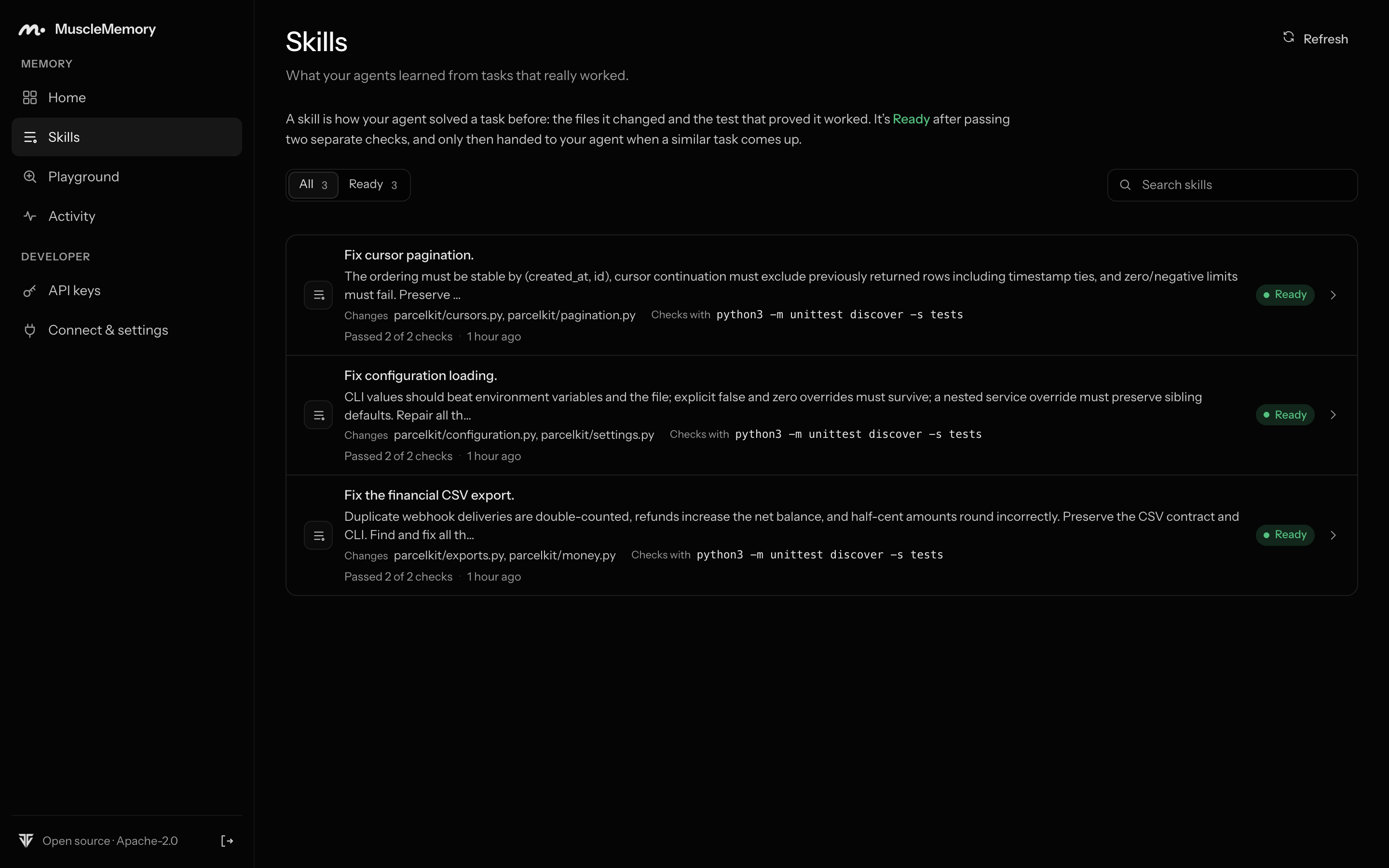 |
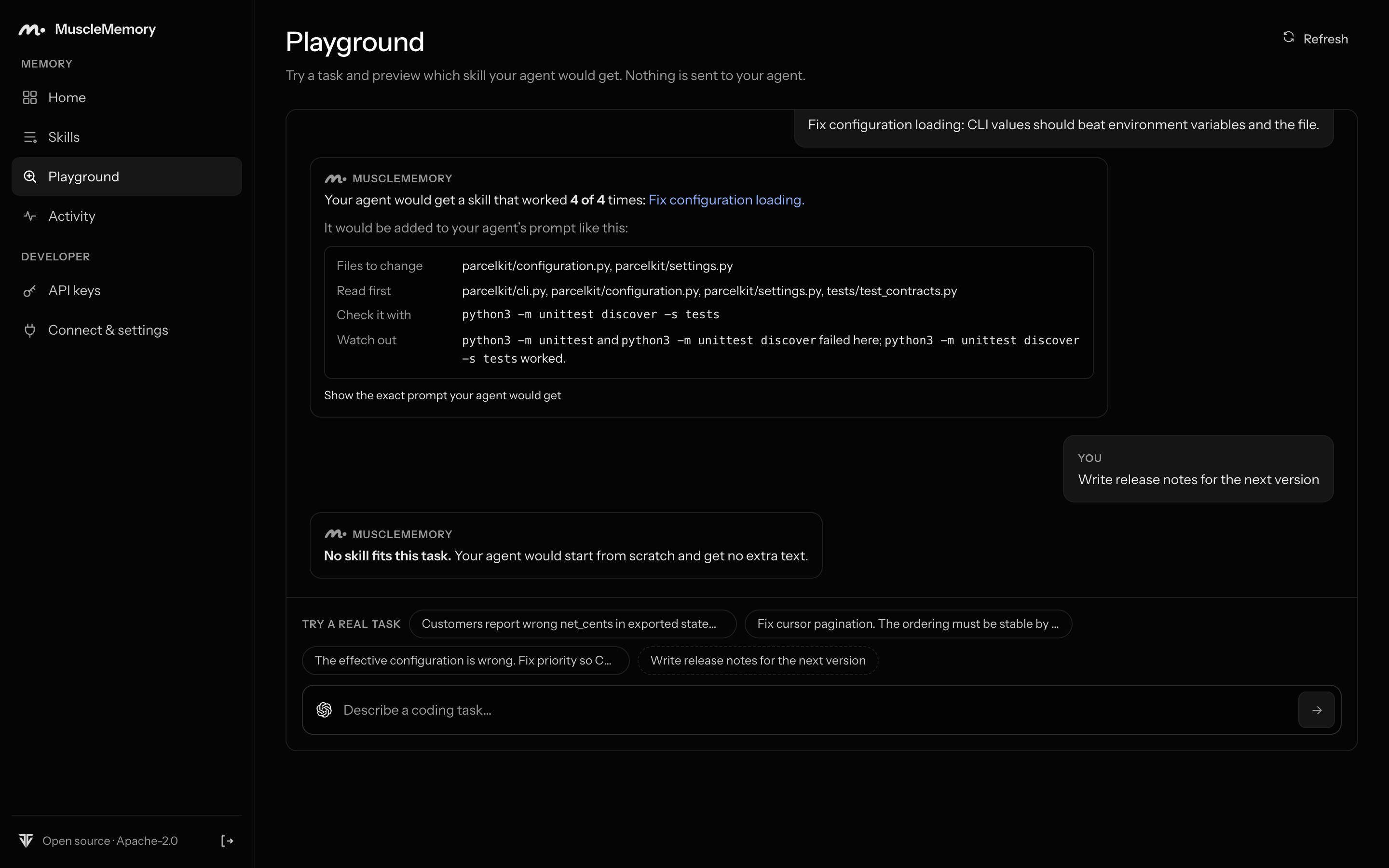
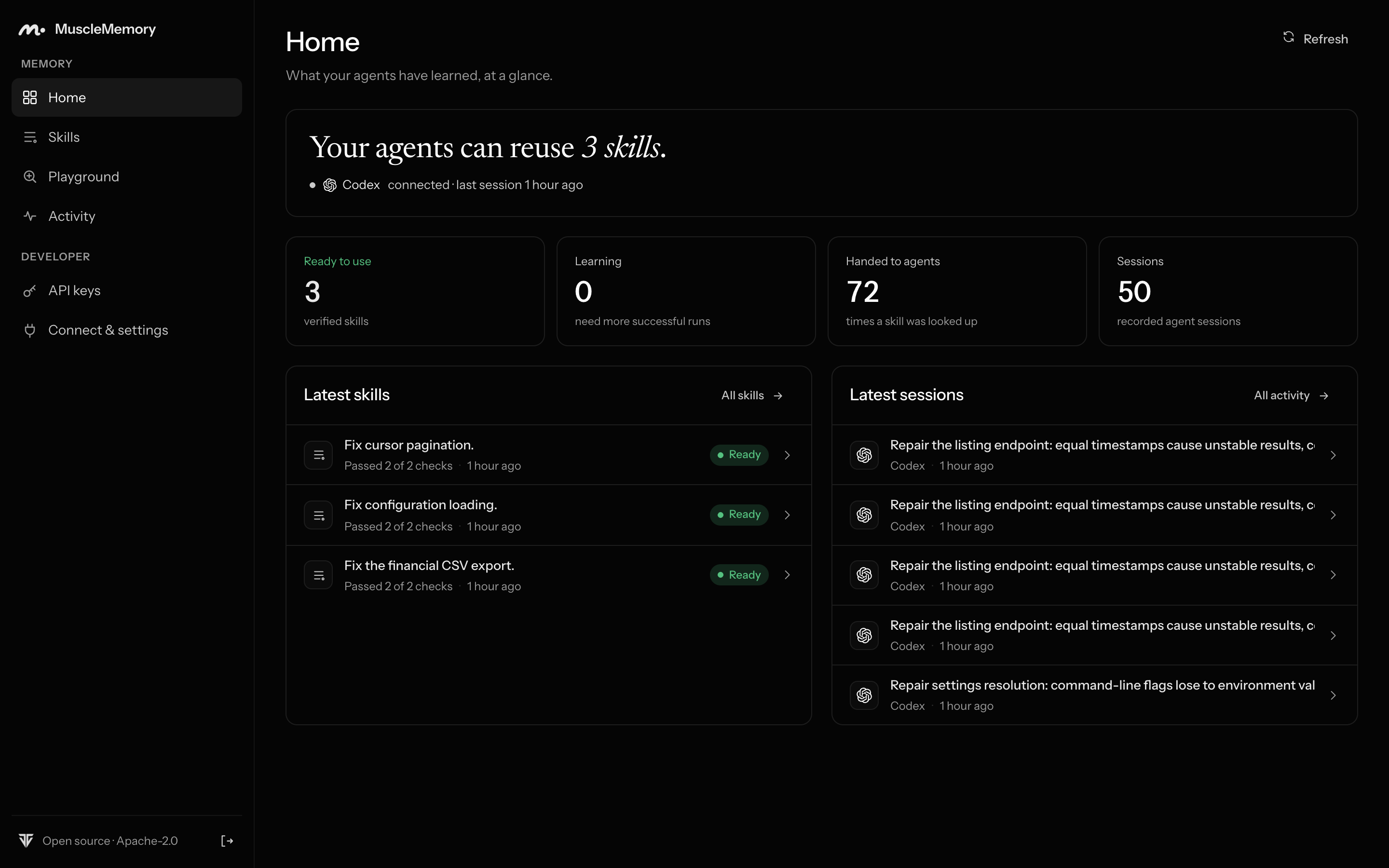
| Home: what your agents can reuse, and anything waiting for your OK | Skills: each one with the task it came from, the files it changes and the test that checks it |
 |
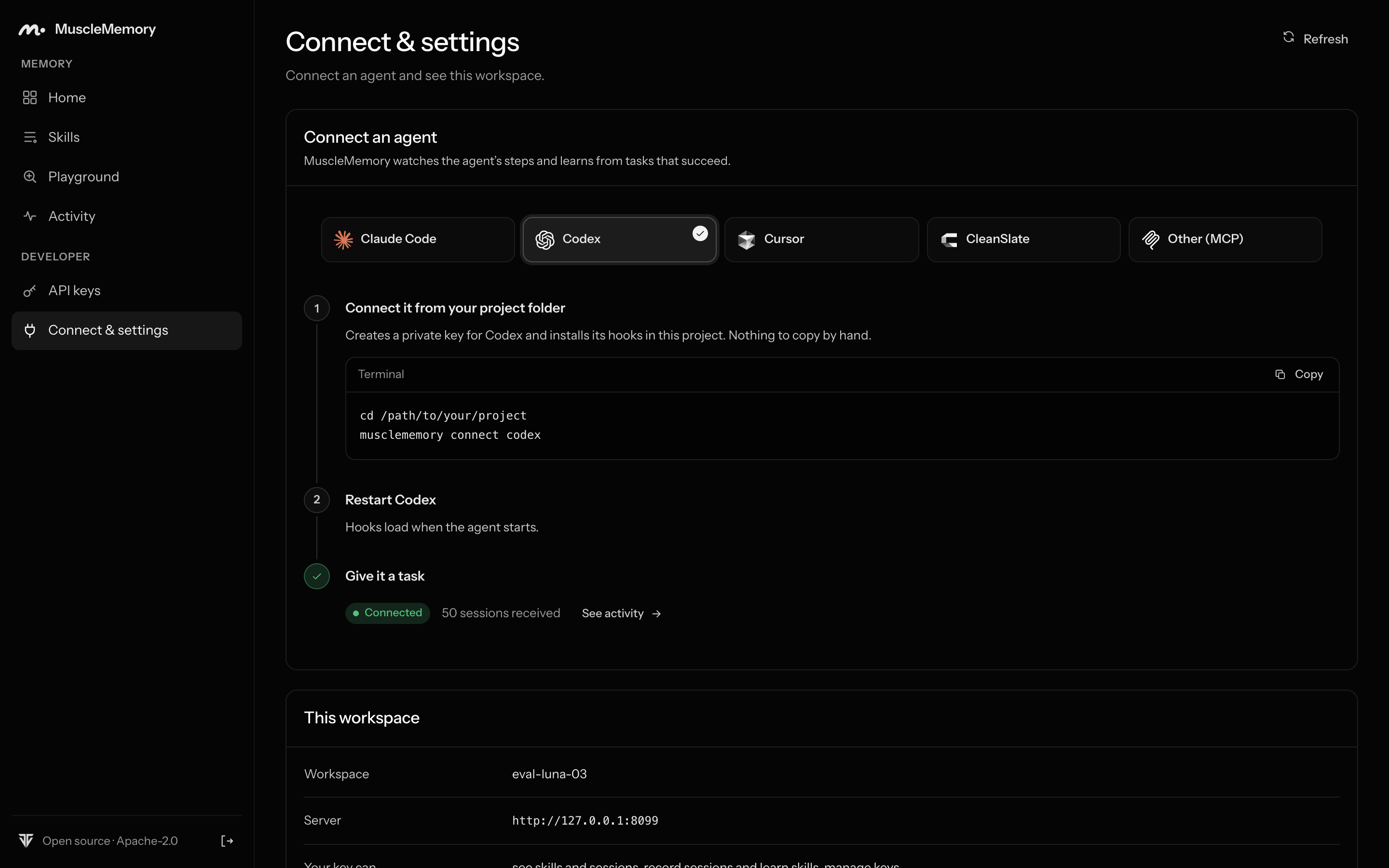 |
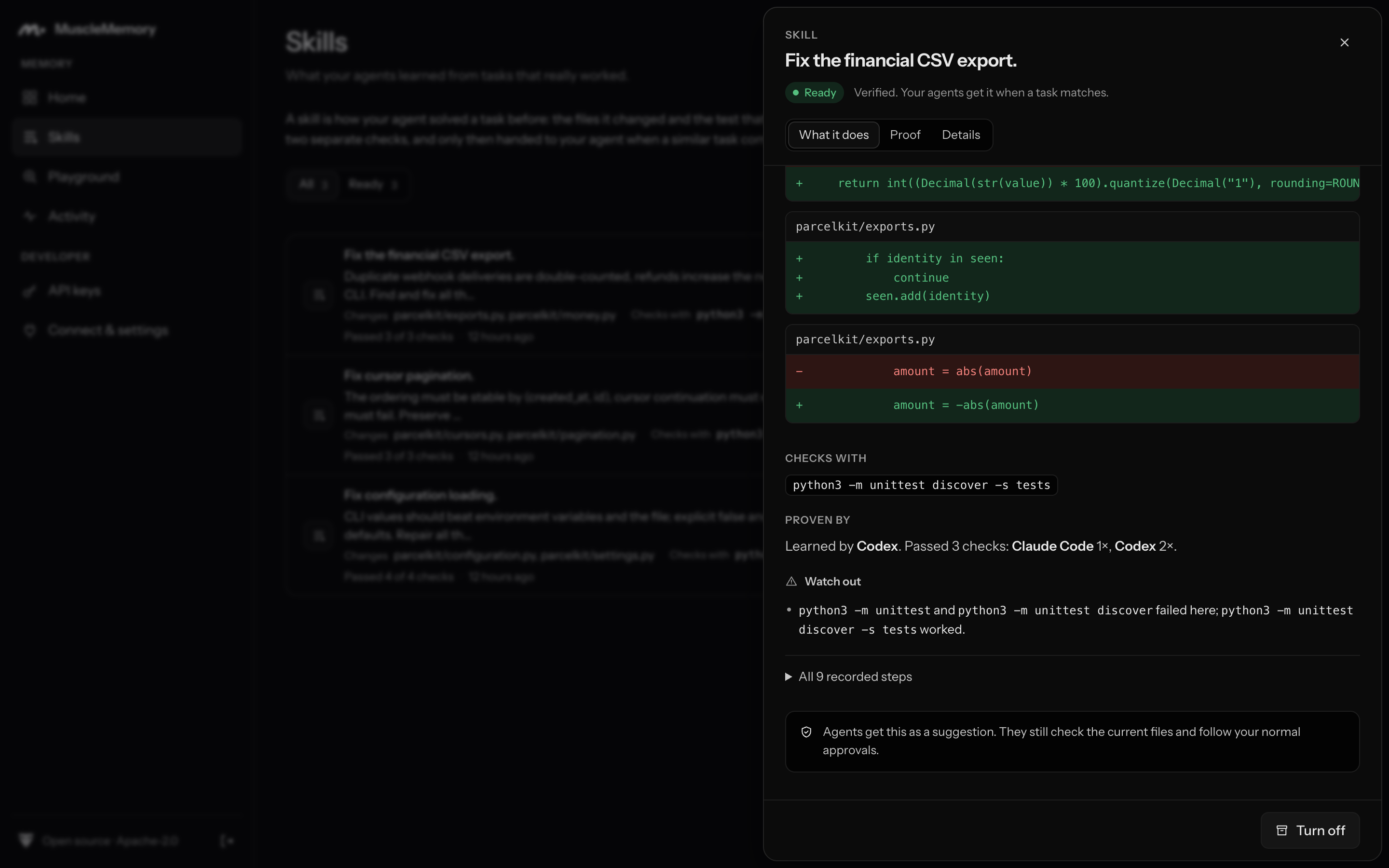
| A skill: its steps in plain words, its proof, and what to watch out for | Connect: one command per agent |
Docs
- Whitepaper: the design, trust rules, retrieval and evaluation in one paper
- Install and run: local setup, Docker and PostgreSQL, configuration
- How it works: the learning loop, retrieval, storage and security
- Integrations: each agent, MCP and the SDKs
- Benchmarks: results, method and limits
- API contracts: MCP tools and REST
- Roadmap: what's next and known limits
Status
MuscleMemory has Python and TypeScript tests, with optional PostgreSQL and live Codex checks. It's early. The benchmarks cover repeat tasks on three controlled codebases, not every kind of work, and the Claude Code run is small. The hooks and CleanSlate learn on their own; with the SDKs your code reports when a task succeeded. See the roadmap.
Issues and pull requests are welcome. Please report security issues privately, as described in SECURITY.md.
License
Apache-2.0. Made by TheWariend.
1 maintainer

Metadata
1 maintainer
Release files for thewariend-musclememory 0.1.2
For a detailed explanation of source distributions (sdists) and built distributions (wheels), please see the package formats documentation.
Built distribution (wheel)
| File | Interpreter | ABI | Platform | Reset |
|---|---|---|---|---|
| thewariend_musclememory-0.1.2-py3-none-any.whl | Python 3 | none | any | Details |
Release files / thewariend_musclememory-0.1.2-py3-none-any.whl
| Download URL | thewariend_musclememory-0.1.2-py3-none-any.whl |
|---|---|
| Size | 1.5 MB |
| Tags | Python 3 |
|
SHA-256 checksum How to use checksums |
c26c394ab39e9bee9e432e76b3fb231bc1c98768a77644bf8dedaec85d47ae48
|
|
BLAKE2b-256 checksum How to use checksums |
507efce35dbd77bbcdec4f9956ddb81eebd0496344a1546c7b7fdbfd90a07015
|
| Upload date | |
|
Uploaded using Trusted Publishing? What is trusted publishing? |
No |
| Uploaded via |
twine/7.0.0 CPython/3.14.2
|














