
Thingi10k: A dataset of 10,000 3D-printable models

Project description
Thingi10K Dataset
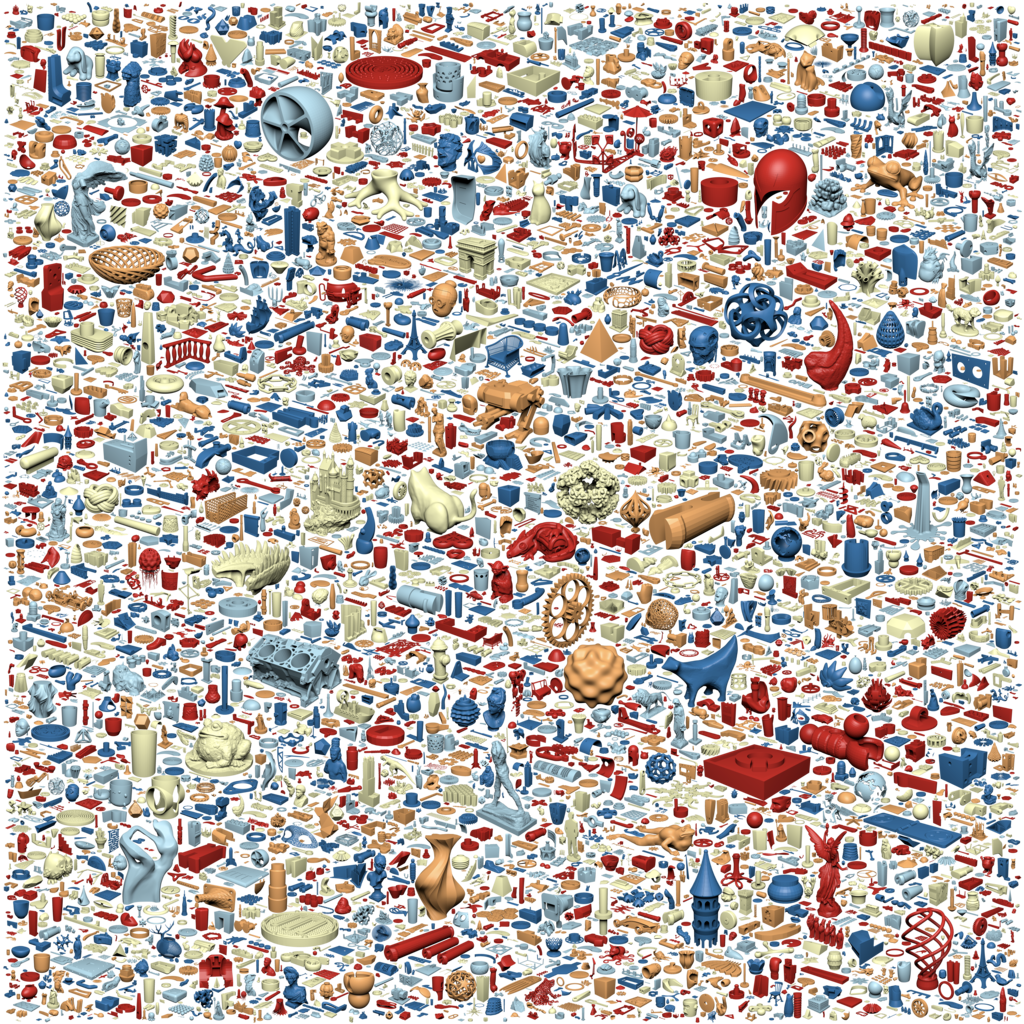
Thingi10K is a large-scale 3D dataset created to study the variety, complexity and quality of real-world 3D printing models. We analyzed every mesh of all things featured on Thingiverse.com between Sept. 16, 2009 and Nov. 15, 2015. In this repository, we share our findings with you.
In a nutshell, Thingi10K contains...
- 10,000 models
- 4,892 tags
- 2,011 things
- 1,083 designers
- 72 categories
- 10 open source licenses
- 7+ years span
- 99.6% .stl files
- 50% non-solid
- 45% with self-intersections
- 31% with coplanar self-intersections
- 26% with multiple components
- 22% non-manifold
- 16% with degenerate faces
- 14% non-PWN
- 11% topologically open
- 10% non-oriented
Thingi10K is curated by Qingnan Zhou and Alec Jacobson.
Raw dataset
You can download the raw dataset from one of the following mirrors: NYU Box, Hugging Face, Google Drive.
One can also obtain the dataset via the thingi10k Python package. It contains both geometric and
contextual data extracted from the raw dataset, and provides a convenient API to access and filter
the dataset.
Usage
In addition to the raw dataset, we provide a Python package thingi10k to facilitate easy access to
the dataset. The package provides functions to download, filter, and load the dataset.
Installation
pip install thingi10k
Simple usage
# /// script
# requires-python = ">=3.10"
# dependencies = [
#   "thingi10k",
# ]
# ///

import thingi10k

thingi10k.init() # Download the dataset and update cache

# Loop through all entries in the dataset
for entry in thingi10k.dataset():
    file_id = entry['file_id']
    author = entry['author']
    license = entry['license']
    vertices, facets = thingi10k.load_file(entry['file_path'])
    # Do something with the vertices and facets

help(thingi10k) # for more information
Filtering the dataset
The thingi10k.dataset() function provides a convenient way to filter the dataset based on various
geometric and contextual criteria. The function returns an iterator over the filtered entries. For
numeric filters, you can specify ranges using tuples where (min, max) sets both bounds, (None, max) sets only an upper bound, and (min, None) sets only a lower bound. The following are some
examples of filtering the dataset:
The example below demonstrates how to iterate over models in the Thingi10K dataset that are closed and have at most 100 vertices.
for entry in thingi10k.dataset(num_vertices=(None, 100), closed=True):
    vertices, facets = thingi10k.load_file(entry['file_path'])
The following example shows how to filter and iterate over models that are licensed under Creative Commons.
for entry in thingi10k.dataset(license='creative commons'):
    vertices, facets = thingi10k.load_file(entry['file_path'])
This example illustrates how to iterate over models that are solid, consist of a single component, and have no self-intersections.
for entry in thingi10k.dataset(num_components=1, self_intersecting=False, solid=True):
    vertices, facets = thingi10k.load_file(entry['file_path'])
Please see help(thingi10k.dataset) for all available filtering options.
Semantic search using CLIP
Thingi10K supports semantic search using open-clip models, allowing one to find 3D models using natural language queries. Please note this a beta feature, and the results may not be perfect.
Installation
To use semantic search, you need to install the optional CLIP dependencies:
pip install 'thingi10k[clip]'
Quotes are used to avoid shell expansion of the square brackets. This installs the required
open_clip and its dependencies.
Basic usage
The semantic search functionality is integrated with the main dataset() function through the
query parameter:
import thingi10k

thingi10k.init()

# Find models that look like cars
for entry in thingi10k.dataset(query="A cute monster"):
    vertices, facets = thingi10k.load_file(entry['file_path'])
Note that semantic query can be combined with any other filtering options.
Dataset variants
Thingi10K provides two variants of the dataset: npz and raw.
npzvariant contains the geometry (vertex and facet arrays) in NumPy arrays. It is faster to download and no mesh parsing is necessary.rawvariant contains the raw mesh files (STL, OBJ, etc.) in their original format. It is slower to download and requires parsing to extract geometric data.
By default, thingi10k.init() will download the npz variant. To download the raw variant:
thingi10k.init(variant='raw')
Caching the dataset
By default, thingi10k.init() will cache the dataset in a local directory.
Any subsequent calls to thingi10k.init() will use the cached dataset and incur no additional
download cost.
The cache directory can be explicitly specified by the user:
thingi10k.init(cache_dir="path/to/.thingi10k")
To force a re-download of the dataset:
thingi10k.init(force_redownload=True)
License
The source code for organizing and filtering the Thingi10K dataset is licensed under the Apache
License, Version 2.0. Each "thing" in the dataset has its own license. Please refer
to the license field associated with each entry in the dataset.
Errata
The following models are known to be "corrupt." However, we decided to still include them in our dataset in order to faithfully reflect mesh qualities on Thingiverse.
- Model 49911 is truncated (ASCII STL).
- Model 74463 is empty.
- Model 286163 is empty.
- Model 81313 contains NURBS curves and surfaces instead of polygonal faces, which may not be supported by many OBJ parsers.
- Model 77942 is corrupt (binary STL).
Acknowledgements
This project is funded in part by NSF grants CMMI-11-29917, IIS-14-09286, and IIS-17257.
We thank Marcel Campen, Chelsea Tymms, and Julian Panetta for early feedback and proofreading. We also thank Neil Dickson for pointing out corrupt models, and Nick Sharp for pointing out bugs in the download script. Lastly, we thank Silvia Sellán and Yun-Chun Chen for discussions and suggestions on hosting the dataset.
Cite us
@article{Thingi10K,
  title={Thingi10K: A Dataset of 10,000 3D-Printing Models},
  author={Zhou, Qingnan and Jacobson, Alec},
  journal={arXiv preprint arXiv:1605.04797},
  year={2016}
}
Release history Release notifications | RSS feed


Download files
Download the file for your platform. If you're not sure which to choose, learn more about installing packages.
Source Distributions
Built Distribution
Filter files by name, interpreter, ABI, and platform.
If you're not sure about the file name format, learn more about wheel file names.
Copy a direct link to the current filters
File details
Details for the file thingi10k-1.3.0-py3-none-any.whl.
File metadata
- Download URL: thingi10k-1.3.0-py3-none-any.whl
- Upload date:
- Size: 20.8 kB
- Tags: Python 3
- Uploaded using Trusted Publishing? Yes
- Uploaded via: twine/6.1.0 CPython/3.12.9
File hashes
| Algorithm | Hash digest | |
|---|---|---|
| SHA256 |
38b7d17883b579e4dbd50ce2ab8a16c8ef5667475a7d89e3aba4d0b4ce188e38
|
|
| MD5 |
b6258ac3c4c57d3f4375fc0596076ddf
|
|
| BLAKE2b-256 |
1959d4fed20a6c2ac47622c99775c80641332aa6a851fedf04d97257361588ee
|
Provenance
The following attestation bundles were made for thingi10k-1.3.0-py3-none-any.whl:
Publisher:
deploy.yml on Thingi10K/Thingi10K
-
Statement:
-
Statement type:
https://in-toto.io/Statement/v1 -
Predicate type:
https://docs.pypi.org/attestations/publish/v1 -
Subject name:
thingi10k-1.3.0-py3-none-any.whl -
Subject digest:
38b7d17883b579e4dbd50ce2ab8a16c8ef5667475a7d89e3aba4d0b4ce188e38 - Sigstore transparency entry: 318287791
- Sigstore integration time:
-
Permalink:
Thingi10K/Thingi10K@54e3dc4489806cddf95787bfbfc45f85bf5a7c88 -
Branch / Tag:
refs/tags/v1.3.0 - Owner: https://github.com/Thingi10K
-
Access:
public
-
Token Issuer:
https://token.actions.githubusercontent.com -
Runner Environment:
github-hosted -
Publication workflow:
deploy.yml@54e3dc4489806cddf95787bfbfc45f85bf5a7c88 -
Trigger Event:
push
-
Statement type:






