
Threadfin
Relationships between B-cell clones from paired single-cell RNA and receptor sequencing



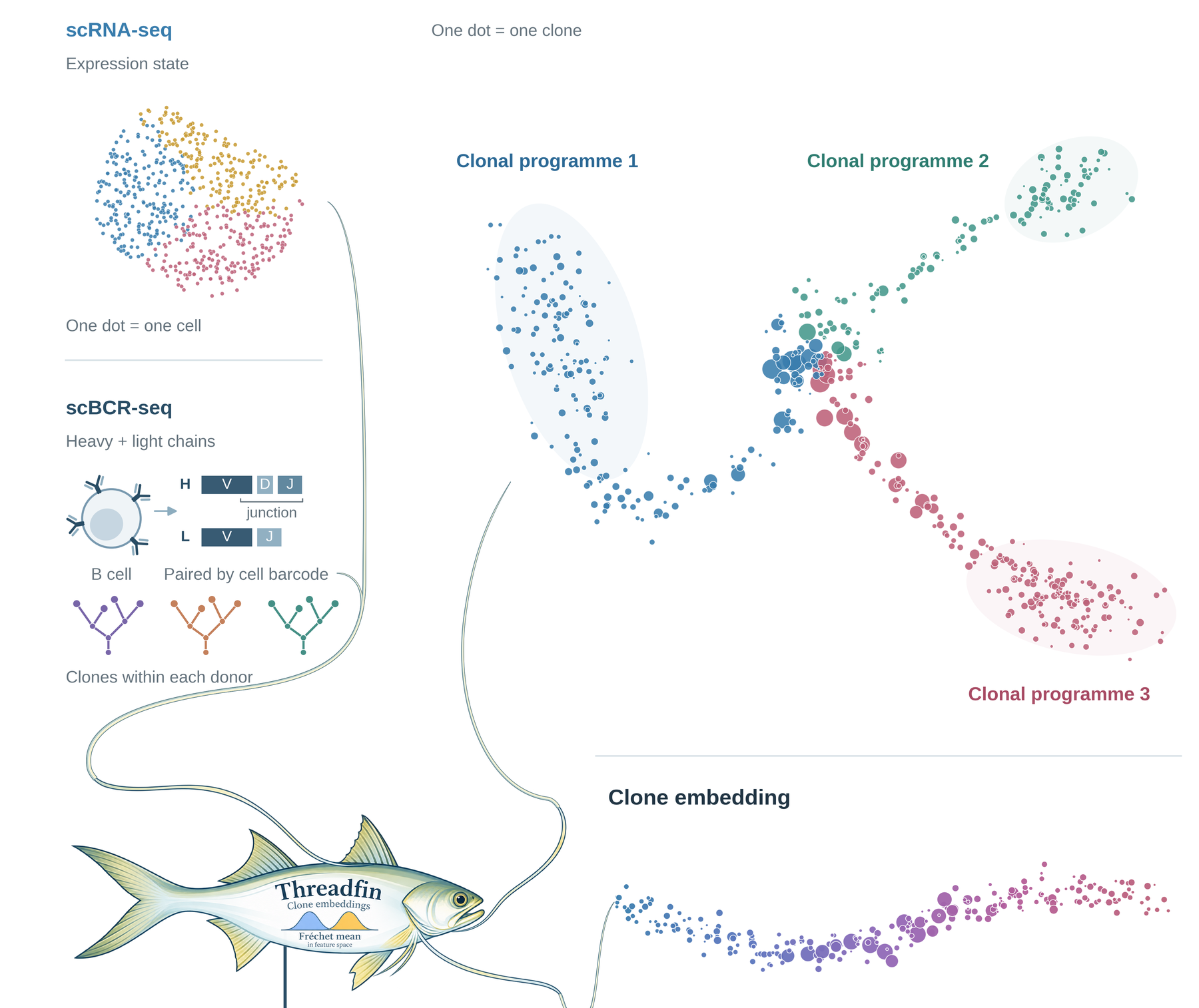
Threadfin takes paired single-cell RNA and receptor (BCR or TCR) sequencing and describes every clone by the distribution of its cells' transcriptional states, so that clones, not cells, can be compared, mapped and tested.
Get started
1. Install
pip install threadfin                  # Python 3.10–3.14 on Linux, macOS or Windows; no GPU or R needed
pip install "threadfin[dandelion]"     # also installs Dandelion (0.5.x), to call clones from BCR or TCR contigs
Scanpy, Leiden, UMAP and Harmony are installed with it. Dandelion's clone calls depend on Python's hash seed:
start Python with PYTHONHASHSEED=0 when clone ids must be identical run after run. Threadfin is validated with
Dandelion 0.5.x; Dandelion 1.0 (October 2026) calls clones differently, so the extra installs sc-dandelion<1. The development version
installs with pip install "git+https://github.com/Reynold4k/Threadfin.git".
2. Run
You need, for the same cells: raw gene counts in an AnnData object, the
contig-level receptor table (Cell Ranger's filtered_contig_annotations.csv or an AIRR .tsv), and the donor
and sample of each cell.
import scanpy as sc
import threadfin as tf

adata = sc.read_h5ad("b_cells.h5ad")           # raw counts, one row per cell

result = tf.run(
    adata,
    bcr="filtered_contig_annotations.csv",     # Cell Ranger VDJ output or an AIRR .tsv
    donor_key="donor",                         # the individual each cell came from
    sample_key="sample",                       # the sample or library each cell came from (never a sort gate,
                                               # tissue or time point you want to compare: those go in test=)
    n_jobs=8,                                  # CPU cores to use; the result is the same with any number
)
tf.run calls clones within each donor (Dandelion, paired chains), builds an expression embedding without the
receptor genes, estimates one profile per clone, tests clonal coherence, lays out the clone map and looks for
clonal programmes. On the 16 public datasets tested (up to 206,000 cells) it took 1 to 15 minutes with 8 cores.
3. Read the results
print(result.summary())                 # plain-language report
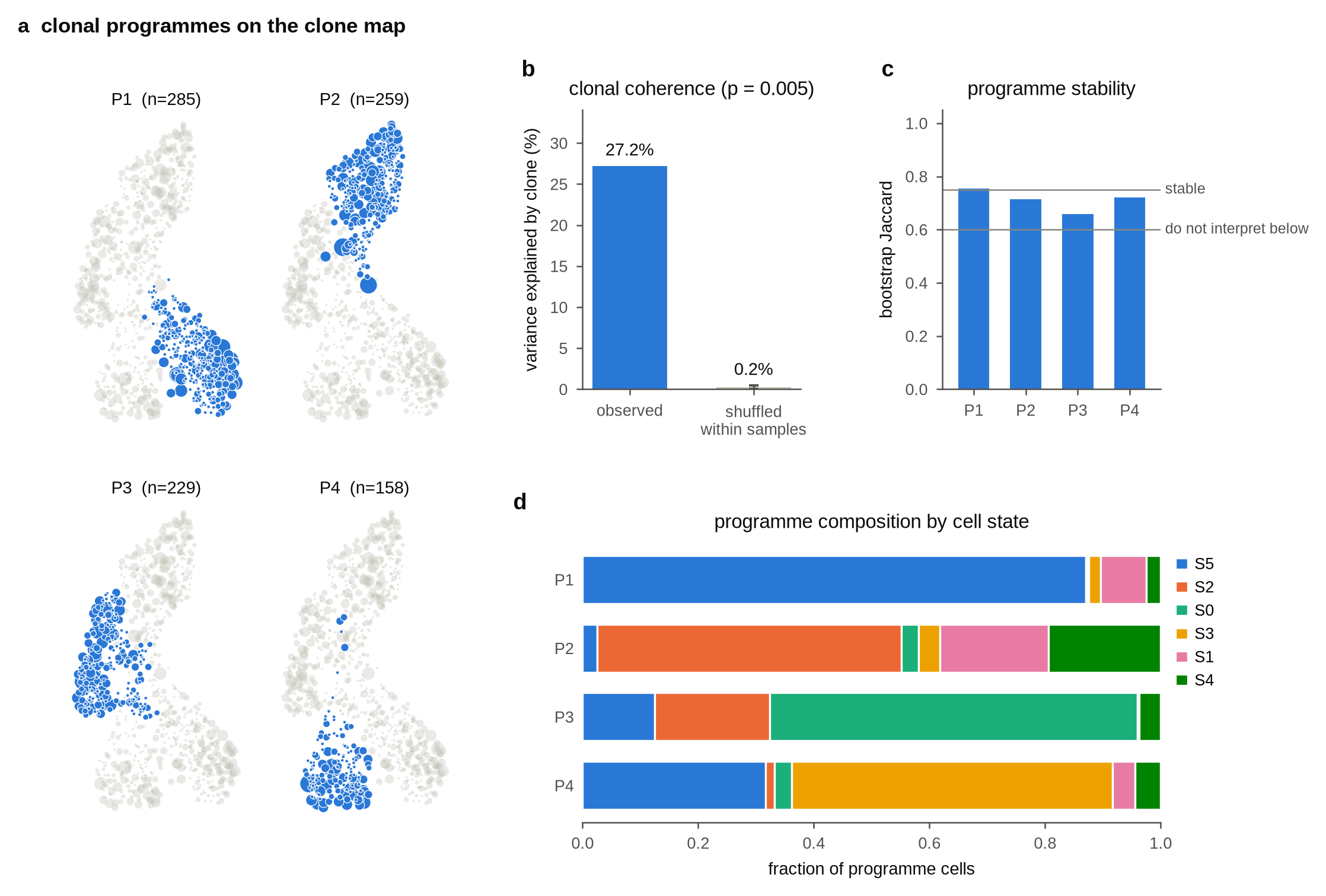
result.plot("threadfin_overview.pdf")   # clone map, coherence, stability, composition
print(result.methods())                 # a Methods paragraph with the settings and versions used
result.clones.to_csv("clones.csv")      # one row per clone: size, reliability, programme, map position
| What you get | Where |
|---|---|
| Does clone identity shape cell state? Clonal coherence, with its permutation P value | result.coherence; first part of the summary |
| A map with one point per clone | result.plot(); result.clones[["x", "y"]] |
| Groups of clones that behave alike, with their stability | result.programmes; adata.obs["clone_programme"] |
| How much your own labels explain the differences between clones | result.profile_tests (with test=[...]) |
| A Methods paragraph for your paper, with references | result.methods() |
Common variations
- Your own labels (antigen binding, isotype, sort gate): any
adata.obscolumns, e.g.tf.run(..., test=["antigen_binding", "isotype"]). - Time points or tissues, to ask whether clones keep their state:
tf.run(..., time_key="timepoint"). - T cells: pass the TCR contigs as
bcr; clones are called on identical beta and alpha junctions. - scirpy users: pass your scirpy AnnData or MuData as
bcr. - Clones defined elsewhere: put them in
adata.obs["clone_id"]and leave outbcr. - Large data:
n_jobs=-1uses every CPU core and gives the same result; a million cells take about an hour on 8 cores. - No data at hand:
adata = tf.sim.simulate_repertoire()makes a repertoire with a known answer; it already has clone ids and an embedding, so run it withtf.run(adata, donor_key="donor", sample_key="context", basis="X_pca")(tutorial 1).
Tutorials
| Tutorial | What it covers |
|---|---|
| 1 — Getting started | the whole analysis on simulated data in a minute, with every output explained |
| 2 — Your own data | from Cell Ranger output to results: quality control, several samples and donors, clone calling, T cells, troubleshooting |
| 3 — The clone map | automatic and hand-set layouts, and how to check a map |
| 4 — Step by step | the individual functions in threadfin.tl |
| 5 — From GEO to results (notebook) | a published dataset (GSE287123) end to end: download, hashtag demultiplexing, clones, embedding, Threadfin and interpretation; executed in a fresh environment before every release (about 6 minutes on 8 cores) |
4.5.1 pins Dandelion below 1.0 and fixes T-cell contig files passed as a path. New in 4.5.0: T cells, scirpy input, result.methods() and gene-level summaries of the clone landscape
(changelog).
What Threadfin does
Threadfin is a Python package for paired single-cell RNA and B-cell receptor (BCR) sequencing. It uses the clone — the B cells that descend from one V(D)J rearrangement — as the unit of analysis. Each clone is represented by the distribution of transcriptional states among its sampled cells, estimated relative to the cells sampled alongside it and shrunk according to the number of cells captured. Clones are then compared with one another: in a clone embedding with one point per clone, in clonal programmes of clones that behave alike, and in clone-level tests of anything you measured. Threadfin works with AnnData and Scanpy, and defines clones with Dandelion.
Why clones?
The cells of one clone are distributed across states: germinal-centre (GC) B cells, plasmablasts, plasma cells and memory B cells. Two clones can have the same average state and still differ in how their cells are distributed. Selection, antigen affinity and fate bias act on clones, so questions such as which clones connect the germinal centre with plasma-cell output or does antigen binding go with a clone's state need the clone as the unit of representation and of statistical inference. Three features of repertoires sampled in vivo make this difficult, and Threadfin addresses each:
- Most clones are captured as one or a few cells. Profiles are shrunk according to the number of cells sampled, and each clone carries a reliability score. No clone is discarded for being small.
- Clone membership is confounded with donor, sample, tissue and sorting gate. Each clone is described relative to the cells sampled with it, and every test shuffles labels within the sampling design.
- Treating cells as independent inflates significance. Tests use clones, not cells, as replicates.
What Threadfin answers
| Question | Output | Function |
|---|---|---|
| Is cell state inherited within clones? | clonal coherence: variance explained by clone, against labels shuffled within samples | tl.clonal_coherence |
| How are clones related to one another? | the clone embedding, laid out automatically so that continua stay connected | tl.embed_clones |
| Which clones behave alike? | clonal programmes, with split tests and bootstrap stability | tl.find_programmes |
| What explains the differences between clones? | variance in clone profiles explained by a label; per-programme effects | tl.profile_association, tl.association_test |
| Do clones keep their state over time or across tissues? | the clonal memory index | tl.clonal_memory |
| How far behind its germinal centre is a clone's output? | the export lag, in somatic mutations and in days | tl.export_lag |
Examples from public data
The manuscript applies Threadfin to nine paired datasets from immunization, infection, vaccination and
spontaneous germinal centres (figures); scripts and results for these and
further public datasets are in case studies, and everything behind the
manuscript — status, datasets, every analysis and a benchmark against related tools — is in
manuscript/.
- Gut-associated lymphoid tissues (Siniscalco et al., Immunity 2025): the clone embedding resolves a continuous path of clones from GC B cells, through clones that contain both GC B cells and plasma cells, to plasma-cell clones, with clones that lack GC-fate labelling grouped at its end.
- Spontaneous germinal centres (Castrillon et al., eLife 2023): position along the clone embedding orders clones by the diversity of their cell states, and memory-containing clones concentrate at one end.
- Plasmodium infection (Skinner et al., Nat. Immunol. 2026): whether plasmablasts were sampled together with GC B cells of the same clone is a property of clones that cannot be read from the cell-level embedding.
- Model-antigen germinal centres (Merkenschlager et al., Nature 2025): the main axis of variation between clone profiles follows recent division in two cohorts whose sequencing libraries are crossed, so the association cannot be a library artefact; antigen-bait and dark-zone gates are also associated with clone profiles but were each sequenced in their own library.
A clone embedding that holds together
UMAP draws continuous populations of clones as one picture only for suitable settings, and the suitable settings differ between datasets. Threadfin therefore chooses them for each dataset by default: it lays the clones out over a ladder of settings, scores each layout for coherence (the fraction of clones in one connected piece) and for fidelity to the clone profiles, and keeps the most faithful setting that holds together in every layout it tried. A map is not allowed to be more fragmented than the clone profiles themselves, and the final map is checked once more before it is returned. The record of the choice is stored with the results, and the settings can always be fixed by hand (Tutorial 3).
tf.tl.embed_clones(adata)                               # automatic (default)
tf.tl.embed_clones(adata, n_neighbors=30, min_dist=0.3) # by hand
tf.tl.map_quality(features, xy)                         # score any clone map (profiles, coordinates)
How it works
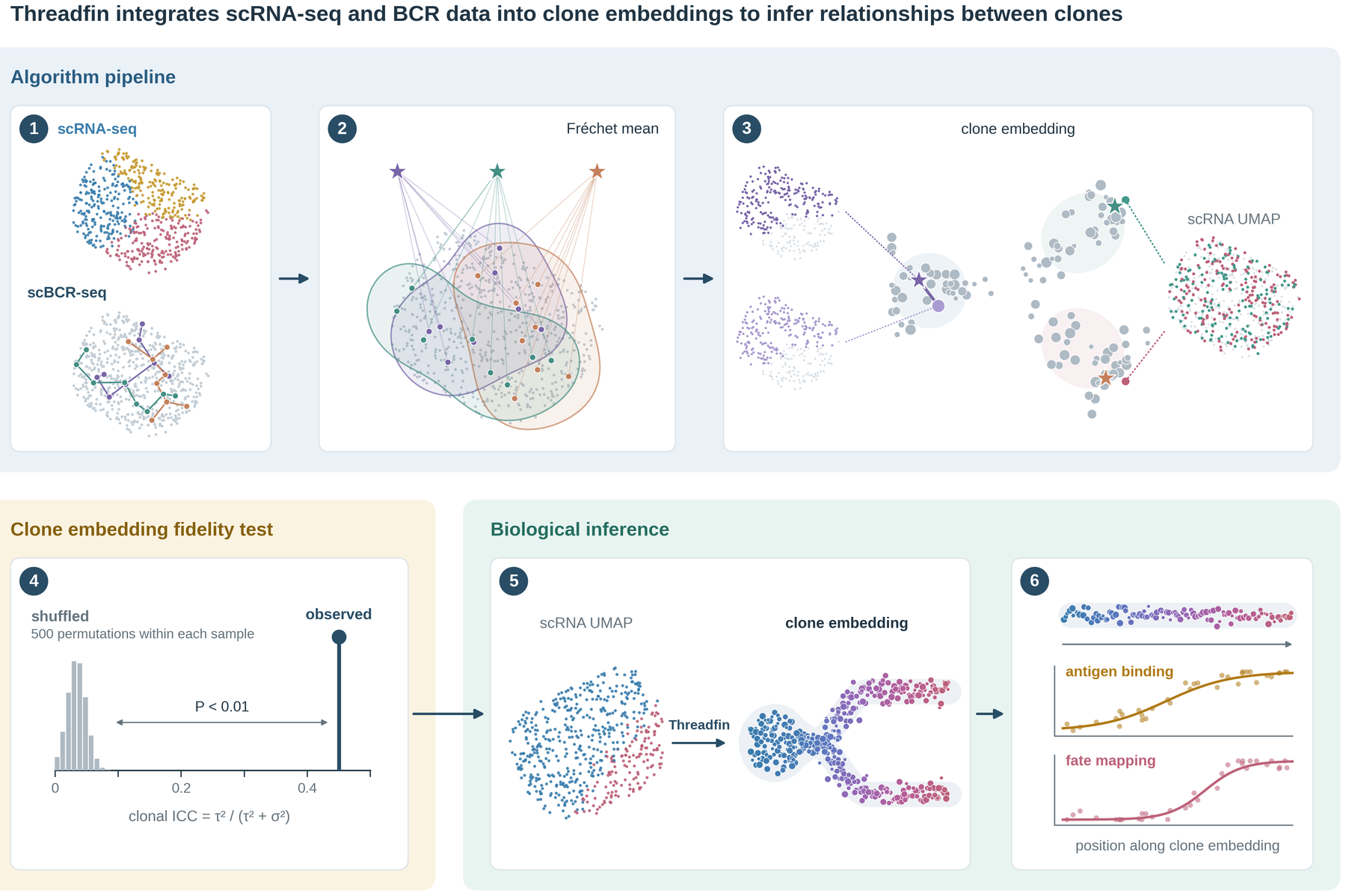
- Clones are defined from paired heavy- and light-chain sequences (for T cells, beta and alpha chains) within each donor (Dandelion).
- Clone profiles. Each cell is described relative to the mean of its sampling context. The cells of a clone are summarised by a kernel mean embedding of their state distribution, so a clone divided between two states differs from a clone in an intermediate state, and the profile is shrunk towards the context according to the number of cells (best linear unbiased prediction under a random-effects model).
- Clonal coherence is the intraclass correlation of state within clones, tested against clone labels permuted within samples.
- The clone embedding is a UMAP of the clone profiles with settings chosen as above.
- Clonal programmes are graph communities of clones; each split is tested against a single Gaussian group, and each programme's stability is estimated by bootstrap resampling.
- Clone-level tests quantify how much of the variance between clone profiles a label explains, with labels permuted among the clones of each donor.
The full description, with references, is in Methods.
Documentation
| Methods | the statistical model behind each step |
| Function reference | every public function and its arguments, generated from the code |
| Compatibility | Python and dependency versions, operating systems and datasets tested |
| Changelog | what changed in each version |
| The manuscript | publication status, datasets, every analysis, open work |
| Case studies | scripts and results for the public datasets |
| Figures | figures of the manuscript, with their source code |
| Benchmark | Threadfin against Clonotrace, clone2vec, Benisse, CoNGA and scirpy |
| Technical validation | the tutorials on 16 public datasets, sensitivity to clone calling and embedding, power, a million cells, T cells |
Citation
A manuscript describing Threadfin is in preparation. Until it is available, please cite this repository (CITATION.cff) and the tools Threadfin builds on: Dandelion (Suo et al., Nat. Biotechnol. 2024) for clone definition, Scanpy (Wolf et al., Genome Biol. 2018) and UMAP (McInnes et al., J. Open Source Softw. 2018).
How Threadfin compares with related tools
Clonotrace, clone2vec, Benisse and CoNGA also combine lineage and transcriptome, and answer related but different questions. On the same data and clones (benchmark, with a one-page overview): Threadfin and Benisse represent every clone with two or more cells by default (clone2vec starts at three cells, Clonotrace at ten), and Threadfin's test of clonal coherence keeps its error rate when samples differ, where per-clone graph scores and cell-level tests do not. For recovering measured clone annotations Threadfin is comparable to clone2vec and to a simple mean of the cells' coordinates, and better than Clonotrace at its default and than Benisse; in simulation, clone2vec groups clones by their planted programme and tells mixed from in-between clones more accurately. Threadfin needs a fraction of the others' time (its clone profiles take seconds; clone2vec about 30 times longer, Clonotrace 300 to 2,400 times) and finished every run without help; a million cells take about an hour on 8 cores (scalability). The benchmark reports every result, including those where Threadfin is not the best.
Related tools
- Dandelion — single-cell immune receptor analysis; Threadfin's clone definition.
- Clonotrace — distances between expanded clones on the cell-state graph after label spreading.
- clone2vec — clone embeddings learned from which clones' cells are neighbours.
- Benisse — a joint space of BCR sequences and expression.
- CoNGA — graph-vs-graph analysis of T-cell receptor and expression similarity.
- Scirpy — single-cell immune receptor analysis in the scverse ecosystem; Threadfin reads its AnnData and MuData objects.
- Scanpy and AnnData — the data structures and single-cell tools Threadfin works with.
- Immcantation — B-cell receptor repertoire analysis, including clonal lineage reconstruction.
Support
Please report bugs and ask questions through GitHub issues.
License
MIT; see LICENSE.
1 maintainer

Metadata
1 maintainer
Release files for threadfin 4.5.1
For a detailed explanation of source distributions (sdists) and built distributions (wheels), please see the package formats documentation.
Source distribution (sdist)
| File | Size | Uploaded | Provenance | |
|---|---|---|---|---|
| threadfin-4.5.1.tar.gz | 216.4 kB | With provenance | Details |
Built distribution (wheel)
| File | Interpreter | ABI | Platform | Reset |
|---|---|---|---|---|
| threadfin-4.5.1-py3-none-any.whl | Python 3 | none | any | Details |
Total release size: 395.4 kB
Release files / threadfin-4.5.1.tar.gz
| Download URL | threadfin-4.5.1.tar.gz |
|---|---|
| Size | 216.4 kB |
| Tags | Source |
|
SHA-256 checksum How to use checksums |
e5a6d9be189c96cbac36364ffce5410aa6adee7faf23daf1a8afbf78709e389e
|
|
BLAKE2b-256 checksum How to use checksums |
7da692633b323ac8b41be54b82374328f72aea95577477d4a71435861d3127b5
|
| Upload date | |
|
Uploaded using Trusted Publishing? What is trusted publishing? |
Yes |
| Uploaded via |
twine/7.0.0 CPython/3.13.16
|
Provenance
Provenance describes where a file came from. On PyPI, provenance is shared via attestations, which provide a verifiable record of the build or publishing details. View details, limitations and caveats.


PyPI Publish Attestation
PyPI verified that this artifact, at this checksum, originated from the publisher listed below.
Signed by GitHub Actions, verified by PyPI on Oct 25, 2026.
Transparency logRelease files / threadfin-4.5.1-py3-none-any.whl
| Download URL | threadfin-4.5.1-py3-none-any.whl |
|---|---|
| Size | 179.0 kB |
| Tags | Python 3 |
|
SHA-256 checksum How to use checksums |
a2ddc666d0edd9f93b017bb51fa3b4270aab1817a52832636cf3453cc4563fc2
|
|
BLAKE2b-256 checksum How to use checksums |
3a369555101d3240e03a702c85a001fdc75055616b8fef61b5ee6ccfdfc36030
|
| Upload date | |
|
Uploaded using Trusted Publishing? What is trusted publishing? |
Yes |
| Uploaded via |
twine/7.0.0 CPython/3.13.16
|
Provenance
Provenance describes where a file came from. On PyPI, provenance is shared via attestations, which provide a verifiable record of the build or publishing details. View details, limitations and caveats.
PyPI Publish Attestation
PyPI verified that this artifact, at this checksum, originated from the publisher listed below.
Signed by GitHub Actions, verified by PyPI on Oct 25, 2026.
Transparency logSecurity for threadfin 4.5.1
Provenance
Provenance describes where a file came from. On PyPI, provenance is shared via attestations, which provide a verifiable record of the build or publishing details. View details, limitations and caveats.
Full provenance
All 2 files in this release have been uploaded with provenance metadata.
Attestation for threadfin-4.5.1.tar.gz
PyPI Publish Attestation
PyPI verified that this artifact, at this checksum, originated from the publisher listed below.
Signed by GitHub Actions, verified by PyPI on Oct 25, 2026.
Transparency logA note on package security
PyPI is a repository for distributing packages, not a service for auditing them. While third-party security researchers and our staff do their best to detect and remove malicious packages, PyPI cannot guarantee the quality, security or suitability of any given package.
To learn more about protecting yourself from malicious actors, visit our package security documentation.














