
Thrifty Networks
Installation
pip install thriftynet
Usage
You can use the encoder only:
from thriftynet import ThriftyEncoder

encoder = ThriftyEncoder(
    filters=128,
    iterations=20,
    kernel_size=3,
    normalization="layer"
)
images = torch.randn(1, 3, 224, 224)
features = encoder(images)
print(features.size(1)) # prints 128
Alternatively initialize a network with a classification head:
from thriftynet import ThriftyNetwork

encoder = ThriftyNetwork(
    100,
    filters=128,
    iterations=20,
    kernel_size=3,
    normalization="layer"
)
images = torch.randn(1, 3, 224, 224)
features = encoder(images)
print(features.size(1)) # prints 100
Abstract
Typical deep convolutional architectures present an increasing number of feature maps as we go deeper in the network, whereas spatial resolution of inputs is decreased through downsampling operations. This means that most of the parameters lay in the final layers, while a large portion of the computations are performed by a small fraction of the total parameters in the first layers.
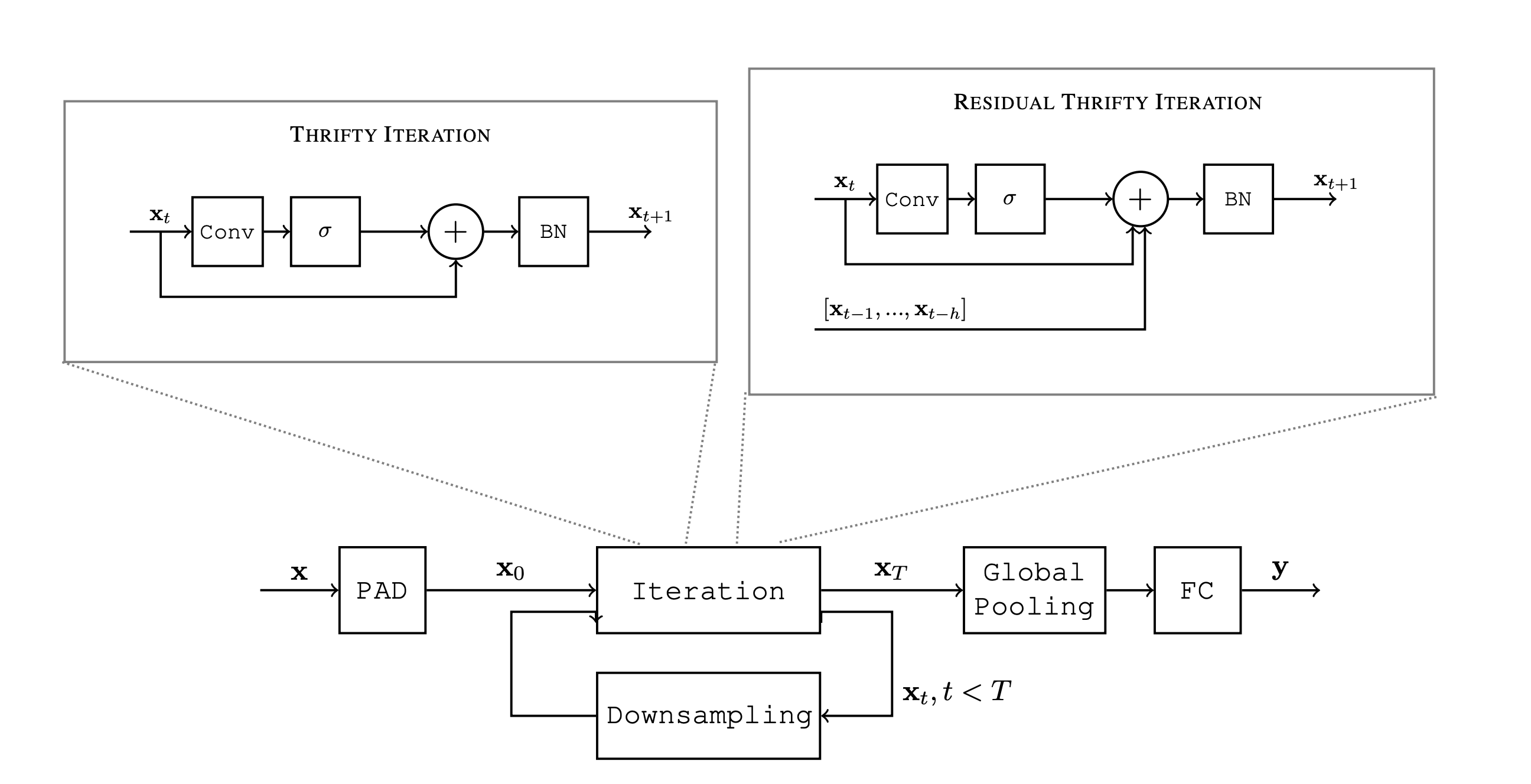
In an effort to use every parameter of a network at its maximum, we propose a new convolutional neural network architecture, called ThriftyNet. In ThriftyNet, only one convolutional layer is defined and used recursively, leading to a maximal parameter factorization.
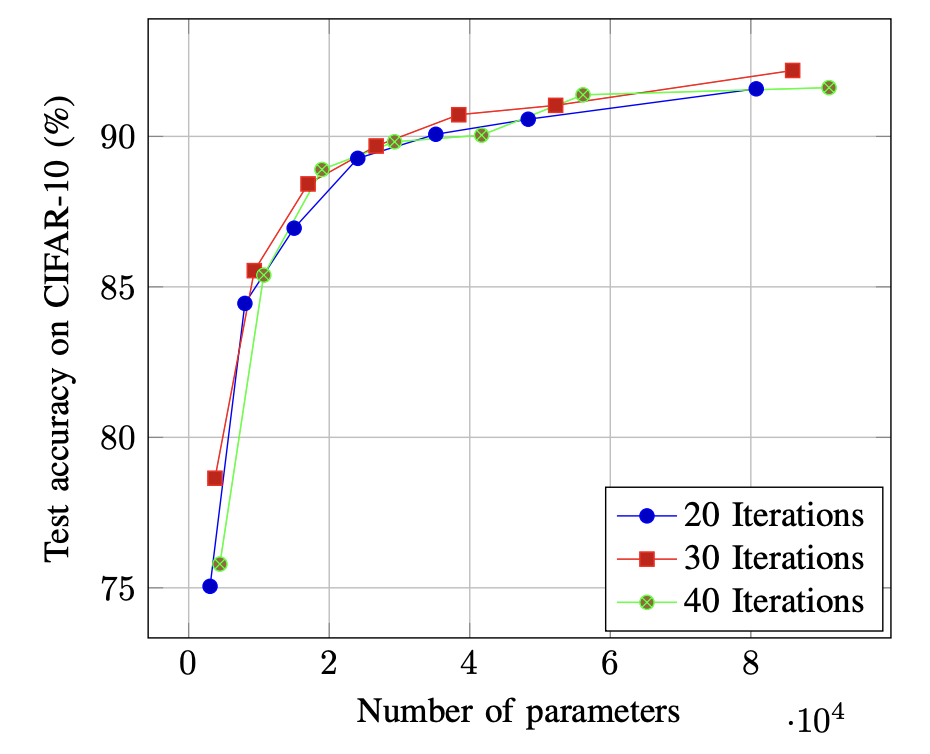
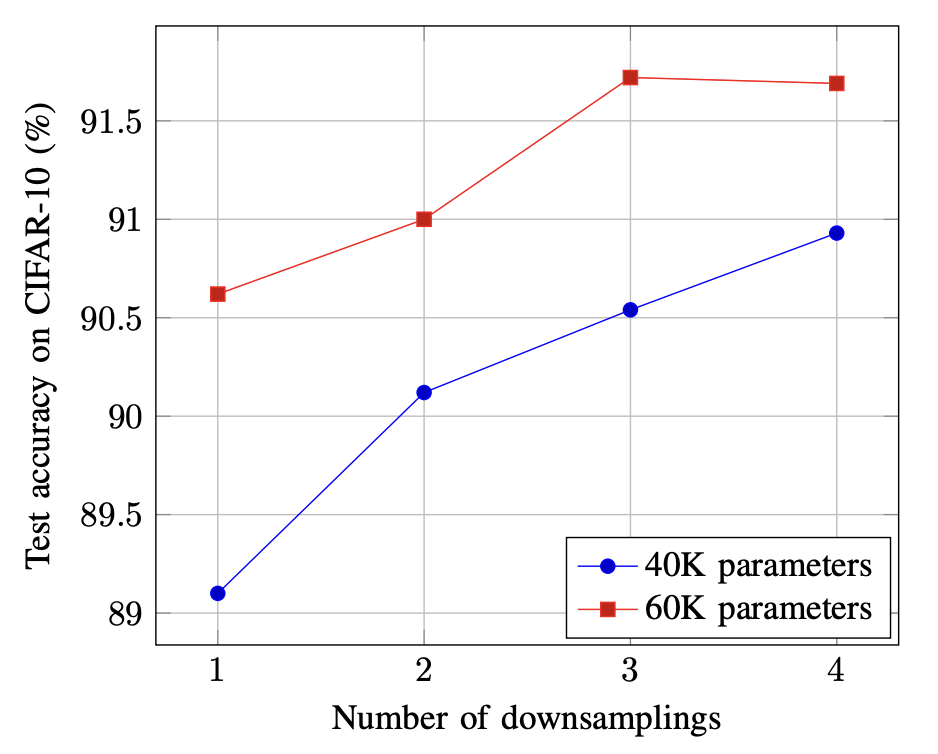
In complement, normalization, non-linearities, downsamplings and shortcut ensure sufficient expressivity of the model. ThriftyNet achieves competitive performance on a tiny parameters budget, exceeding 91% accuracy on CIFAR-10 with less than 40K parameters in total, and 74.3% on CIFAR-100 with less than 600K parameters.
Results
Citation
@software{thriftynets2026implementation,
    author = {Taha Shieenavaz},
    title = {ThriftyNets: Convolutional Neural Networks with Tiny Parameter Budget (Unofficial Implementation)},
    year = {2026},
    url = {https://github.com/tahashieenavaz/thriftynet},
    note = {Unofficial implementation of the paper arXiv:2007.10106 by Coiffier et al.}
}
@misc{2007.10106,
    Author = {Guillaume Coiffier and Ghouthi Boukli Hacene and Vincent Gripon},
    Title = {ThriftyNets : Convolutional Neural Networks with Tiny Parameter Budget},
    Year = {2020},
    Eprint = {arXiv:2007.10106},
}
1 maintainer

Metadata
1 maintainer
Release files for thriftynet 1.0.12
For a detailed explanation of source distributions (sdists) and built distributions (wheels), please see the package formats documentation.
Source distribution (sdist)
| File | Size | Uploaded | Provenance | Actions |
|---|---|---|---|---|
| thriftynet-1.0.12.tar.gz | 537.9 kB | Without provenance | Details for thriftynet-1.0.12.tar.gz |
Built distribution (wheel)
| File | Interpreter | ABI | Platform | Actions Reset |
|---|---|---|---|---|
| thriftynet-1.0.12-py3-none-any.whl | Python 3 | none | any | Details for thriftynet-1.0.12-py3-none-any.whl |
Total release size: 1.1 MB
Release files / thriftynet-1.0.12.tar.gz
| Download URL | thriftynet-1.0.12.tar.gz |
|---|---|
| Size | 537.9 kB |
| Tags | Source |
|
SHA-256 checksum How to use checksums |
21e8df443d24f4118e8f01345cce961d138640e21ff57ae42455459949d6cb0c
|
|
BLAKE2b-256 checksum How to use checksums |
50b9ad7118f063528713ac186a74ed866dec58ab02b23bced071c7611438510d
|
| Upload date | |
|
Uploaded using Trusted Publishing? What is trusted publishing? |
No |
| Uploaded via |
twine/6.2.0 CPython/3.9.6
|
Release files / thriftynet-1.0.12-py3-none-any.whl
| Download URL | thriftynet-1.0.12-py3-none-any.whl |
|---|---|
| Size | 534.3 kB |
| Tags | Python 3 |
|
SHA-256 checksum How to use checksums |
c23c2d1ed356c77cb97dcf58ec7fdab8a24fc554478fc142863df59b1284da08
|
|
BLAKE2b-256 checksum How to use checksums |
8652e0f5e45c971fd32a95089e7c038f6d220d0ef5a7fd0b05faced7eafe3634
|
| Upload date | |
|
Uploaded using Trusted Publishing? What is trusted publishing? |
No |
| Uploaded via |
twine/6.2.0 CPython/3.9.6
|
Security for thriftynet 1.0.12
Provenance
Provenance describes where a file came from. On PyPI, provenance is shared via attestations, which provide a verifiable record of the build or publishing details. View details, limitations and caveats.
No provenance found
None of the files in this release were uploaded with provenance metadata.
A note on package security
PyPI is a repository for distributing packages, not a service for auditing them. While third-party security researchers and our staff do their best to detect and remove malicious packages, PyPI cannot guarantee the quality, security or suitability of any given package.
To learn more about protecting yourself from malicious actors, visit our package security documentation.














