
TimeNet
Download and explore time-series datasets through one standardized format.
[!NOTE] This is a pre-release version and is subject to change. We are actively working on improvements around performance and integrations, and welcome community contributions.



Time-series data is fragmented. TimeNet standardizes it. Every dataset used to ship in its own shape, forcing teams to rewrite the same loading code again and again. TimeF replaces that with one shared format and one set of tools to find, download, and load any dataset the same way, whether it holds ECGs, accelerometer traces, or market prices.
TimeNet hands you the data and stops there. Training, inference, and modeling are up to you.
We're actively growing TimeNet: adding datasets, integrating time-series ML models, and building connectors to data processing libraries. Contributions in any of these areas are welcome.
Full documentation: https://docs.timenet.ai/
How it fits together
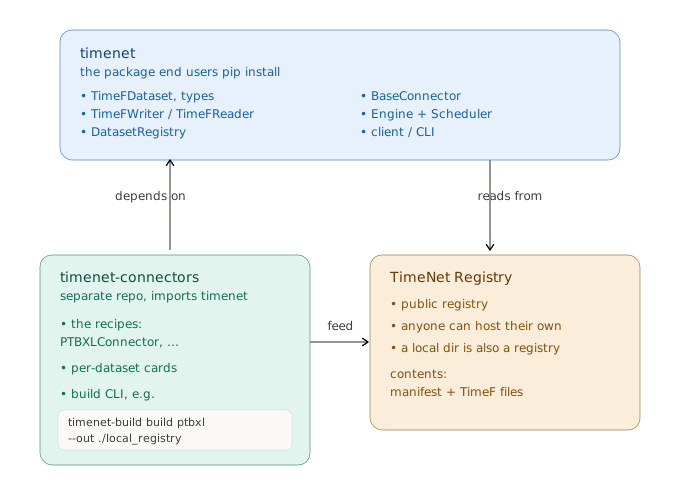
A connector turns a raw source into a manifest plus parquet and publishes it to a registry. The client reads the manifest from the registry and loads the data. Reading never runs connector code, so everything a consumer needs to interpret the parquet lives in the manifest.
BaseConnectoris the only contract a new data source must satisfy.TimeFDatasetis the in-memory model a connector populates duringconvert().TimeFWriterserializes a populatedTimeFDatasetto disk.TimeFReaderreads a TimeF version directory back into aTimeFDataset.
Components
The project is a uv workspace with two packages under packages/,
plus the registry they read from and write to.
| Part | What it is | Ships |
|---|---|---|
timenet |
the SDK and CLI | the TimeF format, reader/writer, registry client, engine, BaseConnector |
timenet-connectors |
the producer package | connector recipes, dataset cards, and the timenet-build CLI |
| registry | a served location | compiled manifests plus parquet; can be public, a private internal one, or a local directory |
See the architecture guide for the full map, and the concepts page for the terminology.
Install
Requires Python 3.11 or newer (tested on 3.11 to 3.13).
uv add timenet            # core: TimeF format, reader/writer, registry client
uv add 'timenet[cli]'     # add the timenet console command
uv add 'timenet[torch]'   # add load_torch (PyTorch Dataset); works with any torch build
Once installed, the CLI is available as timenet. See Get started
to load your first dataset.
License
TimeNet is released under the MIT License.
Dataset licenses
The MIT License covers TimeNet's own code, not the datasets it fetches. Each dataset keeps its
upstream license. Check the license and source_url fields on a dataset's card to see what applies
and where the data comes from. Some sources, such as PhysioNet, only grant credentialed access, so
follow their terms when you download. See
Dataset licensing for the full note.


Release files for timenet 0.1.0
For a detailed explanation of source distributions (sdists) and built distributions (wheels), please see the package formats documentation.
Built distribution (wheel)
| File | Interpreter | ABI | Platform | Reset |
|---|---|---|---|---|
| timenet-0.1.0-py3-none-any.whl | Python 3 | none | any | Details |
Release files / timenet-0.1.0-py3-none-any.whl
| Download URL | timenet-0.1.0-py3-none-any.whl |
|---|---|
| Size | 210.1 kB |
| Tags | Python 3 |
|
SHA-256 checksum How to use checksums |
8c0c1ed122b773f57d66e9242bf76a496e7af5828693d8fb76c5d71d3a25f758
|
|
BLAKE2b-256 checksum How to use checksums |
7e6681f069a6cb3b92505c1cce0ddc38664c76a625befaeb77937af30dacecef
|
| Upload date | |
|
Uploaded using Trusted Publishing? What is trusted publishing? |
Yes |
| Uploaded via |
uv/0.12.12 {"installer":{"name":"uv","version":"0.12.12","subcommand":["publish"]},"python":null,"implementation":{"name":null,"version":null},"distro":{"name":"Ubuntu","version":"24.04","id":"noble","libc":null},"system":{"name":null,"release":null},"cpu":null,"openssl_version":null,"setuptools_version":null,"rustc_version":null,"ci":true}
|














