
timevec



Functions to create time vectors
Description
Time has a periodic nature due to the rotation of the earth and the position of the sun. This affects human behavior in various ways.
- Seasonality ... periodicity in a year (seasonal distinction)
- Daily periodicity ... periodicity in a day (distinction between day and night)
- Day of the week ... periodicity in a week (distinction between weekdays and holidays)
When dealing with these, it is desirable to vectorize with periodicity in mind. That is, at 23:59 on a given day, it is desirable that the value is close to 00:00 on the next day. To achieve this, the time is represented as a combination of cos and sin. This is called a time vector.
Installation
The base package has no NumPy dependency and supports
timevec.builtin_math:
pip install timevec
Install the numpy extra when you use timevec.numpy or
timevec.numpy_datetime64:
pip install "timevec[numpy]"
Usage
With the base install:
import datetime
import timevec.builtin_math as tv

dt = datetime.datetime(2020, 1, 1, 0, 0, 0)
vec = tv.year_vec(dt)
# (1.0, 0.0)
With the numpy extra:
import datetime
import timevec.numpy as tv

dt = datetime.datetime(2020, 1, 1, 0, 0, 0)
vec = tv.year_vec(dt)
# array([1., 0.])
Modules
timevec.numpyprovides functions that return numpy.ndarray.timevec.numpy_datetime64provides functions that return numpy.datetime64.timevec.builtin_mathprovides functions that return tuple of float.
Functions
Almost same functions are provided in timevec.numpy, timevec.numpy_datetime64, and timevec.builtin_math.
The difference is the return type.
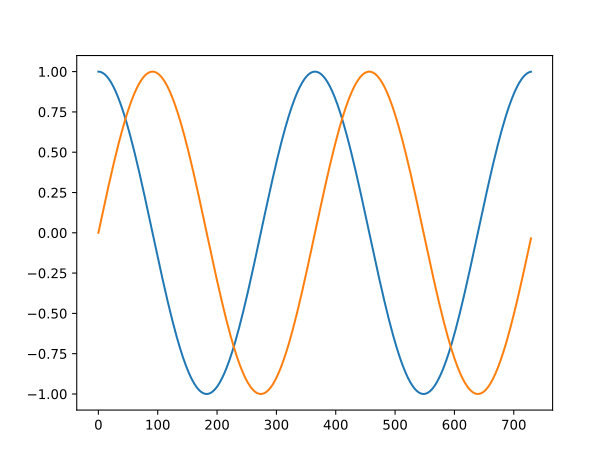
year_vec
year_vec(dt: datetime.datetime)
Create a time vector for a year.
This is a vector that has periodicity like seasonality.
(Summer, Autumn, Winter, Spring)
month_vec
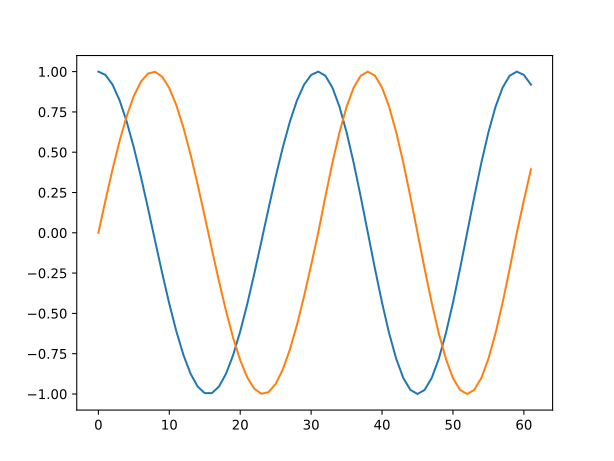
month_vec(dt: datetime.datetime)
Create a time vector for a month.
This is a vector that has periodicity in a month.
You can express periodicity such as the beginning of the month, the end of the month, and the salary day.
week_vec
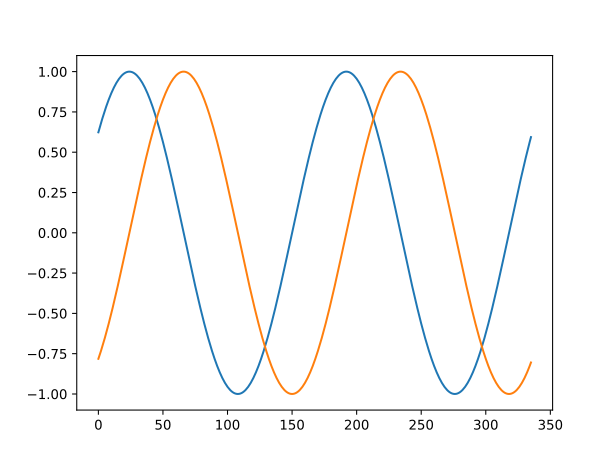
week_vec(dt: datetime.datetime)
Create a time vector for a week.
This is a vector that has periodicity in a week.
You can express periodicity such as weekdays and holidays.
day_vec
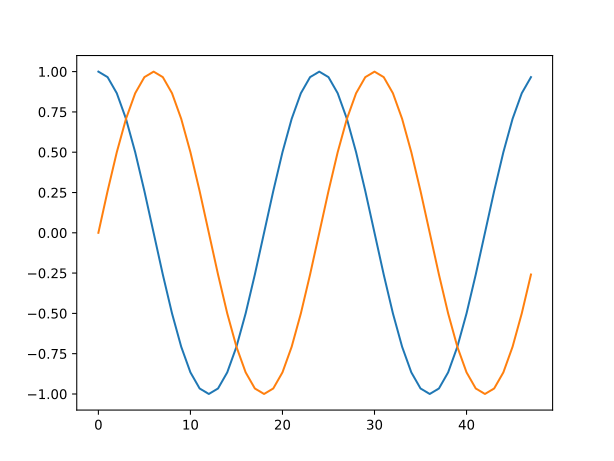
day_vec(dt: datetime.datetime)
Create a time vector for a day.
This is a vector that has periodicity in a day.
You can express periodicity such as morning, noon, and night.
Others
long_time_vec...datetime.mintodatetime.maxperiodmillennium_vec... one millennium (1000 years) periodcentury_vec... one century (100 years) perioddecade_vec... one decade (10 years) period
Development
This repository uses lefthook to run the same checks as CI locally, so problems surface before they reach CI.
# Install dependencies
uv sync

# Install the Git hooks (once; requires lefthook on your PATH)
lefthook install
Once installed, the hooks run automatically:
- pre-commit:
uv run poe check - pre-push:
uv run poe checkanduv run poe test
You can also run the checks manually:
uv run poe check
uv run poe test
CI still runs the full matrix (see .github/workflows/); the hooks only bring that
feedback earlier on your machine.
License
BSD 3-Clause License
1 maintainer

Metadata
1 maintainer
Release files for timevec 0.4.0
For a detailed explanation of source distributions (sdists) and built distributions (wheels), please see the package formats documentation.
Source distribution (sdist)
| File | Size | Uploaded | Provenance | Actions |
|---|---|---|---|---|
| timevec-0.4.0.tar.gz | 131.1 kB | With provenance | Details for timevec-0.4.0.tar.gz |
Built distribution (wheel)
| File | Interpreter | ABI | Platform | Actions Reset |
|---|---|---|---|---|
| timevec-0.4.0-py3-none-any.whl | Python 3 | none | any | Details for timevec-0.4.0-py3-none-any.whl |
Total release size: 142.5 kB
Release files / timevec-0.4.0.tar.gz
| Download URL | timevec-0.4.0.tar.gz |
|---|---|
| Size | 131.1 kB |
| Tags | Source |
|
SHA-256 checksum How to use checksums |
cf3c9b939d0f69b77d325f0794f53e95b0cefa9cf2e3d224a646e580df4b13b0
|
|
BLAKE2b-256 checksum How to use checksums |
a143bdad19400cec6e150d56cf86996f48764754c802597f625777cb893062da
|
| Upload date | |
|
Uploaded using Trusted Publishing? What is trusted publishing? |
Yes |
| Uploaded via |
twine/6.1.0 CPython/3.13.13
|
Provenance
Provenance describes where a file came from. On PyPI, provenance is shared via attestations, which provide a verifiable record of the build or publishing details. View details, limitations and caveats.


PyPI Publish Attestation
PyPI verified that this artifact, at this checksum, originated from the publisher listed below.
Signed by GitHub Actions, verified by PyPI on Oct 27, 2026.
Transparency logRelease files / timevec-0.4.0-py3-none-any.whl
| Download URL | timevec-0.4.0-py3-none-any.whl |
|---|---|
| Size | 11.4 kB |
| Tags | Python 3 |
|
SHA-256 checksum How to use checksums |
cf9d8b128f6b2b66b76a34af7f1c456aa1094d8a3e070d1f6cceb579c0286f96
|
|
BLAKE2b-256 checksum How to use checksums |
accfbbaed02b14292d8c75570988d07c5e78e856505e01e1a1a2476aba890ccf
|
| Upload date | |
|
Uploaded using Trusted Publishing? What is trusted publishing? |
Yes |
| Uploaded via |
twine/6.1.0 CPython/3.13.13
|
Provenance
Provenance describes where a file came from. On PyPI, provenance is shared via attestations, which provide a verifiable record of the build or publishing details. View details, limitations and caveats.
PyPI Publish Attestation
PyPI verified that this artifact, at this checksum, originated from the publisher listed below.
Signed by GitHub Actions, verified by PyPI on Oct 27, 2026.
Transparency logSecurity for timevec 0.4.0
Provenance
Provenance describes where a file came from. On PyPI, provenance is shared via attestations, which provide a verifiable record of the build or publishing details. View details, limitations and caveats.
Full provenance
Both files in this release have been uploaded with provenance metadata.
Attestation for timevec-0.4.0.tar.gz
PyPI Publish Attestation
PyPI verified that this artifact, at this checksum, originated from the publisher listed below.
Signed by GitHub Actions, verified by PyPI on Oct 27, 2026.
Transparency logA note on package security
PyPI is a repository for distributing packages, not a service for auditing them. While third-party security researchers and our staff do their best to detect and remove malicious packages, PyPI cannot guarantee the quality, security or suitability of any given package.
To learn more about protecting yourself from malicious actors, visit our package security documentation.














