

Timoshenko Engine
Reusable structural engineering building blocks for Python applications.








Timoshenko packages common structural calculations, modal analysis, sensor workflows, and monitoring components so applications can reuse them instead of rebuilding the same foundations for every project. It is an embeddable Python library, not a hosted monitoring service or a general finite-element solver.
Alpha: the API may still change between releases. Every behavior change is listed in the changelog.
Install
python -m pip install timoshenko-engine
The distribution is named timoshenko-engine; the import package is
timoshenko. Optional MQTT support is an extra:
python -m pip install "timoshenko-engine[mqtt]"
Quick start
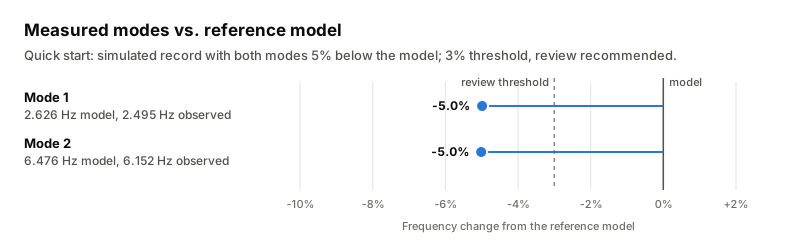
Compare measured vibration with a reference model. This example simulates a record in which both modes are 5% below the model:
import numpy as np
import timoshenko as tm

structure = tm.Structure(
    structure_id="building-01",
    story_masses_kg=[120_000.0, 110_000.0],
    story_stiffness_n_m=[85_000_000.0, 70_000_000.0],
)
print(structure.natural_frequencies_hz)          # (2.626, 6.476)

fs = 100.0
t = np.arange(60_000) / fs
f1, f2 = (0.95 * f for f in structure.natural_frequencies_hz)
signal = np.sin(2 * np.pi * f1 * t) + 0.4 * np.sin(2 * np.pi * f2 * t)
sensors = tm.SensorData(signal, sampling_hz=fs, unit="m/s^2")

result = tm.monitor(structure, sensors, review_threshold_pct=3.0)
print(result.structure.update_scale_factor)      # 0.903, since stiffness scales with frequency squared
for change in result.health.mode_changes:
    print(change.mode_number, change.change_pct)  # 1 -5.0, then 2 -5.0
print(result.health.review_recommended)          # True
Real records load from CSV or JSON with
tm.load_sensors("acceleration.csv", sampling_hz=100.0, column="acc"). The
steps inside tm.monitor are also available separately as tm.modal.identify,
tm.update, and tm.health.assess. The review flag is raised only when you
pass a threshold: a meaningful value depends on the structure and its
environmental variability, so the engine does not choose one.
Engineering calculations
Closed-form functions take and return SI units and validate their inputs:
import timoshenko as tm

section = tm.rectangle_section(width_m=0.3, height_m=0.6)
beam = tm.simply_supported_uniform_load(
    20_000.0, 6.0, 30e9, section.second_moment_y_m4,
    shear_modulus_pa=12.5e9, area_m2=section.area_m2,
)
print(beam.bending_m, beam.shear_m)  # 2.083 mm bending, 0.048 mm shear

frequency = tm.propagate_uncertainty(
    tm.natural_frequency_hz,
    {"mass_kg": 250.0, "stiffness_n_m": 4e5},
    standard_uncertainties={"mass_kg": 5.0, "stiffness_n_m": 8e3},
)
print(frequency.estimate, frequency.standard_uncertainty)  # 6.366 Hz ± 0.090 Hz
What it provides
| Area | Components |
|---|---|
| Engineering calculations | Section properties (including polygons with holes), beam deflection with shear, torsion, Euler buckling, plane stress, thin-wall pressure, SDOF vibration, Rayleigh damping, and GUM / Monte Carlo uncertainty |
| Structural models | Lumped-mass shear-building models and their natural frequencies |
| Modal analysis | Single-channel peak picking with resolution-checked damping, and multi-channel FDD with complex mode shapes |
| Model comparison | Nearest-frequency mode pairing, global stiffness updating, and evidence-oriented health assessment |
| Monitoring | Bounded rolling-window sessions, restart from local history, and source adapters for CSV, MQTT, and OGC SensorThings |
| Data and reporting | Project manifests with SHA-256 provenance, local SQLite history, and standalone HTML reports |
Sensor collection, alarm policy, and engineering interpretation remain with the application that embeds Timoshenko.
Multi-channel modal analysis
Frequency domain decomposition needs synchronized channels with a common sample rate and unit:
signals = tm.load_multichannel_csv(
    "aligned_accelerometers.csv",
    columns=["deck_left", "deck_center", "deck_right"],
    sampling_hz=100.0,
    units=["m/s^2"] * 3,
)
fdd = tm.identify_fdd(signals, nperseg=1024, max_modes=5)
for mode in fdd.modes:
    print(mode.frequency_hz, mode.shape_real)
Monitoring sessions
A host application feeds timestamped observation batches. The session aligns samples to the sample grid, waits for a fresh contiguous window after gaps, and analyzes every configured hop:
session = tm.MonitoringSession(
    structure,
    sensor_ids=["deck-left", "deck-right"],
    units=["m/s^2", "m/s^2"],
    sampling_hz=100.0,
    window_samples=2048,
    hop_samples=512,
    analysis_options={"nperseg": 512, "max_modes": 4},
    review_threshold_pct=5.0,
)
result = session.ingest(batch)  # batch: tm.ObservationBatch from your gateway or a source adapter
for report in result.reports:
    tm.report.save_html(report, "reports/latest.html")
The session does not open network connections or run in the background. Use
tm.SessionRunner with a source such as tm.CSVObservationSource or
tm.MqttObservationSource to drive it.
Documentation
The full documentation is at timoshenko.readthedocs.io. Good places to start:
- API reference
- Numerical methods and limits
- Architecture
- Monitoring sessions and source adapters
- Runnable examples, including a cross-check of PyNite shear-deformable beams
- Changelog
Limits and engineering posture
- Timoshenko is alpha software and is not a structural safety certification tool.
- The shear-building model is a small lumped-mass reference model, not a full FEM solver.
- Modal identification is a screening estimate. A single sensor may miss a mode near a modal node; unpaired peaks are reported rather than compared with the wrong mode.
- Damping is a coarse screening estimate, reported only when the averaged spectrum resolves the half-power bandwidth. FDD does not estimate damping.
- The model update applies a single stiffness scale. It cannot locate or size local damage.
- A frequency shift is evidence for human review, not a damage verdict. Temperature, sensor placement, boundary conditions, and other effects also shift measured frequencies.
- Closed-form mechanics and section functions rely on their documented ideal assumptions. They are not code-compliance checks.
Development
python -m pip install -e ".[test,lint]"
python -m pytest --cov
python -m ruff check .
python -m mypy
To preview the documentation site:
python -m pip install -e ".[docs]"
python -m mkdocs serve
Bug reports and pull requests are welcome in the
issue tracker. See
CONTRIBUTING.md
for the checks a pull request needs to pass; issues labelled
good first issue
are small, self-contained starting points.
Citation
If you use Timoshenko in research, please cite it with its DOI,
10.5281/zenodo.22968739, which
always resolves to the latest release; each release also has its own DOI on
Zenodo. The metadata is in
CITATION.cff,
which GitHub's "Cite this repository" button reads.
License
Apache License 2.0. See LICENSE.
1 maintainer

Metadata
1 maintainer
Release files for timoshenko-engine 2.0.3
For a detailed explanation of source distributions (sdists) and built distributions (wheels), please see the package formats documentation.
Source distribution (sdist)
| File | Size | Uploaded | |
|---|---|---|---|
| timoshenko_engine-2.0.3.tar.gz | 83.6 kB | Details |
Built distribution (wheel)
| File | Interpreter | ABI | Platform | Reset |
|---|---|---|---|---|
| timoshenko_engine-2.0.3-py3-none-any.whl | Python 3 | none | any | Details |
Total release size: 158.4 kB
Release files / timoshenko_engine-2.0.3.tar.gz
| Download URL | timoshenko_engine-2.0.3.tar.gz |
|---|---|
| Size | 83.6 kB |
| Tags | Source |
|
SHA-256 checksum How to use checksums |
86d79eb23b46ecdd79d8b9d7082151eb485b1009c6c003688169f0482ba3e7eb
|
|
BLAKE2b-256 checksum How to use checksums |
25dcb309b98cc212450ae914a07654895fcf0d1f57d502c185858885b3d69ba4
|
| Upload date | |
|
Uploaded using Trusted Publishing? What is trusted publishing? |
Yes |
| Uploaded via |
twine/7.0.0 CPython/3.13.14
|
Provenance
Provenance describes where a file came from. On PyPI, provenance is shared via attestations, which provide a verifiable record of the build or publishing details. View details, limitations and caveats.


PyPI Publish Attestation
PyPI verified that this artifact, at this checksum, originated from the publisher listed below.
Signed by GitHub Actions, verified by PyPI on Sep 28, 2026.
Transparency logRelease files / timoshenko_engine-2.0.3-py3-none-any.whl
| Download URL | timoshenko_engine-2.0.3-py3-none-any.whl |
|---|---|
| Size | 74.9 kB |
| Tags | Python 3 |
|
SHA-256 checksum How to use checksums |
9d22df274deab7622b5581587ff27419b428b3e6755bc7601e55b70a6cd50f1d
|
|
BLAKE2b-256 checksum How to use checksums |
8980c12e579392ab3074d37061ce462ee27ef897666bdb0ca15f2499a1c071d4
|
| Upload date | |
|
Uploaded using Trusted Publishing? What is trusted publishing? |
Yes |
| Uploaded via |
twine/7.0.0 CPython/3.13.14
|
Provenance
Provenance describes where a file came from. On PyPI, provenance is shared via attestations, which provide a verifiable record of the build or publishing details. View details, limitations and caveats.
PyPI Publish Attestation
PyPI verified that this artifact, at this checksum, originated from the publisher listed below.
Signed by GitHub Actions, verified by PyPI on Sep 28, 2026.
Transparency log













