

A lightweight PostGIS based dynamic vector tile server.




Documentation: https://developmentseed.org/timvt/
Source Code: https://github.com/developmentseed/timvt
TiMVT, pronounced tee-MVT, is a python package which helps creating lightweight Vector Tiles service from PostGIS Database.
Built on top of the modern and fast FastAPI framework, timvt is written in Python using async/await asynchronous code to improve the performances and handle heavy loads.
TiMVT is mostly inspired from the awesome urbica/martin and CrunchyData/pg_tileserv projects.
Features
- Multiple TileMatrixSets via morecantile. Default is set to WebMercatorQuad which is the usual Web Mercator projection used in most of Wep Map libraries.)
- Built with FastAPI
- Table and Function layers
- Async API using asyncpg
Install
Install TiMVT from pypi
# update pip (optional)
python -m pip install pip -U

# install timvt
python -m pip install timvt
or install from source:
$ git clone https://github.com/developmentseed/timvt.git
$ cd timvt
$ python -m pip install -e .
PostGIS/Postgres
TiMVT rely mostly on ST_AsMVT function and will need PostGIS >= 2.5.
If you want more info about ST_AsMVT function or on the subject of creating Vector Tile from PostGIS, please read this great article from Paul Ramsey: https://info.crunchydata.com/blog/dynamic-vector-tiles-from-postgis
Configuration
To be able to create Vector Tile, the application will need access to the PostGIS database. TiMVT uses pydantic's configuration pattern which make use of environment variable and/or .env file to pass variable to the application.
Example of .env file can be found in .env.example
POSTGRES_USER=username
POSTGRES_PASS=password
POSTGRES_DBNAME=postgis
POSTGRES_HOST=0.0.0.0
POSTGRES_PORT=5432

# Or you can also define the DATABASE_URL directly
DATABASE_URL=postgresql://username:password@0.0.0.0:5432/postgis
Minimal Application
from timvt.db import close_db_connection, connect_to_db
from timvt.factory import VectorTilerFactory
from timvt.layer import FunctionRegistry
from fastapi import FastAPI, Request

# Create Application.
app = FastAPI()

# Add Function registry to the application state
app.state.function_catalog = FunctionRegistry()

# Register Start/Stop application event handler to setup/stop the database connection
# and populate `app.state.table_catalog`
@app.on_event("startup")
async def startup_event():
    """Application startup: register the database connection and create table list."""
    await connect_to_db(app)


@app.on_event("shutdown")
async def shutdown_event():
    """Application shutdown: de-register the database connection."""
    await close_db_connection(app)

# Register endpoints.
mvt_tiler = VectorTilerFactory(
    with_tables_metadata=True,
    with_functions_metadata=True,  # add Functions metadata endpoints (/functions.json, /{function_name}.json)
    with_viewer=True,
)
app.include_router(mvt_tiler.router, tags=["Tiles"])
Default Application
While we encourage users to write their own application using TiMVT package, we also provide a default production ready application:
# Install timvt dependencies and Uvicorn (a lightning-fast ASGI server)
$ pip install timvt 'uvicorn[standard]>=0.12.0,<0.14.0'

# Set Database URL environment variable so TiMVT can access it
$ export DATABASE_URL=postgresql://username:password@0.0.0.0:5432/postgis

# Launch Demo Application
$ uvicorn timvt.main:app --reload
You can also use the official docker image
$ docker run \
    -p 8081:8081 \
    -e PORT=8081 \
    -e DATABASE_URL=postgresql://username:password@0.0.0.0:5432/postgis \
    ghcr.io/developmentseed/timvt:latest
:endpoint:/docs
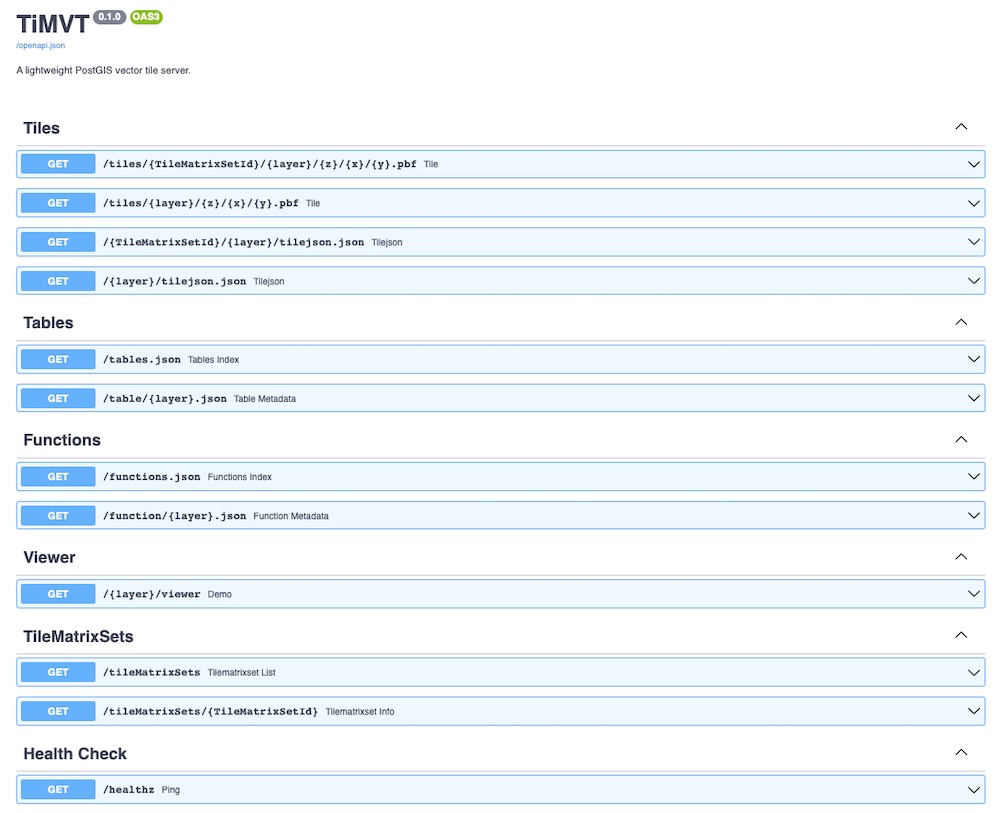
Contribution & Development
See CONTRIBUTING.md
License
See LICENSE
Authors
Created by Development Seed
Changes
See CHANGES.md.
Metadata
Release files for timvt 0.7.0
For a detailed explanation of source distributions (sdists) and built distributions (wheels), please see the package formats documentation.
Source distribution (sdist)
| File | Size | Uploaded | |
|---|---|---|---|
| timvt-0.7.0.tar.gz | 24.6 kB | Details |
Built distribution (wheel)
| File | Interpreter | ABI | Platform | Reset |
|---|---|---|---|---|
| timvt-0.7.0-py3-none-any.whl | Python 3 | none | any | Details |
Total release size: 49.4 kB
Release files / timvt-0.7.0.tar.gz
| Download URL | timvt-0.7.0.tar.gz |
|---|---|
| Size | 24.6 kB |
| Tags | Source |
|
SHA-256 checksum How to use checksums |
ebd251d4df217e840f9f36271e91b0d48a1c94763d6982429edce01bc8a6d304
|
|
BLAKE2b-256 checksum How to use checksums |
a9550558dc40bcb80c03d23b91ea6812f2a5cd78f831d04eec7ce0388ddb58f3
|
| Upload date | |
|
Uploaded using Trusted Publishing? What is trusted publishing? |
No |
| Uploaded via |
python-requests/2.27.1
|
Release files / timvt-0.7.0-py3-none-any.whl
| Download URL | timvt-0.7.0-py3-none-any.whl |
|---|---|
| Size | 24.8 kB |
| Tags | Python 3 |
|
SHA-256 checksum How to use checksums |
d7f04b7e797ff2888559748ab1148fe532767069624c7f8b4a466c6bc7bbf090
|
|
BLAKE2b-256 checksum How to use checksums |
c4b780c68b9648498dad12e4d01e00cbba7bd60bcbad6ccef8804dfc41da9eb9
|
| Upload date | |
|
Uploaded using Trusted Publishing? What is trusted publishing? |
No |
| Uploaded via |
python-requests/2.27.1
|














