
A Python library for terminal text colorization and highlighting

Project description
Tinty
Tinty is a tiny Python library for terminal text colorization and highlighting, inspired by the Ruby colorize gem. Now with a modern, production-safe API featuring Pathlib-inspired operator chaining!




✨ Features
- 🔒 Production Safe: No monkey patching or global state pollution
- 🎯 Multiple APIs: Choose your preferred style - fluent, functional, or global
- 🔗 Pathlib-inspired: Elegant operator chaining with
|and>>operators - 🌈 Comprehensive: Support for all ANSI colors, backgrounds, and text styles
- 🎨 Smart Color Nesting: Automatic priority-based rendering without manual z-index
- 🔍 ANSI-Aware Matching: Patterns match original text, ignoring color codes
- 🎯 Channel Isolation: Foreground, background, and attributes work independently
- ⚡ High Performance: Efficient implementation with minimal overhead
- 🧪 Well Tested: Comprehensive test suite with 100+ tests
- 📦 Zero Dependencies: Pure Python implementation
- 🖥️ Cross Platform: Works on Linux, macOS, and Windows
- 🛠️ CLI Tool: Command-line interface for colorizing text
🚀 Installation
pip install tinty
🖼️ See It In Action
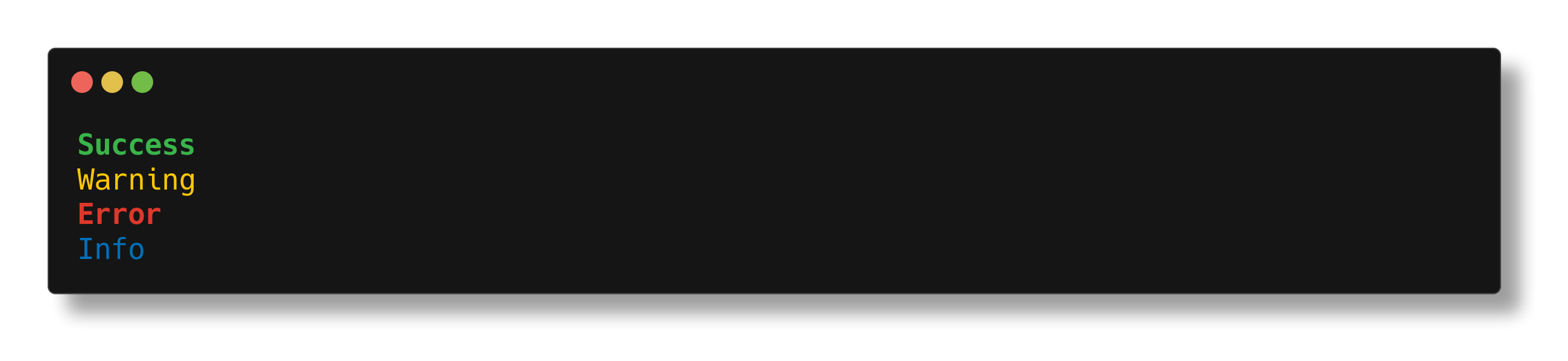
Simple API, beautiful results:
print(colored("Success") | GREEN | BOLD)
print(colored("Warning") | YELLOW)
print(colored("Error") | RED | BOLD)
print(colored("Info") | BLUE)
CLI pattern highlighting:
echo "hello world" | tinty "l.*" yellow
echo "hello world" | tinty "(ll).*(ld)" red,bg_blue blue,bg_red

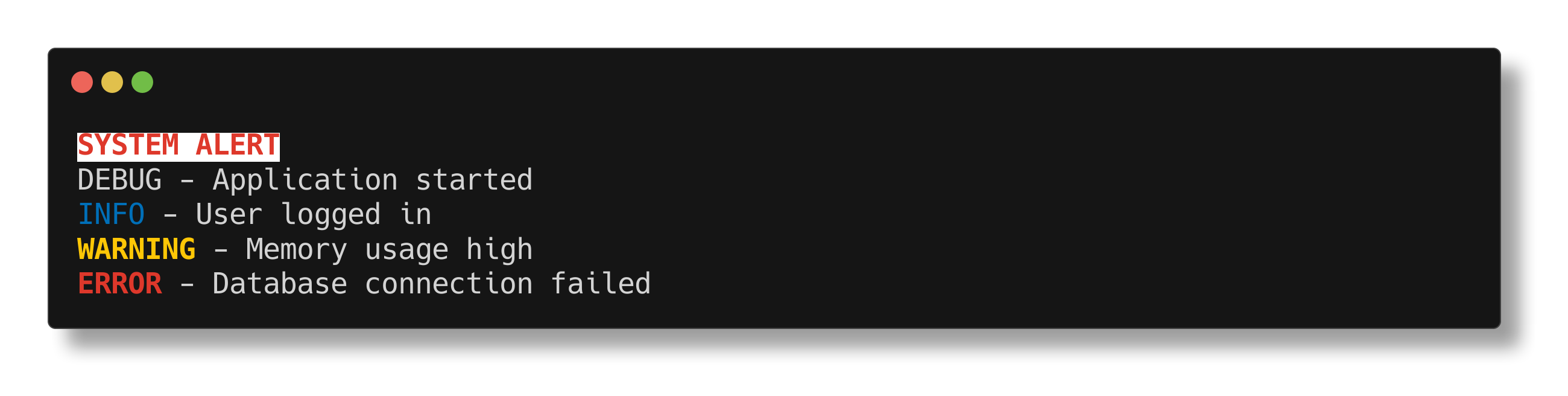
Complex styling made easy:
print(colored("SYSTEM ALERT") | RED | BOLD | BG_WHITE)
print(str(colored("DEBUG") | DIM) + " - Application started")
print(str(colored("INFO") | BLUE) + " - User logged in")
print(str(colored("WARNING") | YELLOW | BOLD) + " - Memory usage high")
print(str(colored("ERROR") | RED | BOLD) + " - Database connection failed")
Regex pattern highlighting:
text = "The quick brown fox jumps over the lazy dog"
highlighted = colored(text).highlight(r"(quick)|(fox)|(lazy)", ["red", "blue", "green"])
print(highlighted)

🎨 Quick Start
Modern Enhanced API (Recommended)
from tinty import colored, C, txt, RED, GREEN, BLUE, YELLOW, BOLD, BG_WHITE, UNDERLINE

# Type-safe constants with operator chaining (RECOMMENDED)
print(colored("Success") | GREEN | BOLD)
print(txt("Warning") | YELLOW)
print(colored("Error") | RED | BOLD | BG_WHITE)
print(txt("Info") >> BLUE >> UNDERLINE)

# Global convenience object with constants
print(C("✓ Tests passing") | GREEN)
print(C("✗ Build failed") | RED)
print(C("Processing...") | BLUE | BOLD)

# Legacy method chaining (still works but uses internal string literals)
print(colored("Success").green().bold())
print(txt("Warning").yellow())
Real-World Examples
from tinty import (
    colored, C, txt, ColorString,
    RED, GREEN, BLUE, YELLOW, BOLD, DIM, BG_WHITE, BLINK
)

# Log levels with type-safe constants
print(C("DEBUG") | DIM + " - Application started")
print(colored("INFO") | BLUE + " - User logged in")
print(txt("WARNING") | YELLOW | BOLD + " - Memory usage high")
print(ColorString("ERROR") | RED | BOLD + " - Database connection failed")

# CLI status indicators (direct color methods still work)
print(f"{C.green('✓')} File saved successfully")
print(f"{C.yellow('⚠')} Configuration outdated")
print(f"{C.red('✗')} Permission denied")

# Complex chaining with constants
alert = (colored("SYSTEM ALERT")
         | RED
         | BOLD
         | BG_WHITE
         | BLINK)
print(alert)
Pattern Highlighting
from tinty import colored

# Highlight search terms
text = "The quick brown fox jumps over the lazy dog"
highlighted = colored(text).highlight(r"(quick)|(fox)|(lazy)", ["red", "blue", "green"])
print(highlighted)

# Syntax highlighting
code = "def hello_world():"
result = colored(code).highlight(r"\b(def)\b", ["blue"])
print(result)
🎨 Advanced: Color Nesting & Priority
Tinty intelligently handles overlapping colors with automatic priority resolution:
Nested Regex Groups
Inner (more specific) capture groups automatically override outer ones:
from tinty import ColorizedString

text = ColorizedString("hello world")

# Pattern: (h.(ll)) creates two groups
# - Group 1: "hell" (outer) → red
# - Group 2: "ll" (inner, higher priority) → blue
result = text.highlight(r'(h.(ll))', ['red', 'blue'])
print(result)
# Output: "he" is red, "ll" is blue (inner wins)
Priority Rules:
- Pipeline stage: Later commands override earlier ones
- Nesting depth: Inner regex groups override outer groups
- Application order: Later applications win within same depth
Channel Isolation
Foreground, background, and attributes are independent channels that can coexist:
text = ColorizedString("hello world")

# Background and foreground don't conflict!
result = text.highlight(r'(h.(ll))', ['bg_red', 'blue'])
print(result)
# Output: "he" has red background
#         "ll" has BOTH red background AND blue foreground
Available Channels:
- Foreground (fg): Text color (red, blue, green, etc.)
- Background (bg): Background color (bg_red, bg_blue, etc.)
- Attributes (attr): Bold, underline, dim, etc.
ANSI-Aware Pattern Matching
Patterns always match the original text, even if it contains ANSI codes:
# Text with existing ANSI codes
colored_text = ColorizedString("H\x1b[31mello\x1b[0m World")

# Pattern still matches "Hello" ignoring the ANSI codes in between
result = colored_text.highlight(r'Hello', ['green'])
print(result)
# Works! Pattern matched the original text "Hello World"
Color Name Flexibility
Both bg_red and red_bg formats are supported:
# These are equivalent:
text.highlight(r'hello', ['bg_red'])    # Official format
text.highlight(r'hello', ['red_bg'])    # Natural format (auto-normalized)
CLI Examples with Nesting
# Nested groups - inner blue wins over outer red
echo "hello world" | tinty '(h.(ll))' red,blue

# Background + foreground coexist (different channels)
echo "hello world" | tinty '(h.(ll))' bg_red,blue
# Result: "he" = red background
#         "ll" = red background + blue foreground

# Pipeline - later commands have higher priority
echo "hello world" | tinty 'hello' red | tinty 'world' blue
# Result: "hello" is red, "world" is blue

# Pipeline with --replace-all to clear previous colors
echo "hello world" | tinty 'hello' red | tinty --replace-all 'world' blue
# Result: Only "world" is blue (red cleared)

# Both color formats work
echo "hello" | tinty 'hello' bg_red     # Official
echo "hello" | tinty 'hello' red_bg     # Natural (auto-normalized)
Advanced Pattern Control
Control priority through regex structure:
# Want inner group to have higher priority?
# Put it deeper in the nesting:
echo "hello" | tinty '(he(ll)o)' red,blue
# Result: "he" and "o" are red, "ll" is blue (deeper nesting)

# Want same priority? Use sibling groups:
echo "hello" | tinty '(he)(ll)' red,blue
# Result: Both at same depth, order determines priority
Real-World Use Cases
Log File Highlighting
from tinty import ColorizedString

log = "ERROR: Connection failed at 10:30:45"
result = (ColorizedString(log)
    .highlight(r'ERROR', ['red', 'bold'])      # Priority 1
    .highlight(r'\d{2}:\d{2}:\d{2}', ['blue']) # Priority 2
)
print(result)
# "ERROR" is red+bold, timestamp is blue
Syntax Highlighting with Context
code = "def hello_world():"
result = (ColorizedString(code)
    .highlight(r'\b(def)\b', ['blue'])           # Keywords
    .highlight(r'[a-z_]+\w*(?=\()', ['green'])   # Function names
)
print(result)
# Keywords and functions properly colored even when overlapping
Multi-Stage Processing
# Stage 1: Highlight errors in red
cat log.txt | tinty 'ERROR|CRITICAL' red > /tmp/colored.txt

# Stage 2: Add blue highlighting for timestamps (higher priority)
cat /tmp/colored.txt | tinty '\d{2}:\d{2}:\d{2}' blue

# Result: Both colors preserved, timestamps override errors if overlapping
📋 Available Colors and Styles
Foreground Colors
red, green, blue, yellow, magenta, cyan, white, black, lightred, lightgreen, lightblue, lightyellow, lightmagenta, lightcyan, lightgray, darkgray
Background Colors
bg_red, bg_green, bg_blue, bg_yellow, bg_magenta, bg_cyan, bg_white, bg_black, bg_lightred, bg_lightgreen, bg_lightblue, bg_lightyellow, bg_lightmagenta, bg_lightcyan, bg_lightgray, bg_darkgray
Text Styles
bright/bold, dim, underline, blink, invert/swapcolor, hidden, strikethrough
🔒 Type-Safe Color Constants (New!)
Use constants instead of error-prone string literals:
from tinty import colored, RED, GREEN, BLUE, YELLOW, BOLD, BG_WHITE

# ✅ Type-safe with IDE autocompletion and error checking
error_msg = colored("CRITICAL") | RED | BOLD | BG_WHITE
success_msg = colored("SUCCESS") | GREEN | BOLD
warning_msg = colored("WARNING") | YELLOW

# ❌ Error-prone string literals
error_msg = colored("CRITICAL") | "red" | "typo"  # Runtime error!
Benefits:
- 🔍 IDE Autocompletion: Get suggestions for valid colors
- 🛡️ Type Checking: Catch typos at development time
- 📝 Self-Documenting: Clear, readable code
- 🔄 Refactoring Safe: Rename constants across codebase
- ⚡ No Runtime Errors: Invalid colors caught early
Available Constants:
- Colors:
RED,GREEN,BLUE,YELLOW,MAGENTA,CYAN,WHITE,BLACK - Light Colors:
LIGHTRED,LIGHTGREEN,LIGHTBLUE, etc. - Backgrounds:
BG_RED,BG_GREEN,BG_BLUE, etc. - Styles:
BOLD,BRIGHT,DIM,UNDERLINE,BLINK,INVERT
🎭 API Styles
Choose the style that fits your needs:
1. Type-Safe Constants (Recommended)
from tinty import colored, txt, RED, BLUE, BOLD, UNDERLINE

colored("hello") | RED | BOLD
txt("world") | BLUE | UNDERLINE
2. Global Object with Constants
from tinty import C, RED, BOLD

C.red("hello")              # Direct color method
C("hello") | RED | BOLD     # Factory with type-safe constants
C("hello", "red")           # Direct colorization (legacy)
3. Enhanced ColorString with Constants
from tinty import ColorString, RED, BOLD, BG_YELLOW

ColorString("hello") | RED | BOLD | BG_YELLOW
4. Legacy Method Chaining (Still Supported)
from tinty import colored, txt

# Method chaining (uses internal string literals)
colored("hello").red().bold()
txt("world").blue().underline()

# Mixed with operators (not recommended - inconsistent)
colored("Mixed").red() | "bright"
🛠️ Command Line Interface
Basic Usage
# Simple pattern matching
echo "hello world" | tinty 'l' red

# Pattern groups
echo "hello world" | tinty '(h.*o).*(w.*d)' red blue
Advanced: Nested Colors
# Nested regex groups - inner wins
echo "hello world" | tinty '(h.(ll))' red,blue
# Output: "he" is red, "ll" is blue (inner group has higher priority)

# Channel isolation - foreground + background
echo "hello world" | tinty '(h.(ll))' bg_red,blue
# Output: "he" = red bg, "ll" = red bg + blue fg

# Color name formats (both work)
echo "hello" | tinty 'hello' bg_red    # Official format
echo "hello" | tinty 'hello' red_bg    # Natural format (auto-normalized)

# Space or comma-separated colors
echo "test" | tinty '(t)(e)' red,blue   # Comma-separated
echo "test" | tinty '(t)(e)' red blue   # Space-separated
Options
# List all available colors
tinty --list-colors

# Case sensitive matching
echo "Hello World" | tinty --case-sensitive 'Hello' green

# Verbose mode (debugging)
echo "test" | tinty --verbose 'test' red

# Clear all previous colors before applying new ones
echo "hello world" | tinty 'hello' red | tinty --replace-all 'world' blue
# Result: Only "world" is blue, "hello" has no color
🔄 Legacy API (Still Supported)
The original API remains fully supported for backward compatibility:
from tinty import Colorize, ColorizedString

# Original Colorize class
colorizer = Colorize()
print(colorizer.colorize("hello", "red"))

# Original ColorizedString
cs = ColorizedString("hello")
print(cs.colorize("blue"))
🧪 Development
Running Tests
# Run all tests
pytest

# Run with coverage
pytest --cov=tinty

# Run specific test file
pytest tests/test_enhanced.py
Code Quality
# Format and lint
ruff format --preview .
ruff check --preview .

# Type checking
mypy src/

# Run pre-commit hooks
pre-commit run --all-files
📖 Examples
See the examples/ directory for more comprehensive examples:
examples/quickstart.py- Basic usage patternsexamples/enhanced_demo.py- Full enhanced API demonstrationexamples/nesting_demo.py- Color nesting and priority examples
Version Management
This project uses automated versioning via git tags:
- Versions are managed by
setuptools-scmbased on git tags poetry-dynamic-versioningintegrates this with Poetry builds- To release:
git tag v1.2.3 && git push --tags
🤝 Contributing
Contributions are welcome! Please feel free to submit a Pull Request. Make sure to:
- Run the pre-commit hooks:
pre-commit run --all-files - Add tests for new features
- Update documentation as needed
📄 License
This project is licensed under the MIT License - see the LICENSE file for details.
🙏 Acknowledgments
- Inspired by the Ruby colorize gem
- Built with modern Python best practices
- Designed for production safety and developer experience


Download files
Download the file for your platform. If you're not sure which to choose, learn more about installing packages.
Source Distribution
Built Distribution
Filter files by name, interpreter, ABI, and platform.
If you're not sure about the file name format, learn more about wheel file names.
Copy a direct link to the current filters
File details
Details for the file tinty-0.2.0.tar.gz.
File metadata
- Download URL: tinty-0.2.0.tar.gz
- Upload date:
- Size: 24.5 kB
- Tags: Source
- Uploaded using Trusted Publishing? No
- Uploaded via: poetry/1.8.3 CPython/3.12.10 Darwin/25.0.0
File hashes
| Algorithm | Hash digest | |
|---|---|---|
| SHA256 |
0e9a682c5a9065cb40acf956c0fce585f25eb707a0fabe64c25f9b4ee1080ecf
|
|
| MD5 |
b473045e3efcf2271a50506b122d3f5d
|
|
| BLAKE2b-256 |
1702a84ec9463643dd9b3368e644732561b983f481351f10e46d888747f49876
|
File details
Details for the file tinty-0.2.0-py3-none-any.whl.
File metadata
- Download URL: tinty-0.2.0-py3-none-any.whl
- Upload date:
- Size: 20.5 kB
- Tags: Python 3
- Uploaded using Trusted Publishing? No
- Uploaded via: poetry/1.8.3 CPython/3.12.10 Darwin/25.0.0
File hashes
| Algorithm | Hash digest | |
|---|---|---|
| SHA256 |
17fd01962f321bac51a9115b9b6903f215349b7015a3febae83216de5825a02a
|
|
| MD5 |
f30157d6808de88368410a568df2381b
|
|
| BLAKE2b-256 |
f06be76c05bf529b2197e8fc186c63eaa7fd10559ed5a29e9190ca1c050c2935
|






