
Tiny8





An educational 8-bit CPU simulator with interactive visualization
Tiny8 is a lightweight and educational toolkit for exploring the fundamentals of computer architecture through hands-on assembly programming and real-time visualization. Designed for learning and experimentation, it features an AVR-inspired 8-bit CPU with 32 registers, a rich instruction set, and powerful debugging tools — all with zero heavy dependencies.
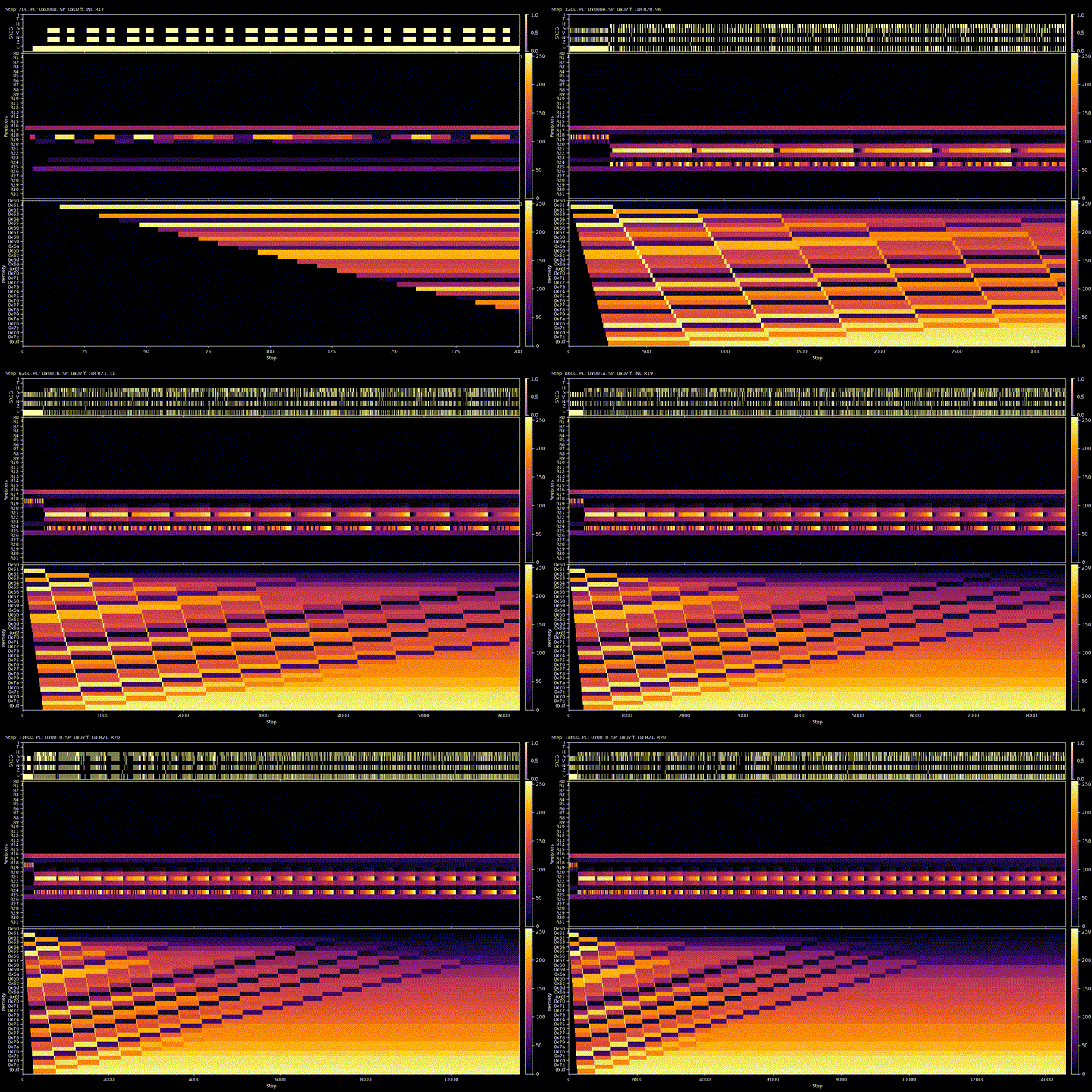
Real-time visualization of a bubble sort algorithm executing on Tiny8
✨ Features
🎯 Interactive Terminal Debugger

- Vim-style navigation: Step through execution with intuitive keyboard controls
- Change highlighting: See exactly what changed at each step (registers, flags, memory)
- Advanced search: Find instructions, track register/memory changes, locate PC addresses
- Marks and bookmarks: Set and jump to important execution points
- Vertical scrolling: Handle programs with large memory footprints
🎬 Graphical Animation
- Generate high-quality GIF/MP4 videos of program execution
- Visualize register evolution, memory access patterns, and flag changes
- Perfect for presentations, documentation, and learning materials
🏗️ Complete 8-bit Architecture
- 32 general-purpose registers (R0-R31)
- 8-bit ALU with arithmetic, logical, and bit manipulation operations
- Status register (SREG) with 8 condition flags
- 2KB address space for unified memory and I/O
- Stack operations with dedicated stack pointer
- AVR-inspired instruction set with 60+ instructions
📚 Educational Focus
- Clean, readable Python implementation
- Comprehensive examples (Fibonacci, bubble sort, factorial, and more)
- Step-by-step execution traces for debugging
- Full API documentation and instruction set reference
🚀 Quick Start
Installation
pip install tiny8
Your First Program
Create fibonacci.asm:
; Fibonacci Sequence Calculator
; Calculates the 10th Fibonacci number (F(10) = 55)
; F(0) = 0, F(1) = 1, F(n) = F(n-1) + F(n-2)
;
; Results stored in registers:
; R16 and R17 hold the two most recent Fibonacci numbers

    ldi r16, 0          ; F(0) = 0
    ldi r17, 1          ; F(1) = 1
    ldi r18, 9          ; Counter: 9 more iterations to reach F(10)

loop:
    add r16, r17        ; F(n) = F(n-1) + F(n-2)
    mov r19, r16        ; Save result temporarily
    mov r16, r17        ; Shift: previous = current
    mov r17, r19        ; Shift: current = new result
    dec r18             ; Decrement counter
    brne loop           ; Continue if counter != 0

done:
    jmp done            ; Infinite loop at end
Run it:
tiny8 fibonacci.asm # Interactive debugger
tiny8 fibonacci.asm -m ani -o fibonacci.gif # Generate animation
Python API
from tiny8 import CPU, assemble_file

asm = assemble_file("fibonacci.asm")
cpu = CPU()
cpu.load_program(asm)
cpu.run(max_steps=1000)

print(f"Result: R17 = {cpu.read_reg(17)}")  # Final Fibonacci number
💡 Why Tiny8?
For Students — Write assembly, see immediate results with visual feedback. Understand how each instruction affects CPU state without abstractions.
For Educators — Interactive demonstrations, easy assignment creation, and generate animations for lectures.
For Hobbyists — Rapid algorithm prototyping at the hardware level with minimal overhead and an extensible, readable codebase.
📖 Documentation
- Full Documentation — Complete API reference and guides
- Instruction Set Reference — All 60+ instructions
- CLI Guide — Terminal debugger keyboard shortcuts
- Examples — Sample programs with explanations
- Contributing — Guidelines for contributors
🎮 Interactive CLI Controls
The terminal-based debugger provides powerful navigation and inspection capabilities.
Navigation & Playback
l/hor→/←— Step forward/backwardw/b— Jump ±10 steps0/$— Jump to first/last stepSpace— Play/pause auto-execution[/]— Decrease/increase playback speed
Display & Inspection
r— Toggle register display (all/changed only)M— Toggle memory display (all/non-zero only)=— Show detailed step informationj/k— Scroll memory view up/down
Search & Navigation Commands (press :)
:123— Jump to step 123:+50/:-20— Relative jumps:/ldi— Search forward for instruction "ldi":?add— Search backward for "add":@0x100— Jump to PC address 0x100:r10— Find next change to register R10:r10=42— Find where R10 equals 42:m100— Find next change to memory[100]:fZ— Find next change to flag Z
Marks & Help
ma— Set mark 'a' at current step'a— Jump to mark 'a'/— Show help screenqorESC— Quit
🎓 Examples
The examples/ directory contains programs demonstrating key concepts:
| Example | Description |
|---|---|
fibonacci.asm |
Fibonacci sequence using registers |
bubblesort.asm |
Sorting algorithm with memory visualization |
factorial.asm |
Recursive factorial calculation |
find_max.asm |
Finding maximum value in array |
is_prime.asm |
Prime number checking algorithm |
gcd.asm |
Greatest common divisor (Euclidean algorithm) |
Bubble Sort
Sort 32 bytes in memory:
tiny8 examples/bubblesort.asm -ms 0x60 -me 0x80 # Watch live
tiny8 examples/bubblesort.asm -m ani -o sort.gif -ms 0x60 -me 0x80   # Create GIF
Using Python
from tiny8 import CPU, assemble_file

cpu = CPU()
cpu.load_program(assemble_file("examples/bubblesort.asm"))
cpu.run()

print("Sorted:", [cpu.read_ram(i) for i in range(0x60, 0x80)])
🔧 CLI Options
Command Syntax
tiny8 FILE [OPTIONS]
General Options
| Option | Description |
|---|---|
-m, --mode {cli,ani} |
Visualization mode: cli for interactive debugger (default), ani for animation |
-v, --version |
Show version and exit |
--max-steps N |
Maximum execution steps (default: 15000) |
Memory Display Options
| Option | Description |
|---|---|
-ms, --mem-start ADDR |
Starting memory address (decimal or 0xHEX, default: 0x00) |
-me, --mem-end ADDR |
Ending memory address (decimal or 0xHEX, default: 0xFF) |
CLI Mode Options
| Option | Description |
|---|---|
-d, --delay SEC |
Initial playback delay in seconds (default: 0.15) |
Animation Mode Options
| Option | Description |
|---|---|
-o, --output FILE |
Output filename (.gif, .mp4, .png) |
-f, --fps FPS |
Frames per second (default: 60) |
-i, --interval MS |
Update interval in milliseconds (default: 1) |
-pe, --plot-every N |
Update plot every N steps (default: 100, higher = faster) |
Windows: CLI debugger requires WSL or
windows-curses. Animation works natively.
📋 Instruction Set Reference
Tiny8 implements an AVR-inspired instruction set with 62 instructions organized into logical categories. All mnemonics are case-insensitive. Registers are specified as R0-R31, immediates support decimal, hex ($FF or 0xFF), and binary (0b11111111) notation.
Data Transfer
| Instruction | Description | Example |
|---|---|---|
LDI Rd, K |
Load 8-bit immediate into register | ldi r16, 42 |
MOV Rd, Rr |
Copy register to register | mov r17, r16 |
LD Rd, Rr |
Load from RAM at address in Rr | ld r18, r16 |
ST Rr, Rs |
Store Rs to RAM at address in Rr | st r16, r18 |
IN Rd, port |
Read from I/O port into register | in r16, 0x3F |
OUT port, Rr |
Write register to I/O port | out 0x3F, r16 |
PUSH Rr |
Push register onto stack | push r16 |
POP Rd |
Pop from stack into register | pop r16 |
Arithmetic Operations
| Instruction | Description | Example |
|---|---|---|
ADD Rd, Rr |
Add registers | add r16, r17 |
ADC Rd, Rr |
Add with carry | adc r16, r17 |
SUB Rd, Rr |
Subtract registers | sub r16, r17 |
SUBI Rd, K |
Subtract immediate | subi r16, 10 |
SBC Rd, Rr |
Subtract with carry | sbc r16, r17 |
SBCI Rd, K |
Subtract immediate with carry | sbci r16, 5 |
INC Rd |
Increment register | inc r16 |
DEC Rd |
Decrement register | dec r16 |
MUL Rd, Rr |
Multiply (result in Rd:Rd+1) | mul r16, r17 |
DIV Rd, Rr |
Divide (quotient→Rd, remainder→Rd+1) | div r16, r17 |
NEG Rd |
Two's complement negation | neg r16 |
ADIW Rd, K |
Add immediate to word (16-bit) | adiw r24, 1 |
SBIW Rd, K |
Subtract immediate from word | sbiw r24, 1 |
Logical & Bit Operations
| Instruction | Description | Example |
|---|---|---|
AND Rd, Rr |
Logical AND | and r16, r17 |
ANDI Rd, K |
AND with immediate | andi r16, 0x0F |
OR Rd, Rr |
Logical OR | or r16, r17 |
ORI Rd, K |
OR with immediate | ori r16, 0x80 |
EOR Rd, Rr |
Exclusive OR | eor r16, r17 |
EORI Rd, K |
XOR with immediate | eori r16, 0xFF |
COM Rd |
One's complement | com r16 |
CLR Rd |
Clear register (XOR with self) | clr r16 |
SER Rd |
Set register to 0xFF | ser r16 |
TST Rd |
Test for zero or negative | tst r16 |
SWAP Rd |
Swap nibbles (high/low 4 bits) | swap r16 |
SBI port, bit |
Set bit in I/O register | sbi 0x18, 3 |
CBI port, bit |
Clear bit in I/O register | cbi 0x18, 3 |
Shifts & Rotates
| Instruction | Description | Example |
|---|---|---|
LSL Rd |
Logical shift left | lsl r16 |
LSR Rd |
Logical shift right | lsr r16 |
ROL Rd |
Rotate left through carry | rol r16 |
ROR Rd |
Rotate right through carry | ror r16 |
Control Flow
| Instruction | Description | Example |
|---|---|---|
JMP label |
Unconditional jump | jmp loop |
RJMP offset |
Relative jump | rjmp -5 |
CALL label |
Call subroutine | call function |
RCALL offset |
Relative call | rcall -10 |
RET |
Return from subroutine | ret |
RETI |
Return from interrupt | reti |
BRNE label |
Branch if not equal (Z=0) | brne loop |
BREQ label |
Branch if equal (Z=1) | breq done |
BRCS label |
Branch if carry set (C=1) | brcs overflow |
BRCC label |
Branch if carry clear (C=0) | brcc no_carry |
BRGE label |
Branch if greater/equal | brge positive |
BRLT label |
Branch if less than | brlt negative |
BRMI label |
Branch if minus (N=1) | brmi negative |
BRPL label |
Branch if plus (N=0) | brpl positive |
Compare Instructions
| Instruction | Description | Example |
|---|---|---|
CP Rd, Rr |
Compare registers (Rd - Rr) | cp r16, r17 |
CPI Rd, K |
Compare with immediate | cpi r16, 42 |
CPSE Rd, Rr |
Compare, skip if equal | cpse r16, r17 |
Skip Instructions
| Instruction | Description | Example |
|---|---|---|
SBRS Rd, bit |
Skip if bit in register is set | sbrs r16, 7 |
SBRC Rd, bit |
Skip if bit in register is clear | sbrc r16, 7 |
SBIS port, bit |
Skip if bit in I/O register is set | sbis 0x16, 3 |
SBIC port, bit |
Skip if bit in I/O register is clear | sbic 0x16, 3 |
MCU Control
| Instruction | Description | Example |
|---|---|---|
NOP |
No operation | nop |
SEI |
Set global interrupt enable | sei |
CLI |
Clear global interrupt enable | cli |
Status Register (SREG) Flags
The 8-bit status register contains condition flags updated by instructions:
| Bit | Flag | Description |
|---|---|---|
| 7 | I | Global interrupt enable |
| 6 | T | Bit copy storage |
| 5 | H | Half carry (BCD arithmetic) |
| 4 | S | Sign bit (N ⊕ V) |
| 3 | V | Two's complement overflow |
| 2 | N | Negative |
| 1 | Z | Zero |
| 0 | C | Carry/borrow |
Flags are used for conditional branching and tracking arithmetic results.
Assembly Syntax Notes
- Comments: Use
;for line comments - Labels: Must end with
:(e.g.,loop:) - Registers: Case-insensitive R0-R31 (r16, R16 equivalent)
- Immediates: Decimal (42), hex ($2A, 0x2A), binary (0b00101010)
- Whitespace: Flexible indentation, spaces/tabs interchangeable
🏗️ Architecture Overview
CPU Components
- 32 General-Purpose Registers (R0-R31) — 8-bit working registers
- Program Counter (PC) — 16-bit, addresses up to 64KB
- Stack Pointer (SP) — 16-bit, grows downward from high memory
- Status Register (SREG) — 8 condition flags (I, T, H, S, V, N, Z, C)
- 64KB Address Space — Unified memory for RAM and I/O
Memory Map
0x0000 - 0x001F    Memory-mapped I/O (optional)
0x0020 - 0xFFFF    Available RAM (stack grows downward from top)
🧪 Testing
pytest                                    # Run all tests
pytest --cov=src/tiny8 --cov-report=html  # With coverage
pytest tests/test_arithmetic.py           # Specific test file
🤝 Contributing
Contributions welcome! See CONTRIBUTING.md for guidelines.
Areas for contribution: New instructions, example programs, documentation, visualizations, performance optimizations.
📄 License
MIT License — see LICENSE for details.
📞 Support
- Issues: GitHub Issues
- Discussions: GitHub Discussions
- Documentation: sql-hkr.github.io/tiny8
Made with ❤️ for learners, educators, and curious minds
Star ⭐ the repo if you find it useful!
1 maintainer

Metadata
1 maintainer
Release files for tiny8 0.2.0
For a detailed explanation of source distributions (sdists) and built distributions (wheels), please see the package formats documentation.
Source distribution (sdist)
| File | Size | Uploaded | |
|---|---|---|---|
| tiny8-0.2.0.tar.gz | 32.6 kB | Details |
Built distribution (wheel)
| File | Interpreter | ABI | Platform | Reset |
|---|---|---|---|---|
| tiny8-0.2.0-py3-none-any.whl | Python 3 | none | any | Details |
Total release size: 67.8 kB
Release files / tiny8-0.2.0.tar.gz
| Download URL | tiny8-0.2.0.tar.gz |
|---|---|
| Size | 32.6 kB |
| Tags | Source |
|
SHA-256 checksum How to use checksums |
4129f1d89fafbc1da2fe6190daa55ac54ec1b00613ab6882fb39d9765779ceeb
|
|
BLAKE2b-256 checksum How to use checksums |
bbd5ed151cf215a123f13a5d4562b93c694d07838af1af90649f6b122a20bfe7
|
| Upload date | |
|
Uploaded using Trusted Publishing? What is trusted publishing? |
Yes |
| Uploaded via |
twine/6.1.0 CPython/3.13.7
|
Provenance
Provenance describes where a file came from. On PyPI, provenance is shared via attestations, which provide a verifiable record of the build or publishing details. View details, limitations and caveats.


PyPI Publish Attestation
PyPI verified that this artifact, at this checksum, originated from the publisher listed below.
Signed by GitHub Actions, verified by PyPI on Nov 1, 2025.
Transparency logRelease files / tiny8-0.2.0-py3-none-any.whl
| Download URL | tiny8-0.2.0-py3-none-any.whl |
|---|---|
| Size | 35.2 kB |
| Tags | Python 3 |
|
SHA-256 checksum How to use checksums |
ce8c5ddf5e5fc9642119702401cc16c7d94da7987b4e26223ed75c0d0250af9e
|
|
BLAKE2b-256 checksum How to use checksums |
7fcc69700069523856827f9b2c1d2c711b0ba25247d2c7ca4c7e3eca3d334b56
|
| Upload date | |
|
Uploaded using Trusted Publishing? What is trusted publishing? |
Yes |
| Uploaded via |
twine/6.1.0 CPython/3.13.7
|
Provenance
Provenance describes where a file came from. On PyPI, provenance is shared via attestations, which provide a verifiable record of the build or publishing details. View details, limitations and caveats.
PyPI Publish Attestation
PyPI verified that this artifact, at this checksum, originated from the publisher listed below.
Signed by GitHub Actions, verified by PyPI on Nov 1, 2025.
Transparency log













