
TinyDoc 0.3.0 (preview) — local-first grounded document extraction
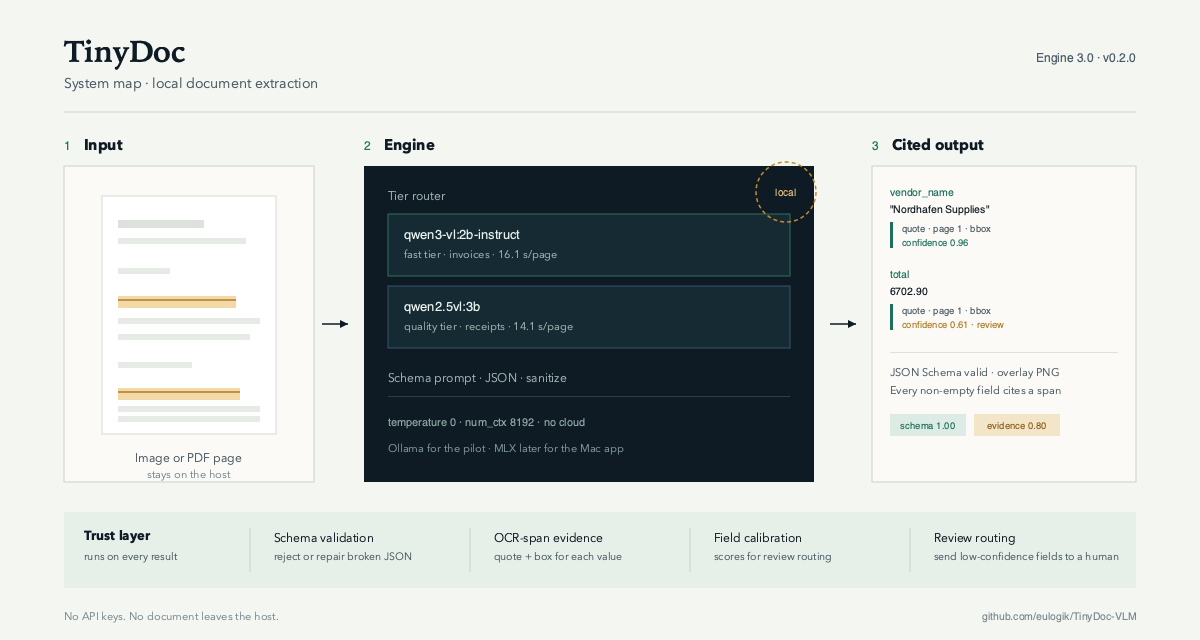
TinyDoc turns receipt and invoice images into schema-validated JSON with per-field evidence (quote + OCR bbox), confidence for receipt review routing, and arithmetic review flags for invoices. It runs local Qwen VLMs through Ollama; no API key, no cloud, no telemetry.
pip install tinydoc==0.3.0           # multipage + local UI
pip install 'tinydoc[pdf,ui]'        # with PDF rendering + Gradio
pip install -e ./sdk                 # development install
ollama pull qwen2.5vl:3b             # quality tier
ollama pull qwen3-vl:2b-instruct     # fast tier
Status (2026-11-12): 0.3.0 is published on PyPI. It adds the page-wise multipage invoice SDK path and the local Gradio UI, both preview-quality. The first-party 256M model is retired (OCRBench 0.0%) and the SmolVLM2-2.2B SFT track is closed (no gain over base). The product is the engine + trust layer, not the old checkpoint. Full analysis: docs/v3_plan.md.
Measured results
Receipts: SROIE public-train-derived clean-100, n=100.
| Engine | Field F1 | Address | Schema | Median latency | Errors |
|---|---|---|---|---|---|
Qwen2.5-VL-3B (ollama:qwen2.5vl:3b) |
0.9475 | 0.86 | 1.00 | 14.1 s | 0 |
Qwen3-VL-2B-Instruct (ollama:qwen3-vl:2b-instruct) |
0.9200 | 0.84 | 1.00 | 7.0 s | 0 |
Hybrid v2 first-party (hybrid_2p2b) |
0.603 | 0.37 | 0.93 | ~8 s | — |
| PP-OCR + heuristics | 0.376 | 0.03 | — | — | — |
| Tesseract + regex | 0.227 | — | 0.60 | — | — |
Invoices: public synthetic benchmark, page 1 only, n=181.
| Engine | Key-header | Fully correct | p50 latency |
|---|---|---|---|
| Qwen2.5-VL-3B | 91.9% | 65.7% | 26.5 s |
| Qwen3-VL-2B-Instruct | 93.5% | 71.8% | 16.1 s |
Multipage probe (2B, 10 synthetic invoices, 46 pages, 1400 px). Sending every
page gets 4/10 fully correct and 71.1% key-header, with two 8-page
runaway failures. Reading one page per request and merging deterministically
gets 6/10 fully correct, 93.3% key-header, and 0.848 line-item F1,
with zero parse errors. Adding deterministic reconciliation (last-page currency,
arithmetic repairs, and OCR-read printed totals accepted only when
subtotal + tax == total) reaches 10/10 on the nine key-header fields
(90/90), with an exact 95% CI of 69.2-100% at n=10. That is a pipeline
result, not a pure VLM score: line-item F1 is 0.848, all lines are right on
1/10, and page-wise is ~2× slower (70.7 s/doc, 16.1 s/page). Reconciliation was
measured on the 10 multipage documents only and the OCR parser was not held out
from those pages; the 181-document page-1 numbers remain VLM-only.
Multipage invoices in the SDK
tinydoc 0.3.0 ships that page-wise path as InvoicePipeline. It renders a PDF
to page images capped at 1400 px (matching the probe), reads one page per
request, merges deterministically, and can reconcile the printed totals with
OCR. No model calls happen in the merge; every repair is recorded.
from tinydoc import InvoicePipeline

pipe = InvoicePipeline("ollama:qwen3-vl:2b-instruct")
result = pipe.extract("invoice.pdf", with_ocr_totals=True)
print(result.fields)          # nine key-header fields
print(result.line_items)      # concatenated, in page order
print(result.review_flags)    # arithmetic checks, not model confidence
print(result.corrections)     # every deterministic repair, e.g. totals_from_ocr
pip install 'tinydoc[pdf]'
tinydoc invoice invoice.pdf --out result.jsonl --max-px 1400
The OCR total reader needs system tesseract (pip install 'tinydoc[ocr]') and
is applied only when the final page yields a consistent subtotal/tax/total block.
Invoice fields intentionally do not carry a confidence probability; use
review_flags and the recorded OCR corrections for review routing.
A deterministic degraded copy of the same 46 pages (downscale-then-upscale, rotation, blur, noise, JPEG 58) completed 8/10 documents: 7/8 fully correct, 71/72 key-header (98.6%), line F1 0.795, and OCR totals consistent on all 10 degraded final pages. Two pages failed (one reproducible malformed JSON, one transient Ollama HTTP 500 under memory pressure); the audit explicitly allows those two failures and lists them. This is a robustness probe, not a production claim.
Local UI:
pip install 'tinydoc[ui]'
tinydoc ui                    # Gradio on 127.0.0.1:7860, local only
The UI is a local app, not a hosted service. It has a receipt tab (four fields, evidence, overlay) and an invoice tab (PDF or page images, merge, flags).
DocVQA reading probe (2B, 200 public images, one question per image, 768 px mirror, single reference): 0.829 ANLS / 0.765 exact, 0 errors, 3.36 s p50. The set may be in pretraining and official DocVQA uses up to 10 references, so this is not a leaderboard number.
Caveat: these are not external benchmark numbers. The 100-doc set is a duplicate-filtered split of the public SROIE train pool; Qwen may have seen it during pretraining. The original 100-doc set is 60% leaked. The invoice set is synthetic and vendor-made, and the 181-document probe is page 1 only; real supplier invoices are unmeasured and flagging fails (0/7). The multipage probes are 10 documents, 2B only, descriptive; the SDK exposes the same page-wise method, but that does not turn the probe into a production multipage claim. The 10/10 key-header result uses deterministic OCR total reconciliation, not the VLM alone; page-wise is ~2× slower and line items remain unreliable. Use the numbers for same-document engine comparisons, not as generalization claims.
Install
pip install tinydoc==0.3.0
Core deps: pydantic, pillow, jsonschema. Optional extras:
pip install 'tinydoc[ocr]'      # pytesseract for evidence + ocr_regex
pip install 'tinydoc[ocr-pp]'   # RapidOCR ONNX evidence
pip install 'tinydoc[pdf]'      # pypdfium2 for multipage PDF invoices
pip install 'tinydoc[ui]'       # Gradio for the local UI
pip install 'tinydoc[smolvlm2]' # optional local HF SmolVLM2 engine
For the default engine, install Ollama and pull a base:
ollama pull qwen2.5vl:3b            # quality default
ollama pull qwen3-vl:2b-instruct    # fast tier (use -instruct, not the thinking tag)
System tesseract is needed for OCR-span evidence (brew install tesseract on macOS).
Quick start
from tinydoc import ReceiptPipeline

# Quality default: Qwen2.5-VL-3B
pipe = ReceiptPipeline("ollama:qwen2.5vl:3b")

# Fast tier: Qwen3-VL-2B-Instruct, ~2x faster on receipts
# pipe = ReceiptPipeline("ollama:qwen3-vl:2b-instruct")

result = pipe.extract("receipt.jpg")
print(result.fields)        # {"company": ..., "date": ..., "address": ..., "total": ...}
print(result.schema_valid)  # True/False (JSON Schema)
print(result.confidence)    # 0..1 aggregate, for review routing only
for field in result.field_results:
    print(field.name, field.value, field.confidence, field.evidence)
CLI:
tinydoc extract ./receipts/ --engine ollama:qwen2.5vl:3b \
    --out results.jsonl --overlay overlays/
Overlay PNGs draw OCR-span evidence boxes and field labels (tinydoc.draw_overlay).
Multipage invoices and the local UI:
tinydoc invoice invoice.pdf --out result.jsonl     # page-wise + OCR totals
tinydoc ui                                        # 127.0.0.1:7860, local only
Engines
| Engine id | What it does |
|---|---|
ollama / ollama:qwen2.5vl:3b |
Quality default; free, local |
ollama:qwen3-vl:2b-instruct |
Fast tier; 1.9 GB Q4, ~2x faster on receipts |
auto |
Ollama if reachable; OCR floor if the schema would fail |
ocr_regex |
Offline floor (Tesseract + rules) |
mlx_2p2b |
Legacy v2 edge engine (MLX SmolVLM2-2.2B 4-bit) |
hybrid_2p2b |
Legacy v2 product path: MLX fields + frozen F3 OCR address |
Do not set Ollama format: "json": constrained decoding truncates long
addresses and can drop total. The SDK uses unconstrained prompts, JSON salvage,
and prompt-v1.
Environment
TINYDOC_OLLAMA_TIMEOUT(default 180 s for receipts, 600 s for invoice page prompts): raise for slow local runs.TINYDOC_OLLAMA_NUM_CTX(default 8192): Ollama context window. The implicit 4096 rejected 2481×3508 scans with HTTP 400; keep 8192 for full pages.TINYDOC_OLLAMA_NUM_PREDICT(default 2048 for invoice pages): output budget. Page-wise sends one page per request; a larger budget does not fix runaway line items, and a smaller one can cut them off.
Evidence and honesty
- Evidence kind is always
ocr_span(RapidOCR word boxes), not VLM-predicted boxes. Treat it as provenance, not model grounding. A 100-box probe measured VLM bbox hit@0.5 of 0.20 (2B) and 0.04 (3B), below the 0.70 gate, so OCR spans remain the shipped path. - The schema is packaged (
tinydoc/schemas/sroie_receipt.schema.json); validation usesjsonschema. - Confidence is a routing signal, not a probability. Evidence-off runs are constant (0.4025; field ECE 0.52–0.55). The default evidence-on path measures field ECE 0.115–0.135 raw and 0.005–0.014 after document-grouped isotonic OOF; document-level confidence is not calibrated (ECE 0.09–0.10).
- Every published number recomputes from
evaluation/phase0/results/:python3 evaluation/phase0/recompute_scores.pymust exit 0. - System card: docs/MODEL_CARD.md.
Layout
sdk/tinydoc/
  pipeline.py   # engines, schema, sanitize, confidence, ReceiptPipeline
  invoice.py    # page-wise invoice prompt, merge, OCR reconciliation, InvoicePipeline
  ocr_totals.py # printed-total OCR (shared with the evaluation harness)
  evidence.py   # OCR-span evidence
  overlay.py    # draw bboxes + labels
  ui.py         # local Gradio UI
  cli.py        # tinydoc extract|invoice|ui
  schemas/      # JSON Schema per doc type
License
Apache 2.0
1 maintainer

Metadata
1 maintainer
Release files for tinydoc 0.3.0
For a detailed explanation of source distributions (sdists) and built distributions (wheels), please see the package formats documentation.
Source distribution (sdist)
| File | Size | Uploaded | Provenance | Actions |
|---|---|---|---|---|
| tinydoc-0.3.0.tar.gz | 47.3 kB | Without provenance | Details for tinydoc-0.3.0.tar.gz |
Built distribution (wheel)
| File | Interpreter | ABI | Platform | Actions Reset |
|---|---|---|---|---|
| tinydoc-0.3.0-py3-none-any.whl | Python 3 | none | any | Details for tinydoc-0.3.0-py3-none-any.whl |
Total release size: 93.9 kB
Release files / tinydoc-0.3.0.tar.gz
| Download URL | tinydoc-0.3.0.tar.gz |
|---|---|
| Size | 47.3 kB |
| Tags | Source |
|
SHA-256 checksum How to use checksums |
0dd87c2f599dcf4eeba92ae9cbd37b417b75a231f2f26c967c8ea108c02ca856
|
|
BLAKE2b-256 checksum How to use checksums |
76f5b24eb755119248afb29be2b4a90c7fafe2167354c9064c053ff9905bb32b
|
| Upload date | |
|
Uploaded using Trusted Publishing? What is trusted publishing? |
No |
| Uploaded via |
twine/6.2.0 CPython/3.14.7
|
Release files / tinydoc-0.3.0-py3-none-any.whl
| Download URL | tinydoc-0.3.0-py3-none-any.whl |
|---|---|
| Size | 46.6 kB |
| Tags | Python 3 |
|
SHA-256 checksum How to use checksums |
03cf47d4b118451630e9a003df8adad3d9eafb51d7ff64e3af29d7cbdf930c23
|
|
BLAKE2b-256 checksum How to use checksums |
c76f7808034cb68a17f20fece73e6e7ca466dd3864474c68c9aea45280a922d1
|
| Upload date | |
|
Uploaded using Trusted Publishing? What is trusted publishing? |
No |
| Uploaded via |
twine/6.2.0 CPython/3.14.7
|
Security for tinydoc 0.3.0
Provenance
Provenance describes where a file came from. On PyPI, provenance is shared via attestations, which provide a verifiable record of the build or publishing details. View details, limitations and caveats.
No provenance found
None of the files in this release were uploaded with provenance metadata.
A note on package security
PyPI is a repository for distributing packages, not a service for auditing them. While third-party security researchers and our staff do their best to detect and remove malicious packages, PyPI cannot guarantee the quality, security or suitability of any given package.
To learn more about protecting yourself from malicious actors, visit our package security documentation.














