
A Python-based framework for Tobii eye tracker experiments and multimodal interaction.

Project description
Toolkit for AI-enhanced Eye-tracking data collection
This toolkit allows to conduct scientific researches of human classification visual aspect by gathering human gaze data on 2 different types of data. It's modality is defined for images and text. The graphical interface uses PsychoPy library and is created dynamically from a dataset with a strict structure. Main config file allows to override values for different PsychoPy research environments which grants more control over received results. Processing pipeline can be extended with a custom model for additional prediction data to compare with human classification. The data of human eye gaze, as well as average pupil size, is collected with Tobbii eyetracker and saved to a file with the rest of results.
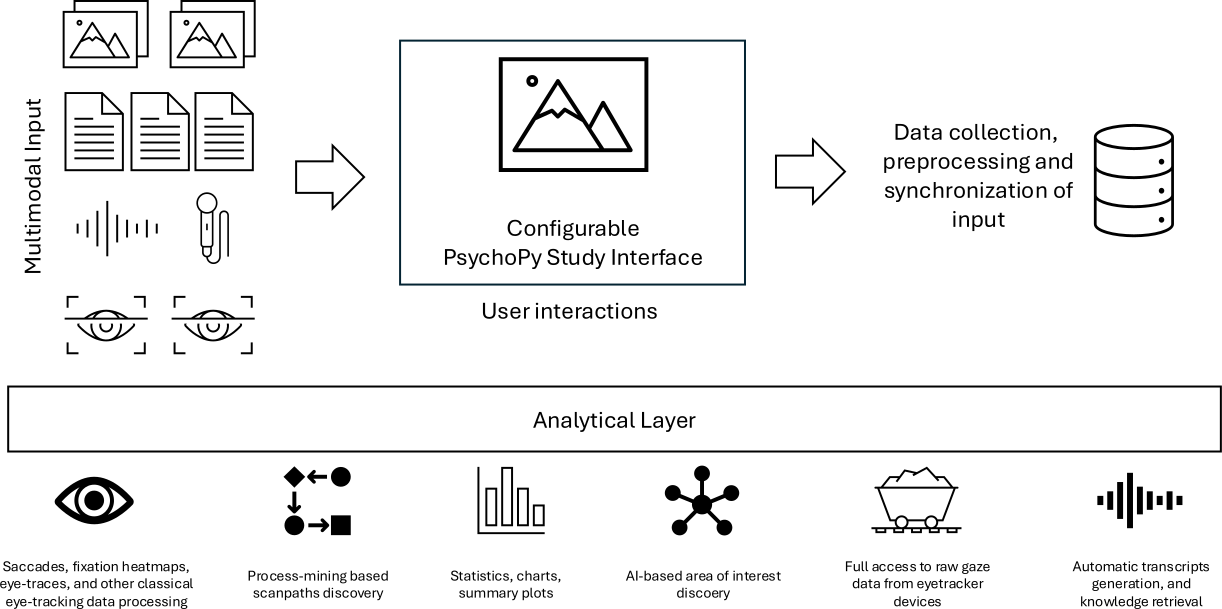
Table of Contents
Requirements
- Python 3.10.x - (Python 3.10 version is crucial, the script won't work with any other version)
- Pip
- Tobii Pro Eye Tracker Manager
Installation
-
Clone or download this repository to your local machine.
conda create --name pytracker-env python=3.10
conda activate pytracker-env
git clone https://github.com/sbobek/tobii-pytracker.git
cd tobii-pytracker
pip install .
Install psychopy, with no-deps, to keep the installation simple and lightweight. Note that we need psychopy in a version at least 2024.1.4
pip install psychopy>=2024.1.4 --no-deps
Usage
-
To run the script, use the following command (make sure you have activated virtual environment):
tobii-pytracker
*Make sure to connect eyetracker to your device before running the script with --enable_eyetracker=True, otherwise it will fail.
- Additionally you can specify a few arguments:
--config_file- Path to YAML script config file - (default = configs/config/config.yaml)--eyetracker_config_file- Path to YAML eyetracker config file - (default = configs/config/eyetracker_config.yaml)--enable_eyetracker- Launch script with launchHubServer (needs connected eyetracker if set to True) - (default = False)--enable_model- Extend processing for custom YOLO model predictions (only for images) - (default = False)--enable_voice- Additionally start recording voice for Think-Aloud-Protocol - (default = False)--loop_count- Number of times that different data will be displayed before the script exits - (default = 10)--log_level- Main logger level ("info", "debug", "warning", "error", "critical") - (default = info)
For more information and usage you can run python main.py --help
Datasets
Different datasets can be specified in the config file that will be processed and displayed in the PsychoPy window. They must be downloaded locally on the device where the script is run and follow these structure rules:
-
Image datasets (.png, .jpg, .jpeg, .bmp, .gif):
├── dataset
│   ├── category1
│   │   ├──file1.jpg
│   │   ├──file2.jpg
│   │   └──...
│   ├── category2
│   │   ├──file1.jpg
│   │   ├──file2.jpg
│   │   └──...
│   └── ...
└── ...
NOTE: GUI will be created accordingly to this structure and class labels will be extracted from subfolder names within the dataset. If using custom model, remember to make them match class names.
-
Text datasets (.csv):
├── dataset.csv
└── ...
NOTE: The first line in .csv file MUST be a header. The GUI will take unique label values from a column with a name specified in config file.
Custom Model
The CustomModel class (located in models/custom_model.py) serves as an abstract base class. It defines the essential methods that any custom model implementation must provide. By inheriting from CustomModel and implementing these methods, your custom model can seamlessly interact with the rest of the toolkit:
prepare_model(self): Load and prepare model for predictionpredict(self, input_data): Run prediction with the loaded modelprocess(self, path): Post-process the prediction and return formatted results
Creating Your Own Model Modules
To create your own model module:
-
Create a new Python file within the specified directory (e.g.,
models/my_custom_model.py). -
Import the CustomModel class:
from models.custom_model import CustomModel
- Define a new class that inherits from
CustomModel:
class MyCustomModel(CustomModel):

  def prepare_model(self):
    # Load and prepare model for prediction
    self.logger.debug("Preparing MyCustomModel...")
    self.model = ...
    self.logger.debug("Model preparation done.")

  def predict(self, input_data):
    # Run prediction with the loaded model
    predictions = ...
    return predictions

  def process(self, data):
    # Post-process the prediction and return formatted results
    predictions = self.predict(data)
    processed_predictions = ...
    return processed_predictions
Keep in mind that main processing pipeline uses the process() method to save processed model predictions.
Configuration
The script requires two configuration files in YAML format: one for general settings and another for eye tracker settings. By default, the configuration files are located in `configs`` directory.
General Configuration (config.yaml)
The general configuration file should include the following fields:
dataset:
  path: path/to/dataset
display:
  monitor:
    name: monitor_name
    resolution:
      - width
      - height
    width: monitor_width
    distance: distance_from_monitor
  gui:
    button:
      size:
        - size_x
        - size_y
      color: color
      text:
        color: text_color
        size: text_size
      fixation_dot:
        size: radius_of_a_dot
        color: dot_color
    aoe:
      - size_x
      - size_y
output:
  folder: folder
  file: file
model:
  folder: folder
  module: module
  class: class
  filename: filename


instructions:
  intro:
    - "Introductory message."
    - "Press SPACE to begin."
  outro:
    - "Message for the end of the study."
    - "You may now close the window or press ESC to exit."
NOTE: If using a dataset with text data, the path should be specified for a file in a
.csvformat, as well as additionaltextfield:
dataset:
  path: path/to/file.csv
  text:
    label_column_name: label_column_name
    text_column_name: text_column_name
Eye Tracker Configuration (eyetracker_config.yaml)
The eye tracker configuration file should include the fields required by launchHubServer from the psychopy.iohub module. Refer to the PsychoPy documentation for more details on the specific settings.
Release history Release notifications | RSS feed


Download files
Download the file for your platform. If you're not sure which to choose, learn more about installing packages.
Source Distribution
Built Distribution
Filter files by name, interpreter, ABI, and platform.
If you're not sure about the file name format, learn more about wheel file names.
Copy a direct link to the current filters
File details
Details for the file tobii_pytracker-0.1.1.tar.gz.
File metadata
- Download URL: tobii_pytracker-0.1.1.tar.gz
- Upload date:
- Size: 21.9 kB
- Tags: Source
- Uploaded using Trusted Publishing? No
- Uploaded via: twine/6.2.0 CPython/3.10.19
File hashes
| Algorithm | Hash digest | |
|---|---|---|
| SHA256 |
d69aaa80acf86abdff6dc95dd4d5828f59e89bdf1eeb914695efb98d315f13f1
|
|
| MD5 |
94b827b7a7d5c1cb5c12355f30643890
|
|
| BLAKE2b-256 |
1480c7e8d465d27fe5259d116386c82d7d4fffbc7605cd658859ba517f7cffa5
|
File details
Details for the file tobii_pytracker-0.1.1-py3-none-any.whl.
File metadata
- Download URL: tobii_pytracker-0.1.1-py3-none-any.whl
- Upload date:
- Size: 21.5 kB
- Tags: Python 3
- Uploaded using Trusted Publishing? No
- Uploaded via: twine/6.2.0 CPython/3.10.19
File hashes
| Algorithm | Hash digest | |
|---|---|---|
| SHA256 |
5d8849c51921b36c1acf5e6c04cb7924ab2a531ba09425caedc943635396842f
|
|
| MD5 |
0e421cf6f064db1aa178ba0f12819396
|
|
| BLAKE2b-256 |
f3c9b0240e8722661daa645f9a9f0d1b39af65be4e55769e8f664f3ffd2a1ade
|






