
tokenizesentences
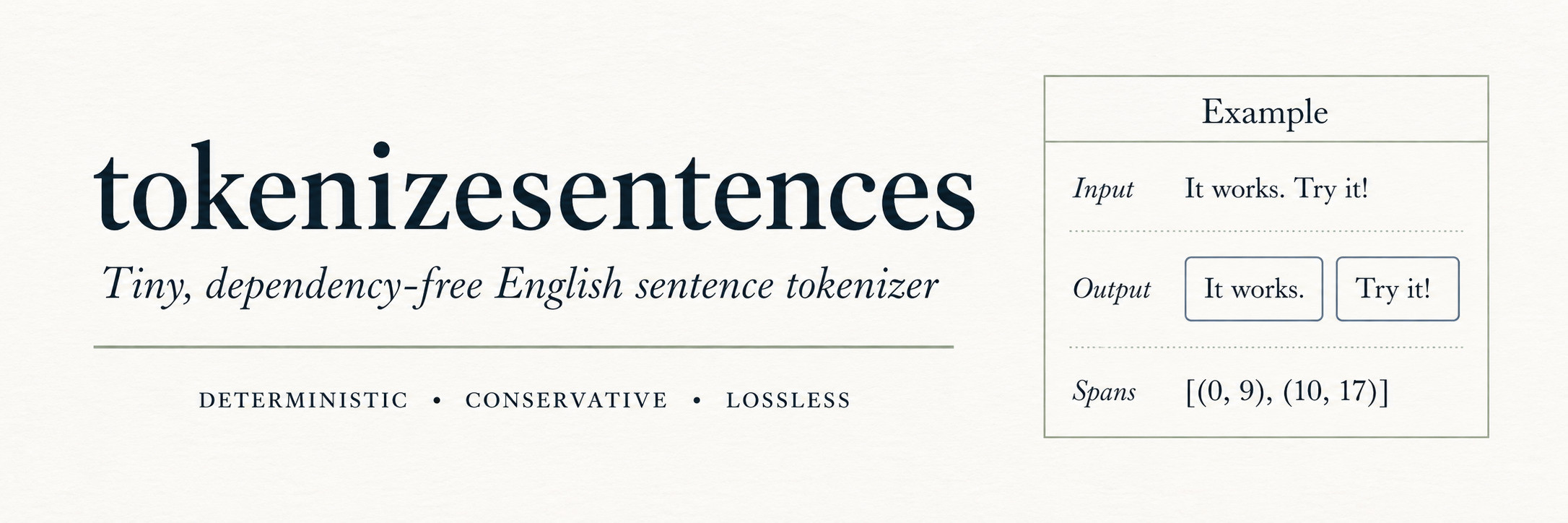
Tiny, dependency-free English sentence tokenizer.





installation
uv add tokenizesentences
or
pip install tokenizesentences
usage
In [1]: from tokenizesentences import tokenize

In [2]: tokenize(
    "Mr. John Johnson Jr. was born in the U.S.A but earned his Ph.D. in Israel before joining Nike Inc. as an engineer. He also worked at craigslist.org as a business analyst."
    )

Out[2]:
[
    'Mr. John Johnson Jr. was born in the U.S.A but earned his Ph.D. in Israel before joining Nike Inc. as an engineer.',
    'He also worked at craigslist.org as a business analyst.'
]
Sentence offsets are available too. Every span is a half-open
[start, end) slice of the input, so text[start:end] is the sentence,
verbatim:
In [3]: from tokenizesentences import tokenize_spans

In [4]: tokenize_spans("It works. Try it!")
Out[4]: [(0, 9), (10, 17)]
notes
Deterministic, rule-based and English-only: an index-based scanner inspired by the answer of D Greenberg in StackOverflow, with no models and no dependencies.
Sentences are literal substrings of the input, by construction. The text is never rewritten: punctuation stays where the author put it (also inside quotes) and single newlines inside a sentence are preserved. A blank line always ends a sentence.
The heuristics are conservative: when in doubt they join, so a missed boundary is preferred over a spurious split. Known limits, pinned by the test suite:
- A lowercase word after the mark never splits:
she yelled "Stop!" and ran away.is one sentence, and so is informal text likei came. i saw. - A dot glued to a word never splits (that is how any domain, filename
or version number survives without a TLD list), so the typo
He left.Then she cried.stays joined. ...(glued or spaced. . .) ends a sentence only when a capitalized word follows.Idoes not count: it is always capitalized, so it carries no signal.- After ambiguous abbreviations (
p.m.,Inc.,U.S.A.) a sentence break is only detected before common starter words:at 5 p.m. He leftsplits,at 5 p.m. Mondaydoes not. - Titles (
Mr.,Sen.,St.) never end a sentence, soMain St. He walked.stays joined.
why tokenizesentences?
tokenizesentences is designed for pipelines where sentence splitting
should be a small, predictable primitive rather than a heavyweight NLP
component. It is conservative, fast, dependency-free and lossless:
- Conservative: ambiguous boundaries are joined rather than split, favoring fewer false boundaries over higher recall.
- Fast: a small index-based scanner keeps segmentation cheap in high-volume pipelines.
- Dependency-free: no models, no data downloads, no runtime dependencies.
- Lossless: sentences are literal slices of the original text,
with exact offsets available through
tokenize_spans().
That combination is built for the case where a false split costs more than a missed boundary: preprocessing, scraping, indexing, annotation, highlighting, and NLP or LLM pipelines where preserving the original text and its offsets matters more than squeezing out the last point of F1.
benchmarks
-
40 of the 52 English Golden Rules from pragmatic_segmenter pass verbatim; the other 12 are pinned in
tests/test_golden_rules.pyas strict xfails with documented reasons (list detection, text rewriting, ellipsis attachment, glued sentences). -
Boundary detection on the UD English-EWT test split: 2,077 gold sentences of raw web text in 316 reconstructed documents, scored on the 1,761 interior boundaries (the trivial final boundary of each document is excluded). All systems ran the same day (August 2026) on the same inputs with the same scoring; reproduce with
uv run python tools/eval_ewt.py --competitors --speed:system precision recall F1 throughput pysbd 95.67% 84.10% 89.51% 0.05 Mchar/s tokenizesentences 99.50% 79.22% 88.21% 4.6 Mchar/s syntok 98.38% 79.16% 87.73% 0.30 Mchar/s nltk-punkt 97.38% 69.56% 81.15% 1.91 Mchar/s spacy-sentencizer 96.62% 68.14% 79.92% 0.60 Mchar/s blingfire 98.79% 60.02% 74.67% 1.50 Mchar/s Highest precision and throughput of the six on this evaluation; only pysbd scores a higher F1, trading 3.8 points of precision and two orders of magnitude of throughput for it. Recall is spent on informal lowercase web text on purpose. Timings are medians of 7 passes after a warm-up; the blingfire and syntok figures include offset reconstruction overhead. The corpus commit, its SHA256 and the competitor versions are pinned, so the run is reconstructible: see
tools/eval_ewt.pyand thebenchmarkdependency group. -
The English suite of Wikimedia's sentencex (MIT), pinned at an exact commit and SHA256, with its parsing and per-case multiset-F1 metric replicated verbatim (234 scoreable cases; the 60-case table in their README predates their current suite). Same-day run, August 2026; reproduce with
uv run python tools/eval_sentencex.py --competitors:system mean F1 perfect cases sentencex 99.94 233/234 tokenizesentences 86.17 195/234 blingfire 83.08 188/234 syntok 80.79 180/234 pysbd 64.33 136/234 nltk-punkt 62.92 132/234 spacy-sentencizer 62.52 134/234 Second only to sentencex itself on sentencex's home suite, first among everything else. The ranking shuffle against the EWT table above (pysbd drops from first to fifth) is exactly why this README carries more than one benchmark.
development
uv sync --group dev
uv run pytest
uv run ruff check .
uv run ruff format --check .
uv run ty check
license
This project is licensed under the MIT License.
1 maintainer

Metadata
1 maintainer
Release files for tokenizesentences 0.5.1
For a detailed explanation of source distributions (sdists) and built distributions (wheels), please see the package formats documentation.
Source distribution (sdist)
| File | Size | Uploaded | Provenance | |
|---|---|---|---|---|
| tokenizesentences-0.5.1.tar.gz | 26.5 kB | Without provenance | Details |
Built distribution (wheel)
| File | Interpreter | ABI | Platform | Reset |
|---|---|---|---|---|
| tokenizesentences-0.5.1-py3-none-any.whl | Python 3 | none | any | Details |
Total release size: 38.1 kB
Release files / tokenizesentences-0.5.1.tar.gz
| Download URL | tokenizesentences-0.5.1.tar.gz |
|---|---|
| Size | 26.5 kB |
| Tags | Source |
|
SHA-256 checksum How to use checksums |
75c632e97a70eb3383eed54a2a3dfd2815b5e83f1675badafdc641fb3989a1e6
|
|
BLAKE2b-256 checksum How to use checksums |
2b3d33804bcab6c687d0f6df6da491ed7a8832a18d5f908f75691e7e237e14b1
|
| Upload date | |
|
Uploaded using Trusted Publishing? What is trusted publishing? |
Yes |
| Uploaded via |
uv/0.12.5 {"installer":{"name":"uv","version":"0.12.5","subcommand":["publish"]},"python":null,"implementation":{"name":null,"version":null},"distro":{"name":"Ubuntu","version":"24.04","id":"noble","libc":null},"system":{"name":null,"release":null},"cpu":null,"openssl_version":null,"setuptools_version":null,"rustc_version":null,"ci":true}
|
Release files / tokenizesentences-0.5.1-py3-none-any.whl
| Download URL | tokenizesentences-0.5.1-py3-none-any.whl |
|---|---|
| Size | 11.6 kB |
| Tags | Python 3 |
|
SHA-256 checksum How to use checksums |
899e0f1b6021ceb96de2e479af3efb092815075a60446f955936951529583b72
|
|
BLAKE2b-256 checksum How to use checksums |
55e0b3f748e53fc4cdda8da0bcb0b0e8e851def81955db8f609719ea205941ad
|
| Upload date | |
|
Uploaded using Trusted Publishing? What is trusted publishing? |
Yes |
| Uploaded via |
uv/0.12.5 {"installer":{"name":"uv","version":"0.12.5","subcommand":["publish"]},"python":null,"implementation":{"name":null,"version":null},"distro":{"name":"Ubuntu","version":"24.04","id":"noble","libc":null},"system":{"name":null,"release":null},"cpu":null,"openssl_version":null,"setuptools_version":null,"rustc_version":null,"ci":true}
|
Security for tokenizesentences 0.5.1
Provenance
Provenance describes where a file came from. On PyPI, provenance is shared via attestations, which provide a verifiable record of the build or publishing details. View details, limitations and caveats.
No provenance found
None of the files in this release were uploaded with provenance metadata.
A note on package security
PyPI is a repository for distributing packages, not a service for auditing them. While third-party security researchers and our staff do their best to detect and remove malicious packages, PyPI cannot guarantee the quality, security or suitability of any given package.














