

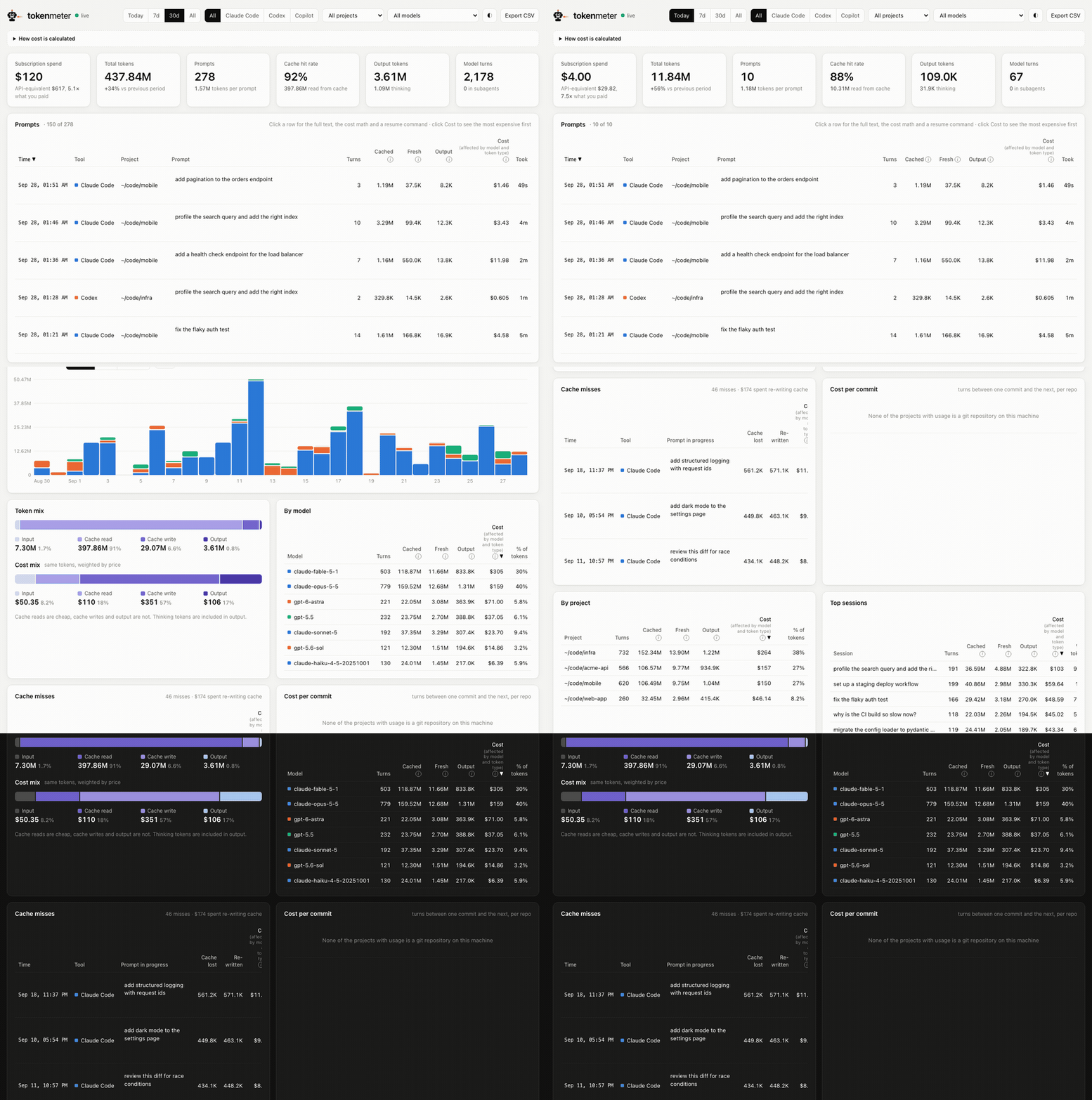
A local dashboard that shows token usage, real cost, cache misses and rate-limit windows for every prompt you send in Claude Code, Codex and GitHub Copilot CLI. Zero dependencies: one Python file, one HTML file, nothing leaves your machine.
What you get
- Live feed of every model turn from Claude Code, Codex and GitHub Copilot CLI, updated a few seconds after each prompt finishes
- Spend tile that shows what you actually pay first (your subscription, prorated to the range) with the API-equivalent cost underneath, or the API cost on top if you have no plan configured
- Usage limits: Codex 5-hour and weekly windows as Codex reports them, plus rolling 5-hour and 7-day usage for every tool
- Active sessions with a context-fill gauge, so you see compaction coming
- Every prompt with its text, the turns it triggered, tokens, cost and duration, plus a resume command. Click any header to sort by date, tokens, cost, turns or duration
- Cache-miss detector: turns where the cached prefix collapsed and had to be re-written, with the prompt that was in progress and what the re-write cost
- Most expensive prompts, cost per git commit, cost mix by token type, and breakdowns by model, project and session
- Budget alerts: set a daily or monthly cap and get a desktop notification when you cross it
- Team mode: teammates export daily aggregates to one shared Tokenmeter and you filter by person
- Menu bar widget for SwiftBar or xbar showing today's spend
- Filters for time range, tool, project, model and user, kept in the URL so views are bookmarkable, plus CSV export and light and dark themes
How it works
Nothing is installed inside Claude Code, Codex or Copilot. All three already save every conversation to a log file on your disk, and each model reply in that log includes how many tokens it used. Tokenmeter just reads those logs.
- Claude Code saves logs in
~/.claude/projects/, Codex in~/.codex/sessions/, Copilot CLI in~/.copilot/session-store.db. server.pyreads every log once, pulls out each prompt and each model reply with its token counts, and keeps them in memory.- It multiplies tokens by the prices in
pricing.jsonto estimate cost. - It serves a web page at
http://127.0.0.1:7788. The page asks the server every 4 seconds if anything changed and redraws when it has.
When you send a new prompt, the tool appends to its log, Tokenmeter notices the file grew, re-reads that one file, and the new turn shows up. Only your machine is involved. Nothing is sent anywhere.
The /tokenmeter skill is just a shortcut that starts server.py and gives you the link.
Install
Any machine with Python 3.9 or newer. Pick one:
brew install serkankorkut/tap/tokenmeter
pipx install tokenmeter-dashboard
uvx --from tokenmeter-dashboard tokenmeter --open
Or, as a Claude Code plugin straight from GitHub:
claude plugin marketplace add serkankorkut/tokenmeter
claude plugin install tokenmeter@tokenmeter
Or clone and link, which also installs the Codex skill and the tokenmeter command:
git clone https://github.com/serkankorkut/tokenmeter ~/repo/tokenmeter
~/repo/tokenmeter/install.sh
Then start it:
tokenmeter start
It runs in the background, opens http://127.0.0.1:7788, and starts again at login (a launchd agent on macOS, a systemd user service on Linux). tokenmeter stop stops it; plain tokenmeter runs it in the terminal instead. Inside Claude Code or Codex, /tokenmeter does the same.
Configuration
Create ~/.tokenmeter/config.json with only the keys you want to change. It is merged over the bundled pricing.json at startup, so upgrades never overwrite your settings. Example for someone on the $100 Claude plan and $20 ChatGPT Plus:
{"_plans": {"claude": 100, "codex": 20}, "_budget": {"daily": 30}}
Available keys:
| Key | Purpose |
|---|---|
| model prefixes | USD per million tokens: input, cache_read, cache_write_5m, cache_write_1h, output. Anthropic and OpenAI list prices are included |
_plans |
What you pay per month per tool. Drives the Subscription spend tile. Default 0, which shows API-equivalent cost on top |
_budget |
daily and monthly caps in API-equivalent USD. Desktop notification once per period when exceeded |
_context_windows |
Context size by model prefix, for the context-fill gauge |
_port |
Port to use instead of 7788. Written for you by tokenmeter start --port N |
Environment and flags:
| Setting | Default | Purpose |
|---|---|---|
--port N |
7788 |
Listen port. With start it is saved as _port in ~/.tokenmeter/config.json, so the background service uses it too. Without a saved port, Tokenmeter tries 7788 and, if another app holds it, the next 10 ports |
TOKENMETER_PORT |
Port for this run only, overrides the saved one | |
--host |
127.0.0.1 |
Bind address. Use 0.0.0.0 only for a team server |
start, stop |
Run in the background and open the browser; stop the background copy | |
--open |
Open the browser after starting in the terminal | |
--user NAME |
your login | Name shown in team mode |
--export URL |
Push your last 30 days to a team server every hour. Prompt text is never sent | |
TOKENMETER_TOKEN |
Shared secret for team ingest, sent as X-Tokenmeter-Token |
|
CLAUDE_CONFIG_DIR, CODEX_HOME, COPILOT_DB |
~/.claude, ~/.codex, ~/.copilot/session-store.db |
Where each tool keeps its logs |
TOKENMETER_DIR |
~/.tokenmeter |
Where config.json, server.log and team data live |
What "% of tokens" means
In the model, project and session tables it is that row's share of all tokens in the current filter. It always sums to 100 percent across a table.
Limits
Codex writes its 5-hour and weekly quota usage into every session log, so Tokenmeter shows the real percentages and reset times, as of the last Codex turn. Anthropic does not write Claude plan usage to disk. If a Claude Code OAuth token is present in the macOS keychain Tokenmeter queries the usage endpoint; otherwise it shows rolling 5-hour and 7-day totals from the logs.
Team mode
On a shared machine: tokenmeter --host 0.0.0.0 with TOKENMETER_TOKEN set. On each laptop: tokenmeter --export http://that-host:7788 with the same token. The shared dashboard gains a user filter. Only token counts, models, project paths and timestamps travel; prompt text stays local.
Menu bar
Copy menubar/tokenmeter.1m.sh into your SwiftBar or xbar plugin folder. It shows today's spend and, on click, the 5-hour and monthly numbers.
API
| Endpoint | Returns |
|---|---|
GET /api/usage |
All records, prompts, and metadata as JSON |
GET /api/version |
Cheap change token, polled by the UI |
GET /api/export.csv?since=ISO |
CSV of records |
GET /api/summary |
Today, last 5 hours, month, projection, limits. Used by the menu bar widget |
GET /api/commits |
Recent commits per repo, for cost-per-commit |
POST /api/ingest |
Team mode receiver |
GET /api/health |
{"ok": true, "app": "tokenmeter"} |
Development
python3 test_server.py
python3 -m tokenmeter --open
Release: bump the version in pyproject.toml, tokenmeter/server.py and .claude-plugin/plugin.json, tag vX.Y.Z and push. The GitHub Action publishes to PyPI via trusted publishing. Then run release/brew-formula.sh > ../homebrew-tap/Formula/tokenmeter.rb and push the tap: the script mirrors the sdist to a GitHub Release on the public tap repo and points the formula at it, so Homebrew installs are counted. release/brew-stats.sh prints those counts; PyPI downloads are at pypistats.org.
What shows where: the PyPI summary line is description in pyproject.toml, the PyPI long description is this README, the Homebrew one-liner is desc in release/brew-formula.sh, and the Claude Code plugin blurb is .claude-plugin/plugin.json. PyPI text only changes with a new release.
Roadmap
- Gemini CLI, Cursor agent and OpenCode parsers once their transcript formats are pinned down
- Slack or email weekly digest
- Windows notification support for budget alerts
License
MIT
1 maintainer

Metadata
1 maintainer
Release files for tokenmeter-dashboard 0.2.7
For a detailed explanation of source distributions (sdists) and built distributions (wheels), please see the package formats documentation.
Source distribution (sdist)
| File | Size | Uploaded | |
|---|---|---|---|
| tokenmeter_dashboard-0.2.7.tar.gz | 37.5 kB | Details |
Built distribution (wheel)
| File | Interpreter | ABI | Platform | Reset |
|---|---|---|---|---|
| tokenmeter_dashboard-0.2.7-py3-none-any.whl | Python 3 | none | any | Details |
Total release size: 72.2 kB
Release files / tokenmeter_dashboard-0.2.7.tar.gz
| Download URL | tokenmeter_dashboard-0.2.7.tar.gz |
|---|---|
| Size | 37.5 kB |
| Tags | Source |
|
SHA-256 checksum How to use checksums |
d8eaace56cf9ff4a374c62ad888cdda23f195fc3eed2577f839e94a16d580a15
|
|
BLAKE2b-256 checksum How to use checksums |
55095a2e3e39795d46305f3fd5bf5f129ca565fdfc83a5525882116895c076e6
|
| Upload date | |
|
Uploaded using Trusted Publishing? What is trusted publishing? |
Yes |
| Uploaded via |
twine/7.0.0 CPython/3.13.14
|
Provenance
Provenance describes where a file came from. On PyPI, provenance is shared via attestations, which provide a verifiable record of the build or publishing details. View details, limitations and caveats.


PyPI Publish Attestation
PyPI verified that this artifact, at this checksum, originated from the publisher listed below.
Signed by GitHub Actions, verified by PyPI on Sep 27, 2026.
Transparency logRelease files / tokenmeter_dashboard-0.2.7-py3-none-any.whl
| Download URL | tokenmeter_dashboard-0.2.7-py3-none-any.whl |
|---|---|
| Size | 34.7 kB |
| Tags | Python 3 |
|
SHA-256 checksum How to use checksums |
f87ad904e1038980d5ba8ff16bf00a9c3ab328b88f58304e370f3f193d227538
|
|
BLAKE2b-256 checksum How to use checksums |
afc61e81927f8cd64986ca2d0ea820d6abe35e8ac9d451a77fd8f65002ad2611
|
| Upload date | |
|
Uploaded using Trusted Publishing? What is trusted publishing? |
Yes |
| Uploaded via |
twine/7.0.0 CPython/3.13.14
|
Provenance
Provenance describes where a file came from. On PyPI, provenance is shared via attestations, which provide a verifiable record of the build or publishing details. View details, limitations and caveats.
PyPI Publish Attestation
PyPI verified that this artifact, at this checksum, originated from the publisher listed below.
Signed by GitHub Actions, verified by PyPI on Sep 27, 2026.
Transparency log













