
tokentab
What your Claude Code token spend bought, per merged PR. Local-first: it reads the transcripts
Claude Code already writes to ~/.claude/projects, matches them to your GitHub pull requests, and
opens a one-page report in your browser. No hosted service, no API key, nothing uploaded.
How this differs from ccusage: ccusage computes cost per day, session, and model from the same files and stops at the session; tokentab joins sessions to the pull requests they produced, so the unit is "cost per merged PR", and it writes a report a non-engineer can read.
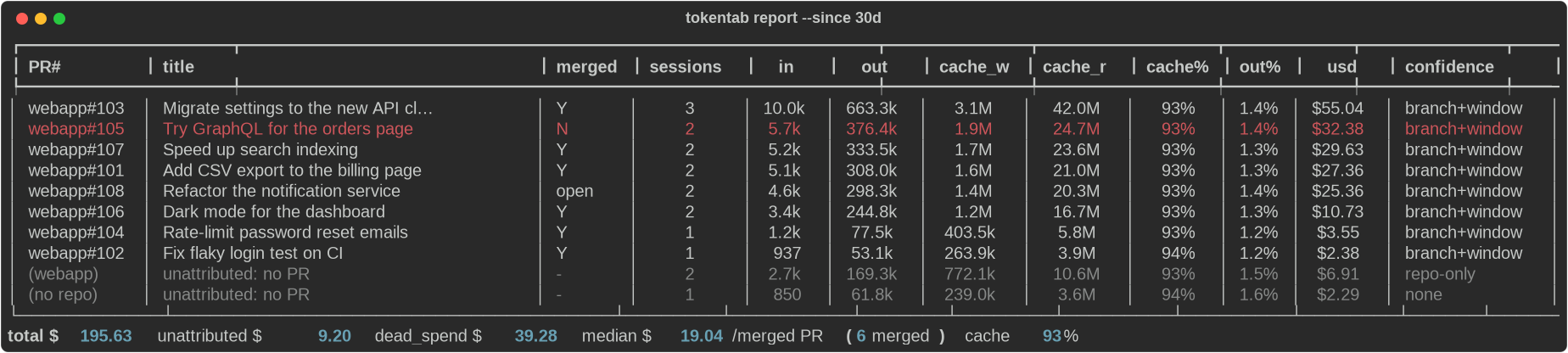
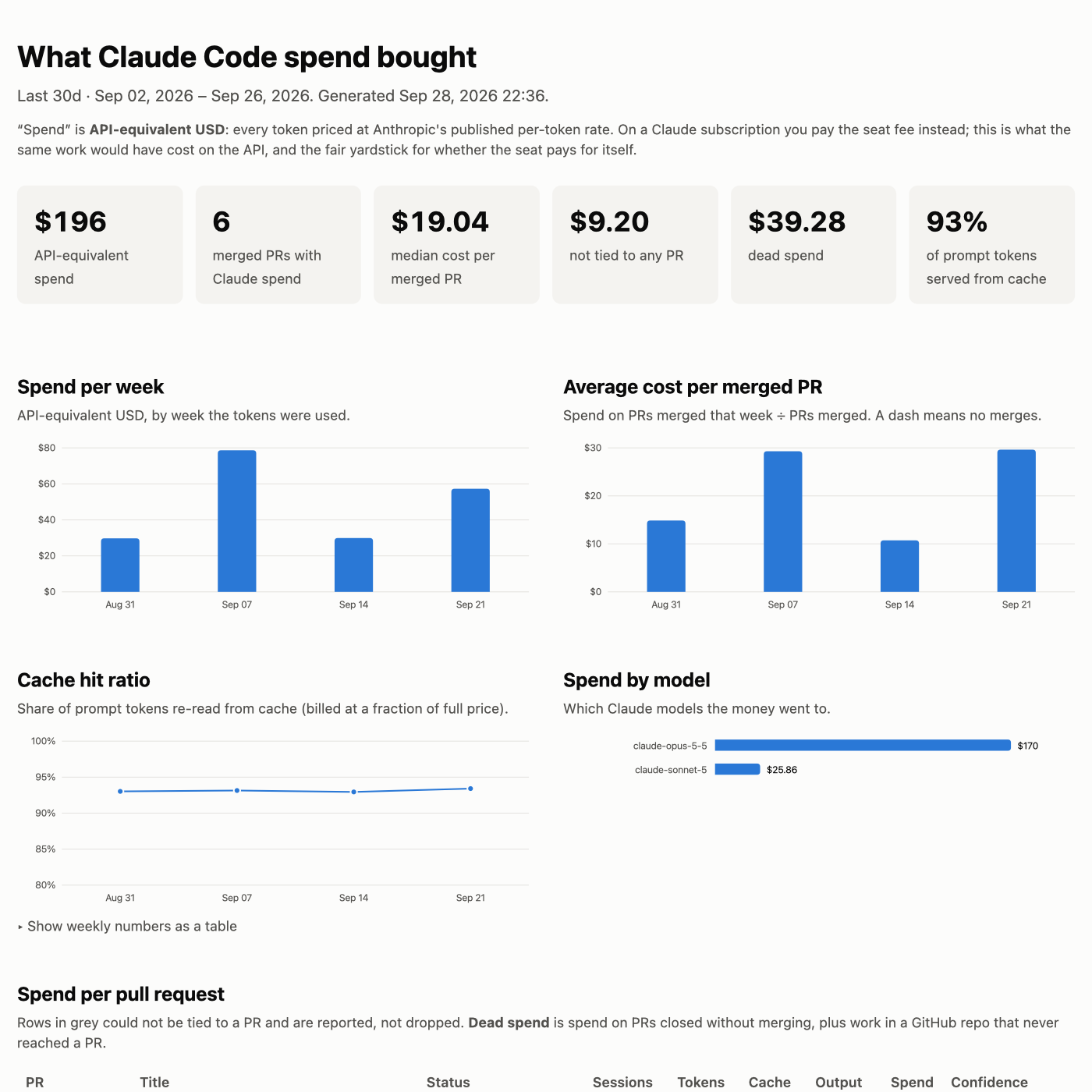
Screenshots use synthetic data for an imaginary repo; regenerate them with scripts/demo.py.
Run it
With uv installed:
uvx tokentab
That prints a summary of the last 30 days and opens the full report in your browser (also saved to
~/.tokentab/report.html). uvx tokentab --since 90d covers a longer period, and --no-open skips the
browser. No uv? pipx run tokentab does the same.
GitHub data comes from the first of these that works, per repo:
- the
ghCLI, if installed and signed in (sees private repos); - the GitHub API with
GH_TOKENorGITHUB_TOKEN, if set; - the GitHub API without a token (public repos only);
- none: spend still lands on the PRs Claude Code itself recorded opening, just without titles or merge status, and the report says so.
For more detail, the same tool has subcommands:
| command | what it does |
|---|---|
report [--since 30d] [--repo PATH] [--by pr|session|branch|model|week|user] |
spend table; footer shows total, unattributed, dead spend, median per merged PR, cache ratio |
report --html FILE |
self-contained HTML (inline CSS and SVG, no scripts, works offline) |
export --csv FILE |
one row per (session, PR) with every field, for finance |
comment [--pr N] [--repo PATH] [--post] |
this PR's cost as a PR comment; prints it unless --post |
otel serve [--host] [--port] [--token] |
receive Claude Code OpenTelemetry and fold it into reports |
billed [--since 30d] |
vendor-reported cost and usage (Anthropic Admin, Claude Enterprise, OpenAI) |
doctor |
observed schema, models and their price rows, unpriced models, repos, other sources, gh auth status |
--since takes 12h, 30d, 2w, or a date. --no-db skips the history database. tokentab keeps its
state in ~/.tokentab; set TOKENTAB_HOME to put it elsewhere.
What the numbers mean
API-equivalent USD. On a Claude subscription there is no per-token bill, so tokentab prices every
token at the published API rate: input×p_in + output×p_out + cache_write_5m×p_in×1.25 + cache_write_1h×p_in×2 + cache_read×p_in×cache_read_mult, per million tokens. That is what the same
work would cost on the API, and the honest denominator for whether a seat pays for itself. Claude Code
writes both 5-minute and 1-hour cache entries, and the transcripts record which, so the two are priced
separately.
- cache ratio: cache reads ÷ (input + cache writes + cache reads).
- output share: output ÷ all tokens.
- cost per PR: sum of the spend attributed to that PR.
- unattributed: spend tied to no PR. Always shown as its own rows, never dropped.
- dead spend: spend on PRs closed without merging, plus work in a GitHub repo that never reached a PR. Work outside any repo (a scratch directory, Downloads) is unattributed but not dead.
How attribution works
Each API message is attributed on its own, so a session that moves between branches or opens several PRs is split by time.
- Repo from the message's
cwd. Worktrees collapse onto their main checkout, and deleted worktrees resolve through the nearest parent directory that still exists. Repos are keyed by theoriginremote. - Branch from
gitBranch. Subagent messages on a detachedHEADinherit the branch their parent session was on at that moment. - PR by branch: a PR whose
headRefNameis that branch and whose window[createdAt − 24h, mergedAt or closedAt or now]contains the message. - PR by explicit link, for everything else: Claude Code's own
pr-linkrecords in the transcript, andClaude-Session:trailers on squash-merged commits (matched to local sessions through thebridge-sessionrecords). A message goes to the next linked PR opened after it, within that PR's window. - Otherwise repo-only (repo known, no PR) or none.
The confidence column is the weakest link among a row's messages: pr-link and trailer (explicit
records) > branch+window > repo-only > none.
Co-Authored-By: Claude trailers are counted in doctor but not used to attribute spend: they don't
name a session, so tying one to a session would mean guessing between whatever sessions were running
at the time.
PR comments
tokentab comment renders the current branch's PR cost as a Markdown comment (spend, sessions, tokens,
cache ratio, per-model split, and how it compares with the repo's median merged PR). It prints the comment
unless you pass --post; with --post it creates one comment and edits that same comment on every later
run, found by a hidden <!-- tokentab:cost --> marker and your GitHub login.
The numbers come from the transcripts on the machine that runs the command, so a PR shows the poster's Claude Code spend, not a teammate's. Posting puts that spend on the PR for everyone who can read it.
To have Claude Code keep the comment current, install tokentab as a command and add a PostToolUse
hook. After any Bash call that runs git push or gh pr create, tokentab hook posts or updates the
comment for that checkout's PR; for anything else it does nothing, and it never fails the tool call.
uv tool install --editable .
In ~/.claude/settings.json (or a project's .claude/settings.json):
{
  "hooks": {
    "PostToolUse": [
      {"matcher": "Bash", "hooks": [{"type": "command", "command": "tokentab hook", "timeout": 60}]}
    ]
  }
}
OpenTelemetry
tokentab otel serve is a small OTLP/HTTP receiver (JSON only; protobuf would need a new dependency).
Point Claude Code at it:
uv run tokentab otel serve
CLAUDE_CODE_ENABLE_TELEMETRY=1 OTEL_LOGS_EXPORTER=otlp OTEL_METRICS_EXPORTER=otlp OTEL_EXPORTER_OTLP_PROTOCOL=http/json OTEL_EXPORTER_OTLP_ENDPOINT=http://127.0.0.1:4318 OTEL_METRICS_INCLUDE_REPOSITORY=true claude
Captures land in ~/.tokentab/otel/ (or TOKENTAB_OTEL_DIR); lines written by an OpenTelemetry
Collector's file exporter in that directory are read too. Every report folds them in:
- Each
claude_code.api_requestevent is one API request. If the samerequest_idis in a transcript, the transcript wins and the OTel copy is dropped, so running both never double counts. - Token metrics are used only for sessions with no request events.
- OTel reports cache writes as one number. tokentab splits it into 5-minute and 1-hour writes by finding
the split that reproduces Claude Code's own
cost_usd; when none does, it assumes 1-hour and says so. - OTel carries no working directory or branch. A request whose session also has a transcript borrows its
repo and branch from it. Otherwise the repo comes from the
vcs.*metric attributes (OTEL_METRICS_INCLUDE_REPOSITORY=true), which name the repo but not the branch, so teammates' OTel-only spend is attributed to the repo (repo-only), never to a PR. --by usergroups spend by theuser.emailon each request.
To collect from other machines, listen beyond localhost with a token
(tokentab otel serve --host 0.0.0.0 --token SECRET) and have Claude Code send
OTEL_EXPORTER_OTLP_HEADERS='Authorization=Bearer SECRET'. The receiver has no TLS; put it behind one
if the traffic leaves a trusted network.
Vendor-reported spend
tokentab billed shows what vendors themselves report, next to (never added to) the API-equivalent
numbers, since the same request can appear in both. Each source turns on when its key is set:
| env var | organization | what it shows |
|---|---|---|
ANTHROPIC_ADMIN_KEY |
Claude Console (API) | invoiced cost and billed tokens per model; per-user Claude Code sessions, PRs, commits, and estimated cost |
ANTHROPIC_ANALYTICS_KEY |
Claude Enterprise (claude.ai seats; key needs read:analytics) |
per-user Claude Code cost, sessions, PRs, commits, and cost per PR |
OPENAI_ADMIN_KEY |
OpenAI | costs per line item and tokens per model |
Keys are sent only to the vendor that issued them. The Enterprise and Claude Code analytics numbers are per user per day, so "cost per PR" there is a user's spend divided by their PR count, not a per-PR figure.
Prices
tokentab/prices.yaml is keyed by model-ID substring (longest match wins). Rows marked verify: true
were filled from Anthropic's published price table rather than by you; tokentab warns when a report
uses them. A model with no matching row is priced at the nearest row and flagged unpriced in every
view. Override the file with TOKENTAB_PRICES=/path/to/prices.yaml.
Files it writes
~/.tokentab/usage.db: SQLite history of every message seen, unique on(message.id, requestId). Claude Code deletes old transcripts (about 30 days by default), so this is what keeps older months reportable.~/.tokentab/gh_cache.json:gh pr listresults, reused for an hour.~/.tokentab/otel/: OTLP payloads received bytokentab otel serve.
Nothing leaves your machine except the gh calls to GitHub, comment --post, and the vendor API calls
made by billed when you set their keys.
Known gaps
- Only a repo's 500 most recent PRs are fetched; older ones are matched only through Claude Code's own records, and tokentab says when a repo hits the limit.
- Sessions whose transcripts were pruned before the first run are gone.
Claude-Session:trailers still name them, but there are no tokens left to count. ~/.claude/stats-cache.jsonkeeps per-model totals for days whose transcripts are gone, but it counts every streamed line of a message (1.8 to 2.5 times the real figure where tokentab could check), sodoctorshows it only as an upper bound and it is never added to spend.- The vendor API clients are written and tested against the documented request and response shapes, not against live accounts.
Develop
uv sync
uv run pytest
Releasing
Publishing uses PyPI trusted publishing from GitHub Actions
(publish.yml), so no
PyPI token exists anywhere. Once, on PyPI under Account → Publishing, add a publisher with project
tokentab, owner smerwin, repository tokentab, workflow publish.yml, and environment pypi.
To release, set version in pyproject.toml, commit and push, then publish a GitHub release whose tag
is that version with a v in front. The workflow checks the tag against the version, runs the tests,
builds, and uploads.
gh release create v0.1.0 --generate-notes
License
MIT; see LICENSE.
1 maintainer

Metadata
1 maintainer
Release files for tokentab 0.1.0
For a detailed explanation of source distributions (sdists) and built distributions (wheels), please see the package formats documentation.
Source distribution (sdist)
| File | Size | Uploaded | Provenance | Actions |
|---|---|---|---|---|
| tokentab-0.1.0.tar.gz | 34.6 kB | Without provenance | Details for tokentab-0.1.0.tar.gz |
Built distribution (wheel)
| File | Interpreter | ABI | Platform | Actions Reset |
|---|---|---|---|---|
| tokentab-0.1.0-py3-none-any.whl | Python 3 | none | any | Details for tokentab-0.1.0-py3-none-any.whl |
Total release size: 75.9 kB
Release files / tokentab-0.1.0.tar.gz
| Download URL | tokentab-0.1.0.tar.gz |
|---|---|
| Size | 34.6 kB |
| Tags | Source |
|
SHA-256 checksum How to use checksums |
464d552e22f7bf9d6b65291b4baafea0c7342b531b3fa3f944e88743f2437efc
|
|
BLAKE2b-256 checksum How to use checksums |
05eb05241561566cbdee16bcc787069d21f517ce065afd58bd1be2db9d055d67
|
| Upload date | |
|
Uploaded using Trusted Publishing? What is trusted publishing? |
Yes |
| Uploaded via |
uv/0.12.20 {"installer":{"name":"uv","version":"0.12.20","subcommand":["publish"]},"python":null,"implementation":{"name":null,"version":null},"distro":{"name":"Ubuntu","version":"24.04","id":"noble","libc":null},"system":{"name":null,"release":null},"cpu":null,"openssl_version":null,"setuptools_version":null,"rustc_version":null,"ci":true}
|
Release files / tokentab-0.1.0-py3-none-any.whl
| Download URL | tokentab-0.1.0-py3-none-any.whl |
|---|---|
| Size | 41.3 kB |
| Tags | Python 3 |
|
SHA-256 checksum How to use checksums |
ac0553b2c595c7256c17bb0d97e550193259975e208a644965177eccda80e370
|
|
BLAKE2b-256 checksum How to use checksums |
a690b7f4606965f6d1430f47591150c31997e1e6ae670e08d6de6ebdf0d9f6b7
|
| Upload date | |
|
Uploaded using Trusted Publishing? What is trusted publishing? |
Yes |
| Uploaded via |
uv/0.12.20 {"installer":{"name":"uv","version":"0.12.20","subcommand":["publish"]},"python":null,"implementation":{"name":null,"version":null},"distro":{"name":"Ubuntu","version":"24.04","id":"noble","libc":null},"system":{"name":null,"release":null},"cpu":null,"openssl_version":null,"setuptools_version":null,"rustc_version":null,"ci":true}
|
Security for tokentab 0.1.0
Provenance
Provenance describes where a file came from. On PyPI, provenance is shared via attestations, which provide a verifiable record of the build or publishing details. View details, limitations and caveats.
No provenance found
None of the files in this release were uploaded with provenance metadata.
A note on package security
PyPI is a repository for distributing packages, not a service for auditing them. While third-party security researchers and our staff do their best to detect and remove malicious packages, PyPI cannot guarantee the quality, security or suitability of any given package.
To learn more about protecting yourself from malicious actors, visit our package security documentation.













