







A stuck agent repeats itself, and repeats come from cache. So looping is nearly free, your dashboard stays green, and the agent that failed silently looks exactly like the one that worked.
Tokeymeter watches whether an agent is still getting anywhere, and stops it when it isn't.
pip install tokeymeter
tokeymeter firstrun
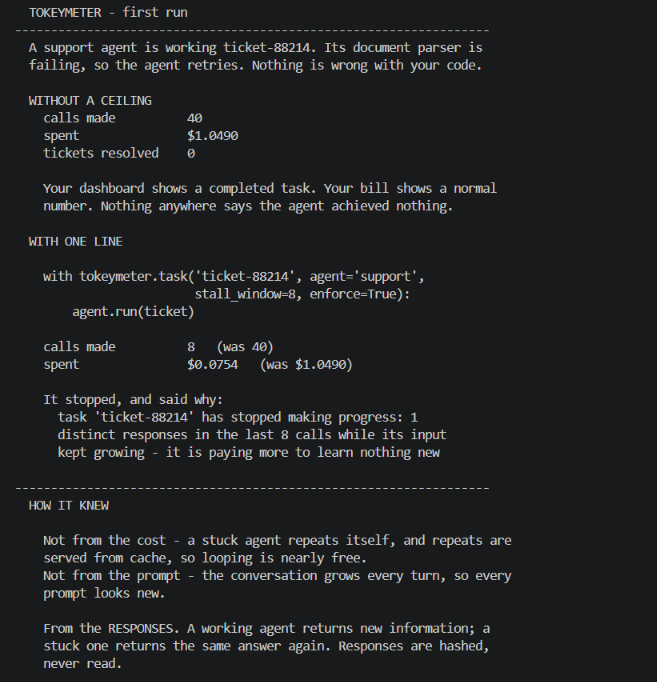
Sixty seconds, offline, no API key, no account. You watch a stuck agent burn 40 calls and $1.05, then the same agent with one line added:
  WITHOUT A CEILING              WITH ONE LINE
    calls made          40         calls made          8    (was 40)
    spent           $1.0490        spent          $0.0754    (was $1.0490)
    tickets resolved     0

  ticket-88214 STOPPED
    1 distinct response in the last 8 calls while its input kept growing
    - it is paying more to learn nothing new
The number that started this
We pointed it at a real workload on a real OpenAI key. 98 requests, 22,811 input tokens, $0.0038 — every figure reconciling exactly with the provider's own usage page.
[!IMPORTANT] $0.0034 of that $0.0038 — 87% — went to six tasks that produced nothing.
Nothing else in that stack could have told us. Not the invoice, not the traces, not the framework. The six failures and the twelve successes were indistinguishable everywhere except here — which is a polite way of saying the agent failed, filed no complaint, and sent us a bill.
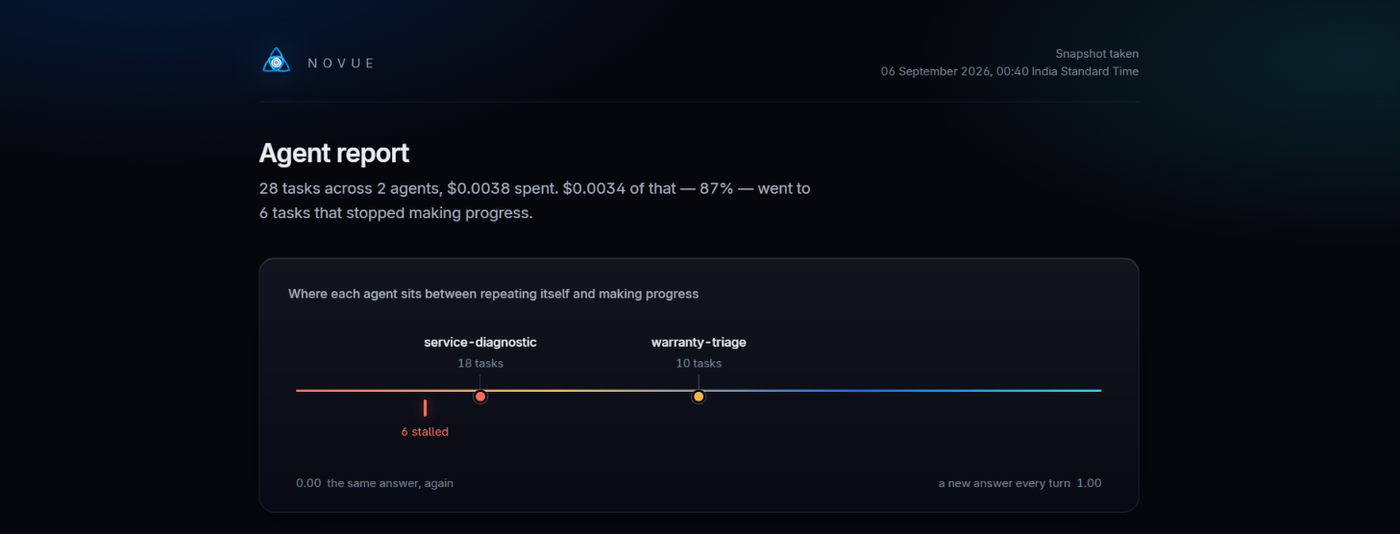
Real numbers from a real run against gpt-4o-mini.
tokeymeter agents --html
Contents
- Why nothing else catches this
- Install
- How it knows
- What you get
- Setting the numbers
- One policy across every service
- Routing halts to Slack, Jira, anywhere
- What it can't catch
- Cost
- Compliance and data residency
- Privacy and security posture
- Performance
- How it fits with what you already run
- Full API
- Configuration
- FAQ
- Stability, security, and roadmap
Why nothing else catches this
| Why it misses a stuck agent | |
|---|---|
| Your bill | A repeat is served from cache. Measured: a 20-call loop cost $0.0155. It looks cheap. |
max_iterations=25 |
Counts calls, not results. Twenty-five useless calls and twenty-five useful ones are identical to a counter. |
| Langfuse / LangSmith | Shows you the trace tomorrow, once you already know which task to open. |
| An API gateway | Sees 25 unrelated requests. A task is application context — it never crosses a network boundary, not even inside your own VPC. |
| A spend cap | Stops working agents too. Databricks' CTO built a circuit breaker that asks permission every $10, whether or not anything is wrong. |
Someone on X put the problem better than we could:
There are only three ways a loop dies. No stop condition. No progress check. No budget ceiling.
Everyone who hit this built a stop condition and a budget ceiling. The progress check is the one nobody built.
Install
pip install tokeymeter
Python 3.9+. Zero runtime dependencies. Nothing in the package makes an outbound network call, so there is no vendor for a security review to assess and nothing to add to a DPA.
Wrap your client once
from openai import OpenAI
from tokeymeter.engines.execution.integrations import openai as tokeymeter_openai

client = tokeymeter_openai.wrap(OpenAI())
Anthropic, LangChain, Bedrock, or anything else
# Anthropic
from tokeymeter.engines.execution.integrations import anthropic as tokeymeter_anthropic
client = tokeymeter_anthropic.wrap(Anthropic())

# LangChain / LlamaIndex
import tokeymeter
runtime = tokeymeter.wrap_langchain_llm(chat_model, model="gpt-4o")

# Anything else — Bedrock, Gemini, your own server, a raw HTTP call
from tokeymeter.engines.execution.integrations.universal import meter

invoke = meter(
    bedrock.invoke_model,
    model="claude-sonnet",
    text_fn=lambda a, k: k["body"]["messages"][-1]["content"],
    usage_fn=lambda r: (r["usage"]["input_tokens"], r["usage"]["output_tokens"]),
)
Mark one unit of work
import tokeymeter

with tokeymeter.task(f"ticket-{ticket.id}", agent="support"):
    agent.run(ticket)
Wrap the agent entry point — the function that handles one whole ticket, one document, one job. Not individual model calls: progress is measured across the calls in one unit of work, and one call has nothing to compare itself to.
That's the integration. Your framework, prompts, tools and retries are untouched.
Try it without an API key
Paste this into a file and run it. Scripted model, nothing leaves your machine.
import tokeymeter
from tokeymeter.storage import MemoryStore
from tokeymeter.engines.economics.usage import set_reported_usage

tokeymeter.set_default_store(MemoryStore())      # scratch, nothing persisted
tokeymeter.set_in_memory_savings(True)
tokeymeter.register_pricing("gpt-4o", input_per_1m=2.5, output_per_1m=10.0)


@tokeymeter.cache(model="gpt-4o")
def agent_turn(messages, tokens):
    # a stand-in for your model call: the tool is broken, so the answer never
    # changes, while the conversation history keeps growing
    set_reported_usage(tokens, 300)
    return "tool error: cannot parse attachment"


history = []
try:
    with tokeymeter.task("ticket-88214", agent="support",
                         stall_window=8, enforce=True) as t:
        for i in range(40):
            history.append(f"assistant: retrying, attempt {i}")
            agent_turn(tuple(history), 1100 + i * 420)
except tokeymeter.TaskStalled as exc:
    snap = t.snapshot()
    print(f"stopped after {snap['calls']} calls, ${snap['spend_usd']:.4f}")
    print(exc)

tokeymeter.set_in_memory_savings(False)
stopped after 8 calls, $0.0754
task 'ticket-88214' has stopped making progress: 1 distinct responses in the
last 8 calls while its input kept growing - it is paying more to learn nothing new
Without the ceiling that task runs all 40 calls and costs $1.0490.
Where it sits
flowchart LR
    A["your agent<br/>the loop you wrote"] --> B["tokeymeter<br/>in your process"]
    B -->|"allowed"| C["OpenAI, Anthropic,<br/>Bedrock, your own box"]
    B -->|"going nowhere"| D["STOPPED<br/>plus one alert"]
    C --> E["one ledger<br/>26 fields, no content"]
    E --> F["report, plan, suggest"]
No proxy, no sidecar, no account. It is a checkpoint inside the caller, which is also the only place a task exists: the API sees forty unrelated requests, and your code knows they are one job.
Six more runnable examples are in examples/ — every one works with
no API key and no network.
Using a coding agent? Point it at AGENTS.md and say "add Tokeymeter task boundaries to my agent entry points." It's written for that.
How it knows
Two signals. Both are required.
The answers stop being new. A working agent returns new information each turn. A stuck one returns the same thing. Responses are hashed — never read — and the distinct count is divided by the executed calls.
working agent   8 distinct answers in 8 calls   progress 1.00
stuck agent     1 distinct answer  in 8 calls   progress 0.12
The input keeps growing. Novelty alone would condemn a batch classifier returning "APPROVED" five hundred times. The difference is that a stuck conversational agent re-sends its whole history every turn, so its input balloons — measured at +3600% — while independent batch work stays flat.
call    input tokens    distinct answers    verdict
   2            1520              1 of 2    ok
   4            2360              1 of 4    ok
   6            3200              1 of 6    ok
   8            4040              1 of 8    STOPPED
Stuck = paying more and more to learn nothing new. Either signal on its own is a false-alarm machine, and a false alarm gets a ceiling switched off inside a week.
What you get
It stops, and says why
try:
    with tokeymeter.task(f"ticket-{id}", agent="support",
                         stall_window=8, enforce=True):
        agent.run(ticket)
except tokeymeter.TaskStalled as exc:
    ticket.flag_for_human(reason=str(exc))
[!TIP] Start without
enforce=True. In record-only mode nothing is ever blocked — it just measures, and it cannot break anything. That recording is also what--suggestfits your thresholds to, so the cautious path is also the fast one.
The report card
$ tokeymeter agents

agent                tasks  med $/task     p95  calls  progress  stalled
service-diagnostic      18      0.0001  0.0007    5.0      0.16      6 !
warranty-triage         10      0.0000  0.0000    5.0      0.50        0

service-diagnostic: 6 task(s) stopped making progress while their input kept
growing ($0.0034)
   diag-broken-0    progress 0.07  input +134%  14 calls  $0.0007
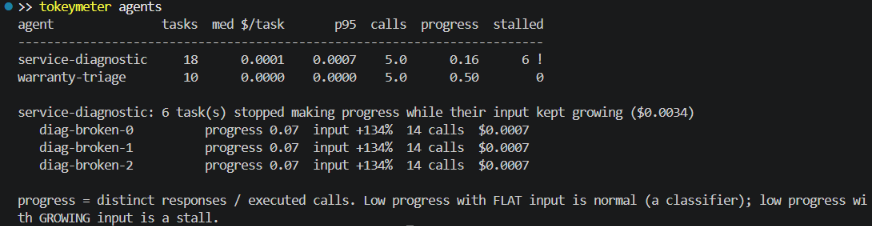
Note warranty-triage: 0.50 progress and zero stalls. That is a batch
classifier repeating three labels — doing its job perfectly, and repeating itself
while doing it. Low progress with flat input is normal work, and a tool that
cannot tell the difference is a tool nobody keeps.
tokeymeter agents --html report.html    # one file you can send to your lead
tokeymeter agents --json                # for your own tooling
The HTML report is self-contained — no server, no account, and it makes no network request when opened. It leads with what the stalls cost, states the rule that flagged them, and states what it could and couldn't see.
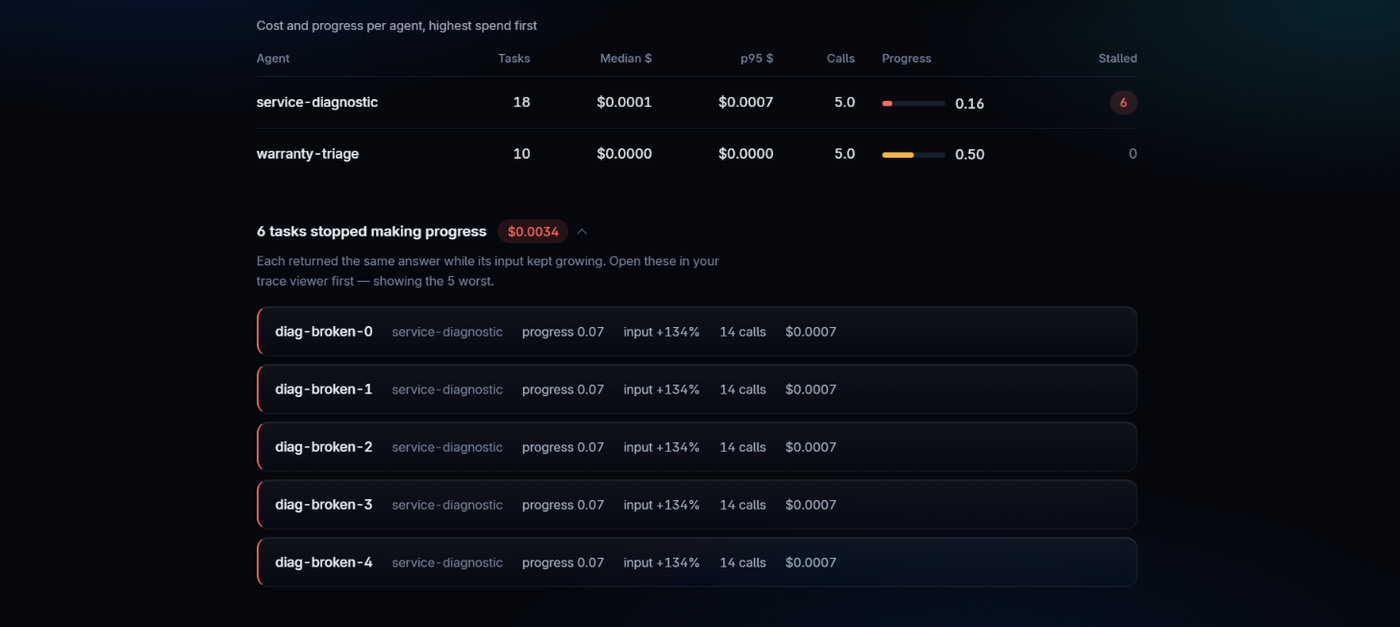
Every stalled task named, with what it cost. The next click is your trace viewer.
Watch it happen
$ tokeymeter watch

  ticket-88214  support    call  12  $ 0.1383  █···  0.12
  order-1102    checkout   call   4  $ 0.0228  ████  1.00
  doc-4471      extract    call   6  $ 0.0065        .     5 cached

  ticket-88214 STALLED - 1 distinct answer in 8 calls, input +64%

  5 tasks - $0.2132 spent - 1 stalled
Reads the ledger. Opens no port, starts no server, and killing it cannot affect a
running agent. --replay --speed 3 runs it against yesterday's history at speed.
--json streams one event per line.
Setting the numbers
The hard question after installing is what should stall_window be? Guess low
and healthy work dies; guess high and the runaway slips through. So most people
set nothing, and a ceiling nobody sets protects nobody.
$ tokeymeter agents --suggest

  service-diagnostic  17 tasks, 5 stalled, healthy progress 1.00-1.00
      stall_window 4  -> would have caught 5, 0 false positives
          longest legitimate repeat run seen: 1 (3 calls of headroom)
      envelope 0.0011  -> would have caught 5, 0 false positives

  warranty-triage     10 tasks, healthy progress 0.50-0.50
      no task in this window shows the stalled shape, so there is
      nothing to tune against. A ceiling suggested here would be a guess.
Every value is replayed against your own history and reported with the two numbers that decide it: stalled tasks it would have caught, and healthy tasks it would also have stopped. Zero false positives is a hard requirement — a ceiling that kills working tasks gets switched off, and then it protects nothing.
Where the data can't support a recommendation, it says so instead of inventing one. Anything can print a number; refusing to is the harder half.
Is it getting worse?
$ tokeymeter agents --since 7d --compare

  extract               <-- regressed
      calls/task   6.4 -> 11.2  +75% !
      $/task       0.046 -> 0.081  +76% !
      progress     1 -> 0.88  -12% !
      stalled      0 -> 2 !
An agent quietly going from 6 calls a task to 11 costs real money and looks completely normal in any single snapshot. Regression is the failure that never announces itself.
One policy across every service
Move the numbers out of code and into a file your platform team owns. Hot-reloaded, no deploy.
version: 1
rules:
  - name: agent-guard
    then: {envelope: 2.00, reserve: 0.10, stall_window: 8, enforce: true}

  - name: non-production-is-cheap
    when: {env: [dev, ci]}
    then: {envelope: 0.25}

  - name: checkout-is-protected
    when: {agent: checkout}
    then: {enforce: false}
Conditions: agent, env, task_id, principal, data_class, region,
endpoint. Actions: envelope, reserve, max_calls, max_repeats,
stall_window, min_novelty, enforce, plus the compliance actions below.
Between the file and your code, the most restrictive wins — neither side can
loosen what the other set.
See what a rule would do before you apply it
$ tokeymeter plan --policy ai-execution.yaml --protect checkout --since 30d

Against the last 30 days:
  312 tasks seen, 29 would halt, 283 would complete
  $1,203.4400 avoided of $4,911.0200 in window

  by agent:
    service-diagnostic     26 halted   $1,180.22 avoided
    checkout                3 halted   $  23.22 avoided   <-- PROTECTED

Coverage: 94.2% of executed spend is task-attributed
Exit codes are for CI: 0 clean, 2 a protected agent would halt, 1 policy error.
- name: AI execution policy check
  run: tokeymeter plan --policy ai-execution.yaml --protect checkout
The simulation is checked against live enforcement in the test suite: 27 predicted halts, 27 actual, $0.00000000 error on avoided spend.
Routing halts to Slack, Jira, anywhere
Register one handler, process-wide. It fires once per halted task.
import json, tokeymeter
from urllib.request import urlopen, Request

@tokeymeter.on_halt
def notify(halt):
    urlopen(Request(SLACK_WEBHOOK_URL,
                    data=json.dumps({"text": halt.summary()}).encode(),
                    headers={"Content-Type": "application/json"}))
support/ticket-88214 stopped after 8 calls ($0.0720) - stalled,
progress 0.12, input +107%
The event carries identifiers, counts and money — no prompt, no response — so it's safe to put in a channel by construction.
It fires even when your code swallows the exception. TaskLimitExceeded
subclasses RuntimeError, so ordinary retry code catches it. Measured on one
stuck agent: 22 halts swallowed, the task correctly bounded at 8 calls, and
nothing upstream any the wiser. Notification therefore fires where the halt is
decided, not where it's raised. It also fires in record-only mode, with
enforced=False, so an alert never confuses "stopped" with "would have been
stopped".
Why there are no bundled connectors
Each would mean an HTTP dependency, an auth scheme and a token store in a package that currently has none — and "no dependencies" is why a security team can approve this in an afternoon. Use the client you already have configured:
@tokeymeter.on_halt
def notify(halt):
    jira.create_issue(project="OPS", summary=f"Agent stalled: {halt.task_id}",
                      description=halt.summary())
A handler that raises is swallowed and counted; one that fails repeatedly is retired with a loud log rather than burning latency on every halt forever. A broken alert never becomes a broken agent.
What it can't catch
An agent that's varied but useless. Different search each time, different file each time, all of it failing. Progress reads 1.00 and it runs to completion.
That's structural, not a bug: novel output is indistinguishable from useful
output without knowing the goal, and knowing the goal means reading the prompt —
the one thing this doesn't do. Use envelope or max_calls for that case.
Non-deterministic errors. "failed at 03:14:22" looks new every time. Most
tool errors are fixed strings; not all.
Whether the ticket was actually answered. It detects that an agent stopped producing new information, not that it failed. Those overlap heavily — a stuck agent is nearly always a failing one — but they are not the same claim.
Sorting twenty-two real "my agent burned money" posts, this would have caught about half — the mechanical half, where a tool is broken and the agent doesn't know to stop.
Not for you if
[!WARNING] You're paying for Claude Code, Cursor or Codex. Those tokens are the vendor's; there is no call site in your repo to wrap. This works on agents you wrote, not agents you bought.
You make single-shot calls — one prompt, one answer. Nothing to stall. You would still get caching and cost tracking, but the part that makes this different would not apply. Better you know now than in week two.
Cost
The bill dropping is a consequence, not the pitch.
When it fires, it's large. A stalled task in the shipped demo goes from 40 calls and $1.0490 to 8 calls and $0.0754 — a 93% reduction on that task.
Across a healthy month it's small. You only save on tasks that were going nowhere. If none are, you save nothing, which is the correct outcome.
It doesn't make your calls cheaper. It stops the calls that shouldn't happen — and an agent going nowhere is 100% waste, not 30%.
You also get the number nobody had: cost per task, per agent.
tokeymeter.chargeback_report(group_by=("agent",))
tokeymeter.general_ledger_csv(...)     # mapped to your GL accounts
tokeymeter.close_packet(...)           # self-reconciling month close
The optimization engine (all opt-in)
Exact caching and single-flight deduplication are on by default — that's why repeats are free, and why the loop is invisible to your bill in the first place.
The rest is off until you ask for it:
@tokeymeter.cache(model="gpt-4o", semantic=True, ttl=3600,
                  compressor=tokeymeter.SafeCompressor())
Semantic caching with false-positive monitoring, four prompt compressors, a router, and cascade-and-escalate. Useful, well tested, and not what this library is for.
Compliance and data residency
Rules about what is permitted, not just how much.
- name: phi-handling
  when: {data_class: PHI}
  then: {only: [gpt-4o-secure], never_cache: true, record_outcome: true}

- name: eu-residency
  when: {region: EU}
  then: {only_endpoints: [azure-westeurope], record_outcome: true}
with tokeymeter.data_class("PHI"), tokeymeter.region("EU"):
    agent.run(record)          # a forbidden model is refused before the call
data_class and region are declared by your application, never inferred —
inferring means reading the prompt. The honest consequence, stated up front:
enforcement is on the declared class, so if your app tags a PHI case as
general, the wrong rule is faithfully enforced. Every record says "the declared
rule was applied to the declared class", never "we verified the content".
A model allowlist can't express residency — gpt-4o runs in eastus and
westeurope, so only_endpoints restricts where a call is processed. An
undeclared endpoint is refused under a residency rule, because "we don't know
where this went" is not evidence that it stayed in the EU.
The auditor's question, answered from the ledger
>>> tokeymeter.policy_report()
{'by_data_class': {'PHI': {'calls': 20, 'models': ['gpt-4o-secure']}},
 'by_region':     {'EU':  {'calls': 81, 'endpoints': ['azure-westeurope']}},
 'governed_calls': 101, 'ungoverned_calls': 0}
"Prove PHI never reached an unapproved model" — that's the exhaustive list, not a promise.
Six starter policies ship as data you read and commit, never auto-installed:
hipaa-phi-handling, eu-data-residency, data-residency-multi-region,
pii-minimisation, runaway-agent-guard, dev-and-ci-caps.
Known gap: EU AI Act Article 14 asks for demonstrable human oversight. This provides halting, not approval queues. For a high-risk classification, stopping may not satisfy the requirement.
Privacy and security posture
- No prompt or response text is ever stored. 26 record fields, all identifiers, counts, money and hashes. Responses are hashed for the progress signal and discarded.
- Nothing leaves your process. No proxy, no sidecar, no telemetry, no account, no phone-home. Zero runtime dependencies.
- No subprocessor. There is no vendor in your data path to add to a DPA or a disclosure list.
- Fails open. If the meter breaks, traffic flows. The single exception is compliance enforcement, which fails closed — but narrowly: a ruleset that fails to resolve contributes nothing, so a bug degrades to "no policy", never to "deny everything".
- A refusal is never bypassed. Fail-open exists so a bug in metering can't break your request. It does not apply to a deliberate refusal — that would make the call anyway, off-meter.
- Tamper-evident. Append-only audit chain with independently verifiable proofs, plus package integrity verification.
tokeymeter doctor # verdict, overhead percentiles, ledger and integrity health
Performance
Measured on the CI machine, cache-hit path, 3,000 samples:
| p50 | p95 | |
|---|---|---|
| Baseline (no task boundary) | 60.9 µs | 94.2 µs |
| Task boundary + stall detection | 85.8 µs | 128.0 µs |
| Policy with no compliance rules | +1.9 µs |
Scale, measured:
- 20,000 tasks: zero leaked state, 60 MB RSS
- 500 concurrent async tasks: 500 distinct ids, zero cross-contamination
- 64 threads × 1,000 tasks: zero cross-contamination
- Real file ledger: 7,843 tasks/s
- 220,000 records through
--suggest: 1.13 s - Five processes writing while reports read: zero errors
tokeymeter doctor measures all of this on your machine. Ours is not the one
your agents run on.
How it fits with what you already run
Keep your observability. 89% of teams running agents already have it. Langfuse tells you why a task went wrong; this tells you which one, and stops it. The report card names the stalled tasks — the next click is your trace viewer.
Keep your framework. LangChain, CrewAI, LlamaIndex or hand-rolled. This bounds the loop; it doesn't build it.
Keep your gateway. It caps a request. This caps the work. Both are useful, and neither substitutes.
Cheaper models help too. Substitution saves more per call than optimization ever will. But a cheaper model that loops thirty times still loops thirty times and still returns nothing. Cheaper models make runaway agents cheaper, not safer.
Full API
The twenty names that are the product
tokeymeter.PRIMARY_API     # the shortlist
tokeymeter.primary_api()   # with one-line descriptions
cache, cache_stream |
the decorator |
task, bind_task, TaskLimitExceeded |
the boundary |
on_halt, HaltEvent |
routing |
register_pricing, register_cluster_costs |
pricing |
load_rules_file, set_rules |
policy |
agent_report, plan_report, savings_report |
reporting |
chargeback_report, close_packet, general_ledger_csv |
finance |
data_class, region, policy_report |
compliance |
doctor, verify_self |
health |
193 public names in total; the rest is depth. bind_task matters if you use
threads: contextvars propagate into asyncio automatically but not into
ThreadPoolExecutor workers, so a plain worker would otherwise escape the ceiling
silently.
Ceilings, and what each one is for
| Stops when | Catches | |
|---|---|---|
stall_window=8 |
answers stop being new and input grows | the mechanical runaway |
envelope=2.00 |
the task has spent $2 | anything expensive, including varied exploration |
max_calls=50 |
50 calls, whatever they cost | anything long |
max_repeats=4 |
the same request 4 times | identical retries |
They are orthogonal on purpose. An envelope can never catch a loop — after the
first execution every repeat is a cache hit, so a 20-call loop costs $0.0155 and
never approaches any budget. reserve makes the envelope a hard cap by holding the
worst case before the call and settling after — the way a hotel holds a card, and
for the same reason: the bill arrives after the damage.
Exceptions
RuntimeError
├── TaskLimitExceeded
│   ├── TaskStalled            progress collapsed while input grew
│   ├── TaskLoopDetected       max_repeats
│   ├── TaskEnvelopeExceeded   envelope
│   └── TaskCallLimitExceeded  max_calls
└── PolicyViolation
    ├── ModelNotPermitted      wrong model for this data class
    └── EndpointNotPermitted   wrong place to process it
PolicyViolation is deliberately not a TaskLimitExceeded: running out of budget
and violating a data-handling rule fail for different reasons, are owned by
different people, and need different handling.
Configuration
Optional extras
The base install has no dependencies. Add only what you use:
pip install "tokeymeter[providers]"     # openai, anthropic SDKs
pip install "tokeymeter[semantic]"      # paraphrase matching (~1GB)
pip install "tokeymeter[scale]"         # redis, sqlite-vec, encrypted cache
pip install "tokeymeter[compression]"   # llmlingua prompt compression
pip install "tokeymeter[audit]"         # Ed25519 signing for the audit chain
pip install "tokeymeter[dev]"           # to run the test suite
Environment variables
TOKEYMETER_HOME |
where the ledger and config live. Default: ~/.tokeymeter |
TOKEYMETER_SAVINGS_PATH |
the ledger file specifically, overriding HOME |
TOKEYMETER_ENV |
the env a policy rule can match on — dev, ci, prod |
TOKEYMETER_QUIET |
suppress non-error console output |
Precedence: an explicit set_savings_path() beats TOKEYMETER_SAVINGS_PATH,
which beats TOKEYMETER_HOME.
Where the ledger lives
One append-only JSONL file per machine, written by every process that imports the library. Several services can share one file safely — a torn final line from a concurrent write is skipped and re-read, not treated as corruption.
tokeymeter.set_savings_path("/var/log/tokeymeter/ledger.jsonl")
tokeymeter.set_buffered_savings(True)     # fewer file opens; helps on Windows
                                          # where antivirus scans every open
For the cache itself, in-memory is the default:
from tokeymeter.storage import MemoryStore, SQLiteStore          # both built in
from tokeymeter.engines.optimization.redis_store import RedisStore   # [scale]

tokeymeter.set_default_store(SQLiteStore("/var/lib/tokeymeter/cache.db"))
Checking your install
tokeymeter doctor        # verdict, overhead, ledger and integrity health
python ACCEPTANCE.py     # walks the whole journey, reports PASS/FAIL and friction
ACCEPTANCE.py exists because a green test suite tells you the code is correct
and cannot tell you the product is usable.
FAQ
Do I have to change my agent? One line at the entry point. Nothing inside it.
What if the meter breaks? Traffic flows. Everything fails open except compliance, and that inversion is kept as narrow as it can be.
Does it work with async and streaming? Yes, both, including cache_stream.
Every control is verified on all four execution routes — sync, async, streaming,
and the runtime kernel.
Can it run in a bank? That's what the design is for: no prompt storage, no outbound calls, no subprocessor, an audit chain, and package integrity you can verify yourself.
How do I know the report is right? --suggest, agents, plan and live
enforcement all read one ledger and are tested to agree exactly — including across
five processes writing concurrently to a deliberately corrupted file. And the
ledger reconciles with a real provider invoice: 98 requests, 22,811 tokens,
$0.0038, matching OpenAI's own usage page.
Is it production ready?
[!NOTE] 1,758 tests, a 17-check release gate, and nine adversarial audits that each found and fixed real defects — three of them found only by running it against a real provider with real money. But be aware: no one outside the project has run it against a workload we didn't write. If that matters to you, wait. If it interests you, open an issue — you will get answers fast.
Stability, security, and roadmap
Versioning
Pre-1.0, so the public API can still change. Two things reduce the risk: a
frozen-signature test guards cache(), cache_stream() and the export list, so
any change to them is deliberate and appears in CHANGELOG.md; and
new parameters are appended to the end of signatures rather than inserted, so
positional arguments never shift underneath you.
The PRIMARY_API list is the surface intended to stay stable.
Reporting a security issue
Please don't open a public issue for a vulnerability. Email the maintainers and you'll get an acknowledgement within a few days. See SECURITY.md.
Worth knowing before you look: the package makes no outbound network calls, holds no credentials, and stores no prompt or response text. The attack surface is mostly what an attacker could do with write access to a policy file — a policy file is executable authority over your agents, so it belongs under CODEOWNERS like any other control.
Roadmap
Being worked on: a docs page of copy-paste on_halt recipes for Slack, Teams,
Jira, Linear and PagerDuty; OpenTelemetry span attributes so cost-per-task and
progress show up in Datadog, Grafana or Honeycomb without a separate integration.
Deliberately not planned: bundled connectors for individual SaaS tools; a hosted dashboard; and anything that puts a network hop in your request path.
Known gaps, stated in full above: agents that are varied but useless aren't detected; EU AI Act Article 14 wants approval queues and this provides halting; and nobody outside the project has run it against a workload we didn't write.
Contributing
Issues and pull requests welcome. The most valuable report you can file is a working agent that got stopped — there's an issue template for it, and it's treated as a priority bug rather than a tuning question.
pip install -e ".[dev]"
pytest
python scripts/run_all_checks.py
Two rules that aren't obvious:
Every control must work on all four execution routes — sync decorator, async
decorator, cache_stream, and the runtime kernel. A control that exists on one
path is only as strong as the path a team happens to pick. Three separate bugs of
exactly this shape have been found and fixed.
Enforcement and simulation move together. If you add a control, add it to
simulate in the same commit. Otherwise plan reports that a real rule does
nothing, someone applies it believing that, and production halts.
See CONTRIBUTING.md for what will get a change rejected.
License
Apache-2.0.
1 maintainer

Release files for tokeymeter 0.31.1
For a detailed explanation of source distributions (sdists) and built distributions (wheels), please see the package formats documentation.
Source distribution (sdist)
| File | Size | Uploaded | |
|---|---|---|---|
| tokeymeter-0.31.1.tar.gz | 1.4 MB | Details |
Built distribution (wheel)
| File | Interpreter | ABI | Platform | Reset |
|---|---|---|---|---|
| tokeymeter-0.31.1-py3-none-any.whl | Python 3 | none | any | Details |
Total release size: 1.9 MB
Release files / tokeymeter-0.31.1.tar.gz
| Download URL | tokeymeter-0.31.1.tar.gz |
|---|---|
| Size | 1.4 MB |
| Tags | Source |
|
SHA-256 checksum How to use checksums |
8d476893e31539bf0a2cf14b87cf5db623069d3288d4d4ddaa5ec06a5b2695d1
|
|
BLAKE2b-256 checksum How to use checksums |
af305bdf5c7df6afbec3fc3c4d8a3721f82bedc202c9c480b8f8713aa3ece211
|
| Upload date | |
|
Uploaded using Trusted Publishing? What is trusted publishing? |
No |
| Uploaded via |
twine/7.0.0 CPython/3.12.9
|
Release files / tokeymeter-0.31.1-py3-none-any.whl
| Download URL | tokeymeter-0.31.1-py3-none-any.whl |
|---|---|
| Size | 484.8 kB |
| Tags | Python 3 |
|
SHA-256 checksum How to use checksums |
c11b0650d986d3a2a34f40023d61246852431cbe3a4f4348c9dc838693d6c397
|
|
BLAKE2b-256 checksum How to use checksums |
166071327beb7b826b101343a3f60a84e30b80a9d2cf8b73b2d7b3d4d9332bb0
|
| Upload date | |
|
Uploaded using Trusted Publishing? What is trusted publishing? |
No |
| Uploaded via |
twine/7.0.0 CPython/3.12.9
|













