
toktier
English | 简体中文
Tokenize the conversation once — after that, only what's new.
TokTier is a stateful tokenization system for agentic LLM serving. It keeps
per-session token state, repairs appended text with a certified CPU path, and
offers a certified GPU path for fresh or large requests. Both fast paths return token IDs
bit-identical to a full Hugging Face (HF) tokenizers encode from scratch.
- Exact, at scale. The release campaign records 57.0 billion checks across 15 tokenizer artifacts and 3.8 billion real documents (12.33 trillion characters), with zero observed divergence.
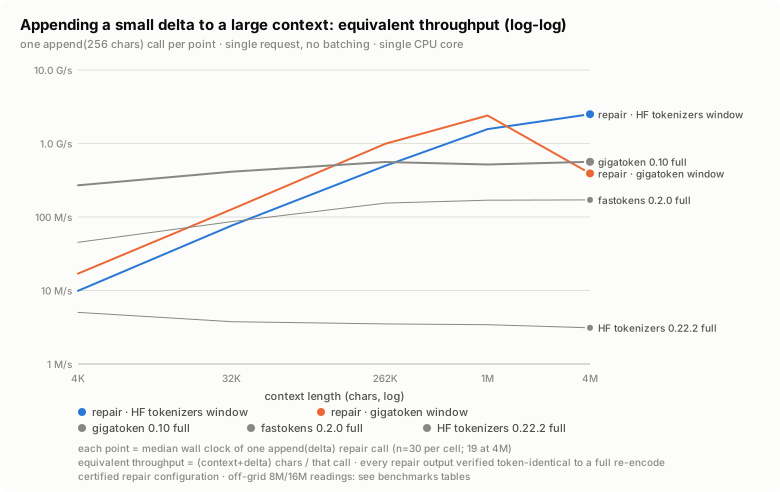
- Fast on both paths. On the recorded benchmark battery, the GPU path encodes a fresh 4-million-character request (~786K tokens) in 3.88 ms, and the bounded CPU repair for a 256-character append to a 4.19M-character session takes 1.68 ms. The benchmark protocol excludes engine construction, so the 3.88 ms result assumes an already constructed and prepared engine; it is not a cold first-call figure. The repair reading measures the repair operation itself; it excludes materializing the full historical token sequence as a Python tuple.
- Certified before acceleration. Fast paths run only for the exact
tokenizer artifacts, under the reference versions, that recorded evidence
covers. Under the default
SUPPORTEDpolicy a device architecture or compiler no campaign has judged still runs when every constraint the registry binds verifies, labelledsupported_untestedrather than certified.explain()reports the route and its reasons.
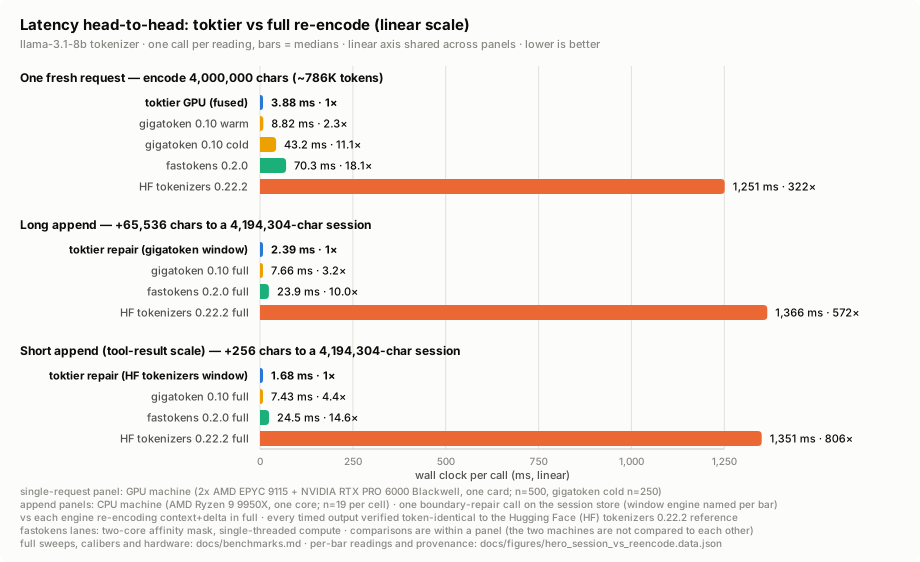
Every bar is a measured median. The 1.68 ms reading above comes from the
toktier repair (HF tokenizers window) lane, which is the repair window
measured in that cell; the corrected-Gigatoken window is a separate lane in the
same figure (2.39 ms on the 65,536-character append). Both are bounded repairs
under the routing table below, and the figure data names the lane of each bar.
A native Rust serving integration can avoid the full-sequence materialization
by retaining session state and consuming only the repaired suffix. Exact
values, workload sizes, and sample counts are in
hero_session_vs_reencode.data.json;
the complete sweeps are in docs/benchmarks.md.
News
- 2026.10.15 🚀 toktier 0.3.0 released — one long request can now use
more than one core on the CPU route without leaving the exact-ID contract.
toktier.chunked.encodecuts the input at certified stable boundaries, encodes the chunks in parallel and concatenates the ids, which is the serial encoding by construction; it runs as a Python helper over the batch path or inside a native chunk encoder, and the Rust crate reaches the same encoder throughTokenizer::chunked(). Which artifacts may be chunked is read from a table that ships with the package and is generated from evidence on the chunked path itself, and three levels of evidence are kept apart: the corrected CPU engine's whole-document campaign (41,800,181,401 checks, zero divergence) is about the engine that encodes each chunk and never cut a document, so it is not chunked-path evidence; the chunked path holds an adversarial battery (460,000 strings over the eleven roster artifacts, both paths, 2026-10-15) and a web-corpus cut comparison (102,400,000 documents each for four artifacts, Python path, 2026-09-17), neither with a difference from the reference. The four artifacts that hold both levels, qwen3_8b, llama_3_1_8b, deepseek_v3 and gpt_oss_120b, are admitted, and on them the native encoder runs by default on both faces, labellednative_evidence:adversarial_onlyuntil the corpus comparison covers the native path too. The other seven roster artifacts hold the battery only and are encoded serially until the corpus campaign covers them (R_CHUNK_FAMILY_UNSUPPORTED, refusalchunked_evidence_incomplete:adversarial_only): a measurement not yet taken, not a measured problem, and their whole-document fast CPU routes are unchanged. An added token with anlstrip,rstriporsingle_wordflag is not admitted (added_token_strip_or_single_word), and an installedtokenizersoutside the certified set keeps the call serial (oracle_differs_from_chunked_evidence:<version>). In cold readings on one 16-core desktop (2026-10-15) the native encoder ran 1.35 to 5.25 times as fast as the serial encode withlookup="off"on four to eight cores, for texts of 262,144 to 4,194,304 characters, least on English text for Llama-3.1-8B. The release also addsSession.append_patch, which returns the splice without a copy of the stream, and an SGLang adapter (toktier.integrations.sglang) that serves SGLang's encode calls on the certified CPU route once it has checked that the tokenizer it wraps is the one toktier loaded (TOKTIER_SGLANG_IDENTITYaccepts onlyrequire), with an optional pool of tokenizer worker processes, chunked dispatch for long stateless requests and a chunk-encoder warm-up when it wraps an admitted tokenizer; theTOKTIER_SGLANG_*settings are read by the adapter alone. It was checked on SGLang 0.5.19, 0.5.20 and 0.5.21 on 2026-10-13, and on 2026-10-15 against a real SGLang 0.5.21 model server, where the ids of all 138 requests equaled the Hugging Face ids. The exacttokenizersandtransformerspins become ranges (tokenizers>=0.22.2,<0.24,transformers>=4.57.6,<6), sopip install toktierbeside SGLang resolves the ordinary way (a new environment also getsplatformdirs), andpip checkreported no broken requirements beside SGLang 0.5.21 and beside SGLang main's pins (checked on 2026-10-14 and 2026-10-15). The certificates speak for the certified reference versionstokenizers0.22.2, 0.23.2 and 0.23.3, the two 0.23 releases install beside atransformersloader of the 5.19 line, and an installedtokenizersoutside that set runs on the reference route. On the Rust crate every third-party dependency takes a caret edge (most were exact before;Cargo.lockis unchanged); the fast CPU engine is admitted by its source identity under every policy butReference, so a build on another rustc or feature recipe runs it labelledsupported_untested, withrust-versionat 1.89 and the judged toolchain still 1.93.1, and the Python facade follows the same rule; a reference library outside its certified versions is a label on the CPU route, while the GPU route keeps its certified-build requirement; andRuntime::family_for_sha256names the shipped family of atokenizer.jsondigest. The prebuilt GPU delivery is certified onsm_80,sm_89andsm_120;sm_90is not certified in this release (the fatbin keeps its image as experimental, and certification is planned for 0.3.1). Because the native chunk encoder is compiled into the corrected CPU engine, all three source identities move, exact and version-normalized alike, and the roster is recertified against them; artifacts and capability ids do not move. A persistent session store written by 0.2.9 is refused at open withSESSION_STATE_MISMATCH, and 0.2.9 refuses one 0.3.0 wrote: pointstore=at a new directory and replay the transcript. The store format and the artifact fetch manifest do not change, so a 0.2.9 artifact cache serves 0.3.0, offline included. With the sametokenizersandtransformersinstalled, served ids are unchanged on every packaged artifact (qwen3_5_08bbeside atransformers5.x loader follows that loader and reportsR_LOADER_FACE_MISMATCH).doctor --jsongains three top-level keys and onefamilykey, the reason-code namespace gainsR_CHUNK_NO_CUT,R_CHUNK_FAMILY_UNSUPPORTED,R_CHUNK_ROUTE_NOT_FAST_CPUandR_LOADER_FACE_MISMATCH, andexplain()gains achunkedblock and the loader-face digest. Same-host A/B runs against 0.2.9 kept the encode, session, serving and GPU timings of both faces within a few percent, so the paths this release did not add are not faster;Runtime::doctor()takes about 0.6 to 0.8 microseconds more to report its new facts. The chunk-parallel path, the CPU pool and the SGLang adapter are described in the Delta Tokenizer paper (arXiv:2610.19801); TokTier (arXiv:2607.29678) remains the citation for the system. See the v0.3.0 release notes. - 2026.10.14 📄 Our paper Delta Tokenizer: Reference-Identical Tokenization of Session Deltas and Segment-Parallelism for Long Prompts on Multicore CPUs is available on arXiv.
- 2026.08.31 🚀 toktier 0.2.9 released — both capability fingerprints
are now computed on the loader face the pinned loader materializes rather
than on the artifact file, so a capability id names the document the
certification readings were taken against. Six cells of the shipped registry
move — five
pipeline.*ids and theadded-frontend.*id ofqwen3_5_08b— and the release notes map old to new; no served id changes on any input over any packaged artifact,artifact_sha256still keys every certification lookup, and neither runtime recomputes a fingerprint. On that shared faceQwen/Qwen3.8-27BandQwen/Qwen3.8-Flash-Nextare admitted by content throughfrom_pretrained()onto theqwen3_5_08banchor, recorded on a fifth sibling basisequivalent_loader_face(215 registry rows, 214 siblings, 208 packaged); no sixteenth family id is added, soload("qwen3_8_27b")still reportsARTIFACT_NOT_FOUND. This release also fixes a defect the published 0.2.8 carries: the shipped artifact manifest named onlytokenizer.json, so a cache built from nothing byartifacts fetchlacked the sidecar that declares the seven added tokens ofqwen3_5_08b(ids 248070-248076,<tts_pad>at 248072), andtoktier.load("qwen3_5_08b")failed closed withARTIFACT_HASH_MISMATCH, reasonconfig_added_tokens_mismatch. The manifest now pins the loader face's whole input closure, 15 file lines to 46, measured rather than assumed and proved by rematerializing from the recorded group alone. An offline deployment wants that wider set staged before it upgrades:qwen3_8b, for one, goes from one file to three. A connected host repairs itself on the firstload(); an offline host raisesARTIFACT_NOT_FOUND, andtoktier artifacts fetch <family> --forceneeds the network. Its route istoktier artifacts export <family> --out <family>.taron a connected 0.2.9 host, thentoktier artifacts importon the offline one — move the existing alias directory aside first, or the import answersALIAS_CONFLICTover the older, smaller tree already there. A persistent session store written by 0.2.8 is refused at open withSESSION_STATE_MISMATCH, as 0.2.8 was for 0.2.7 and for the same reason: pointstore=at a new directory and replay the transcript. Smaller movements: an import clears the verified marker's own leftover temporary instead of refusing over it; a directory holding neitherconfig.jsonnortokenizer_config.jsonis materialized file-only rather than through a loader class guessed from the directory path, so resolution no longer depends on where the cache sits;doctorreads the engine binding forautomatic_effective_backendand names the CPU lane it refuses; the support-registry schema drops two optional carry-over fields no document ever carried; andchacha20moves to 0.10.2, the version crates.io has not withdrawn. The registry schema version stays 1 and the fingerprint preimages and domain tags are unchanged, though the two JSON shapes just named — the siblingbasisvocabulary and that schema — do move under it. TheALIAS_CONFLICTcode and its details, the store format, the shipped fatbin, and the kernel ABI are unchanged. See the v0.2.9 release notes. - 2026.08.30 🚀 toktier 0.2.8 released — on the Python face the
certified subject is now the loader face:
tokenizer.jsonplus the configuration-only added tokens that the pinnedtransformers.AutoTokenizermaterializes. The seven configuration-only literals ofqwen3_5_08b, at ids 248070-248076, now return their declared single ids under every Python policy, whereREFERENCEused to spell them as ordinary text; the Rust crate still executes the artifact file, so its answers for those literals do not change. The declared subset is verified fail-closed, and a drifted sidecar raisesARTIFACT_HASH_MISMATCHwith reasonconfig_added_tokens_mismatch. Re-importing an unchanged air-gap bundle is now idempotent, and a conflicting alias raises the new stableALIAS_CONFLICTcode. Diagnostics addautomatic_routing_policy,guarantee_basis.family_ids, and, on Rustverify-local --json,route_admittedandunserved_paths; underREFERENCE,doctornow answersfalse/hfinstead oftrue/gpu.pip install "toktier[fastokens]"resolvestoktier-fastokens==0.3.1.2, and 0.3.1.1 stays recognized. A persistent store written by 0.2.7 is refused withSESSION_STATE_MISMATCHbecause the semantic fingerprint moved: pointstore=at a new directory and replay the transcript. The store format, the shipped fatbin, and the kernel ABI are unchanged, and existing Python facade calls remain source-compatible. See the v0.2.8 release notes. - 2026.08.27 🚀 toktier 0.2.7 released —
pip install "toktier[fastokens]"now installstoktier-fastokens, a pinned build of fastokens 0.3.1 with five patches from this project. The project publishes the build, so the extra installs the same bytes described by the adapter's readings. The adapter resolves the installed engine by its import package and reportsengine_assurance, while its admission remainsexperimental. For the published wheel, the report showscertified_pinnedwith a guardedexact_id_guarantee: true; otherwise, it identifies the premise that does not hold. The 154-code-point Unicode guard moved from the judge into the adapter. Served IDs, the store format, and the kernel ABI are unchanged. See the v0.2.7 release notes. - 2026.08.27 🚀 toktier 0.2.6 released — Rust certification now
speaks for the certified core (TokTier's own crates, the packages they call
directly, and the text-semantics libraries beneath them). Drift elsewhere in
the compiled closure is reported as an advisory with alignment commands and
no longer withholds acceleration. The whole-closure reading stays available
as
dependency_closure. The libraries whose Unicode tables decide where text is cut are compared by the version of those tables rather than by their package version, anddoctorreports each one. The property data the fast CPU pre-tokenizer reads is pinned to the Unicode version the reference engine carries, with an exhaustive gate that keeps the two equal. On the GPU side, driver and CUDA versions are reported as environment facts, andsm_80andsm_90join the certified prebuilt list on a bounded spot check. A device architecture or compiler toolchain unjudged by any campaign now runs under the new defaultsupportedpolicy and is labelledsupported_untested.verify-local(the same command on both faces) compares such a route with the reference engine on your own text and records the answer aslocally_verified. Served IDs, the store format, and the kernel ABI are unchanged. See the v0.2.6 release notes. - 2026.08.15 🚀 toktier 0.2.5 released — the Rust crate's
networkfeature is now opt-in, which takes sixteen packages and the whole TLS stack out of a default build that may never fetch; addfeatures = ["network"]to keep acquiring artifacts over the network, andcargo install --locked --features network toktierfor a CLI that fetches. The Python package acquires artifacts exactly as before; the feature change does not reach it. What does reach it isSession.revision, which is durable from this release: a conversation resumed in a later process reports the revision its record carries, andTokenizer.store_session_revision()returns that number instead ofNone. Diagnostics gain an executionreasonand anetwork_compiledbuild fact. Served IDs, the store format, and the kernel ABI are unchanged. See the v0.2.5 release notes. - 2026.08.14 🚀 toktier 0.2.4 released — the Han family (
kimi_k3) joins the certified roster with the product's own end-to-end GPU engine; Rust certification now judges the packages a build actually compiles, not only its sources, and its build flags claim only what a build script can observe; the Rust crate followsTOKTIER_HOME/XDG; the Python facade gains thesession()context manager,--jsonon every command, anddoctor --family; a directory root that cannot hold private state,artifacts check-conversion, and the last-execution diagnostic all answer inside their contracts. Served IDs, the store format, and the kernel ABI are unchanged. See the v0.2.4 release notes. - 2026.08.11 🚀 toktier 0.2.1 released — a maintenance update: richer
diagnostics (
doctornow reports JIT toolchain eligibility, andexplain()summaries state the time window each field covers) plus documentation fixes. Served IDs, the store format, and the kernel ABI are unchanged. See the v0.2.1 release notes. - 2026.08.10 🚀 toktier 0.2.0 released — the first public release: certified exact-ID sessions with bounded CPU repair, a prebuilt GPU path, and the Rust serving API, shipped as a Python wheel on PyPI and six Rust crates on crates.io.
- 2026.07.31 📄 Our paper TokTier: Exact Stateful CPU+GPU Tokenization for Agentic LLM Serving is available on arXiv.
Quick start
Install with pip install toktier; GPU options are described in
Install. On a GPU host where ninja is importable, the default
gpu_delivery="auto" selects the JIT delivery, so the first long request
compiles the kernel for tens of seconds; pass gpu_delivery="prebuilt" to use
the shipped kernel or device="cpu" to stay on the CPU route
(GPU delivery).
import toktier

tok = toktier.load("qwen3_8b")          # family id from the support matrix
enc = tok.encode("hello world")         # token IDs
print(enc.ids)
print(tok.decode(enc.ids))
print(tok.explain(summary=True))        # concise route and verdict
encode followed by decode does not necessarily reproduce the original
text. For example, a tokenizer whose pipeline applies NFC normalization
returns normalized text; that is the tokenizer's own behavior, not a TokTier
divergence. TokTier's guarantee concerns token IDs: they match a
from-scratch HF encode of the same input, and both decoders return the same
text under the same decoding options. The options themselves differ by
default: decode here skips special tokens (skip_special_tokens=True)
where the HF decoder keeps them, so ids carrying special tokens decode to
different text until one call is given the other's setting. Pass the same
value to both and the two results are identical byte for byte.
If application code starts from a Hugging Face model repository instead of a TokTier family id, resolve it by content:
tok = toktier.from_pretrained("Qwen/Qwen3-0.6B")
from_pretrained() downloads the audited immutable revision for a recorded
sibling or canonical repository, hashes the exact file, and consults the
sibling registry, which contains 214 audited repositories plus one canonical
self-row and is itself covered by a root digest.
For an unknown repository, from_pretrained() resolves main unless
revision= is passed.
Byte-identical, source-level identical, canonicalization-equivalent,
serialization-equivalent, and loader-face-equivalent records run on the already
certified canonical artifact through the same CPU/GPU router. A known repository whose bytes have changed — and any
unregistered content — stays on HF under policies that permit
the reference fallback; REQUIRE_ACCELERATED raises an error instead. See
explain()["model_resolution"] for both the source identity and the
canonical identity used for execution. load(family) remains the direct
family API and the air-gap-friendly path.
Sessions
Use session= to name a growing transcript and persist its token state across
calls and processes:
tok = toktier.load("qwen3_8b", store="./toktier-store")

transcript = "user: hello\nassistant: hello! how can I help?\n"
enc = tok.encode(transcript, session="chat-42")

transcript += "user: what changed since my last call?\n"
enc = tok.encode(transcript, session="chat-42")

# Store-backed and from-scratch paths return the same IDs.
assert enc.ids == tok.encode(transcript, lookup="off").ids
Without session=, the store can find a byte-verified stored prefix by content.
Use lookup="off" to skip that lookup. A failed byte check is a miss, never a
trusted hit; cache eviction changes latency, not output. Long sessions whose
stable prefix has been sealed remain reusable after restart: TokTier binds the
record to the caller-presented historical prefix before restoring it, and a
missing or corrupt binding results in a cold encode.
Routing and policies
Routing policy is selectable and inspectable:
from toktier import RoutingPolicy

tok = toktier.load("qwen3_8b", policy=RoutingPolicy.CERTIFIED)
| Policy | What runs | If a fast-path premise fails |
|---|---|---|
SUPPORTED (default since 0.2.6) |
Everything CERTIFIED admits, and in addition a device architecture or compiler toolchain no campaign has judged, provided the shipped kernel loads and runs there and every constraint the registry does bind still verifies; such a route is labelled supported_untested rather than certified |
Falls back to HF and records the reason |
CERTIFIED (the strict setting; the default through 0.2.5) |
Only routes the evidence covers: the exact artifact under a certified reference version and, for the GPU, the exact kernel bytes, delivery, a judged architecture and a judged toolchain. The fast CPU engine is admitted by its source identity, as under the default; a build of it with another compiler or flags is labelled supported_untested |
Falls back to HF and records the reason |
REFERENCE |
HF tokenizers only |
No accelerated route is attempted |
REQUIRE_ACCELERATED |
The same routes the default policy admits | Construction raises if no fast path is eligible; per-input safety fallbacks remain enabled |
EXPERIMENTAL |
May admit an unjudged combination for evaluation | Labels every waived premise; never the default |
The install profile and input shape then determine the automatic route:
Situation under the default SUPPORTED policy |
Automatic route |
|---|---|
toktier, one of 11 certified tokenizer artifacts (12 model families) |
Corrected Gigatoken for full CPU encoding; HF if any binding check fails |
toktier[gpu], cold/plain input below the GPU crossover (64 KiB default) |
Corrected Gigatoken CPU path (HF for a family without CPU-fast certification) |
toktier[gpu], cold/plain input at or above the GPU crossover (64 KiB default) |
Shipped prebuilt GPU path; then corrected Gigatoken and HF in the frozen fallback chain |
| Existing session receives a strict append | Corrected Gigatoken CPU repair for the 12 covered model families, independent of total transcript size |
| Added-token or repair guard cannot prove its premise | HF reference path for that input |
The two GPU rows describe what happens when the GPU route is admitted, and
admission is narrower than "a GPU is present". The shipped evidence covers
sm_80, sm_89 and sm_120 for the prebuilt delivery. On any
other architecture the default SUPPORTED policy still runs the shipped
kernel when it loads and every constraint the registry does bind verifies,
and labels that route supported_untested rather than certified;
toktier verify-local compares it with the reference engine on your own
text. The strict CERTIFIED policy refuses it instead, so those rows fall
to the row above them. Either way explain() records the reason. The
evidence scale per architecture is in
docs/support-matrix.md.
explain(summary=True) reports:
- the headline route and certification verdict;
- what the last request actually did (
last_execution_backend/_path/_source), pluslast_execution_fallbackwhen a request finished somewhere other than where it started; and - whether any fallback has occurred over the process lifetime
(
fallback_ever_occurred, which also counts the ordinary below-threshold crossover).
The full no-argument explain() report adds the fixed chain, the crossover
decision (gpu_min_bytes, 64 KiB by default), detailed probe and certification
data, and every fallback counter.
Rust serving API
The workspace includes a Python-free Rust serving facade for frontends that retain token state directly. It exposes:
- pinned artifact fetch, mirror, and air-gap operations
- reference, corrected-CPU, and prebuilt-or-direct-JIT GPU routing
- continuous token buffers
- bounded, executor-neutral batching
- persistent named sessions
- delta-native
TokenPatchresults
use toktier::{Device, Runtime};

let runtime = Runtime::builder().device(Device::Auto).build()?;
let tokenizer = runtime.load("qwen3_8b")?;
let mut session = tokenizer.open_session("agent-42")?;
let seed = session.seed("user: hello\n")?;
let patch = session.append("assistant: hi\n")?;
patch.keep_tokens() says where a retained downstream ID buffer should be
truncated; patch.replacement_ids() is the exact repaired suffix. The append
does not allocate the complete historical ID sequence unless the caller asks
for snapshot(). The crate is published on crates.io from 0.2.0 onward and
tracks the package version, so cargo add toktier resolves it from the
registry. See docs/rust-api.md for the serving surface and
docs/rust-lifecycle.md for acquisition, JIT,
concurrency, and reproducible offline distribution.
Since 0.1.1, the UTF-8 crossover and no-hit added-token prefilter execute in
one allocation-free Rust selector call. On the recorded RTX 5090 host, its
4M-byte control-plane microprofile fell from 2.97 ms to 0.052 ms (57.5x); this
is a routing-only measurement, separate from tokenization and Python result
materialization. See docs/native-routing.md.
Install
pip install toktier                 # complete certified CPU product
pip install "toktier[gpu]"          # CPU product + automatic prebuilt GPU route
pip install "toktier[gpu-jit]"      # same routing, with local JIT delivery
cargo add toktier                   # Python-free Rust serving API
cargo add toktier --features network # ... plus artifact acquisition over TLS
The Python package is unaffected by the Rust crate's features: it fetches
artifacts through huggingface-hub as it always has. On the Rust side,
network is opt-in from 0.2.5; without it the crate still verifies,
mirrors, imports, exports, and runs from a verified cache.
| Install | Delivery | Requirements |
|---|---|---|
toktier |
Corrected Gigatoken full CPU encode and session repair, HF fallback, persistent store, routing, and CLI | Linux x86_64 with glibc 2.34+, CPython 3.10+; requires tokenizers>=0.22.2,<0.24 and transformers>=4.57.6,<6 (the certified reference versions are the registry's; see Correctness and evidence) |
toktier[gpu] |
Strict superset of toktier; automatic 64 KiB crossover to the shipped multi-architecture CUDA fatbin |
NVIDIA GPU, driver 580.65.06+, torch; no compiler or first-use build |
toktier[gpu-jit] |
Same CPU/GPU routing as toktier[gpu]; compiles the certified kernel source locally |
judged NVCC / torch-runtime CUDA / PyTorch triple, torch, ninja; first-use compilation |
Both GPU extras pull in torch and its CUDA wheels, so budget for it: a fresh
[gpu] or [gpu-jit] virtual environment measures around 5 GiB, and an
uncached install downloads several wheels in the hundreds-of-megabytes range
(plus a comparable pip cache). That is the Torch ecosystem's footprint, not
TokTier's — the base toktier wheel needs none of it.
JIT toolchain certification
JIT is fail-closed on every binding the registry records — sources, class
tables, build flags. Certification additionally checks the actual nvcc
selected by PyTorch's extension builder, torch.version.cuda, and the PyTorch
distribution version as independent axes; for example, torch CUDA 13.0 with
NVCC 13.2 is not treated as the judged NVCC 13.0 combination.
That triple is the one premise where a miss is a coverage gap rather than a
failed check: the sources and flags are the judged ones and no campaign has
compiled them with this pair. The default SUPPORTED policy therefore compiles
and runs it and labels the route supported_untested, with the gap reported
rather than warned about: toktier doctor and explain() both show the
observed triple beside jit_toolchain_satisfied: false. CERTIFIED refuses it
as it always has — automatic routing keeps to the corrected Gigatoken → HF
fallback chain and records the reason, and an explicit CUDA request fails with
the observed compiler/runtime triple, the certified constraint, and a copyable
remedy.
Under either policy, a combination can be compiled ahead of first use with:
toktier gpu compile qwen3_8b
Under the stricter policies, an unjudged combination can still be compiled for evaluation with explicit risk acceptance:
toktier gpu compile qwen3_8b --accept-uncertified-jit
This does not certify the resulting kernel. That form runs under
EXPERIMENTAL, prints an UNCERTIFIED JIT OPT-IN warning, and records every
waived premise; under the default policy it is not needed, and the command
waives nothing. Application code reaches the same treatment by opting in
explicitly with policy="experimental", gpu_delivery="jit"; the acceptance is
deliberately not persisted or inherited by later certified processes. Inspect
explain()["experimental_waivers"] before using those results.
CPU engine provenance and build identity
The corrected, data-version-pinned Gigatoken implementation is linked directly
into the core toktier._native extension. TokTier does not install or trust a
top-level package named gigatoken, and the wheel carries no second CPU native
module. The base wheel also requires the HF loader and oracle packages as
ranges (tokenizers>=0.22.2,<0.24, transformers>=4.57.6,<6); the route is
certified under the tokenizers releases the registry lists as certified
reference versions (0.22.2, 0.23.2 and 0.23.3 in this release). There is no
separate CPU-fast installation step.
For provenance, a source checkout can independently recompute the active source identity and build the same release profile:
python3 tools/fast_cpu_source_identity.py
python3 tools/compute_identity_v2.py
python3 tools/compute_identity_v2.py --show-diff
maturin build --locked --release
The three established identity scripts (fast_cpu_source_identity.py,
native_host_source_identity.py, rust_api_source_identity.py) remain the
byte-exact v1 view used by current build facts. compute_identity_v2.py hashes those same fast-CPU,
native-host, and Rust-API coverage sets under new domains after normalizing
only the enumerated workspace version fields; --show-diff prints every
normalized line for review. python3 tools/dev.py check also rejects
package-version reads in covered Rust or Python code outside the explicitly
enumerated build-fact reporting sites, so tolerated metadata changes cannot
select runtime behavior.
The provenance and build record pins the upstream commit, patch, Unicode inputs, compiler, and release flags. The executing extension reports its domain-separated source digest, Rust toolchain, and build flags; the registry verifies the source digest together with the repair configuration, oracle, and tokenizer artifact before opening the route, and reports whether the toolchain and flags are the judged recipe. The core wheel carries Gigatoken's MIT license, TokTier's modification notice, the dependency SBOM, and the dependency-license bundle.
TokTier is currently published as an ABI3 Linux x86-64 wheel, not an sdist.
An install-time rebuild from the tagged source with another toolchain carries
the same source identity and runs the fast CPU engine; what it does not carry
is the judged recipe, which doctor reports as gigatoken_recipe_judged: false and explain() as a supported_untested entry (since 0.3.0; earlier
releases failed closed on the toolchain). The tagged repository contains the
complete source and pinned build record; sdist publication remains a separate
release decision.
GPU delivery
The prebuilt fatbin contains sm_75/80/86/89/90/100/120 images and a
compute_75 PTX fallback. Its binary-digest-bound certificate covers
sm_80, sm_89 and sm_120; the other embedded architectures, sm_90 among them in this release, are marked experimental. With
the default facade, toktier[gpu] selects this prebuilt delivery and
toktier[gpu-jit] selects JIT from the detected profile; an explicit
gpu_delivery= argument can override that detection. Under prebuilt delivery,
the GPU engine opens lazily on the first request that routes to the GPU at or
above the crossover, so explain()["gpu_backend"]["loaded"] stays false
while only short requests have run; the crossover decides per input which
backend executes. JIT delivery keeps the Python host, whose GPU backend opens
the same way on the first input that routes to the GPU. The
JIT delivery is certified_source on sm_89 and sm_120, meaning its
certificate binds source, class tables, flags, and toolchain constraints rather
than a machine-local binary. See docs/gpu-jit.md for the
automatic facade, explicit engine API, and delivery diagnostics.
Tokenizer artifacts, mirrors, and air-gapped hosts
Tokenizer artifacts are fetched from pinned upstream revisions and verified by SHA-256; they are not bundled in the wheel. The CLI supports connected, mirrored, and air-gapped environments.
On the connected host, fetch the pinned artifact and pack it:
toktier artifacts fetch qwen3_8b
toktier artifacts export qwen3_8b --out qwen3_8b.tar
Copy qwen3_8b.tar across, then on the air-gapped host unpack and check it:
toktier artifacts import qwen3_8b.tar
toktier artifacts verify qwen3_8b
toktier inspect qwen3_8b
toktier doctor --json
The two halves belong on two machines, or at least on two caches: import
installs the alias into the cache it resolves. A cache that already holds that
alias is re-read rather than overwritten. If the installed tree still
authenticates as exactly this bundle — every declared path, byte count and
SHA-256, and nothing undeclared beyond the verification marker toktier writes
there itself — the import is idempotent and returns the
directory that is already there, which is what running the recipe twice, or
importing on the connected host where fetch just placed the same bytes,
reaches. If it holds anything else the import stops and names one file, rather
than replacing bytes someone else may be using: an entry the bundle does not
declare, at any depth, if the tree holds one, and otherwise the first declared
file that is missing or does not match. The bundle itself verified either way.
This recipe transports tokenizer artifacts, and only those. A genuinely disconnected host also needs the TokTier wheel and every dependency wheel staged separately (a wheelhouse or a local index); the bundle format carries no Python distributions.
Doctor: what will actually run here
toktier doctor is probe-only and never loads a CUDA kernel. Its devices
entries report index, name, and architecture; driver_version reports the
driver observed by the shared host probe; and
automatic_gpu_delivery_certification maps each observed architecture to the
status of the selected installation-profile delivery. cuda_available reports
whether TokTier's CUDA runtime binding is installed; cuda_hardware_present
reports whether the device probe found at least one usable CUDA device.
It also answers "what will actually run here?" without constructing a tokenizer or compiling anything:
| Field | Answers |
|---|---|
automatic_gpu_candidate |
installation level only: torch is importable and the GPU is not disabled by configuration; it is not an eligibility result |
jit_toolchain_satisfied |
under JIT delivery, whether the observed compiler/runtime triple is one the registry judged; null under prebuilt delivery, which has no such premise |
jit_toolchain_observed / jit_toolchain_constraint |
the triple this machine presents, and the judged set it is compared against |
automatic_routing_policy |
which policy the two answers below were computed under, since 0.2.8. The same machine reads a different effective backend under three of the five policies, so the answers only mean something beside the policy that produced them |
automatic_gpu_eligible |
the conjunction the policy in effect applies: candidate, an observed device, that delivery's own materials, a driver at or above the certified floor and, for a prebuilt delivery, the Rust host the fatbin is paired with matching its binding (since 0.3.0, read from the list the plan refuses from), plus — under CERTIFIED — a judged architecture and a judged toolchain. The default SUPPORTED policy treats those last two as coverage gaps, runs them, and labels the route supported_untested, so the field follows suit. Waivers are not counted: under EXPERIMENTAL, which only an explicit argument selects, a plan may run the GPU past a driver-floor or host-binding refusal, or the corrected Gigatoken CPU engine past an engine-binding refusal, with a recorded waiver, and this field and automatic_effective_backend still answer false and fast_cpu or hf there; the loaded tokenizer's explain()["experimental_waivers"] lists what was waived |
automatic_effective_backend |
what an at-or-above-crossover automatic request would use for a CPU-fast-certified family: gpu, fast_cpu, or hf |
directory_roots_usable / directory_roots_problem |
whether the three resolved roots above can hold what they are for, and what stands in the way when they cannot — the same judgement the next command would answer with CONFIG_INVALID, read without creating anything |
Those fields describe the installation. toktier doctor --family FAMILY
adds a family section that answers for one family on that installation — its
certification identity, its fast_cpu and GPU statuses, and two effective
backends, one at or above the crossover and one below it. The second is
where families differ: one whose CPU lane is the reference engine reads
hf below the crossover while the installation-level field, correctly,
reads fast_cpu.
So a toktier[gpu-jit] install on an unjudged compiler reports
automatic_gpu_candidate: true beside jit_toolchain_satisfied: false, and
then answers for the policy in effect: under the default SUPPORTED policy
automatic_gpu_eligible: true and automatic_effective_backend: gpu, because
that policy runs the unjudged combination and labels it supported_untested;
under CERTIFIED the same machine reads false and fast_cpu. Either way it
is the conclusion toktier gpu compile and the next request reach, before you
run them.
certified_cpu_profile_ready says whether the installed engine reported its
facts and the installed tokenizers is one of the certified reference
versions, not whether a route is open. certified_reference_versions lists
that set as the shipped registry records it, and
reference_certification_reason is null when the installed release is in it
and uncertified_reference when it is not; an installed release outside the
set still runs, on the reference route, and family.plan_reasons names the
same comparison as R_ORACLE_MISMATCH. The transformers release is not a
premise of this key: the loader is admitted as a range and judged per artifact
by the recorded loader-face digest when a tokenizer is loaded, which is what a
loaded tokenizer's explain() shows
(Installing beside SGLang).
Caches, state, and directory layout
The core package has no torch dependency and can be imported without CUDA,
network access, or hardware probing. Artifact caches, compiled-kernel caches,
and persistent session state use separate directories: the two caches follow
XDG_CACHE_HOME and the session store follows XDG_STATE_HOME, because state
is not a cache. Relocating everything at once is what TOKTIER_HOME is for
(docs/contracts/config.md Section 5).
Since 0.2.4 the Rust crate reads the same variables with the same precedence, so one environment places both layers:
| Layer | Artifact cache | Compiled-kernel cache | Session state |
|---|---|---|---|
Python (toktier) |
TOKTIER_HOME / XDG_CACHE_HOME |
TOKTIER_HOME / XDG_CACHE_HOME |
TOKTIER_HOME / XDG_STATE_HOME |
Rust (toktier crate) |
TOKTIER_ARTIFACT_CACHE, else the same roots |
TOKTIER_JIT_CACHE, else the same roots (jit feature) |
RuntimeBuilder::home(), else TOKTIER_HOME / XDG_STATE_HOME |
The leaf names stay the crate's own — artifacts land beside the Python
product's, JIT products in jit-rust, deliberately apart from the Python
kernels directory, because the two hold different things. Persistent
sessions with no resolvable home are refused rather than placed by
guesswork: state is not a cache. See
docs/rust-lifecycle.md.
Experimental: the pinned Fastokens adapter
pip install "toktier[fastokens]" installs toktier-fastokens, a pinned
build of fastokens 0.3.1 with six patches from the toktier project: five
close defects, and one records in each modified file that it was modified.
The project publishes this build on PyPI. The adapter still requires explicit
selection:
tok = toktier.load(
    "qwen3_8b", policy="experimental", repair_backend="fastokens"
)
Two things are reported separately. certification: experimental says how it
is admitted (explicit opt-in, never automatic); engine_assurance says what is
known about the installed engine. When the installed engine's bytes match those
in the wheel toktier published, engine_assurance is certified_pinned and
exact_id_guarantee is true in the guarded sense: the IDs equal those from
the pinned reference, or the adapter's Unicode guard routes the request to it.
The comparison uses the engine digest, not the wheel builder's identity. A
build whose digest is not among the published ones reports false. This
includes the upstream wheel and, usually, a build from the sdist produced on
another host or with another toolchain. A build with an identical digest reads
exactly as the published one does. The pinned distribution keeps the upstream
import name, so having both installed is not recommended: they share the files
that import fastokens runs, and whichever was installed last owns them
(toktier doctor reports which one that is, and names the other as
co-installed). If the upstream distribution is already installed, reinstall
rather than remove one of the two, because uninstalling either removes the
files they share:
pip uninstall -y fastokens toktier-fastokens && pip install "toktier[fastokens]"
If other code needs the upstream distribution, use a separate environment.
The two share one import name, so only one of them can own the bytes that
import fastokens runs: installing both leaves the files belonging to
whichever was installed last, and uninstalling either removes them for both.
toktier doctor reports the other as co-installed rather than pretending it
is not there.
The readings behind certified_pinned were taken on the published wheel
(engine digest 2c4f48450a866e3f...). Across 15 tokenizer artifacts,
998,857,881 documents per artifact were checked against
tokenizers==0.22.2, using eight visible CPUs, with zero guarded mismatches
and zero engine errors. The same wheel was also used for a stateful-replay
gate, a six-topology gate, and a splice/edit gate. The five patches close five
defects we observed in the upstream 0.3.1 code. Of these defects, one raises
an error on a rare character, and four are silent ID divergences. Reports on
these defects have been submitted to the upstream project. The guard covers
154 combining marks that the frozen reference does not reorder; a request
containing one is answered by the reference and counted
as routed. docs/support-matrix.md carries the full digests, the states the
adapter reports and what each one means.
Correctness and evidence
The certified reference is Hugging Face tokenizers 0.22.2 with default
settings: the reference engine compiled into the native extension is that
release exactly, and the roster certification readings use it as the
reference; 0.23.2 and 0.23.3 have their own shipped reference-compatibility
readings (readings/oracle_compat/).
Certification is bound to exact artifact bytes and to the certified reference
versions, the exact tokenizers releases the support registry's oracle record
lists; a later release joins that set only on evidence that it agrees with the
embedded reference on the certified surface, and the package metadata admits a
range of releases so that it can be installed beside other pins. If the
installed tokenizers is outside the certified set, accelerated routing is
disabled and the request remains on the installed reference path.
One related definition, settled in 0.2.8: the reference is the loader face.
An artifact's identity key is its tokenizer.json, and the certified subject
covers that file plus the added tokens its tokenizer_config.json declares
beyond it -- the object transformers.AutoTokenizer materializes, which is
what loader-based serving stacks compare against. Accelerated and reference
routes read that one subject and return the same IDs for inputs holding such
a literal; the existing campaign readings carry over unchanged because a
dedicated scan found zero occurrences of every affected literal in the
certified corpora.
docs/support-matrix.md
records the one artifact whose two faces differ as documents and the
carry-over evidence.
Four different counts appear in this document, and each answers a different
question: 15 packaged artifacts (what toktier inspect lists), 15+3
model families (byte-level BPE plus WordPiece, since families can share an
artifact), 11 artifacts with a certified CPU fast path (12 families by
exact-artifact inheritance), and 215 registry rows (214 audited sibling
repositories plus one canonical self-row). Numbers that appear inconsistent
usually belong to different axes.
| Campaign | Scale | Recorded divergence |
|---|---|---|
| Full-corpus differential | 15 artifacts × 3,800,016,491 documents = 57,000,247,365 checks | 0 |
| Corpus volume | 12,328,592,579,973 Unicode code points | — |
| Released-code parity | 15,960,166 documents | 0 |
| Corrected Gigatoken CPU repair | 11 unique artifacts × 3,800,016,491 documents = 41,800,181,401 checks (12 model families by exact-artifact inheritance) | 0 |
The machine-readable records are
evidence/evidence_manifest.json,
evidence/evidence_manifest_added_families.json,
evidence/evidence_manifest_kimi_band.json,
and tables/support_registry.json. Shipped
per-artifact readings account for 53,720,215,504 checks; an archived earlier
phase accounts for the remaining 3,280,031,861. Together they produce the
headline total above. What ships is that per-artifact summary: the
document-by-document ledger the campaigns were reduced from lives in the
audit records behind this document and does not ship inside the package.
A focused end-to-end rerun through the historical public session API is
kept in
readings/fast_cpu_focused_parity.json.
The executing one-call Rust front end is separately checked across all 11
CPU-fast artifacts in
readings/fast_cpu_native_frontend_parity.json.
Three status values keep evidence and runtime behavior distinct:
| Status | Meaning |
|---|---|
certified |
Evidence binds the exact artifact and accelerated binary. The prebuilt GPU delivery additionally binds the Rust host's source digest, exact rustc, and release build facts. |
certified_source |
Evidence binds source identity and records the build inputs and toolchain it was taken with; used by the integrated CPU engine and locally built GPU JIT. Since 0.3.0 the CPU engine's recipe is reported, not required. |
reference-only |
No accelerated route is admitted; HF tokenizers runs. |
These are empirical differential results, not a proof over all possible inputs. Per-request checks and the reference fallback remain part of the contract.
The chunk-parallel encode added in 0.3.0 has evidence of its own, kept apart
from the table above, whose campaigns encode whole documents and never cut
one: an adversarial battery and a corpus cut comparison on the chunked path,
from which a shipped admission table decides, artifact by artifact, what may be
chunked (docs/support-matrix.md).
Repository self-checks:
pip install pytest==9.1.1 jsonschema==4.26.0    # or: pip install --group test
python3 tools/generate_evidence.py --check
python3 tools/verify_carryover.py --check
python3 tools/generate_native_legal.py --check    # needs cargo
python3 tools/validate_registry.py tables/support_registry.json
python3 tools/generate_registry.py --release-check
python3 tools/generate_sibling_aliases.py --check
python3 tools/dev.py test-packaging
Five of these commands also run from the published Rust source archive, which
carries evidence/, data/, and this README's translation alongside the
sources. Two are repository-only. In the archive, they decline rather than
fail without explanation: each prints a line beginning declined:, says that
nothing was checked, and exits 3 — neither a pass nor a finding.
generate_registry.py --release-check reads the repository's own sources
and its built extension, and the archive has neither; the copy of the
registry it carries is verified by validate_registry.py, which does run
there. dev.py test-packaging runs the test suite, which the archive
deliberately does not carry. The two trees are told apart by the
SOURCE-MANIFEST.json the archive builder writes at its root and nowhere
else, so a repository checkout runs all seven exactly as before.
| Exit | What the tool is saying |
|---|---|
0 |
it ran, and what it checks holds |
3 |
it declined: this is not a tree it can check, and nothing was checked or run |
| anything else | it ran and found something, or could not run — the message says which |
The prerequisites are stated here so that a failure means a real problem
rather than a missing tool. The schema checks need jsonschema (the test
dependency group in pyproject.toml); without it they refuse with
error: the jsonschema package is required .... The last command runs
the packaging test suite and also needs pytest, which the same group
carries — the first line above installs both pins directly and covers
every command in the block. The pip install --group alternative reads
that group from pyproject.toml and needs pip 25.1 or newer (PEP 735).
generate_native_legal.py reads the workspace's locked resolve graph
and needs cargo (the toolchain pinned by rust-toolchain.toml). On a
fresh checkout, populate the local Cargo cache once with
cargo fetch --locked (network required; a plain cargo build is not
enough, since the legal closure covers every target) — the check
itself then runs offline.
generate_registry.py reads the native host's compile-time identity from
the built extension. It uses this tree's src/toktier/_native when one has
been built; otherwise, it uses the extension of an installed toktier wheel
and says on stderr which one it read. The identity must equal the current
source set either way. That second reading is available only as a convenience
in a repository checkout — in the published source archive the
command declines instead, rather than answering about an extension that
belongs to some other installation on the machine. pytest tests/gpu follows
the same rule: the two tests that assert on that identity read whichever
extension is available and skip with a stated reason only when neither
is.
Performance
The top figure compares the automatic GPU and repair routes with full re-encoding on identical text. The released batched GPU path also has a same-host throughput measurement:
| Path | Throughput | Setup |
|---|---|---|
| GPU, end to end (text in, IDs out) | 0.6028 GB/s | one RTX PRO 6000 Blackwell |
| HF reference CPU path | 0.0047 GB/s | same host and input, one CPU core |
This pair uses 2.2 GB of RAM-resident real web text and reports UTF-8 bytes over
wall clock with host ID arrays materialized. Full protocols, all cells, and
provenance are in docs/benchmarks.md.
The primary study used an RTX PRO 6000 Blackwell, but a consumer RTX 5090
sweep using the same protocol was 11–17% faster (4.24–5.50 GB/s across the
reported families); that sweep measures the kernel's batched throughput rather
than the end-to-end figure in the table above, so the two are not comparable
cell by cell. Consumer hardware is therefore a practical target, not a
reduced mode: the RTX 4090 also passed the sm_89 correctness and prebuilt-delivery
battery. These observations do not promise the same speedup for every GPU;
architecture, workload, and host delivery still matter.
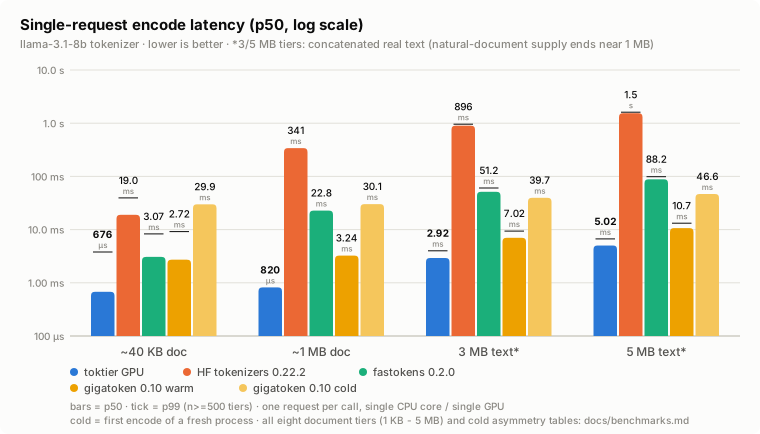
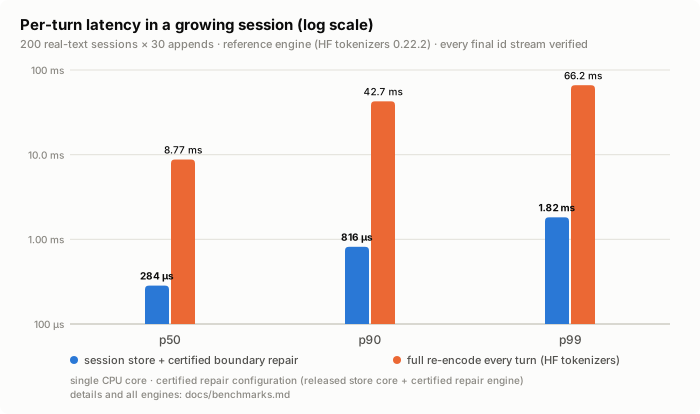
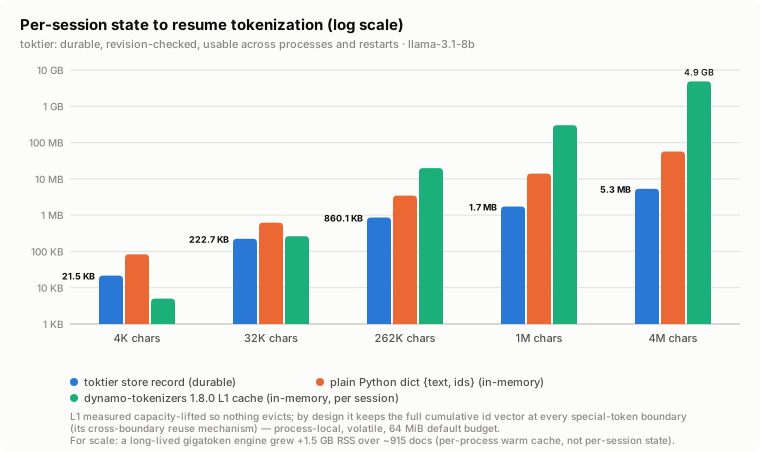
The figures name Hugging Face (HF) tokenizers explicitly and link to the
corresponding machine-readable docs/figures/*.data.json files. The benchmark
document also shows the regimes where direct use of another engine is faster.
Support matrix
| Track | Families | Coverage |
|---|---|---|
| Certified CPU fast repair | 12 model families / 11 unique tokenizer artifacts | corrected Gigatoken, 12.33T characters, zero observed ID divergence |
| Byte-level BPE | 15 | CPU evidence; GPU status recorded per artifact |
| WordPiece | 3 | CPU evidence |
| Structural exclusions | 2 | reason recorded |
docs/support-matrix.md lists every anchor artifact,
SHA-256, backend status, and 214 verified model repositories whose
tokenizer is byte-identical to a certified one, identical at the upstream
source file it is converted from, or equivalent after canonicalization, in
serialization form, or on the loader face. Coverage follows tokenizer
content, not repository naming. toktier.from_pretrained(repo_id) enforces
that rule at runtime: it hashes the resolved file, maps registered content to
the canonical artifact, and otherwise remains on HF.
The shipped registry holds 215 rows: those 214 siblings plus
moonshotai/Kimi-K3 itself, so resolving the canonical repository by name
reports itself as the evidence repository rather than a byte-identical
sibling. 208 of the rows map to canonical artifacts present in this wheel.
The other 7 are WordPiece rows, whose canonical artifacts are not packaged and
which therefore run through HF. The 13 source-level kimi_k3 rows are among
the 208: their canonical artifact is derived on your machine from pinned
upstream bytes, so the comparison stays at tiktoken.model level while the
loaded object is the certified conversion. toktier inspect is the
authoritative packaged-family list.
Relation to existing work
Incremental BPE work studies how the merge stage can be extended as bytes arrive. TokTier operates one layer above it: session state contains token IDs and spans for the complete tokenizer pipeline — normalization, pre-tokenization, merges, and added-token handling — and an append is accepted only after its boundary check passes.
Serving projects such as llm-tokenizer and NVIDIA Dynamo's
dynamo-tokenizers also cache encodings. The main interface differences are:
| Property | toktier | In-process prefix caches |
|---|---|---|
| Lifetime | persistent and cross-process | tokenizer-process lifetime |
| Hit check | digest proposes; stored bytes verify | digest-keyed lookup |
| Reuse boundary | certified tokenizer boundary | typically special-token boundary |
| Surface | Python library for session-owning applications | serving-gateway component |
See docs/integration/dynamo.md for using the two
layers together.
Documentation
docs/releases/v0.3.0.md— release notes for this version.ARCHITECTURE.md— layers, routing, and store format.docs/serving.md— which encode call for which request shape, patch-only appends, and chunk-parallel encode for long requests.docs/integration/sglang.md— using toktier as an SGLang tokenizer backend.ROADMAP.md— release scope and planned integration.docs/support-matrix.md— artifacts and covered repositories.docs/gpu-jit.md— prebuilt and JIT GPU deliveries.docs/rust-api.md— Python-free Rust serving API.docs/rust-lifecycle.md— native artifacts, direct JIT, concurrency, and offline distribution.docs/integration/dynamo.md— Dynamo integration.docs/paper/toktier-preprint.pdf— current preprint.
Acknowledgements
TokTier's CPU Fast Pass and Fast Repair build on the excellent Gigatoken and Fastokens projects. We thank their authors and contributors for making this work openly available.
Corrected Gigatoken is the default certified repair-window engine for 11
unique tokenizer artifacts, covering 12 model families because NVIDIA
Nemotron-Terminal ships a tokenizer that is byte-for-byte identical to the
qwen3_8b tokenizer. TokTier's
compatibility patch aligns Gigatoken's Unicode data and UTF-8 handling with the
frozen Hugging Face tokenizers
reference; the resulting path recorded 41.8 billion checks over 12.33 trillion
characters with zero observed token-ID divergence.
The toktier project publishes toktier-fastokens, a pinned build of Fastokens
0.3.1 with six patches, for use with its explicitly selected experimental
adapter. The upstream project is a separate implementation and does not
endorse this build. Fastokens is Apache-2.0 and Gigatoken is MIT; exact
revisions, license copies, patch series, and modification notices are in
THIRD_PARTY_NOTICES and packaging/.
License and citation
toktier is licensed under the Apache License 2.0; see
NOTICE for attribution information.
Paper: TokTier: Exact Stateful CPU+GPU Tokenization for Agentic LLM Serving · PDF
If you use toktier in your research, please cite:
@misc{zhang2026toktier,
  title         = {TokTier: Exact Stateful CPU+GPU Tokenization for Agentic LLM Serving},
  author        = {Zhenyu Zhang and Zhichao Cao},
  year          = {2026},
  eprint        = {2607.29678},
  archivePrefix = {arXiv},
  primaryClass  = {cs.CL},
  doi           = {10.48550/arXiv.2607.29678},
  url           = {https://arxiv.org/abs/2607.29678}
}
For the chunk-parallel CPU path and the serving adapter, cite:
@misc{zhang2026deltatokenizer,
  title         = {Delta Tokenizer: Reference-Identical Tokenization of Session Deltas and Segment-Parallelism for Long Prompts on Multicore CPUs},
  author        = {Zhenyu Zhang and Zhichao Cao},
  year          = {2026},
  eprint        = {2610.19801},
  archivePrefix = {arXiv},
  primaryClass  = {cs.CL},
  doi           = {10.48550/arXiv.2610.19801},
  url           = {https://arxiv.org/abs/2610.19801}
}
Machine-readable citation metadata is available in
CITATION.cff.
1 maintainer

Metadata
1 maintainer
Release files for toktier 0.3.0
For a detailed explanation of source distributions (sdists) and built distributions (wheels), please see the package formats documentation.
Built distribution (wheel)
| File | Interpreter | ABI | Platform | Actions Reset |
|---|---|---|---|---|
| toktier-0.3.0-cp310-abi3-manylinux_2_34_x86_64.whl | CPython 3.10 | abi3 | Linux glibc 2.34+ x86-64 | Details for toktier-0.3.0-cp310-abi3-manylinux_2_34_x86_64.whl |
Release files / toktier-0.3.0-cp310-abi3-manylinux_2_34_x86_64.whl
| Download URL | toktier-0.3.0-cp310-abi3-manylinux_2_34_x86_64.whl |
|---|---|
| Size | 6.0 MB |
| Tags | CPython 3.10 Linux glibc 2.34+ x86-64 abi3 |
|
SHA-256 checksum How to use checksums |
82065ecf9188abeea1360b8b7b8f2977d130ddbd3e4cd29606c2293d6c654925
|
|
BLAKE2b-256 checksum How to use checksums |
f051f3ac65eace208840573f6d142025d9caf6e2d96645e5a6f01fc5520a9a6a
|
| Upload date | |
|
Uploaded using Trusted Publishing? What is trusted publishing? |
Yes |
| Uploaded via |
twine/7.0.0 CPython/3.13.14
|
Provenance
Provenance describes where a file came from. On PyPI, provenance is shared via attestations, which provide a verifiable record of the build or publishing details. View details, limitations and caveats.


PyPI Publish Attestation
PyPI verified that this artifact, at this checksum, originated from the publisher listed below.
Signed by GitHub Actions, verified by PyPI on Oct 15, 2026.
Transparency logSecurity for toktier 0.3.0
Provenance
Provenance describes where a file came from. On PyPI, provenance is shared via attestations, which provide a verifiable record of the build or publishing details. View details, limitations and caveats.
Full provenance
All 1 file in this release has been uploaded with provenance metadata.
Attestation for toktier-0.3.0-cp310-abi3-manylinux_2_34_x86_64.whl
PyPI Publish Attestation
PyPI verified that this artifact, at this checksum, originated from the publisher listed below.
Signed by GitHub Actions, verified by PyPI on Oct 15, 2026.
Transparency logA note on package security
PyPI is a repository for distributing packages, not a service for auditing them. While third-party security researchers and our staff do their best to detect and remove malicious packages, PyPI cannot guarantee the quality, security or suitability of any given package.
To learn more about protecting yourself from malicious actors, visit our package security documentation.














