
toktier
English | 简体中文
Tokenize the conversation once — after that, only what's new.
toktier is a stateful tokenization system for agentic LLM serving. It keeps
per-session token state, repairs appended text with a certified CPU path, and
offers a certified GPU path for fresh or large requests. Both fast paths return token IDs
bit-identical to a full Hugging Face (HF) tokenizers encode from scratch.
- Exact, at scale. The release campaign records 53.2 billion checks across 14 tokenizer artifacts and 3.8 billion real documents (12.33 trillion characters), with zero observed divergence.
- Fast on both paths. On the recorded benchmark battery, the GPU path encodes a fresh 4-million-character request (~786K tokens) in 3.88 ms. CPU repair answers a 256-character append to a 4.19M-character session in 1.68 ms.
- Certified before acceleration. Fast paths are admitted only for the exact
tokenizer artifact, oracle version, kernel delivery, and architecture covered
by recorded evidence.
explain()reports the route and its reasons.
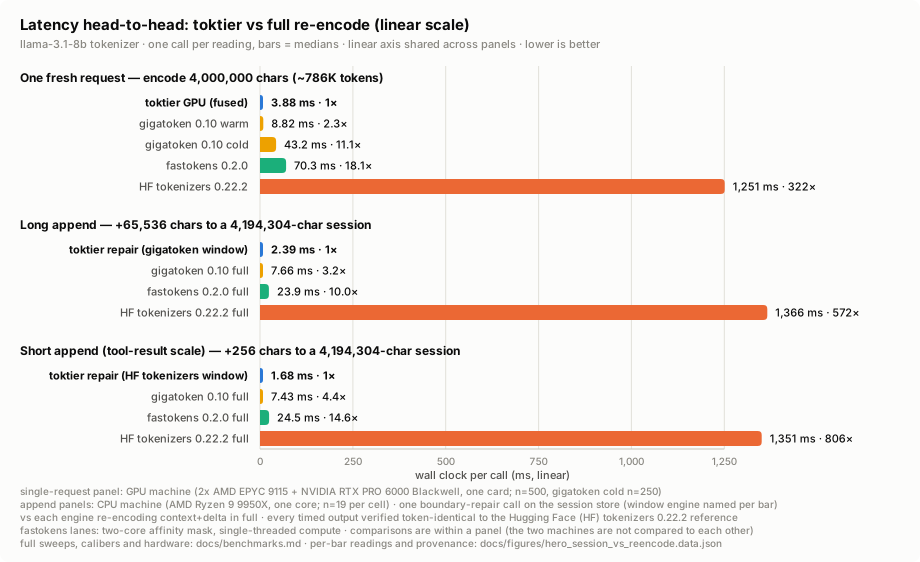
Every bar is a measured median. Exact values, workload sizes, and sample counts
are in
hero_session_vs_reencode.data.json;
the complete sweeps are in docs/benchmarks.md.
Quick start
Install with pip install toktier; GPU options are described in
Install.
import toktier

tok = toktier.load("qwen3_8b")          # family id from the support matrix
enc = tok.encode("hello world")         # token IDs
print(enc.ids)
print(tok.decode(enc.ids))
print(tok.explain())                    # backend chosen, and why
Name a growing transcript with session= to persist its token state across
calls and processes:
tok = toktier.load("qwen3_8b", store="./toktier-store")

transcript = "user: hello\nassistant: hello! how can I help?\n"
enc = tok.encode(transcript, session="chat-42")

transcript += "user: what changed since my last call?\n"
enc = tok.encode(transcript, session="chat-42")

# Store-backed and from-scratch paths return the same IDs.
assert enc.ids == tok.encode(transcript, lookup="off").ids
Without session=, the store can find a byte-verified stored prefix by content.
Use lookup="off" to skip that lookup. A failed byte check is a miss, never a
trusted hit; cache eviction changes latency, not output.
Routing policy is selectable and inspectable:
from toktier import RoutingPolicy

tok = toktier.load("qwen3_8b", policy=RoutingPolicy.CERTIFIED)
| Policy | What runs | If a fast-path premise fails |
|---|---|---|
CERTIFIED (default) |
Only routes covered for the exact artifact, HF version, engine/kernel bytes, delivery, and hardware | Falls back to HF and records the reason |
REFERENCE |
HF tokenizers only |
No accelerated route is attempted |
REQUIRE_ACCELERATED |
The same certified routes | Construction raises if no fast path is eligible; per-input safety fallbacks remain enabled |
EXPERIMENTAL |
May admit an unjudged combination for evaluation | Labels every waived premise; never the default |
The install profile and input shape then determine the automatic route:
Situation under the default CERTIFIED policy |
Automatic route |
|---|---|
toktier, one of 11 certified tokenizer artifacts (12 model families) |
Corrected Gigatoken for full CPU encoding; HF if any binding check fails |
toktier[gpu], cold/plain input below 64 KiB |
Corrected Gigatoken CPU path (HF for a family without CPU-fast certification) |
toktier[gpu], cold/plain input at least 64 KiB |
Shipped prebuilt GPU path; then corrected Gigatoken and HF in the frozen fallback chain |
| Existing session receives a strict append | Corrected Gigatoken CPU repair for the 12 covered model families, independent of total transcript size |
| Added-token or repair guard cannot prove its premise | HF reference path for that input |
explain() reports the fixed chain, the 64 KiB decision, the backend that
actually returned the last result, and every fallback counter.
Install
pip install toktier                 # complete certified CPU product
pip install "toktier[gpu]"          # CPU product + automatic prebuilt GPU route
pip install "toktier[gpu-jit]"      # same routing, with local JIT delivery
| Install | Delivery | Requirements |
|---|---|---|
toktier |
Corrected Gigatoken full CPU encode and session repair, HF fallback, persistent store, routing, and CLI | Linux x86_64 with glibc 2.34+, CPython 3.10+; installs tokenizers==0.22.2 and transformers==4.57.6 |
toktier[gpu] |
Strict superset of toktier; automatic 64 KiB crossover to the shipped multi-architecture CUDA fatbin |
NVIDIA GPU, driver 580.65.06+, torch; no compiler or first-use build |
toktier[gpu-jit] |
Same CPU/GPU routing as toktier[gpu]; compiles the certified kernel source locally |
judged CUDA/PyTorch toolchain, nvcc, torch, ninja; first-use compilation |
JIT is fail-closed at the toolchain boundary. If the installed CUDA/PyTorch pair is outside the pairs recorded in the registry, automatic routing emits a prominent warning and keeps using the corrected Gigatoken → HF fallback chain; an explicit CUDA request fails with the observed pair, certified constraint, and a copyable remedy. A judged combination can be compiled ahead of first use with:
toktier gpu compile qwen3_8b
For evaluation only, an unjudged pair can be compiled with an explicit risk acceptance:
toktier gpu compile qwen3_8b --accept-uncertified-jit
This does not certify the resulting kernel. The command runs under
EXPERIMENTAL, prints an UNCERTIFIED JIT OPT-IN warning, and records every
waived premise. Application code must also opt in explicitly with
policy="experimental", gpu_delivery="jit"; the acceptance is deliberately
not persisted or inherited by later certified processes. Inspect
explain()["experimental_waivers"] before using those results.
The corrected, data-version-pinned Gigatoken native module is already inside
the core wheel under the private name toktier._vendor.gigatoken_rs. TokTier
does not install or trust a top-level package named gigatoken. The base wheel
also pins the HF loader and oracle versions needed to open this certified route;
there is no separate CPU-fast installation step.
For provenance, a source checkout can reproduce the exact native bytes:
pip install .
TOKTIER_GIGATOKEN_BUILD_ROOT="$PWD/.build/gigatoken" \
  packaging/fast_cpu/build_pinned.sh
The reproducible build recipe pins the upstream commit, patch, Unicode inputs, compiler, and build backend. Its output is a reproduction artifact, not another runtime install. The registry verifies the vendored module digest, repair configuration, oracle, and tokenizer artifact before opening the route. The core wheel carries Gigatoken's MIT license, TokTier's modification notice, the dependency SBOM, and the dependency-license bundle.
Version 0.1.0 is published as an ABI3 Linux x86-64 wheel, not an sdist: the certified CPU binary requires glibc 2.34 or newer, and silently rebuilding it during an sdist install would create different, uncertified bytes. The tagged repository contains the complete source and pinned reproduction recipe.
The prebuilt fatbin contains sm_75/80/86/89/90/100/120 images and a
compute_75 PTX fallback. Its binary-digest-bound certificate covers sm_89
and sm_120; the other embedded architectures are marked experimental. With
the default facade, toktier[gpu] chooses this prebuilt delivery lazily and
toktier[gpu-jit] chooses JIT lazily; an explicit gpu_delivery= argument can
override profile detection. The
JIT delivery is certified_source on sm_89 and sm_120, meaning its
certificate binds source, class tables, flags, and toolchain constraints rather
than a machine-local binary. See docs/gpu-jit.md for the
automatic facade, explicit engine API, and delivery diagnostics.
Tokenizer artifacts are fetched from pinned upstream revisions and verified by SHA-256; they are not bundled in the wheel. The CLI supports connected, mirrored, and air-gapped environments:
toktier artifacts fetch qwen3_8b
toktier artifacts export qwen3_8b --out qwen3_8b.tar
toktier artifacts import qwen3_8b.tar
toktier artifacts verify qwen3_8b
toktier inspect qwen3_8b
toktier doctor --json
The core package has no torch dependency and can be imported without CUDA,
network access, or hardware probing. Artifact caches, compiled-kernel caches,
and persistent session state use separate directories.
Fastokens 0.3.1 is available only as an explicit experimental comparison:
tok = toktier.load(
    "qwen3_8b", policy="experimental", repair_backend="fastokens"
)
This adapter re-encodes the full session and reports
exact_id_guarantee: false; it is never selected by the certified policy and
is not covered by the 12.4 TB corrected-Gigatoken claim.
Correctness and evidence
The certified reference is Hugging Face tokenizers 0.22.2 with default
settings. Certification is bound to exact artifact bytes and that oracle
version. If the installed HF version is outside the certified set, accelerated
routing is disabled and the request remains on the installed reference path.
| Campaign | Scale | Recorded divergence |
|---|---|---|
| Full-corpus differential | 14 artifacts × 3,800,016,491 documents = 53,200,230,874 checks | 0 |
| Corpus volume | 12,328,592,579,973 Unicode code points | — |
| Released-code parity | 15,960,166 documents | 0 |
| Corrected Gigatoken CPU repair | 11 unique artifacts × 3,800,016,491 documents = 41,800,181,401 checks (12 model families by exact-artifact inheritance) | 0 |
The machine-readable records are
evidence/evidence_manifest.json,
evidence/evidence_manifest_added_families.json,
and tables/support_registry.json. Shipped
per-artifact readings account for 49,920,199,013 checks; an archived earlier
phase accounts for the remaining 3,280,031,861. Together they produce the
headline total above. A focused end-to-end rerun through the released public
session API covers all 11 CPU-fast artifacts in
readings/fast_cpu_focused_parity.json.
Three status values keep evidence and runtime behavior distinct:
| Status | Meaning |
|---|---|
certified |
Evidence binds the exact artifact and accelerated binary. |
certified_source |
Evidence binds source, build inputs, and constraints for a local build. |
reference-only |
No accelerated route is admitted; HF tokenizers runs. |
These are empirical differential results, not a proof over all possible input. Per-request checks and the reference fallback remain part of the contract.
Repository self-checks:
python tools/generate_evidence.py --check
python tools/validate_registry.py
python tools/generate_registry.py --release-check
python tools/dev.py test-packaging
Performance
The top figure compares the automatic GPU and repair routes with full re-encoding on identical text. The released batched GPU path also has a same-host throughput measurement:
| Path | Throughput | Setup |
|---|---|---|
| GPU, end to end (text in, IDs out) | 0.6028 GB/s | one RTX PRO 6000 Blackwell |
| HF reference CPU path | 0.0047 GB/s | same host and input, one CPU core |
This pair uses 2.2 GB of RAM-resident real web text and reports UTF-8 bytes over
wall clock with host ID arrays materialized. Full protocols, all cells, and
provenance are in docs/benchmarks.md.
The primary study used an RTX PRO 6000 Blackwell, but a same-protocol consumer
RTX 5090 sweep was 11–17% faster (4.24–5.50 GB/s across the reported
families). Consumer hardware is therefore a practical target, not a reduced
mode: the RTX 4090 also passed the sm_89 correctness and prebuilt-delivery
battery. These observations do not promise the same speedup for every GPU;
architecture, workload, and host delivery still matter.
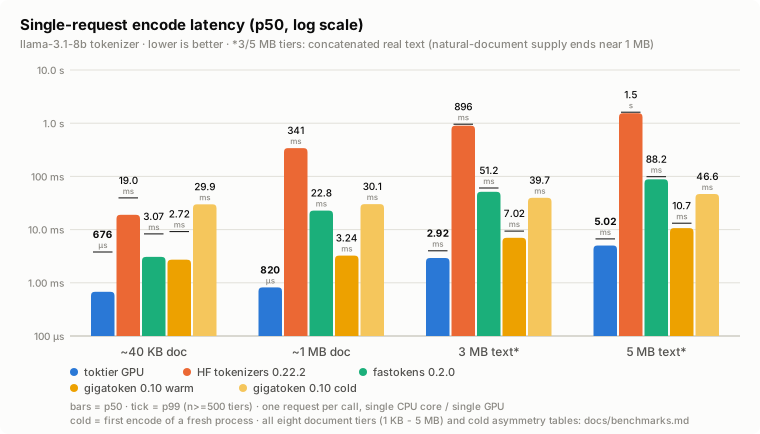
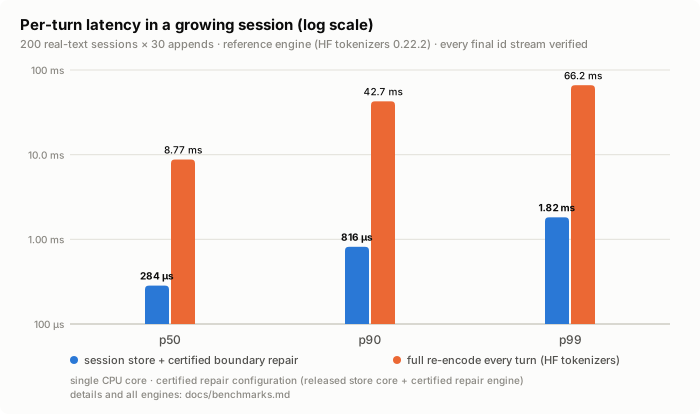
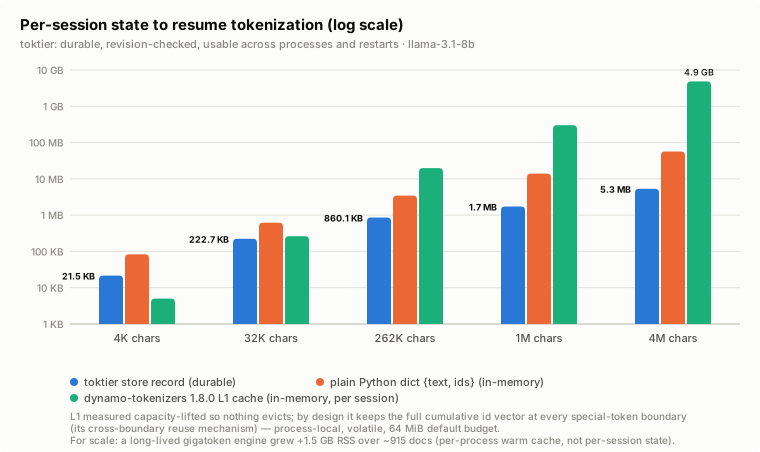
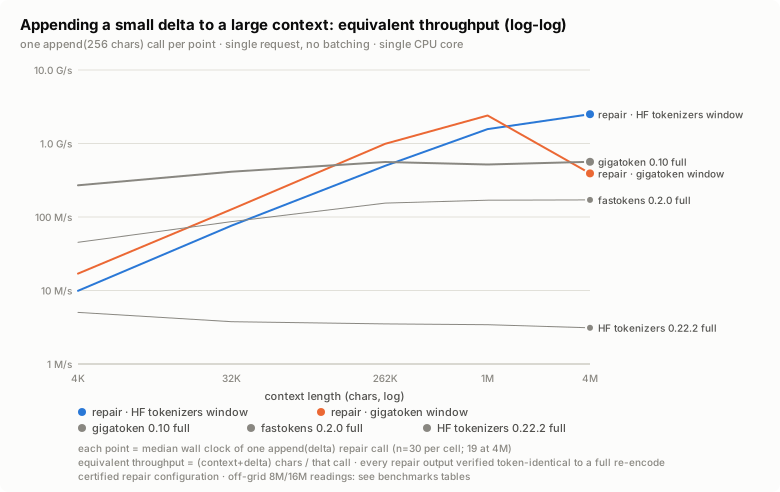
The figures name Hugging Face (HF) tokenizers explicitly and link to their
machine-readable docs/figures/*.data.json files. The benchmark document also
shows the regimes where direct use of another engine is faster.
Support matrix
| Track | Families | Coverage |
|---|---|---|
| Certified CPU fast repair | 12 model families / 11 unique tokenizer artifacts | corrected Gigatoken, 12.33T characters, zero observed ID divergence |
| Byte-level BPE | 15 | CPU evidence; GPU status recorded per artifact |
| WordPiece | 3 | CPU evidence |
| Structural exclusions | 2 | reason recorded |
docs/support-matrix.md lists every anchor artifact,
SHA-256, backend status, and 210 verified model repositories that share an
identical or serialization-equivalent tokenizer. Coverage follows tokenizer
content, not repository naming.
The wheel currently resolves the 14 artifacts in its generated manifest.
kimi_k3 and the three WordPiece families have evidence but are not yet wired
into that manifest; toktier inspect is the authoritative packaged list.
Relation to existing work
Incremental BPE work studies how the merge stage can be extended as bytes arrive. toktier operates one layer above it: session state contains token IDs and spans for the complete tokenizer pipeline—normalization, pre-tokenization, merges, and added-token handling—and an append is accepted only after its boundary check passes.
Serving projects such as llm-tokenizer and NVIDIA Dynamo's
dynamo-tokenizers also cache encodings. The main interface differences are:
| Property | toktier | In-process prefix caches |
|---|---|---|
| Lifetime | persistent and cross-process | tokenizer-process lifetime |
| Hit check | digest proposes; stored bytes verify | digest-keyed lookup |
| Reuse boundary | certified tokenizer boundary | typically special-token boundary |
| Surface | Python library for session-owning applications | serving-gateway component |
See docs/integration/dynamo.md for using the two
layers together.
Documentation
ARCHITECTURE.md— layers, routing, and store format.ROADMAP.md— release scope and planned integration.docs/support-matrix.md— artifacts and covered repositories.docs/gpu-jit.md— prebuilt and JIT GPU deliveries.docs/integration/dynamo.md— Dynamo integration.docs/paper/toktier-preprint.pdf— current preprint.
Acknowledgements
TokTier's CPU Fast Pass and Fast Repair build on the excellent Gigatoken and Fastokens projects. We thank their authors and contributors for making this work openly available.
Corrected Gigatoken is the default certified repair-window engine for 11
unique tokenizer artifacts, covering 12 model families because NVIDIA
Nemotron-Terminal ships the qwen3_8b tokenizer byte-for-byte. TokTier's
compatibility patch aligns Gigatoken's Unicode data and UTF-8 handling with the
frozen Hugging Face tokenizers
reference; the resulting path recorded 41.8 billion checks over 12.33 trillion
characters with zero observed token-ID divergence.
Fastokens 0.3.1 remains an explicit experimental alternative. TokTier does not
claim exact-ID equivalence for that adapter and never chooses it automatically.
Fastokens is Apache-2.0 and Gigatoken is MIT; exact revisions, license copies,
the Gigatoken patch, and modification notices are in
THIRD_PARTY_NOTICES and packaging/.
License and citation
toktier is licensed under the Apache License 2.0; see
NOTICE for attribution information.
Paper: TokTier: Exact Stateful CPU+GPU Tokenization for Agentic LLM Serving · PDF
If you use toktier in your research, please cite:
@misc{zhang2026toktier,
  title         = {TokTier: Exact Stateful CPU+GPU Tokenization for Agentic LLM Serving},
  author        = {Zhenyu Zhang and Zhichao Cao},
  year          = {2026},
  eprint        = {2607.29678},
  archivePrefix = {arXiv},
  primaryClass  = {cs.CL},
  doi           = {10.48550/arXiv.2607.29678},
  url           = {https://arxiv.org/abs/2607.29678}
}
Machine-readable citation metadata is available in
CITATION.cff.
1 maintainer

Download files
Download the file for your platform. If you're not sure which to choose, learn more about installing packages.
Source Distributions
Built Distribution
Filter files by name, interpreter, ABI, and platform.
If you're not sure about the file name format, learn more about wheel file names.
Copy a direct link to the current filters
File details
Details for the file toktier-0.1.0-cp310-abi3-manylinux_2_34_x86_64.whl.
File metadata
- Download URL: toktier-0.1.0-cp310-abi3-manylinux_2_34_x86_64.whl
- Upload date:
- Size: 8.2 MB
- Tags: CPython 3.10+, manylinux: glibc 2.34+ x86-64
- Uploaded using Trusted Publishing? Yes
- Uploaded via:
twine/7.0.0 CPython/3.13.14
File hashes
| Algorithm | Hash digest | |
|---|---|---|
| SHA256 |
fac465e417e1e31e4435d2afff0f3a2f4ecdde2ec2c3e7971c3459c2c85012fd
|
|
| MD5 |
2225059292aba8c73344acca77262fdd
|
|
| BLAKE2b-256 |
615117b368444de88bba9175fb1d87002d067ec400f61f773c627a57a6eee9ee
|
Provenance
The following attestation bundles were made for toktier-0.1.0-cp310-abi3-manylinux_2_34_x86_64.whl:
Publisher:
publish.yml on asu-idi/toktier
-
Statement:
-
Statement type:
https://in-toto.io/Statement/v1 -
Predicate type:
https://docs.pypi.org/attestations/publish/v1 -
Subject name:
toktier-0.1.0-cp310-abi3-manylinux_2_34_x86_64.whl -
Subject digest:
fac465e417e1e31e4435d2afff0f3a2f4ecdde2ec2c3e7971c3459c2c85012fd - Sigstore transparency entry: 2370998306
- Sigstore integration time:
-
Permalink:
asu-idi/toktier@38197fc05ec13118ef4752ee82521359198b6a39 -
Branch / Tag:
refs/tags/v0.1.0 - Owner: https://github.com/asu-idi
-
Access:
public
-
Token Issuer:
https://token.actions.githubusercontent.com -
Runner Environment:
github-hosted -
Publication workflow:
publish.yml@38197fc05ec13118ef4752ee82521359198b6a39 -
Trigger Event:
release
-
Statement type:














