
tooldata-lint
English | 한국어
Lint tool-calling fine-tuning data (JSONL) before you train. tooldata-lint checks that every tool call matches the tool's JSON Schema, that calls and responses pair up, and that arguments are encoded consistently, and it reports each problem with a line number and a rule code. Messages are available in English and Korean.
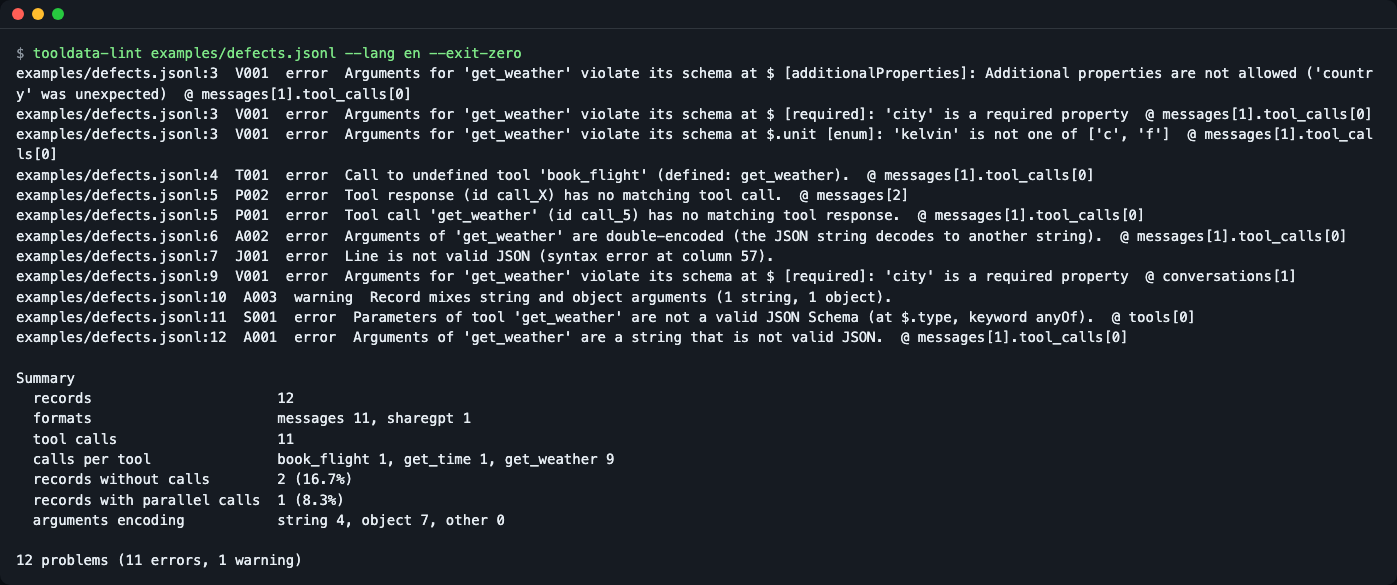
tooldata-lint on examples/defects.jsonl: three schema violations of one call on line 3, an undefined tool on line 4, a broken pair on line 5, and so on.
Who it is for
- You fine-tune a model for tool calling (TRL, Axolotl, Unsloth, LLaMA-Factory, or OpenAI fine-tuning) and want to catch data defects before the run, not after.
- You generate synthetic tool-call conversations and want a last CI step that fails on bad records.
- You convert data between the OpenAI format (
argumentsis a JSON string) and the Hugging Face format (argumentsis an object) and want to see which records mix the two.
Why
A fine-tuned model only learns what the data shows. If a record calls a tool with "unit": "kelvin" when the schema allows c or f, or the call has no matching tool response, the training run does not fail. The model quietly learns the defect, and you notice it later as "the model invents wrong arguments". This tool moves that discovery to before training.
A tool-call record has three parts that must agree: the tool definitions (name and JSON Schema of the parameters), the calls the assistant makes, and the tool responses that answer them.
flowchart LR
    D[Tool definitions<br/>name + JSON Schema] --> C[Assistant call<br/>name + arguments]
    C --> R[Tool response<br/>matched by id or order]
    C -. checked against .-> D
- A call must name a tool that is defined (
T001) and its arguments must satisfy that tool's schema (V001). - Each call needs exactly one response and each response needs a call (
P001,P002).
Install
Requires Python 3.10 or newer. uv is the easiest way to run it (curl -LsSf https://astral.sh/uv/install.sh | sh). On a minimal Linux image you also need git and curl.
git clone https://github.com/LeeGyeongPil/tooldata-lint
cd tooldata-lint
uv run tooldata-lint --version
tooldata-lint 0.1.1
The package is also prepared for uv tool install git+https://github.com/LeeGyeongPil/tooldata-lint and, once published on PyPI, uvx tooldata-lint.
Quick start
The repository ships two sample files: examples/clean.jsonl (no defects) and examples/defects.jsonl (one defect per kind).
uv run tooldata-lint examples/defects.jsonl --exit-zero
examples/defects.jsonl:3  V001  error  Arguments for 'get_weather' violate its schema at $ [additionalProperties]: Additional properties are not allowed ('country' was unexpected)  @ messages[1].tool_calls[0]
examples/defects.jsonl:3  V001  error  Arguments for 'get_weather' violate its schema at $ [required]: 'city' is a required property  @ messages[1].tool_calls[0]
examples/defects.jsonl:3  V001  error  Arguments for 'get_weather' violate its schema at $.unit [enum]: 'kelvin' is not one of ['c', 'f']  @ messages[1].tool_calls[0]
examples/defects.jsonl:4  T001  error  Call to undefined tool 'book_flight' (defined: get_weather).  @ messages[1].tool_calls[0]
examples/defects.jsonl:5  P002  error  Tool response (id call_X) has no matching tool call.  @ messages[2]
examples/defects.jsonl:5  P001  error  Tool call 'get_weather' (id call_5) has no matching tool response.  @ messages[1].tool_calls[0]
examples/defects.jsonl:6  A002  error  Arguments of 'get_weather' are double-encoded (the JSON string decodes to another string).  @ messages[1].tool_calls[0]
examples/defects.jsonl:7  J001  error  Line is not valid JSON (syntax error at column 57).
examples/defects.jsonl:9  V001  error  Arguments for 'get_weather' violate its schema at $ [required]: 'city' is a required property  @ conversations[1]
examples/defects.jsonl:10  A003  warning  Record mixes string and object arguments (1 string, 1 object).
examples/defects.jsonl:11  S001  error  Parameters of tool 'get_weather' are not a valid JSON Schema (at $.type, keyword anyOf).  @ tools[0]
examples/defects.jsonl:12  A001  error  Arguments of 'get_weather' are a string that is not valid JSON.  @ messages[1].tool_calls[0]

Summary
  records                      12
  formats                      messages 11, sharegpt 1
  tool calls                   11
  calls per tool               book_flight 1, get_time 1, get_weather 9
  records without calls        2 (16.7%)
  records with parallel calls  1 (8.3%)
  arguments encoding           string 4, object 7, other 0

12 problems (11 errors, 1 warning)
How to read a line: file:line CODE severity message @ location.
lineis the 1-based line number in the file, so you can jump straight to it.- Line 3 shows why all schema errors are reported, not only the first: one call violates
enum,requiredandadditionalPropertiesat once, and fixing only the first would leave the other two. The message gives the JSON path ($.unit) and the failing keyword ([enum]). - Line 7 is not valid JSON. It is reported as
J001and the check continues with line 8. --exit-zeromakes the exit code 0 so the demo does not look like a failed command. Without it the command above exits with 1.
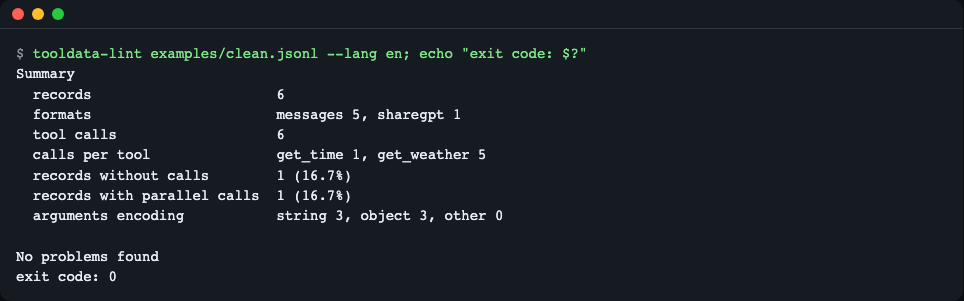
A clean file ends with No problems found and exits with 0:
uv run tooldata-lint examples/clean.jsonl
Summary
  records                      6
  formats                      messages 5, sharegpt 1
  tool calls                   6
  calls per tool               get_time 1, get_weather 5
  records without calls        1 (16.7%)
  records with parallel calls  1 (16.7%)
  arguments encoding           string 3, object 3, other 0

No problems found
The summary is a quick look at your data distribution. "records without calls" at 0% means the model never sees an example where it should answer without calling a tool.
Usage
tooldata-lint [--format FORMAT] [-o OUT] [--fail-on LEVEL] [--ignore CODES]
              [--exit-zero] [--lang LANG] [--version] [-h]
              FILE [FILE ...]
| Option | What it does | Example |
|---|---|---|
FILE ... |
JSONL files to check. - reads standard input. |
tooldata-lint train.jsonl val.jsonl |
--format text|json |
Human-readable text (default) or a JSON report. | --format json |
-o, --output OUT |
Write the report to a file instead of standard output. | -o report.json |
--fail-on error|warning |
Lowest severity that makes the exit code 1 (default error). |
--fail-on warning |
--ignore CODES |
Comma-separated rule codes to drop from the output and the exit code. | --ignore J001,P004 |
--exit-zero |
Always exit with 0, even if problems are found. | --exit-zero |
--lang en|ko |
Output language, see Configuration. | --lang ko |
--version |
Print the version. |
Exit codes: 0 no problems at the chosen level, 1 problems found, 2 tool error (wrong usage, an unreadable input file, an output file that cannot be written, or an internal error). The tool never ends with a traceback. See docs/rules.md.
Pipe data in.
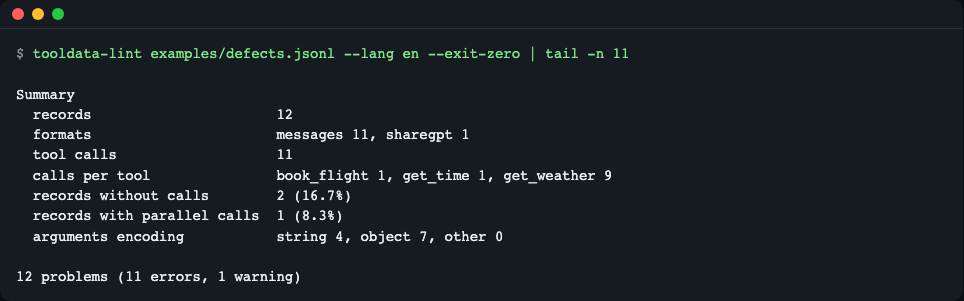
cat examples/defects.jsonl | uv run tooldata-lint - --exit-zero | tail -n 3
  arguments encoding           string 4, object 7, other 0

12 problems (11 errors, 1 warning)
Ignore a rule and make warnings fail. Dropping V001 and J001 leaves the other findings, and --fail-on warning makes even the lone warning count:
uv run tooldata-lint examples/defects.jsonl --ignore V001,J001 --fail-on warning | tail -n 1
7 problems (6 errors, 1 warning)
Machine-readable output. --format json prints tool, version, files, counts, issues and summary. Keys, rule codes and severity values do not depend on the language; only message is localized.
uv run tooldata-lint examples/defects.jsonl --format json -o report.json
Report written to report.json.
This command exits with 1 because the file has errors.
Tool errors exit with 2, which CI can tell apart from "problems found" (1).
uv run tooldata-lint nope.jsonl
uv run tooldata-lint examples/clean.jsonl -o /nonexistent/d/r.json
tooldata-lint: error: Cannot open 'nope.jsonl': the file does not exist.
tooldata-lint: error: Cannot write '/nonexistent/d/r.json': the path or its directory does not exist
Rules
| Code | Severity | Meaning |
|---|---|---|
| J001 | error | The line is not valid JSON. Linting continues. |
| U001 | warning | Record has an unknown format and is skipped, or the file has no records at all (empty or only blank lines). |
| S001 | error | A tool's parameters is not a valid JSON Schema. |
| T001 | error | The call names a tool that is not defined in the record. |
| T002 | error | The record has calls but no tool definitions at all. |
| V001 | error | Arguments violate the tool's JSON Schema (one finding per violation). |
| A001 | error | arguments is a string that is not valid JSON. |
| A002 | error | arguments is double-encoded (decodes to another string). |
| A003 | warning | One record mixes string and object arguments. |
| P001 | error | A call has no tool response although the conversation continues after it. A call in the last message of a record is the training label (OpenAI fine-tuning layout) and is not reported. |
| P002 | error | A tool response has no matching call. |
| P003 | error | The same call id appears twice in a record. |
| P004 | warning | Some calls have ids and some do not. |
Each rule with its cause and fix: docs/rules.md.
Supported formats
The format is detected per line. Every format is converted to one internal record, so the same rules run on all of them.
| Format | Detected by | Notes |
|---|---|---|
| OpenAI | messages |
arguments is a JSON string, calls carry ids. |
| Hugging Face / TRL / Axolotl | messages |
arguments is an object, ids may be missing. tools may be a list or a JSON string. |
| ShareGPT (LLaMA-Factory) | conversations |
function_call and observation turns. An array in a function_call turn means parallel calls. |
If a record has any id, responses are paired with calls by id. If it has none (common in Hugging Face data), they are paired in order, and that is not reported as an error.
Use it from Python
Install it as a library in your own project with uv add git+https://github.com/LeeGyeongPil/tooldata-lint (or pip install git+https://github.com/LeeGyeongPil/tooldata-lint; pip install tooldata-lint once it is on PyPI).
import json
from tooldata_lint import lint_file, lint_record

report = lint_file("examples/defects.jsonl")
print(report.exit_code(), len(report.issues), report.summary.records)

kept = []
with open("examples/clean.jsonl", encoding="utf-8") as f:
    for number, line in enumerate(f, start=1):
        record = json.loads(line)
        if not lint_record(record, line=number):
            kept.append(record)
print(len(kept))
1 12 12
6
lint_record returns a list of Issue objects (code, severity, message, line, json_path, keyword, ...). Data defects are returned as issues, not raised as exceptions; lint_file raises InputError only when the file cannot be opened.
Configuration
| Setting | Values | Default |
|---|---|---|
--lang |
en, ko |
see below |
TOOLDATA_LINT_LANG |
en, ko |
unset |
The language is chosen in this order: --lang, then TOOLDATA_LINT_LANG, then LC_ALL, LC_MESSAGES and LANG. A value starting with ko selects Korean; anything else selects English. Help, usage, argument errors, findings and the summary are all localized.
TOOLDATA_LINT_LANG=ko uv run tooldata-lint examples/clean.jsonl
요약
  레코드            6
  형식              messages 5, sharegpt 1
  도구 호출         6
  도구별 호출       get_time 1, get_weather 5
  호출 없는 레코드  1 (16.7%)
  병렬 호출 레코드  1 (16.7%)
  arguments 인코딩  문자열 3, 객체 3, 기타 0

문제가 없습니다
No API key, network access or GPU is needed.
How it works
flowchart LR
    IN[JSONL files or stdin] --> RD[Reader<br/>line numbers, J001]
    RD --> AD[Format adapters<br/>messages / ShareGPT]
    AD --> REC[One internal record<br/>tools, calls, responses]
    REC --> RU[Rules<br/>S T V A P]
    REC --> ST[Distribution summary]
    RU --> RP[Report]
    ST --> RP
    RP --> OUT[text or JSON<br/>exit code]
- The reader streams the file line by line, so large files are fine, and a broken line becomes
J001instead of stopping the run. - An adapter converts each format into the same internal record, so no rule depends on a format.
- Pairing of calls and responses is decided first, then arguments are checked. That keeps one defect from causing several follow-up findings (for example, a double-encoded call does not also produce a "response without call").
- Arguments are validated with jsonschema and every error is collected, with its JSON path and keyword. Validators are cached per schema.
Use in CI
The exit code is the gate: 0 passes, 1 means data problems, 2 means the tool itself could not run. This GitHub Actions job checks every JSONL file under data/, fails on warnings too (that includes an empty file, U001), and keeps a JSON report:
name: data-lint
on: [push, pull_request]
jobs:
  lint:
    runs-on: ubuntu-latest
    steps:
      - uses: actions/checkout@v6.1.0
      - uses: astral-sh/setup-uv@v10.3.3
      - name: Lint tool-call data
        run: uvx --from git+https://github.com/LeeGyeongPil/tooldata-lint tooldata-lint data/*.jsonl --fail-on warning --format json -o report.json
      - uses: actions/upload-artifact@v4
        if: always()
        with:
          name: tooldata-lint-report
          path: report.json
This repository's own workflow runs the same kind of exit-code check on the sample files: .github/workflows/ci.yml. SARIF output is not available yet (see Limitations). Once the package is on PyPI, uvx tooldata-lint ... works without the --from part.
Limitations
- Only JSONL files with
messages(OpenAI, Hugging Face, TRL, Axolotl) orconversations(ShareGPT) records are checked. Other layouts (Glaive, xLAM, Hermes) getU001and are skipped. - When
argumentsis double-encoded (A002), the inner object is not validated against the schema, because there is no object to validate. - The tool checks arguments against the tool's JSON Schema, not against a model's chat template. A Hermes or template check is planned, not available.
- Findings on the same line are listed in the order they are found, not sorted by rule code (for example,
P002can come beforeP001). - A
$refthat cannot be resolved (a missing local definition or a remote URL) is reported asS001. Remote references are never downloaded. - It does not look for general dataset problems such as duplicates, PII, role order or token length.
When to use it
- Good fit: you want the tool-call-specific checks (schema, undefined tools, pairing, encoding) on line-numbered JSONL, locally or as a CI step, with no model or network.
- It does not cover general SFT checks such as role order, duplicates, PII or token length. Use a general dataset linter such as parallelogram alongside it.
- If you only need a format check for an OpenAI upload, the OpenAI fine-tuning data preparation notebook is a starting point. For validating agent traces rather than training data, look at toolcall-linter.
Roadmap
Not part of this release: checking arguments against a target model's chat template, SARIF output, tool-definition fingerprints and --tools-ref comparison, Hermes records (planned next), and --fix plus Glaive and xLAM records (after that). The README will be updated when they ship.
Troubleshooting
| Symptom | Cause | Fix |
|---|---|---|
| Exit code 1 in a script, but the report looks fine | Problems were found, which is the intended signal | Fix the data, or use --exit-zero for reporting only |
U001 for many lines |
The records are neither messages nor conversations (for example Glaive or xLAM style) |
Convert them first; those formats are not supported yet |
S001 on every record of one dataset |
The dataset's tool parameters are not standard JSON Schema (for example "type": "int") |
Convert the parameters to JSON Schema |
T002 |
Calls exist but the record has no tools |
Add tools to each record |
U001 "File has no records" |
The file is empty or has only blank lines, often a pipeline step that wrote nothing | Fix the step; --fail-on warning makes CI fail on it |
No P001 for a call at the end of a record |
A call in the last message is the training label, so it needs no response | Nothing to fix; a call followed by more messages without a response is reported |
P004 warnings on OpenAI data |
Only some calls have ids | Add ids to all calls, or remove them from all |
| Output is not in the language you expect | A higher-priority setting wins | Pass --lang en or --lang ko explicitly |
Development
uv run pytest
all tests passed
Bug reports and suggestions are welcome as issues. Changes are listed in CHANGELOG.md.
License
MIT. The sample data in examples/ and tests/fixtures/ is written for this project and uses made-up tools.
1 maintainer

Metadata
1 maintainer
Release files for tooldata-lint 0.1.1
For a detailed explanation of source distributions (sdists) and built distributions (wheels), please see the package formats documentation.
Source distribution (sdist)
| File | Size | Uploaded | Provenance | Actions |
|---|---|---|---|---|
| tooldata_lint-0.1.1.tar.gz | 574.8 kB | Without provenance | Details for tooldata_lint-0.1.1.tar.gz |
Built distribution (wheel)
| File | Interpreter | ABI | Platform | Actions Reset |
|---|---|---|---|---|
| tooldata_lint-0.1.1-py3-none-any.whl | Python 3 | none | any | Details for tooldata_lint-0.1.1-py3-none-any.whl |
Total release size: 608.1 kB
Release files / tooldata_lint-0.1.1.tar.gz
| Download URL | tooldata_lint-0.1.1.tar.gz |
|---|---|
| Size | 574.8 kB |
| Tags | Source |
|
SHA-256 checksum How to use checksums |
22f87d6ea9adf8a354b55f3d12d4f3bee325f8d2f583f59db6a03a8c6c3262c1
|
|
BLAKE2b-256 checksum How to use checksums |
d1d231a8ba1488f0f8786f64dfd304a626e0cf6d7cab2eab9429e988a985be93
|
| Upload date | |
|
Uploaded using Trusted Publishing? What is trusted publishing? |
No |
| Uploaded via |
uv/0.13.6 {"installer":{"name":"uv","version":"0.13.6","subcommand":["publish"]},"python":null,"implementation":{"name":null,"version":null},"distro":{"name":"macOS","version":null,"id":null,"libc":null},"system":{"name":null,"release":null},"cpu":null,"openssl_version":null,"setuptools_version":null,"rustc_version":null,"ci":null}
|
Release files / tooldata_lint-0.1.1-py3-none-any.whl
| Download URL | tooldata_lint-0.1.1-py3-none-any.whl |
|---|---|
| Size | 33.3 kB |
| Tags | Python 3 |
|
SHA-256 checksum How to use checksums |
cd4c64bb99604f512fc1ad982d28ba72b4cb0eb64376a10e0156eafbe6c6c60e
|
|
BLAKE2b-256 checksum How to use checksums |
3d58ab7bb4ece11996072ab503e2affdb51b7efc72245224402be90e3adfce6b
|
| Upload date | |
|
Uploaded using Trusted Publishing? What is trusted publishing? |
No |
| Uploaded via |
uv/0.13.6 {"installer":{"name":"uv","version":"0.13.6","subcommand":["publish"]},"python":null,"implementation":{"name":null,"version":null},"distro":{"name":"macOS","version":null,"id":null,"libc":null},"system":{"name":null,"release":null},"cpu":null,"openssl_version":null,"setuptools_version":null,"rustc_version":null,"ci":null}
|
Security for tooldata-lint 0.1.1
Provenance
Provenance describes where a file came from. On PyPI, provenance is shared via attestations, which provide a verifiable record of the build or publishing details. View details, limitations and caveats.
No provenance found
None of the files in this release were uploaded with provenance metadata.
A note on package security
PyPI is a repository for distributing packages, not a service for auditing them. While third-party security researchers and our staff do their best to detect and remove malicious packages, PyPI cannot guarantee the quality, security or suitability of any given package.
To learn more about protecting yourself from malicious actors, visit our package security documentation.














