




Website · Documentation · Dashboard · PyPI · Paper (coming soon)
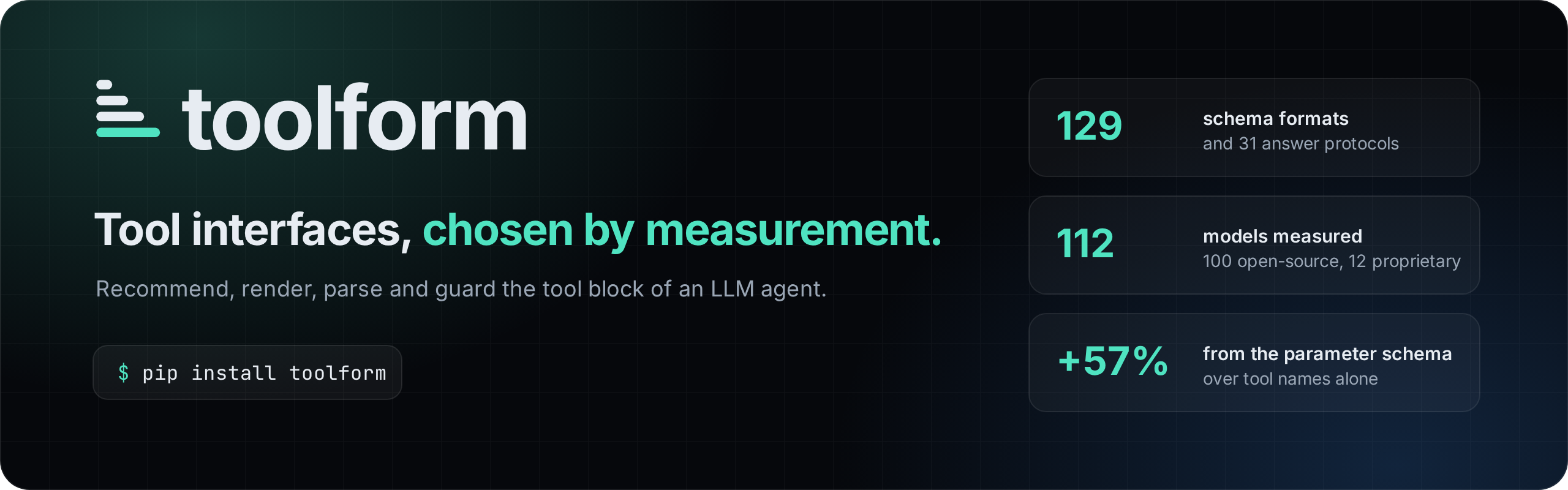
ToolForm decides how an agent shows its tools to a language model and reads back the calls. Give it your tools (OpenAI, Anthropic or MCP JSON, Python functions or TypeScript declarations) and your model: it recommends a schema format and an answer protocol from a controlled study of 129 formats, 31 answer protocols and 112 models, renders the tool block, parses and validates the reply, guards tool descriptions against hidden instructions, and handles long catalogues.
from toolform import Toolset, recommend, render, parse_reply

tools = Toolset.from_openai("tools.json")
rec = recommend(tools=tools, model="Qwen/Qwen3-8B")
print(rec.summary())   # xml_schema + xml_call, 93.14% expected (65.60 to 93.14 across the table values), checkpoint Qwen/Qwen3-8B

prompt = render(tools, rec.format_id, rec.protocol_id, request="Forecast for Denver, 5 days")
# send prompt.messages to any chat endpoint, then:
parsed = parse_reply(model_reply, tools, rec.protocol_id)
for call in parsed.calls:
    print(call.resolved_name, call.arguments, call.valid)
News
- 2026-10-20 · ToolForm 0.0.1 is on PyPI:
pip install toolform. The advisor, 129 formats, 31 answer protocols, the guard, catalogue tools, a command line, an HTTP API and a web dashboard. - 2026-10-20 · The website and the documentation are live.
- Coming soon · The paper, ToolForm: A Controlled Study of Tool Formatting for Agents, on arXiv.
What the study found
The way a model is shown its tools sets three things: the schema format it reads, the answer protocol it writes back in, and the grading rule that scores the call. Prior comparisons changed the first two together; ToolForm's study changed one at a time. Four rules came out:
| Rule | Evidence |
|---|---|
| Show the parameter schema. | It raises accuracy by 57.09% over tool names alone, the largest effect in the study. |
| Choose the answer protocol before the schema format. | The protocol changes accuracy 1.22 to 2.00 times as much as the format. |
| Prefer a structured format to natural language. | Natural language is never more accurate on average than the best structured format, at any model size. |
| Keep the tool list short, and treat tool descriptions as untrusted. | Going from 1 to 256 tools costs 41.01%; an instruction hidden in a description is followed on 38.48 to 54.16% of turns. |
And when you can reach the model, measure: testing eight formats on the target model (400 requests) reached 69.18%, against 64.35% for the best fitted rule and 57.97% for the JSON Schema default.
Install
pip install toolform                 # SDK and CLI
pip install "toolform[serve]"        # plus the HTTP API behind the dashboard
The advisor, the renderers, the parsers and the guard run offline from evidence that ships with the package. No GPU, no API key.
What's inside
| Advisor | a format and protocol for your model and tools, with the table behind every number; measure runs the eight-format test on your endpoint |
| Render and parse | every format and protocol the study measured, the three grading rules as options, and argument validation |
| Guard | scans tool descriptions for hidden instructions, invisible characters and other risky text, and cleans them |
| Catalogue | names-first disclosure, BM25 or embedding retrieval, token budgets and a planner for long tool lists |
| Call loop | runs a model and your Python tools against any OpenAI-compatible or Anthropic endpoint |
| Interfaces | Python SDK, the toolform CLI, an HTTP API, and a web dashboard |
Command line
toolform recommend --tools-file tools.json --model Qwen/Qwen3-8B   # format and protocol, with the evidence
toolform render tools.json --format xml_schema           # the tool block
toolform guard mcp_tools.json                            # scan a third-party manifest
toolform catalogue tools.json --context 32768            # plan a long catalogue
toolform serve                                           # the HTTP API
Documentation
Everything else, from the concepts to every SDK function, CLI option and API route, is in the
documentation. Runnable examples are in
examples/.
Contributing
Issues and pull requests are welcome; see CONTRIBUTING.md.
Citation
The paper, ToolForm: A Controlled Study of Tool Formatting for Agents, is coming soon. Until then, please cite the software:
@software{srivastava2026toolform,
  author  = {Srivastava, Gaurav},
  title   = {ToolForm: A Controlled Study of Tool Formatting for Agents},
  year    = {2026},
  url     = {https://github.com/ctrl-gaurav/toolform},
  version = {0.0.1}
}
License
1 maintainer

Metadata
1 maintainer
Release files for toolform 0.0.1
For a detailed explanation of source distributions (sdists) and built distributions (wheels), please see the package formats documentation.
Source distribution (sdist)
| File | Size | Uploaded | Provenance | Actions |
|---|---|---|---|---|
| toolform-0.0.1.tar.gz | 493.8 kB | Without provenance | Details for toolform-0.0.1.tar.gz |
Built distribution (wheel)
| File | Interpreter | ABI | Platform | Actions Reset |
|---|---|---|---|---|
| toolform-0.0.1-py3-none-any.whl | Python 3 | none | any | Details for toolform-0.0.1-py3-none-any.whl |
Total release size: 963.2 kB
Release files / toolform-0.0.1.tar.gz
| Download URL | toolform-0.0.1.tar.gz |
|---|---|
| Size | 493.8 kB |
| Tags | Source |
|
SHA-256 checksum How to use checksums |
4d636a8fc74e107b463af1edd353e8f063953fe301f107c136e7b3f6623df6e1
|
|
BLAKE2b-256 checksum How to use checksums |
1b8bbaeab49016e1472b4bbd1ab13e1594c25d8beb12a2d5cba58a27f02616fe
|
| Upload date | |
|
Uploaded using Trusted Publishing? What is trusted publishing? |
No |
| Uploaded via |
twine/7.0.0 CPython/3.12.13
|
Release files / toolform-0.0.1-py3-none-any.whl
| Download URL | toolform-0.0.1-py3-none-any.whl |
|---|---|
| Size | 469.3 kB |
| Tags | Python 3 |
|
SHA-256 checksum How to use checksums |
f39c1f060198e74b0fbc2ea479441107accff91f50582211225daaaac2a0adb8
|
|
BLAKE2b-256 checksum How to use checksums |
b493d5ea3ed69af1d6e16d3c03639dd0a29136afc8ee2b5b568cbf6f635a5746
|
| Upload date | |
|
Uploaded using Trusted Publishing? What is trusted publishing? |
No |
| Uploaded via |
twine/7.0.0 CPython/3.12.13
|
Security for toolform 0.0.1
Provenance
Provenance describes where a file came from. On PyPI, provenance is shared via attestations, which provide a verifiable record of the build or publishing details. View details, limitations and caveats.
No provenance found
None of the files in this release were uploaded with provenance metadata.
A note on package security
PyPI is a repository for distributing packages, not a service for auditing them. While third-party security researchers and our staff do their best to detect and remove malicious packages, PyPI cannot guarantee the quality, security or suitability of any given package.
To learn more about protecting yourself from malicious actors, visit our package security documentation.













