
TopasDoseCalc

A GUI to merge and scale split-up TOPAS simulations to absolute doses and calculate DVHs
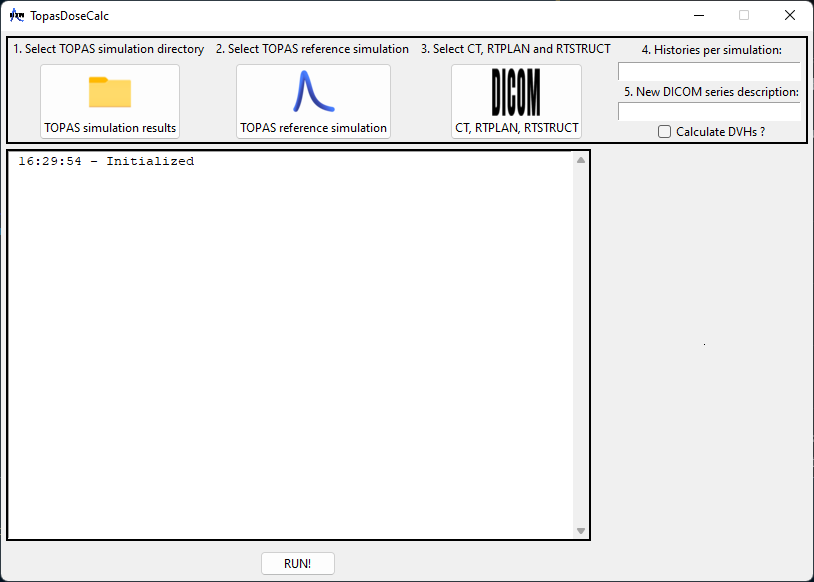
This GUI allows the merging of multiple TOPAS DICOM simulations. This can be useful when a patient plan has been split up into individual simulations of the control points. The merged simulation can then be scaled using a reference calibration simulation and data from the RTPLAN. Finally, DVHs can be automatically created when supplying a RTSTRUCT file.
Installation
Install using pip:
$ pip install topasdosecalc
Then, start the GUI by running:
$ python -m topasdosecalc
Or, if your Python is added to $PATH, simply run:
$ topasdosecalc
Manual
To use TopasDoseCalc, you need to supply at least five things:
- A directory containing your TOPAS DICOM simulation results, named after the control point (order is relevant!)
- A TOPAS dose profile reference simulation. The mean of the values close to the center axis is used as the scale
- A directory containing at least the relevant RTPLAN file. For DVH calculation, a RTDOSE and RTSTRUCT file is required
- The histories used for the simulation of each control point (individual, not total)
- A new series description for the merged DICOM
If you supplied a RTDOSE and RTSTRUCT file, you can select the structures for which to calculate a DVH. This can be useful as an initial validation of the simulation results.
Note: The program assumes 1 MU to be equivalent to 1cGy. If this doesn't apply to your case, scale the histories per simulation by the relevant amount.
Screenshots
Dependencies
Built using the beautiful Azure-ttk theme by @rdbende. Requires python3, numpy, matplotlib, pydicom and dicompyler-core.
Contact me!
Thank you for using TopasDoseCalc! Please let me know about any issues you encounter, or suggestions/wishes you might have!
1 maintainer

Metadata
1 maintainer
Release files for topasdosecalc 1.4
For a detailed explanation of source distributions (sdists) and built distributions (wheels), please see the package formats documentation.
Source distribution (sdist)
| File | Size | Uploaded | Provenance | Actions |
|---|---|---|---|---|
| topasdosecalc-1.4.tar.gz | 1.3 MB | Without provenance | Details for topasdosecalc-1.4.tar.gz |
Built distribution (wheel)
| File | Interpreter | ABI | Platform | Actions Reset |
|---|---|---|---|---|
| topasdosecalc-1.4-py3-none-any.whl | Python 3 | none | any | Details for topasdosecalc-1.4-py3-none-any.whl |
Total release size: 2.7 MB
Release files / topasdosecalc-1.4.tar.gz
| Download URL | topasdosecalc-1.4.tar.gz |
|---|---|
| Size | 1.3 MB |
| Tags | Source |
|
SHA-256 checksum How to use checksums |
b3b1aafaad450d3ebab90efb360b4a53ec8372702254c87553648928dffd7745
|
|
BLAKE2b-256 checksum How to use checksums |
a0c3e6846d962c2f0fbaebe827b5eb04fd4bec3c198264a3dd3359f3194e6d2e
|
| Upload date | |
|
Uploaded using Trusted Publishing? What is trusted publishing? |
No |
| Uploaded via |
twine/3.7.1 importlib_metadata/4.11.3 pkginfo/1.8.2 requests/2.27.1 requests-toolbelt/0.9.1 tqdm/4.64.0 CPython/3.8.13
|
Release files / topasdosecalc-1.4-py3-none-any.whl
| Download URL | topasdosecalc-1.4-py3-none-any.whl |
|---|---|
| Size | 1.4 MB |
| Tags | Python 3 |
|
SHA-256 checksum How to use checksums |
b4871080d88fd7be137d754107f7bcaac208fd0d6127b0a1629af43624fddbf8
|
|
BLAKE2b-256 checksum How to use checksums |
ca7aa4a8244aa59006da9bc4062df562ca3e0623e6d8de9c1d577aea138d633f
|
| Upload date | |
|
Uploaded using Trusted Publishing? What is trusted publishing? |
No |
| Uploaded via |
twine/3.7.1 importlib_metadata/4.11.3 pkginfo/1.8.2 requests/2.27.1 requests-toolbelt/0.9.1 tqdm/4.64.0 CPython/3.8.13
|
Security for topasdosecalc 1.4
Provenance
Provenance describes where a file came from. On PyPI, provenance is shared via attestations, which provide a verifiable record of the build or publishing details. View details, limitations and caveats.
No provenance found
None of the files in this release were uploaded with provenance metadata.
A note on package security
PyPI is a repository for distributing packages, not a service for auditing them. While third-party security researchers and our staff do their best to detect and remove malicious packages, PyPI cannot guarantee the quality, security or suitability of any given package.
To learn more about protecting yourself from malicious actors, visit our package security documentation.














