
topocheck





Sanity checks for claims about topology-aware segmentation — the losses, decoders and repair methods that promise fewer broken vessels, airways, neurons or roads.
Connectivity metrics are unusually easy to move for the wrong reasons. Each check here exists because it caught a result that looked publishable and was not.
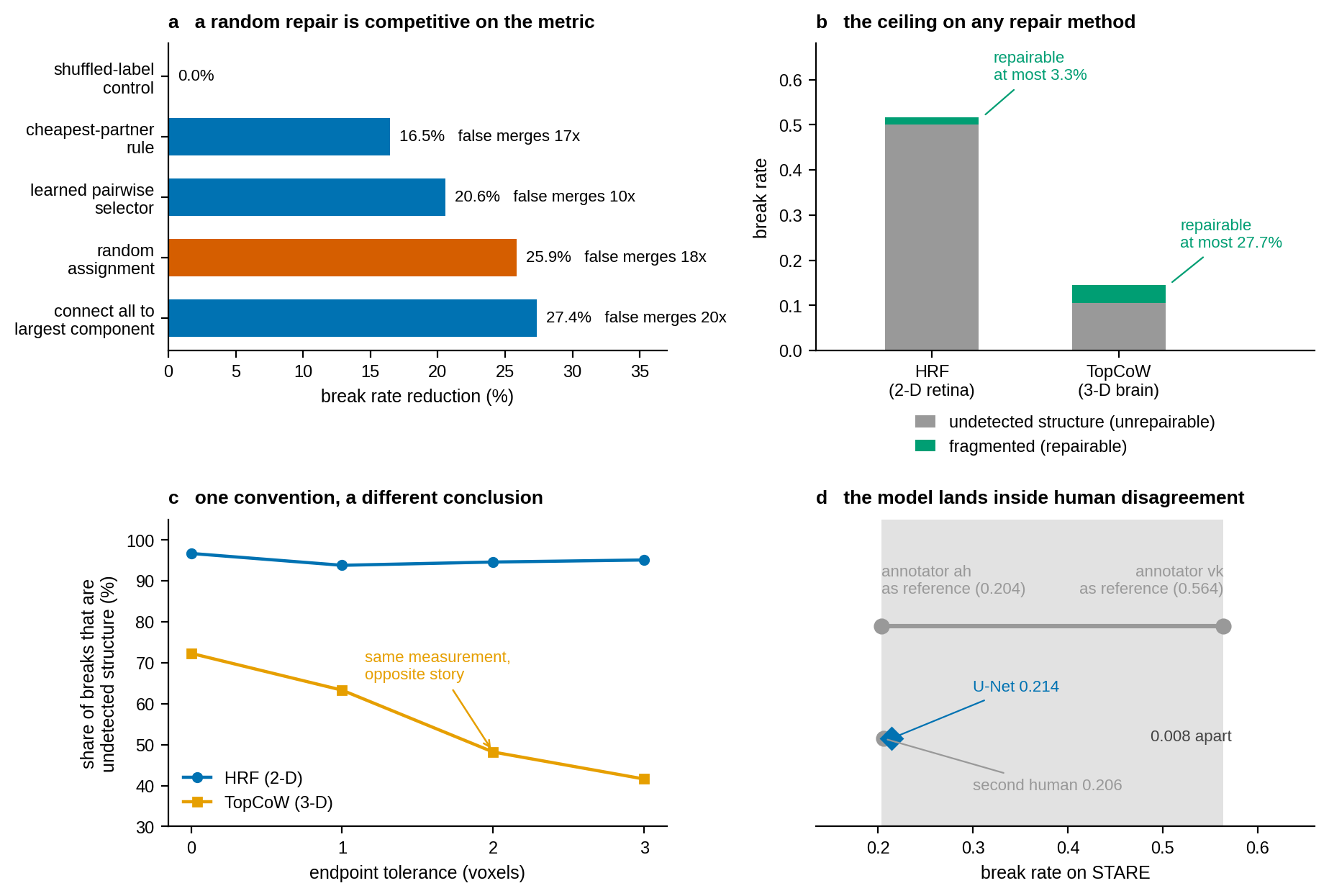
(a) On TopCoW, a random assignment of fragments reduced the break rate by
25.9% — ahead of every learned repair we built, and 1.5 points behind simply
connecting everything to the largest component. All of them multiply false merges
by 10-20x, which is the only reason they are distinguishable at all.
(b) The fragmented share of the errors is a hard ceiling on any repair method:
3.3% on HRF against 27.7% on TopCoW, an 8.4-fold difference in how much a decoder
could possibly buy. (c) Allowing endpoints to match within 2 voxels leaves HRF's
undetected share essentially unchanged (96.7% to 94.6%) and cuts TopCoW's by a
third (72.3% to 48.2%) — the same measurement telling two different stories.
(d) A U-Net cross-validated against one STARE annotator lands 0.008 from where
the second human annotator lands, inside the gap between the two humans.
Regenerate with python examples/make_hero_figure.py.
Install
pip install topocheck
Requires numpy, scipy and scikit-image.
Tests cover 99% of the package and CI enforces a 95% floor across Python 3.9, 3.11 and 3.12, together with linting and a regeneration of both figures.
Thirty seconds
python examples/quickstart.py
builds a synthetic vessel tree, breaks it in two different ways, applies a deliberately useless "repair", and asks the checks whether to believe it:
ground truth decomposes into 7 branches

[1] how much of the error is repairable at all
    break 0.286 = missing 0.143 + fragmented 0.143
    a repair method can remove at most 50% of the breaks

[2] does a proposed repair beat a random one of the same size
    added 36 voxels
    break: 0.286 -> 0.286 (random of equal size: 0.143)
    beats random: False
In your own code:
import topocheck as tc

units = tc.build_units(gt)                          # GT branch decomposition, 2-D or 3-D
tc.decompose_errors(pred, units)                    # how much of the error is even repairable?
tc.random_repair_baseline(pred, repaired, units)    # does your repair beat a random one?
tc.tolerance_sweep(pred, units)                     # does the conclusion survive the conventions?
tc.annotation_floor(gt_observer1, gt_observer2)     # is the gain inside human disagreement?
tc.prevalence_check(y, scores, prevalence=1e-3)     # does a balanced AUC survive deployment?
Who this is for
| If you | this gives you |
|---|---|
| develop topology-aware losses or decoders | the ceiling on what your method could buy on a given dataset, before you train anything, and a floor it has to clear |
| review or referee such papers | five specific questions with numeric answers, each of which a paper can be asked to report |
| curate or run a benchmark | the inter-annotator floor for your own ground truth, which decides whether the benchmark still has room to measure anything |
| just inherited a segmentation pipeline | a decomposition of where its connectivity errors actually come from, which is usually not where people assume |
Which check applies to what
(renders as a diagram on GitHub; the same decision tree in words follows below)
flowchart TD
    A["A reported improvement in a connectivity<br/>or topology metric"] --> B{"Where does the<br/>improvement come from?"}

    B -->|"post-processing,<br/>decoding or repair"| C["decompose_errors<br/><i>is any of the error repairable?</i>"]
    C -->|"repairable share is small"| C1["the method is capped there<br/>whatever it does"]
    C -->|"repairable share is large"| D["random_repair_baseline<br/><i>beat a random repair of<br/>the same size, at matched<br/>false-merge cost?</i>"]
    D -->|no| D1["the gain is from connecting more,<br/>not from connecting correctly"]

    B -->|"a loss, an architecture<br/>or a training change"| E["tolerance_sweep<br/><i>does the conclusion survive<br/>the endpoint convention?</i>"]
    E -->|"conclusion flips"| E1["the metric cannot carry<br/>a claim about <i>why</i>"]

    D --> F["annotation_floor<br/><i>is the gain larger than the<br/>disagreement between two<br/>human annotators?</i>"]
    E --> F
    F -->|no| F1["the benchmark has no<br/>room left to measure this"]

    F --> G{"Is any part of the evidence<br/>an AUC on a balanced sample?"}
    G -->|yes| H["prevalence_check<br/><i>what precision does that<br/>become at the real class ratio?</i>"]
    G -->|no| I["the improvement survives<br/>the checks that apply"]
    H --> I

    classDef warn fill:#fdece3,stroke:#D55E00,color:#7a3a10;
    classDef ok fill:#e4f5ee,stroke:#009E73,color:#0b4f3a;
    class C1,D1,E1,F1 warn;
    class I ok;
The five checks, and why each one exists
1. random_repair_baseline — does your repair beat a random one?
Connectivity metrics reward adding voxels: link anything to anything and endpoints become co-connected. On TopCoW (3-D cerebrovascular, 50 held-out cases), a random assignment of fragments to components reduced the break rate by 25.9% — beating every learned repair we had built (best: 20.6%) and landing within a point of the crude "connect every fragment to the largest component" rule (27.4%). Both blew up false merges by 17–20x, which is the only reason the difference is visible at all.
A method that does not clearly beat a random repair of the same size, at matched false-merge cost, has not been shown to repair anything. Report both.
2. decompose_errors — how much of the error is even repairable?
Split connectivity failures into
- missing — an endpoint is in no predicted component at all: the structure was never detected, and no decoder can recover it;
- fragment — both endpoints detected but in different components: this is the part a repair could fix.
fragment / break is then a hard upper bound on any repair method, and in our
data it was not a loose bound: on the 50 TopCoW held-out volumes an oracle
repair captured 27.36% against a predicted budget of 27.4%, with a
per-case Spearman correlation of 1.000 between a case's budget and its
realised gain, and 0/50 cases exceeding their own budget.
Measure this before building the method. On HRF (2-D retinal fundus) the repairable share was only 1.8–3.3% across four training objectives, which caps that entire family of methods at a few percent no matter how clever the decoder is.
3. tolerance_sweep — does the conclusion survive the metric's conventions?
Requiring the exact ground-truth endpoint voxel to lie inside a predicted component is one convention among several. Relaxing it to "within 2 voxels" changed TopCoW from 72.3% of errors are undetected structure to 48.2%, and cut the break rate from 0.146 to 0.095 (-34.6%) — while the same relaxation moved HRF almost not at all (undetected share stayed within 93.8–98.2% over tolerances 0–3, on two different training objectives).
If your error composition moves under the sweep, the metric cannot on its own carry a claim about why the errors happen. Report the sweep, not one setting.
4. annotation_floor — is the improvement inside human disagreement?
Evaluate the metric between two independent annotations of the same images. On STARE (20 retinal fundus images, two expert annotators) the break rate between them was 0.204 in one direction and 0.564 in the other, and 99.4% of that disagreement was structure one annotator drew and the other did not — not fragmentation.
A U-Net cross-validated on the same 20 images against annotator ah reached a
break rate of 0.214 where the second human scored 0.206, while scoring
higher on both Dice (0.775 vs 0.740) and clDice (0.845 vs 0.715). A model can fit
one annotator's inclusion convention about as well as another expert does, which
is worth knowing before reading a 30% improvement as 30% better topology.
(Model-vs-human numbers are field-of-view masked, hence 0.206 rather than 0.204.)
The direction matters: a more inclusive annotator scores very differently as reference than as prediction. Both are reported.
5. prevalence_check — does a balanced-sample AUC survive deployment?
Discriminative power measured on a 1:1 sample says little when positives are rare. On TopCoW, a classifier separating missed-vessel voxels from background using only local image statistics reached AUC 0.971 on balanced samples (label-shuffled control: 0.505). Deployed at the real class ratio it needed a 12.2x increase in false structure to buy a 15.6% break reduction, and was beaten at every operating point by simply ranking the same voxels by the segmentation network's own probability (13.1% break reduction at 6.7x).
This check turns an AUC into the precision, and the false-positives-per-true, that you would actually operate at. A zero false-positive count in a finite sample is reported as a rule-of-three bound rather than a precision of 1.0.
Reproducing the phenomenon
The headline observation — a random repair scoring well — is not a property of
those datasets. examples/why_random_wins.py builds synthetic vasculature,
fragments it, and repairs it three ways: at random, by nearest component, and by
the true partner. It takes about a minute and downloads nothing.
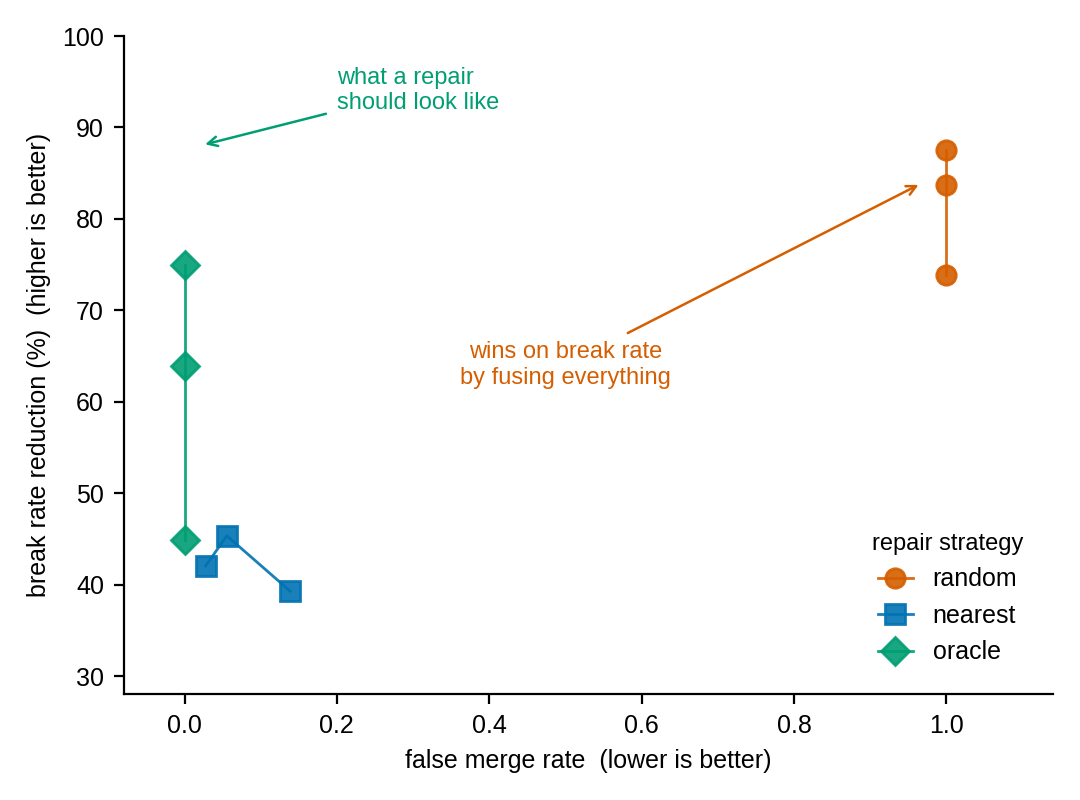
Across fragmentation levels, the strategy that scores best on break rate is
the random one, because fusing everything makes every pair of endpoints
co-connected. It is only on the second axis that it is revealed as a collapse
rather than a repair. This is why random_repair_baseline reports both when you
pass it the ground truth.
For how each number quoted above was produced, and what cannot be checked from this repository, see docs/EVIDENCE.md.
What this does not claim
- It does not say topology-aware losses do not work. Several of them clearly do; the point is that the size of the effect is easy to overstate and these are the specific ways it happens.
- It does not provide a better repair method. It provides the floor and the ceiling that one would have to beat.
- The checks are domain-agnostic; the numbers are not. Every figure quoted above comes from public datasets, with a plain U-Net and standard topology-aware losses: HRF (2-D retinal fundus, 45 images), STARE (2-D retinal fundus, 20 images, two annotators), TopCoW (3-D cerebrovascular, 50 held-out cases plus external centres from ISLES, Lausanne and IXI) and MSD Task08 Hepatic Vessel (3-D). No private or patient-identifiable data is involved.
Implementation notes
- Units are open branches of the ground-truth skeleton: junctions are removed and only pieces with exactly two endpoints are kept. Under full connectivity, removing a junction also removes its immediate neighbours, so very short stubs do not survive; this is pinned by a test.
- Full connectivity (8-neighbour in 2-D, 26 in 3-D) is used for the foreground throughout, which avoids the foreground/background connectivity paradox for thin structures.
random_repair_baselinematches the number of voxels added, a deliberately crude proxy for "amount of intervention". Its purpose is to establish a floor, not to compete.- A zero false-positive count in a finite sample is reported as a rule-of-three bound rather than a precision of 1.0.
Related work
The methods these checks are aimed at:
- Shit et al., clDice: a novel topology-preserving loss function for tubular structure segmentation (arXiv:2003.07311)
- Kirchhoff et al., Skeleton Recall Loss for connectivity conserving and resource efficient segmentation of thin tubular structures (arXiv:2404.03010)
- Efficient connectivity-preserving instance segmentation with a supervoxel-based loss function (arXiv:2501.01022)
- Stucki et al., Topograph: an efficient graph-based framework for strictly topology preserving image segmentation (arXiv:2411.03228)
The closest work in spirit, and complementary to this one — it examines how the metrics are computed (connectivity choice, ground-truth artefacts, metric aggregation), where these checks examine what a reported improvement can be attributed to:
- Berger, Lux, Weers, Menten, Rueckert and Paetzold, Pitfalls of topology-aware image segmentation, IPMI 2025 (arXiv:2412.14619)
Where help is wanted
Concrete and in order of usefulness:
- A counterexample. A domain where the repairable share is large and a repair method beats the random baseline at matched false-merge cost. We did not find one across 2-D retina, 3-D cerebrovascular and 3-D hepatic vessels, and we would rather be shown wrong than keep saying so.
- More annotation floors. Any dataset with two or more independent annotations of the same images. The floor is cheap to measure and almost never reported, and it decides whether a benchmark has room left.
- The decomposition for other structural metrics. The missing/fragmented split is defined here for endpoint connectivity; the same argument should apply to Betti-number error, variation of information, and split/merge counts, but the bookkeeping differs.
Contribution guidelines and what qualifies as a check: CONTRIBUTING.md.
Citing
See CITATION.cff.
Other things from the same desk
- groundwork — a research pipeline for coding agents whose first stage can return NO-GO; on PyPI as
groundwork-research - ct-reconstruction-harness — reproduce the LoDoPaB-CT baselines from scratch, then beat a published one with guards that must fail on broken operators
- sciglyph — draw publication figures as code, in pure matplotlib
More at github.com/GuoCheng24.
License
MIT
1 maintainer

Metadata
1 maintainer
Release files for topocheck 0.1.2
For a detailed explanation of source distributions (sdists) and built distributions (wheels), please see the package formats documentation.
Source distribution (sdist)
| File | Size | Uploaded | Provenance | |
|---|---|---|---|---|
| topocheck-0.1.2.tar.gz | 26.5 kB | Without provenance | Details |
Built distribution (wheel)
| File | Interpreter | ABI | Platform | Reset |
|---|---|---|---|---|
| topocheck-0.1.2-py3-none-any.whl | Python 3 | none | any | Details |
Total release size: 42.8 kB
Release files / topocheck-0.1.2.tar.gz
| Download URL | topocheck-0.1.2.tar.gz |
|---|---|
| Size | 26.5 kB |
| Tags | Source |
|
SHA-256 checksum How to use checksums |
86e6b4b507a489573c29e09ef3f9760e9565f3487e1faf2e72160fad5ddbdb88
|
|
BLAKE2b-256 checksum How to use checksums |
0065066528d0cca181f72b1cae956f857b7a593c59a18a2bb27d3e827b99f416
|
| Upload date | |
|
Uploaded using Trusted Publishing? What is trusted publishing? |
No |
| Uploaded via |
twine/7.0.0 CPython/3.13.15
|
Release files / topocheck-0.1.2-py3-none-any.whl
| Download URL | topocheck-0.1.2-py3-none-any.whl |
|---|---|
| Size | 16.3 kB |
| Tags | Python 3 |
|
SHA-256 checksum How to use checksums |
6103a2f92ac152900758e239f953b1d2743f80b3c09f73cf3131a7a0fab93797
|
|
BLAKE2b-256 checksum How to use checksums |
85f005d2f1e764a23817d13073778887af95dc97e8992ac3dde8652cc32c982a
|
| Upload date | |
|
Uploaded using Trusted Publishing? What is trusted publishing? |
No |
| Uploaded via |
twine/7.0.0 CPython/3.13.15
|
Security for topocheck 0.1.2
Provenance
Provenance describes where a file came from. On PyPI, provenance is shared via attestations, which provide a verifiable record of the build or publishing details. View details, limitations and caveats.
No provenance found
None of the files in this release were uploaded with provenance metadata.
A note on package security
PyPI is a repository for distributing packages, not a service for auditing them. While third-party security researchers and our staff do their best to detect and remove malicious packages, PyPI cannot guarantee the quality, security or suitability of any given package.














