
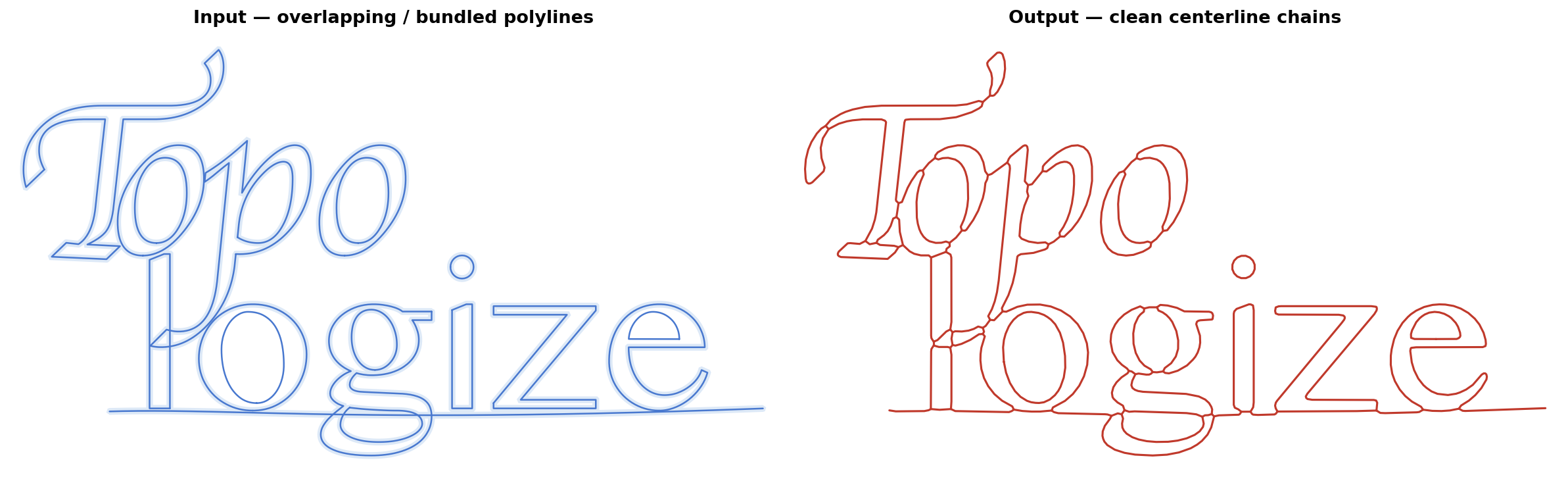
Convert messy overlapping polylines into clean topological centerline chains
Verified details
These details have been verified by PyPIProject links
GitHub Statistics
Maintainers

Project description
topologize
Convert messy, overlapping polylines into a clean topological skeleton.
Given a set of curves — open or closed, possibly intersecting or bundled — topologize inflates them into a region, skeletonizes that region via constrained Delaunay triangulation, and returns a list of maximal non-branching polylines tracing the medial axis.
What it does
The three-stage pipeline:
- Inflate — buffer all input curves by
inflation_radiusand union the results into one or more polygons (Clipper2) - Skeletonize — constrained Delaunay triangulation of the polygon interior; midpoints of internal edges form the skeleton graph
- Extract chains — snap nearby endpoints, then traverse the graph to extract maximal non-branching polylines
The output chains share junction points, so the result is a proper topological graph: you can traverse it, measure it, and match it to other representations.
When to use it
Use topologize when you have geometry that approximates a graph and need an actual graph — a set of polylines with shared junction points you can traverse, measure, or match to other data.
Concrete examples:
- Vector artwork or scanned drawings converted to machine toolpaths (laser, pen plotter, CNC, printing)
- Road, river, or network centerline extraction from polygon or buffered line data
- GPS or sensor traces where the same route was recorded multiple times
Installation
pip install topologize
Runtime dependency: numpy only.
To build from source (requires a Rust toolchain):
git clone https://github.com/tdamsma/topologize
cd topologize
uv run maturin develop --release
Quick start
import numpy as np
from topologize import topologize

# Any collection of (N, 2) numpy arrays — open or closed, overlapping is fine
curves = [
    np.array([[0.0, 0.0], [10.0, 0.0], [5.0, 5.0]]),
    np.array([[0.1, 0.1], [9.9, 0.1], [5.1, 4.9]]),  # near-duplicate stroke
]

result = topologize(curves, inflation_radius=0.5)
result.chains          # list of (M, 2) arrays — one per non-branching segment
result.nodes           # (K, 2) array of unique junction/endpoint positions
result.chain_node_ids  # list of (start_id, end_id) per chain
inflation_radius is the main tuning parameter. Use roughly half the typical gap between nearby strokes — small enough to keep distinct paths separate, large enough to merge strokes that belong together.
For variable-width inflation, pass a list of per-vertex radius arrays:
widths_a = np.linspace(0.3, 0.1, len(curve_a))
widths_b = np.linspace(0.1, 0.5, len(curve_b))
result = topologize([curve_a, curve_b], inflation_radius=[widths_a, widths_b])
| Parameter | Type | Description |
|---|---|---|
curves |
list[np.ndarray] |
Input polylines, each (N, 2) or (N, 3) with per-vertex widths. Closed curves should repeat the first point at the end. |
inflation_radius |
float | list |
Inflation radius. A single float for uniform width, or a list of per-vertex radius arrays for variable width. |
feature_size |
float | None |
Scale parameter for all derived thresholds. Defaults to inflation_radius (float) or median(all widths) (list). |
simplification |
float | None |
RDP tolerance on output chains (default: feature_size / 10). Set to 0 to disable. |
min_tip_fraction |
float | None |
Prune terminal chains shorter than fraction × feature_size (default: 2.0). Set to 0 to disable. |
junction_merge_fraction |
float | None |
Merge nearby junctions within fraction × feature_size (default: 1.5). Set to 0 to disable. |
compute_widths |
bool |
If True, populate result.chain_widths with estimated contour width at each chain point. |
Visualization
TopologizeResult has a built-in plot() method (requires plotly):
result.plot(curves, inflation_radius=0.5)                    # basic
result.plot(curves, inflation_radius=0.5, show_triangulation=True)  # + CDT overlay
When compute_widths=True, the plot also shows bead-width envelopes around each chain.
Batch processing
For workloads with many independent curve-sets (e.g. per-layer toolpath slicing), topologize_batch processes them in parallel via Rayon with the GIL released. Each job carries its own parameters:
from topologize import topologize_batch, TopologizeJob

jobs = [
    TopologizeJob(curves_layer_1, inflation_radius=0.5),
    TopologizeJob(curves_layer_2, inflation_radius=1.0, simplification=0.0),
    # ...
]
results = topologize_batch(jobs)
# returns list[TopologizeResult], one per job
On multi-core machines this is significantly faster than a Python loop.
Async-style processing with ThreadPoolExecutor
Single topologize releases the GIL during Rust computation, so you can also use Python's ThreadPoolExecutor for async-style processing:
from concurrent.futures import ThreadPoolExecutor
from topologize import topologize

with ThreadPoolExecutor() as pool:
    futures = [pool.submit(topologize, cs, inflation_radius=0.5) for cs in curve_sets]
    results = [f.result() for f in futures]
This is useful when jobs arrive one at a time (e.g. from a queue) rather than all at once.
Examples
All examples are # %% cell-delimited Python files — run directly or open as Jupyter notebooks.
uv sync --group dev  # install plotly, svgpathtools, etc.

# Getting started — basic usage and inflation_radius tuning
uv run python/examples/getting_started.py

# SVG centerline extraction
uv run python/examples/svg_centerline.py python/examples/data/topologize.svg --buffer 0.47

# Variable-width per-vertex inflation
uv run python/examples/variable_width_demo.py

# Parallel / batch processing benchmarks
uv run python/examples/parallel_processing.py
Algorithm
See algorithm.md for a detailed description of all three pipeline stages, the boundary preprocessing steps (RDP simplification + subdivision), the post-processing applied to output chains (projection smoothing, endpoint straightening, RDP), and the rationale for the CDT midpoint approach over alternatives (Voronoi, Python prototype).
Project structure
src/
  lib.rs             pymodule entry point (_internal)
  python.rs          Python-facing bindings
  inflate.rs         Clipper2-based polygon inflation + boundary prep
  skeleton_cdt.rs    CDT midpoint-graph skeletonizer
  graph.rs           Endpoint snapping + chain extraction

python/
  topologize/
    __init__.py      Public API (TopologizeResult, topologize, topologize_batch, inflate, triangulate)
  examples/
    getting_started.py
    svg_centerline.py
    variable_width_demo.py
    compare_methods.py
    parallel_processing.py

tests/
  test_topologize.py
  test_batch.py

Cargo.toml           Rust manifest
pyproject.toml       Python build config (maturin)
Project details
Verified details
These details have been verified by PyPIProject links
GitHub Statistics
Maintainers


Download files
Download the file for your platform. If you're not sure which to choose, learn more about installing packages.
Source Distributions
Built Distributions
Filter files by name, interpreter, ABI, and platform.
If you're not sure about the file name format, learn more about wheel file names.
Copy a direct link to the current filters
File details
Details for the file topologize-0.0.6-cp312-cp312-manylinux_2_17_i686.manylinux2014_i686.whl.
File metadata
- Download URL: topologize-0.0.6-cp312-cp312-manylinux_2_17_i686.manylinux2014_i686.whl
- Upload date:
- Size: 576.6 kB
- Tags: CPython 3.12, manylinux: glibc 2.17+ i686
- Uploaded using Trusted Publishing? Yes
- Uploaded via: twine/6.1.0 CPython/3.13.12
File hashes
| Algorithm | Hash digest | |
|---|---|---|
| SHA256 |
69ba8ccc78cba41b13f942f988869d75808c0b54283425a4305761ae28fb2650
|
|
| MD5 |
685311e10c18192cca3042ae7ba3660e
|
|
| BLAKE2b-256 |
f6e2a5bad27eb6071554130bdc85d836b3387ed47ee533600e98fb9d9ab3d3d5
|
Provenance
The following attestation bundles were made for topologize-0.0.6-cp312-cp312-manylinux_2_17_i686.manylinux2014_i686.whl:
Publisher:
ci.yml on tdamsma/topologize
-
Statement:
-
Statement type:
https://in-toto.io/Statement/v1 -
Predicate type:
https://docs.pypi.org/attestations/publish/v1 -
Subject name:
topologize-0.0.6-cp312-cp312-manylinux_2_17_i686.manylinux2014_i686.whl -
Subject digest:
69ba8ccc78cba41b13f942f988869d75808c0b54283425a4305761ae28fb2650 - Sigstore transparency entry: 1261069049
- Sigstore integration time:
-
Permalink:
tdamsma/topologize@8897c333d70ad7d7be1ee5aa2077bf2f6559c1ab -
Branch / Tag:
refs/tags/v0.0.6 - Owner: https://github.com/tdamsma
-
Access:
public
-
Token Issuer:
https://token.actions.githubusercontent.com -
Runner Environment:
github-hosted -
Publication workflow:
ci.yml@8897c333d70ad7d7be1ee5aa2077bf2f6559c1ab -
Trigger Event:
push
-
Statement type:
File details
Details for the file topologize-0.0.6-cp312-cp312-manylinux_2_17_armv7l.manylinux2014_armv7l.whl.
File metadata
- Download URL: topologize-0.0.6-cp312-cp312-manylinux_2_17_armv7l.manylinux2014_armv7l.whl
- Upload date:
- Size: 530.8 kB
- Tags: CPython 3.12, manylinux: glibc 2.17+ ARMv7l
- Uploaded using Trusted Publishing? Yes
- Uploaded via: twine/6.1.0 CPython/3.13.12
File hashes
| Algorithm | Hash digest | |
|---|---|---|
| SHA256 |
8b998e59a8533006da569496b4c956243a07e9ccfd98dd55c9161f927a52d7b6
|
|
| MD5 |
790546f1d8ec10a8b4ce24b98b08d17b
|
|
| BLAKE2b-256 |
7f02e8558474f4977c4a47c10ba3d1146159dccb3a7ea55b16a94419f581b927
|
Provenance
The following attestation bundles were made for topologize-0.0.6-cp312-cp312-manylinux_2_17_armv7l.manylinux2014_armv7l.whl:
Publisher:
ci.yml on tdamsma/topologize
-
Statement:
-
Statement type:
https://in-toto.io/Statement/v1 -
Predicate type:
https://docs.pypi.org/attestations/publish/v1 -
Subject name:
topologize-0.0.6-cp312-cp312-manylinux_2_17_armv7l.manylinux2014_armv7l.whl -
Subject digest:
8b998e59a8533006da569496b4c956243a07e9ccfd98dd55c9161f927a52d7b6 - Sigstore transparency entry: 1261068447
- Sigstore integration time:
-
Permalink:
tdamsma/topologize@8897c333d70ad7d7be1ee5aa2077bf2f6559c1ab -
Branch / Tag:
refs/tags/v0.0.6 - Owner: https://github.com/tdamsma
-
Access:
public
-
Token Issuer:
https://token.actions.githubusercontent.com -
Runner Environment:
github-hosted -
Publication workflow:
ci.yml@8897c333d70ad7d7be1ee5aa2077bf2f6559c1ab -
Trigger Event:
push
-
Statement type:
File details
Details for the file topologize-0.0.6-cp312-cp312-manylinux_2_17_aarch64.manylinux2014_aarch64.whl.
File metadata
- Download URL: topologize-0.0.6-cp312-cp312-manylinux_2_17_aarch64.manylinux2014_aarch64.whl
- Upload date:
- Size: 503.0 kB
- Tags: CPython 3.12, manylinux: glibc 2.17+ ARM64
- Uploaded using Trusted Publishing? Yes
- Uploaded via: twine/6.1.0 CPython/3.13.12
File hashes
| Algorithm | Hash digest | |
|---|---|---|
| SHA256 |
95c22f65690b67143b67666f21a11a61b99971ba54752ff7016a09fed93909ee
|
|
| MD5 |
4960d026870b72530020dc38326bf4d1
|
|
| BLAKE2b-256 |
bc4e2bc9c1c4a2160b5ab27ebe29f237298d6fcc14cddab4498d6b4b4c81e365
|
Provenance
The following attestation bundles were made for topologize-0.0.6-cp312-cp312-manylinux_2_17_aarch64.manylinux2014_aarch64.whl:
Publisher:
ci.yml on tdamsma/topologize
-
Statement:
-
Statement type:
https://in-toto.io/Statement/v1 -
Predicate type:
https://docs.pypi.org/attestations/publish/v1 -
Subject name:
topologize-0.0.6-cp312-cp312-manylinux_2_17_aarch64.manylinux2014_aarch64.whl -
Subject digest:
95c22f65690b67143b67666f21a11a61b99971ba54752ff7016a09fed93909ee - Sigstore transparency entry: 1261070066
- Sigstore integration time:
-
Permalink:
tdamsma/topologize@8897c333d70ad7d7be1ee5aa2077bf2f6559c1ab -
Branch / Tag:
refs/tags/v0.0.6 - Owner: https://github.com/tdamsma
-
Access:
public
-
Token Issuer:
https://token.actions.githubusercontent.com -
Runner Environment:
github-hosted -
Publication workflow:
ci.yml@8897c333d70ad7d7be1ee5aa2077bf2f6559c1ab -
Trigger Event:
push
-
Statement type:
File details
Details for the file topologize-0.0.6-cp312-cp312-macosx_11_0_arm64.whl.
File metadata
- Download URL: topologize-0.0.6-cp312-cp312-macosx_11_0_arm64.whl
- Upload date:
- Size: 454.9 kB
- Tags: CPython 3.12, macOS 11.0+ ARM64
- Uploaded using Trusted Publishing? Yes
- Uploaded via: twine/6.1.0 CPython/3.13.12
File hashes
| Algorithm | Hash digest | |
|---|---|---|
| SHA256 |
a8c4b350d5218aeb5783e4e37d4c8df64ae35976943d6f343def9bb1f363dec3
|
|
| MD5 |
6c983932c34c23ba6ac9efa6eb5e2910
|
|
| BLAKE2b-256 |
04eabfb79250a7226339640e45d6c42ee2eda271cc01ddcce188bb19596a00b3
|
Provenance
The following attestation bundles were made for topologize-0.0.6-cp312-cp312-macosx_11_0_arm64.whl:
Publisher:
ci.yml on tdamsma/topologize
-
Statement:
-
Statement type:
https://in-toto.io/Statement/v1 -
Predicate type:
https://docs.pypi.org/attestations/publish/v1 -
Subject name:
topologize-0.0.6-cp312-cp312-macosx_11_0_arm64.whl -
Subject digest:
a8c4b350d5218aeb5783e4e37d4c8df64ae35976943d6f343def9bb1f363dec3 - Sigstore transparency entry: 1261071076
- Sigstore integration time:
-
Permalink:
tdamsma/topologize@8897c333d70ad7d7be1ee5aa2077bf2f6559c1ab -
Branch / Tag:
refs/tags/v0.0.6 - Owner: https://github.com/tdamsma
-
Access:
public
-
Token Issuer:
https://token.actions.githubusercontent.com -
Runner Environment:
github-hosted -
Publication workflow:
ci.yml@8897c333d70ad7d7be1ee5aa2077bf2f6559c1ab -
Trigger Event:
push
-
Statement type:
File details
Details for the file topologize-0.0.6-cp312-cp312-macosx_10_12_x86_64.whl.
File metadata
- Download URL: topologize-0.0.6-cp312-cp312-macosx_10_12_x86_64.whl
- Upload date:
- Size: 475.4 kB
- Tags: CPython 3.12, macOS 10.12+ x86-64
- Uploaded using Trusted Publishing? Yes
- Uploaded via: twine/6.1.0 CPython/3.13.12
File hashes
| Algorithm | Hash digest | |
|---|---|---|
| SHA256 |
fdfc1955fb3f17bb508fd1d3b040f207ca2c0463a60e9df2b35c48557e768a82
|
|
| MD5 |
c81c30de820e40e1f21fb1cb39b7016e
|
|
| BLAKE2b-256 |
3d2d29d2fd79ad2a9b16fd3f3fa99f33ea02fc2db95faa24252609a735523281
|
Provenance
The following attestation bundles were made for topologize-0.0.6-cp312-cp312-macosx_10_12_x86_64.whl:
Publisher:
ci.yml on tdamsma/topologize
-
Statement:
-
Statement type:
https://in-toto.io/Statement/v1 -
Predicate type:
https://docs.pypi.org/attestations/publish/v1 -
Subject name:
topologize-0.0.6-cp312-cp312-macosx_10_12_x86_64.whl -
Subject digest:
fdfc1955fb3f17bb508fd1d3b040f207ca2c0463a60e9df2b35c48557e768a82 - Sigstore transparency entry: 1261069597
- Sigstore integration time:
-
Permalink:
tdamsma/topologize@8897c333d70ad7d7be1ee5aa2077bf2f6559c1ab -
Branch / Tag:
refs/tags/v0.0.6 - Owner: https://github.com/tdamsma
-
Access:
public
-
Token Issuer:
https://token.actions.githubusercontent.com -
Runner Environment:
github-hosted -
Publication workflow:
ci.yml@8897c333d70ad7d7be1ee5aa2077bf2f6559c1ab -
Trigger Event:
push
-
Statement type:






