
The higher the blockiness metric value, the more likely it is that the image was JPEG-compressed at a low quality. Re-implementation of blockiness from "Rethinking Image Super-Resolution from Training Data Perspectives"

Project description
🧱 Torch JPEG Blockiness Metric
The higher the blockiness metric value, the more likely it is that the image was JPEG-compressed at a low quality.
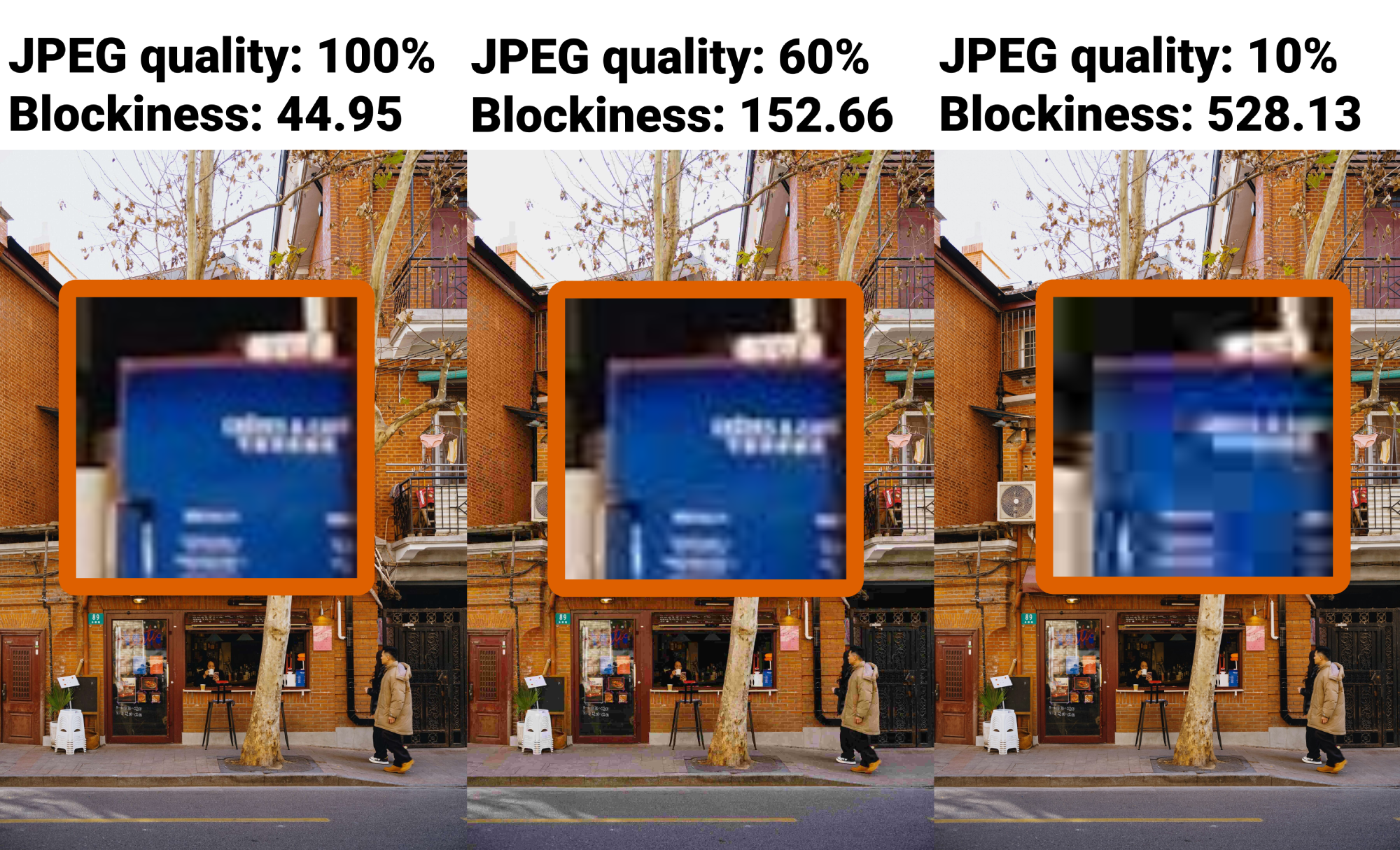
This is a implementation of blockiness algorithm from the paper "A JPEG blocking artifact detector for image forensics" (Dinesh Bhardwaj, Vinod Pankajakshan).
It is based on the gohtanii's implementation from DiverSeg dataset: "Rethinking Image Super-Resolution from Training Data Perspectives" (Go Ohtani, Ryu Tadokoro, Ryosuke Yamada, Yuki M. Asano, Iro Laina, Christian Rupprecht, Nakamasa Inoue, Rio Yokota, Hirokatsu Kataoka, and Yoshimitsu Aoki, ECCV2024).
It has the following improvements over the gohtanii's implementation:
- 🔥 operations are written in torch (gpu friendly)
- 🔥 operations are vectorized
- 🔥 batched input is supported, with the assumption of same image size
Usage
you can copy paste the torch_jpeg_blockiness/blockiness.py file to your project directory as it has no dependencies except torch and numpy.
import torchvision
import torchvision.transforms.functional
from torch_jpeg_blockiness.blockiness import calculate_image_blockiness, rgb_to_grayscale

img = torchvision.io.read_image("example_images/unsplash.jpg")
img_gray = rgb_to_grayscale(img)
blockiness = calculate_image_blockiness(img_gray)
blockiness_float = float(blockiness)
test the code against original (gohtanii's implementation)
python3 -m test.test
.
------------------------
Ran 1 test in 11.771s

OK
Formal definitions
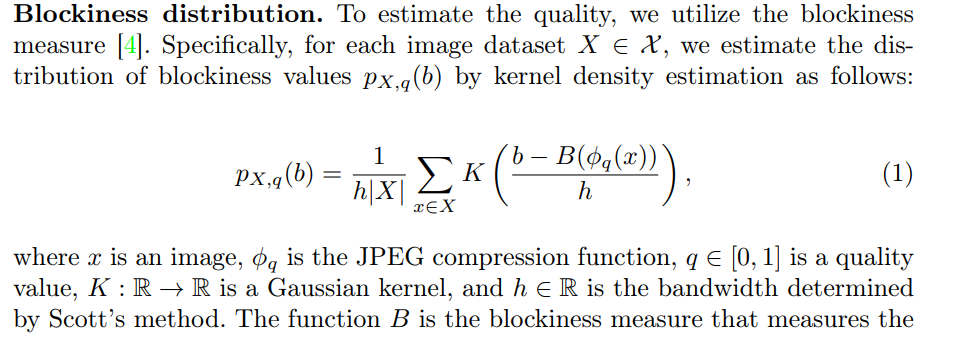
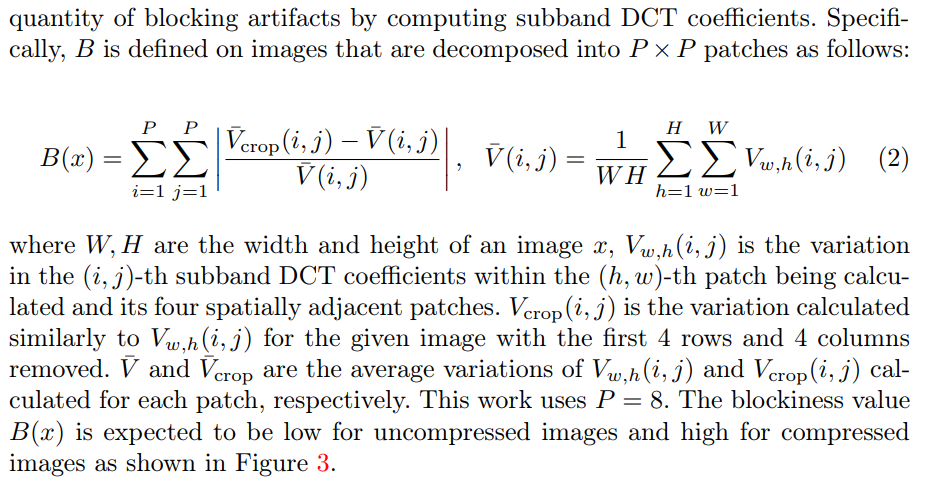
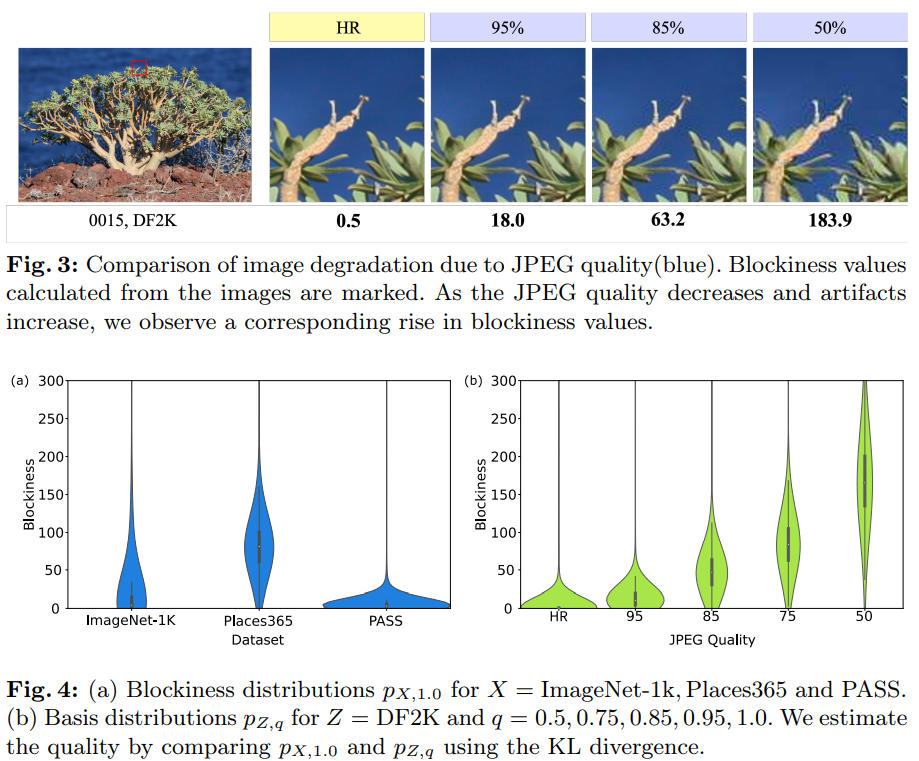
Definisions from the DiverSeg dataset: "Rethinking Image Super-Resolution from Training Data Perspectives" (Go Ohtani, Ryu Tadokoro, Ryosuke Yamada, Yuki M. Asano, Iro Laina, Christian Rupprecht, Nakamasa Inoue, Rio Yokota, Hirokatsu Kataoka, and Yoshimitsu Aoki, ECCV2024) paper:
These definitions are missing some crucial parts that would make them easier to understand. I therefore recommend reading the original paper "A JPEG blocking artifact detector for image forensics" with sci-hub.
Other
Motivation: Authors of the paper have demonstrated that filtering images which have JPEG compresson helps the super resolution model achieve better performance in the long run. Even more crucial, JPEG blockiness filtering prevents the dataset from containing excessively strong compression, which can be highly detrimental to the overall training process as shown by the DiverSeg dataset paper and Phillip Hoffman's BHI filtering blog post.
note: the code is tested against the original implementation. test can be found at tests/test.py
note 2: this method should be shift and scale-invariant as it computes the DCT for each fixed block rather than the entire image, but I haven't empirically tested this yet.
note 3: I was thinking about using the centarl crop of an image (most likely high entropy area) to reduce the compute time even more. The problem is that the crop might start in the middle of the JPEG block. I'm not sure if this method is robust to JPEG grid offsets. However, you could start cropping from the upper-left corner to some fixed dimension. Preferably, the bottom-right corner should pass through the center of the image.
References
Phillip Hoffman's "Filtering single image super-resolution datasets with BHI" blog post https://huggingface.co/blog/Phips/bhi-filtering
DiverSeg dataset: "Rethinking Image Super-Resolution from Training Data Perspectives" (Ohtani, Go and Tadokoro, Ryu and Yamada, Ryosuke and Asano, Yuki M and Laina, Iro and Rupprecht, Christian and Inoue, Nakamasa and Yokota, Rio and Kataoka, Hirokatsu and Aoki, Yoshimitsu)
github: https://github.com/gohtanii/DiverSeg-dataset/tree/284cc1c030424b8b0f7040020bd6435e8ed2e6d7
arxiv: https://arxiv.org/abs/2409.00768
@inproceedings{ohtani2024rethinking,
  title={Rethinking Image Super-Resolution from Training Data Perspectives},
  author={Ohtani, Go and Tadokoro, Ryu and Yamada, Ryosuke and Asano, Yuki M and Laina, Iro and Rupprecht, Christian and Inoue, Nakamasa and Yokota, Rio and Kataoka, Hirokatsu and Aoki, Yoshimitsu},
  booktitle={European Conference on Computer Vision},
  pages={19--36},
  year={2024},
  organization={Springer}
}
"A JPEG blocking artifact detector for image forensics", original paper which defined this concrete blockiness metric.
(open with sci-hub) https://www.sciencedirect.com/science/article/abs/pii/S0923596518302066
@article{bhardwaj2018jpeg,
  title={A JPEG blocking artifact detector for image forensics},
  author={Bhardwaj, Dinesh and Pankajakshan, Vinod},
  journal={Signal Processing: Image Communication},
  volume={68},
  pages={155--161},
  year={2018},
  publisher={Elsevier}
}


Download files
Download the file for your platform. If you're not sure which to choose, learn more about installing packages.
Source Distribution
Built Distribution
Filter files by name, interpreter, ABI, and platform.
If you're not sure about the file name format, learn more about wheel file names.
Copy a direct link to the current filters
File details
Details for the file torch_jpeg_blockiness-1.0.0.tar.gz.
File metadata
- Download URL: torch_jpeg_blockiness-1.0.0.tar.gz
- Upload date:
- Size: 2.8 MB
- Tags: Source
- Uploaded using Trusted Publishing? No
- Uploaded via: twine/6.1.0 CPython/3.10.13
File hashes
| Algorithm | Hash digest | |
|---|---|---|
| SHA256 |
f88c4c5d0b752cd8515aec6174f6b00d57b8db68515505e23bb1d4c84b72f868
|
|
| MD5 |
15007ec8e94801ede68506e821f361fe
|
|
| BLAKE2b-256 |
5ab08d30bd6778ac01f71c690c4ef9722d56f12c8baad2bd0b9621886b5c7cbf
|
File details
Details for the file torch_jpeg_blockiness-1.0.0-py3-none-any.whl.
File metadata
- Download URL: torch_jpeg_blockiness-1.0.0-py3-none-any.whl
- Upload date:
- Size: 2.8 MB
- Tags: Python 3
- Uploaded using Trusted Publishing? No
- Uploaded via: twine/6.1.0 CPython/3.10.13
File hashes
| Algorithm | Hash digest | |
|---|---|---|
| SHA256 |
29e4e273f276e26988e040326f90fc74ad9a9b52eaf7e58d7761d4ac0b4fe020
|
|
| MD5 |
c812ed691ab2737a137facc1c5f6e10f
|
|
| BLAKE2b-256 |
8c8521053bb576e865b582f7efea27209f93911ae5a12b6de74dee67ffb86fce
|






