
A pytorch toolkit for calculating material properties using MLIPs


Project description
TorchSim





TorchSim is a next-generation open-source atomistic simulation engine for the MLIP era. By rewriting the core primitives of atomistic simulation in Pytorch, it allows orders of magnitude acceleration of popular machine learning potentials.
- Automatic batching and GPU memory management allowing significant simulation speedup
- Support for MACE, Fairchem, SevenNet, ORB, MatterSim, graph-pes, and metatomic MLIP models
- Support for classical lennard jones, morse, and soft-sphere potentials
- Molecular dynamics integration schemes like NVE, NVT Langevin, and NPT Langevin
- Relaxation of atomic positions and cell with gradient descent and FIRE
- Swap monte carlo and hybrid swap monte carlo algorithm
- An extensible binary trajectory writing format with support for arbitrary properties
- A simple and intuitive high-level API for new users
- Integration with ASE, Pymatgen, and Phonopy
- and more: differentiable simulation, elastic properties, custom workflows...
Quick Start
Here is a quick demonstration of many of the core features of TorchSim: native support for GPUs, MLIP models, ASE integration, simple API, autobatching, and trajectory reporting, all in under 40 lines of code.
Running batched MD
import torch
import torch_sim as ts

# run natively on gpus
device = torch.device("cuda" if torch.cuda.is_available() else "cpu")

# easily load the model from mace-mp
from mace.calculators.foundations_models import mace_mp
from torch_sim.models.mace import MaceModel
mace = mace_mp(model="small", return_raw_model=True)
mace_model = MaceModel(model=mace, device=device)

from ase.build import bulk
cu_atoms = bulk("Cu", "fcc", a=3.58, cubic=True).repeat((2, 2, 2))
many_cu_atoms = [cu_atoms] * 50
trajectory_files = [f"Cu_traj_{i}.h5md" for i in range(len(many_cu_atoms))]

# run them all simultaneously with batching
final_state = ts.integrate(
    system=many_cu_atoms,
    model=mace_model,
    n_steps=50,
    timestep=0.002,
    temperature=1000,
    integrator=ts.Integrator.nvt_langevin,
    trajectory_reporter=dict(filenames=trajectory_files, state_frequency=10),
)
final_atoms_list = final_state.to_atoms()

# extract the final energy from the trajectory file
final_energies = []
for filename in trajectory_files:
    with ts.TorchSimTrajectory(filename) as traj:
        final_energies.append(traj.get_array("potential_energy")[-1])

print(final_energies)
Running batched relaxation
To then relax those structures with FIRE is just a few more lines.
# relax all of the high temperature states
relaxed_state = ts.optimize(
    system=final_state,
    model=mace_model,
    optimizer=ts.Optimizer.fire,
    autobatcher=True,
    init_kwargs=dict(cell_filter=ts.CellFilter.frechet),
)

print(relaxed_state.energy)
Speedup
TorchSim achieves up to 100x speedup compared to ASE with popular MLIPs.
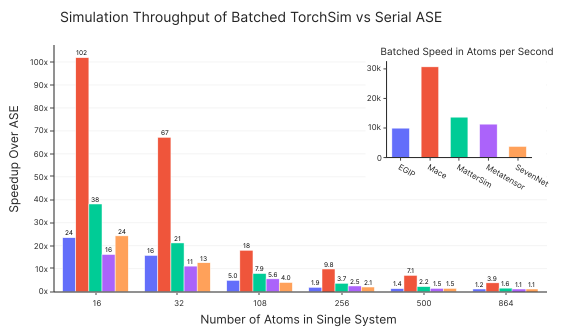
This figure compares the time per atom of ASE and torch_sim. Time per atom is defined
as the number of atoms / total time. While ASE can only run a single system of n_atoms
(on the $x$ axis), torch_sim can run as many systems as will fit in memory. On an H100 80 GB card,
the max atoms that could fit in memory was ~8,000 for EGIP,
~10,000 for MACE-MPA-0, ~22,000 for Mattersim V1 1M,
~2,500 for SevenNet, and ~9000 for PET-MAD.
This metric describes model performance by capturing speed and memory usage simultaneously.
Installation
PyPI Installation
pip install torch-sim-atomistic
Installing from source
git clone https://github.com/TorchSim/torch-sim
cd torch-sim
pip install .
Examples
To understand how TorchSim works, start with the comprehensive tutorials in the documentation.
Core Modules
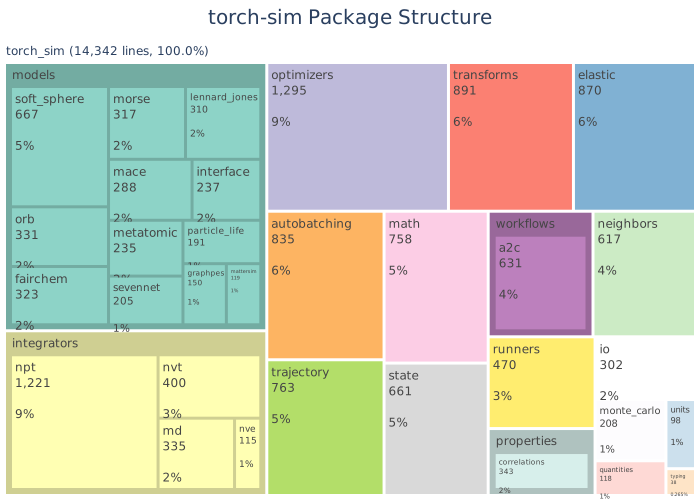
TorchSim's package structure is summarized in the API reference documentation and drawn as a treemap below.
Contributing
If you are interested in contributing, please join our slack and check out the contributing.md.
License
TorchSim is released under an MIT license.
Citation
If you use TorchSim in your research, please cite our publication.
Release history Release notifications | RSS feed


Download files
Download the file for your platform. If you're not sure which to choose, learn more about installing packages.
Source Distribution
Built Distribution
Filter files by name, interpreter, ABI, and platform.
If you're not sure about the file name format, learn more about wheel file names.
Copy a direct link to the current filters
File details
Details for the file torch_sim_atomistic-0.4.1.tar.gz.
File metadata
- Download URL: torch_sim_atomistic-0.4.1.tar.gz
- Upload date:
- Size: 166.0 kB
- Tags: Source
- Uploaded using Trusted Publishing? No
- Uploaded via: uv/0.7.12
File hashes
| Algorithm | Hash digest | |
|---|---|---|
| SHA256 |
ca32f5b30c64e27e6aff34e469ab01887228bea04331a35cb63bf6cec3234bca
|
|
| MD5 |
9fb17a51126cb46cea7f48042a7fdb08
|
|
| BLAKE2b-256 |
ac47334284456f3ca4c30d8386d308f78e6e347b9c823d10c5365644922a2d1e
|
File details
Details for the file torch_sim_atomistic-0.4.1-py3-none-any.whl.
File metadata
- Download URL: torch_sim_atomistic-0.4.1-py3-none-any.whl
- Upload date:
- Size: 196.8 kB
- Tags: Python 3
- Uploaded using Trusted Publishing? No
- Uploaded via: uv/0.7.12
File hashes
| Algorithm | Hash digest | |
|---|---|---|
| SHA256 |
b96f94f61a7e65d74598b2badd3796a86968c905c841da03995695b149355604
|
|
| MD5 |
0435a99604572dbbdae2b90df9560fcc
|
|
| BLAKE2b-256 |
4b98e01271de489966cdb909c8e1cfa3db8678d328df0eaaab58aaca6cd4d411
|






