








⚡ TorchEBM: simulation-free, GPU-first generative modeling in PyTorch
Composable primitives for scalable, stable training of modern EBMs, diffusion, flow matching, and Schrödinger bridges.
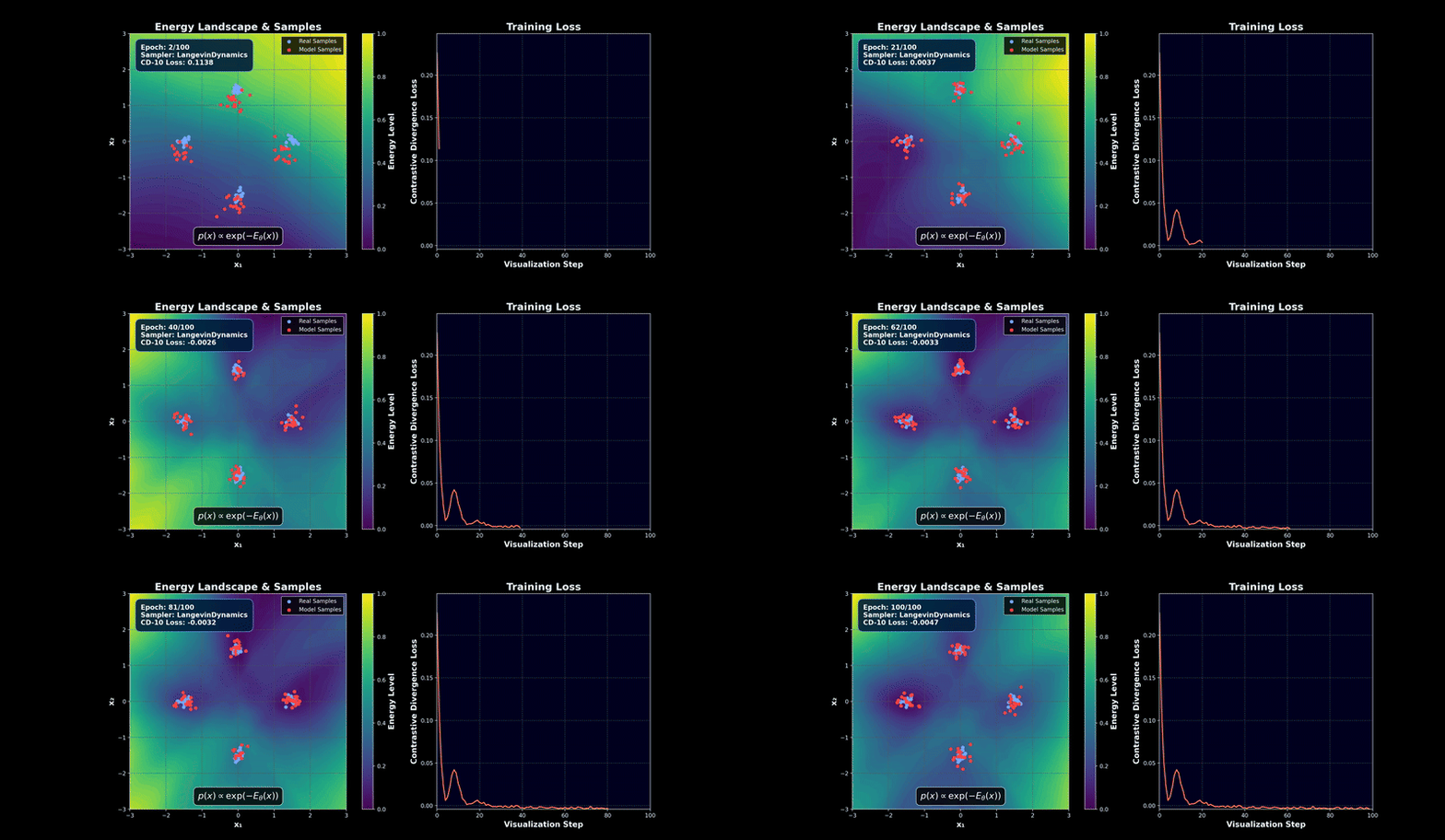
An energy landscape learning to place its low-energy basins on the data.
What is ∇ TorchEBM 🍓?
TorchEBM is a PyTorch library for simulation-free, GPU-first generative modeling: scalable, stable training of modern energy-based models, diffusion, flow matching, and Schrödinger bridges. Simulation-free objectives (flow matching, equilibrium matching, denoising score matching) fit the model with no sampler in the training loop, so training scales like supervised learning; sampling-based objectives (contrastive divergence) stay available where a calibrated energy is worth the MCMC. One set of composable primitives covers both.
TorchEBM takes the statistical-mechanics view of generative modeling. A system is described by a scalar potential $E_\theta(x)$, which induces a Boltzmann measure
$$p_\theta(x) ;\propto; e^{-E_\theta(x)/\varepsilon},$$
and generation is the act of relaxing a distribution toward that equilibrium, or of transporting one density onto another along a prescribed path. MCMC is relaxation toward equilibrium, diffusion and flow matching are prescribed transport between densities, and the recent hybrids parameterize the transport by the potential itself.
So TorchEBM implements the components once and lets the method be a configuration:
| Component | The question it answers | Package |
|---|---|---|
| Energy / field | what is the system? | torchebm.core, torchebm.models |
| Interpolant | along which path do noise and data connect? | torchebm.interpolants |
| Coupling | which noise sample is paired with which datum? | torchebm.couplings |
| Objective | how is the model fit to data? | torchebm.losses |
| Sampler | which dynamics produce samples? | torchebm.samplers |
| Integrator | how are those dynamics discretized? | torchebm.integrators |
Compose them one way and you have flow matching with optimal-transport couplings; another way and you have contrastive divergence with Langevin negatives; another and you have equilibrium matching, sampled as an ODE or descended as an energy. The Design and Scope page places every method family in this taxonomy, with references.
📚 Full documentation: the TorchEBM website · ⚡ Benchmarks dashboard
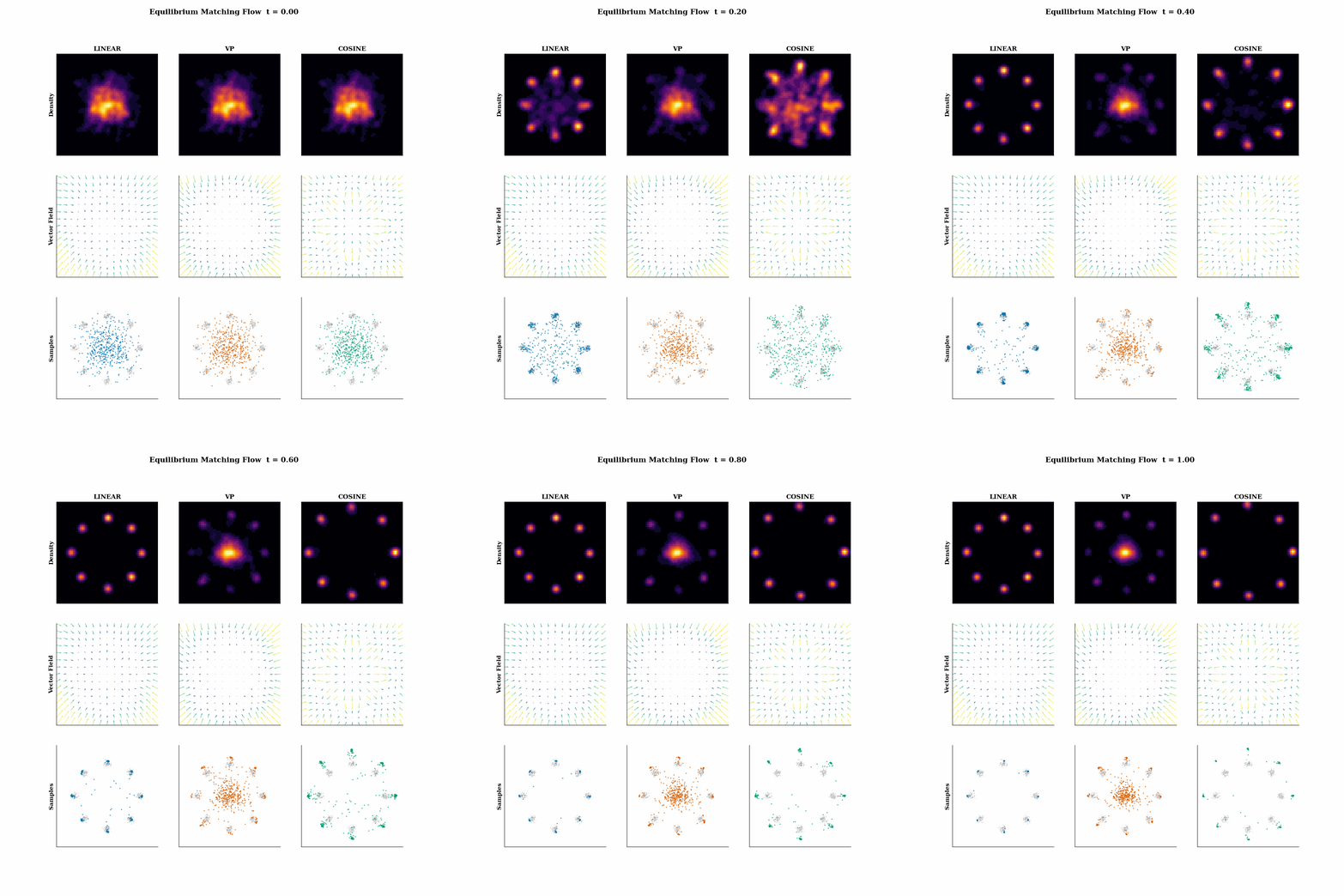
Equilibrium matching: a time-invariant field trained on eight gaussians, then integrated from noise with FlowSampler.
What's inside
Training objectives (torchebm.losses)
Sampling-based objectives buy a calibrated energy at the cost of MCMC in the loop; transport-based objectives are simulation-free, replacing that inner loop with regression along a path so training scales like supervised learning.
| Objective | Idea | Inner sampling |
|---|---|---|
ContrastiveDivergence |
push energy down on data, up on short-run MCMC negatives; persistent=True gives persistent CD with a replay buffer |
yes |
ScoreMatching |
match the model score to the data score | no |
DenoisingScoreMatching |
match the score of noise-perturbed data | no |
SlicedScoreMatching |
estimate the Hessian trace by random projections | no |
EquilibriumMatchingLoss |
learn a time-invariant equilibrium field; generate as an ODE or descend it as an energy | no |
EnergyMatchingLoss |
one time-independent potential: optimal-transport flow warm-up, then contrastive sharpening of its Boltzmann density | phase two only |
Samplers (torchebm.samplers)
| Sampler | Dynamics |
|---|---|
LangevinDynamics |
overdamped Langevin: gradient descent on the energy plus noise |
HamiltonianMonteCarlo |
Hamiltonian trajectories with a symplectic integrator and a Metropolis test |
RiemannianManifoldHMC |
HMC on a position-dependent metric, for ill-conditioned geometry |
GradientDescentSampler |
noise-free mode seeking |
NesterovSampler |
momentum-accelerated mode seeking |
FlowSampler |
continuous-time generation: mode="ode" (probability flow) or mode="sde" (diffusion), from velocity, score, or noise predictions |
Numerical integrators (torchebm.integrators)
Every sampler takes integrator= as a registry name or an instance, so the numerics are swappable without touching the model.
| Family | Integrators |
|---|---|
| Explicit Runge-Kutta | HeunIntegrator, Bosh3Integrator, RK4Integrator, RK438Integrator |
| Adaptive step size | AdaptiveHeunIntegrator, Dopri5Integrator, Dopri8Integrator |
| Stochastic (SDE) | EulerMaruyamaIntegrator, BackwardEulerMaruyamaIntegrator (implicit) |
| Symplectic (Hamiltonian) | LeapfrogIntegrator, GeneralisedLeapfrogIntegrator (non-separable) |
Paths and pairings (torchebm.interpolants, torchebm.couplings)
The path decides how noise becomes data; the coupling decides which noise becomes which datum. Straighter pairings mean straighter paths and fewer sampling steps.
| Interpolants | Couplings |
|---|---|
LinearInterpolant (flow matching) |
IndependentCoupling (the classical pairing) |
CosineInterpolant |
GreedyCoupling (nearest unmatched) |
VariancePreservingInterpolant (diffusion) |
SinkhornCoupling (entropic OT), ExactOTCoupling |
UnbalancedSinkhornCoupling (per-pair weights), ReflowCoupling (model-induced) |
And the rest
Energies (GaussianModel, DoubleWellModel, HarmonicModel, RastriginModel, AckleyModel, RosenbrockModel) with known statistics, so sampler behavior is measurable. Architectures (ConditionalTransformer2D, LabelClassifierFreeGuidance, InteractionModel) for image-scale energies and fields. Schedulers (CosineScheduler, WarmupScheduler, TemperatureScheduler, ...) for any parameter that should anneal. Datasets: eight synthetic 2D benchmarks. CUDA acceleration and mixed precision throughout.
Install
pip install torchebm
Usage
Each block below is one method, as published, in as few lines as it takes. Every snippet runs as-is. Annotated, full-scale versions of all of them live in the examples gallery, which is executed in CI. Simulation-free training comes first, sampling-based training after it, and the MCMC samplers that power both close the section.
Equilibrium matching
Equilibrium Matching: Generative Modeling with Implicit Energy-Based Models, Wang & Du 2025. Drop time conditioning: learn one equilibrium gradient field instead of a family of time-varying ones, then sample by integrating it or by simply descending it.
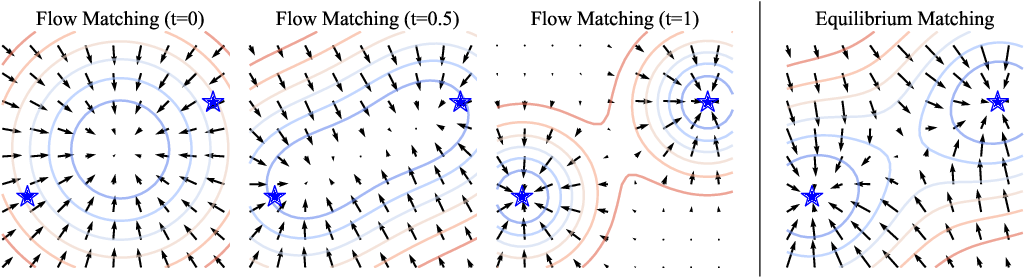
Fig. 1 of Wang & Du (2025): flow matching needs a different field at every $t$ (left); EqM learns one time-invariant field whose minima are the data (right), so sampling becomes optimization.
import torch
from torchebm.core import BaseModel
from torchebm.datasets import TwoMoonsDataset
from torchebm.losses import EquilibriumMatchingLoss
from torchebm.samplers import FlowSampler, NesterovSampler

data = TwoMoonsDataset(n_samples=3000, noise=0.05).get_data()
loss_fn = EquilibriumMatchingLoss(model=field, interpolant="linear", energy_type="dot")
opt = torch.optim.Adam(field.parameters(), lr=1e-3)

for _ in range(3000):
    loss = loss_fn(data[torch.randint(len(data), (256,))])
    opt.zero_grad(); loss.backward(); opt.step()

# generate by integrating the field ...
flow = FlowSampler(model=field, interpolant="linear",
                   negate_velocity=True, integrator="euler")
samples = flow.sample(x=torch.randn(1000, 2), n_steps=100)       # (1000, 2)

# ... or by descending it, because the field is the gradient of an energy
class LearnedEnergy(BaseModel):
    def __init__(self, net):
        super().__init__()
        self.net = net
    def forward(self, x):
        return (x * self.net(x, torch.zeros(x.shape[0]))).sum(-1)

modes = NesterovSampler(LearnedEnergy(field), step_size=0.01,
                        momentum=0.9).sample(n_samples=1000, dim=2, n_steps=200)
Energy matching
Energy Matching: Unifying Flow Matching and Energy-Based Models, Balcerak et al. 2025. One time-independent potential does both jobs: an optimal-transport flow warm-up shapes it far from the data, then a contrastive phase sharpens its Boltzmann density near the data. Generation is a single temperature-scheduled Langevin sweep.
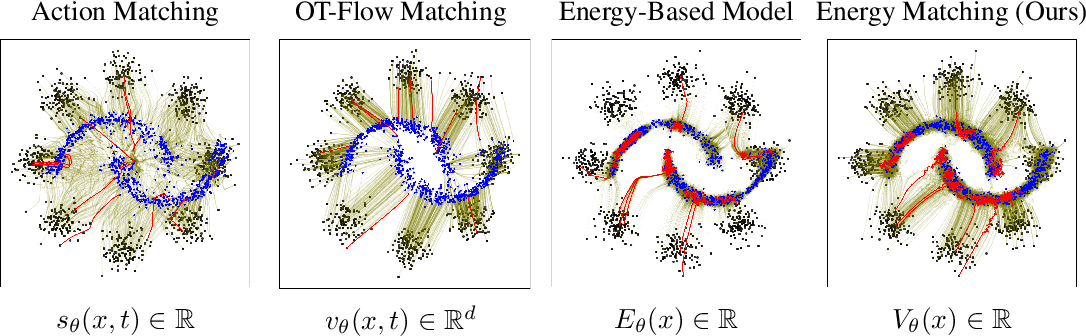
Fig. 1 of Balcerak et al. (2025): a time-independent potential $V_\theta(x)$ (right) both transports and equilibrates, where flow matching needs $v_\theta(x, t)$ and a plain EBM needs long MCMC. Reproduced in the examples.
from torchebm.core import TemperatureScheduler
from torchebm.couplings import SinkhornCoupling
from torchebm.losses import EnergyMatchingLoss
from torchebm.samplers import LangevinDynamics

loss_fn = EnergyMatchingLoss(model=potential, coupling=SinkhornCoupling(reg=0.01),
                             lambda_cd=0.0,          # phase 1: pure OT flow matching
                             epsilon_max=0.15, tau_star=0.8)

for step in range(22_000):
    if step == 20_000:
        loss_fn.lambda_cd = 2.0                      # phase 2: contrastive sharpening
    loss = loss_fn(data[torch.randint(len(data), (128,))])
    opt.zero_grad(); loss.backward(); opt.step()

temperature = TemperatureScheduler(epsilon_max=0.15, tau_star=0.8, n_steps=200, t_end=1.0)
samples = LangevinDynamics(model=potential, step_size=0.01,
                           noise_scale=temperature).sample(x=torch.randn(4000, 2), n_steps=200)
Flow matching
Flow Matching for Generative Modeling, Lipman et al. 2023. Regress a velocity field onto the conditional velocity of a probability path. With TorchEBM's primitives, that is the loop itself.

Fig. 2 of Lipman et al. (2023): the diffusion path's conditional score (left) against the OT path's conditional vector field (right). Choosing between them is choosing the interpolant.
from torchebm.interpolants import LinearInterpolant
from torchebm.samplers import FlowSampler

interpolant = LinearInterpolant()

x1 = data[torch.randint(len(data), (256,))]     # (b, 2) data
x0 = torch.randn_like(x1)                       # (b, 2) noise
t = torch.rand(x1.shape[0])                     # (b,)

xt, ut = interpolant.interpolate(x0, x1, t)     # (b, 2), (b, 2)
loss = (field(xt, t) - ut).pow(2).mean()

samples = FlowSampler(model=field, interpolant="linear",
                      integrator="heun").sample(x=torch.randn(1000, 2), n_steps=50)
Swap interpolant="vp" and mode="sde" and the same sampler runs score-based diffusion (Song et al. 2021); prediction= selects whether the network emits velocity, score, or noise.
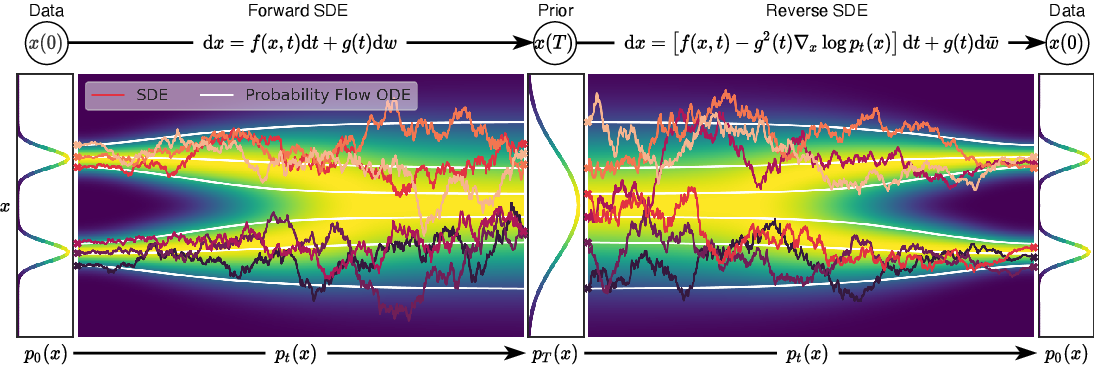
Fig. 2 of Song et al. (2021): the reverse SDE and its probability-flow ODE are the two modes of one sampler (mode="sde" and mode="ode").
diffusion = FlowSampler(model=field, mode="sde", interpolant="vp", prediction="noise")
samples = diffusion.sample(x=torch.randn(1000, 2), n_steps=250)
Optimal-transport couplings
Improving and generalizing flow-based generative models with minibatch optimal transport, Tong et al. 2024. Pair each noise sample with the right datum and the paths straighten, so generation needs fewer steps.

Fig. 1 of Tong et al. (2024): an OT coupling turns crossing, curved transport into straight transport. Same objective, different coupling=.
from torchebm.couplings import SinkhornCoupling, ExactOTCoupling

coupling = SinkhornCoupling(reg=0.05)           # entropic OT; or ExactOTCoupling()
x0, x1 = coupling(x0, x1)                       # re-paired, then interpolate as above
Rectified flow
Flow Straight and Fast, Liu et al. 2023. Retrain on the flow's own (noise, generation) pairs and the trajectories become straight enough for few-step sampling.

Fig. 2 of Liu et al. (2023): paths that cross (left) are rewired by the flow's own pairing into straight ones (right). That rewiring is ReflowCoupling.
from torchebm.couplings import ReflowCoupling

reflow = ReflowCoupling(flow, n_steps=50)       # flow: a trained FlowSampler
x0, x1 = reflow(torch.randn(256, 2))            # x1 = Phi(x0), the model's own output
Contrastive divergence
Training products of experts by minimizing contrastive divergence, Hinton 2002, with the deep-EBM recipe of Du & Mordatch 2019. Push the energy down on data and up on short-run MCMC negatives.
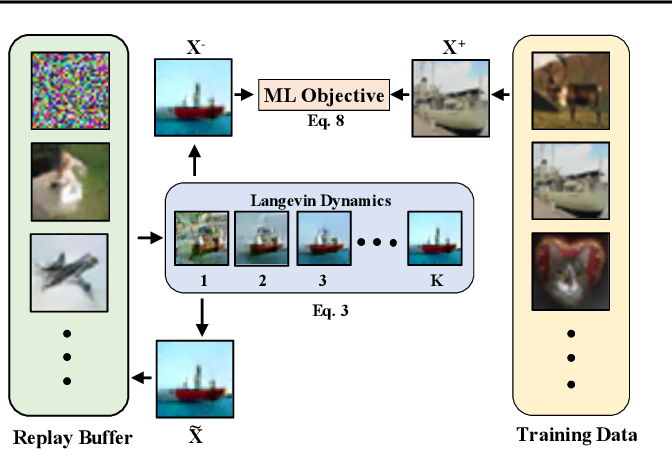
Fig. 1 of Du & Mordatch (2019): Langevin draws the negatives, the buffer persists the chains, the objective separates them from data. That is ContrastiveDivergence(sampler=..., persistent=True).
import torch
from torch import nn
from torchebm.core import BaseModel
from torchebm.datasets import TwoMoonsDataset
from torchebm.losses import ContrastiveDivergence
from torchebm.samplers import LangevinDynamics

class MLPEnergy(BaseModel):                     # E(x): (b, 2) -> (b,)
    def __init__(self):
        super().__init__()
        self.net = nn.Sequential(nn.Linear(2, 128), nn.SiLU(), nn.Linear(128, 1))
    def forward(self, x):
        return self.net(x).squeeze(-1)

data = TwoMoonsDataset(n_samples=3000, noise=0.05).get_data()
energy = MLPEnergy()
sampler = LangevinDynamics(model=energy, step_size=0.1, noise_scale=1.0)

cd = ContrastiveDivergence(model=energy, sampler=sampler, k_steps=10)  # CD-10
opt = torch.optim.Adam(energy.parameters(), lr=1e-3)

for _ in range(1000):
    loss, negatives = cd(data[torch.randint(len(data), (256,))])   # (b, 2)
    opt.zero_grad(); loss.backward(); opt.step()
Persistent CD (Tieleman 2008) is one flag: chains resume from a replay buffer instead of restarting at the data.
cd = ContrastiveDivergence(model=energy, sampler=sampler, k_steps=10,
                           persistent=True, buffer_size=8192)
Score matching
Estimation of non-normalized statistical models by score matching, Hyvärinen 2005. No MCMC at all: fit $\nabla_x \log p_\theta$ directly. Denoising (Vincent 2011) and sliced (Song et al. 2019) variants avoid the Hessian trace.
from torchebm.losses import ScoreMatching, DenoisingScoreMatching, SlicedScoreMatching

loss_fn = ScoreMatching(model=energy, hessian_method="exact")
loss_fn = DenoisingScoreMatching(model=energy, noise_scale=0.1)
loss_fn = SlicedScoreMatching(model=energy, n_projections=5)

loss = loss_fn(data[:256])                      # scalar; no sampler needed
Sampling an energy
Langevin dynamics: descend the energy, add noise, repeat. Chains are a batch dimension, so 10,000 of them cost one integer. The same samplers that generate from a trained energy also draw the negatives inside ContrastiveDivergence.
import torch
from torchebm.core import GaussianModel
from torchebm.samplers import LangevinDynamics

model = GaussianModel(mean=torch.zeros(2), cov=torch.tensor([[1., .8], [.8, 1.]]))
sampler = LangevinDynamics(model=model, step_size=0.02, noise_scale=1.0)

samples = sampler.sample(dim=2, n_samples=10_000, n_steps=500)  # (10000, 2)
Hamiltonian Monte Carlo
MCMC using Hamiltonian dynamics, Neal 2011. Momentum plus a symplectic integrator buys long, decorrelated proposals.
from torchebm.samplers import HamiltonianMonteCarlo

hmc = HamiltonianMonteCarlo(model=model, step_size=0.1, n_leapfrog_steps=10)

samples, diagnostics = hmc.sample(dim=2, n_samples=1000, n_steps=500,
                                  return_diagnostics=True)
diagnostics["acceptance_rate"].mean()   # scalar
Riemannian manifold HMC
Riemann manifold Langevin and Hamiltonian Monte Carlo, Girolami & Calderhead 2011. A position-dependent metric makes the geometry local; the non-separable Hamiltonian is solved by an implicit generalised leapfrog.
from torchebm.samplers import RiemannianManifoldHMC

def metric_fn(x):                                   # (b, d) -> (b, d, d), SPD
    scale = 1.0 + x.pow(2).sum(-1)[:, None, None]
    return torch.eye(2).expand(x.shape[0], 2, 2) * scale

rmhmc = RiemannianManifoldHMC(model=model, metric_fn=metric_fn,
                              step_size=0.05, n_leapfrog_steps=5)
samples = rmhmc.sample(dim=2, n_samples=1000, n_steps=200)
Image-scale backbones
A DiT-style conditional transformer (Peebles & Xie 2023) for energies and velocity fields on images, adaLN-Zero blocks included. LabelClassifierFreeGuidance wraps any label-conditioned model base(x, t, y=...) for classifier-free guidance (Ho & Salimans 2022).
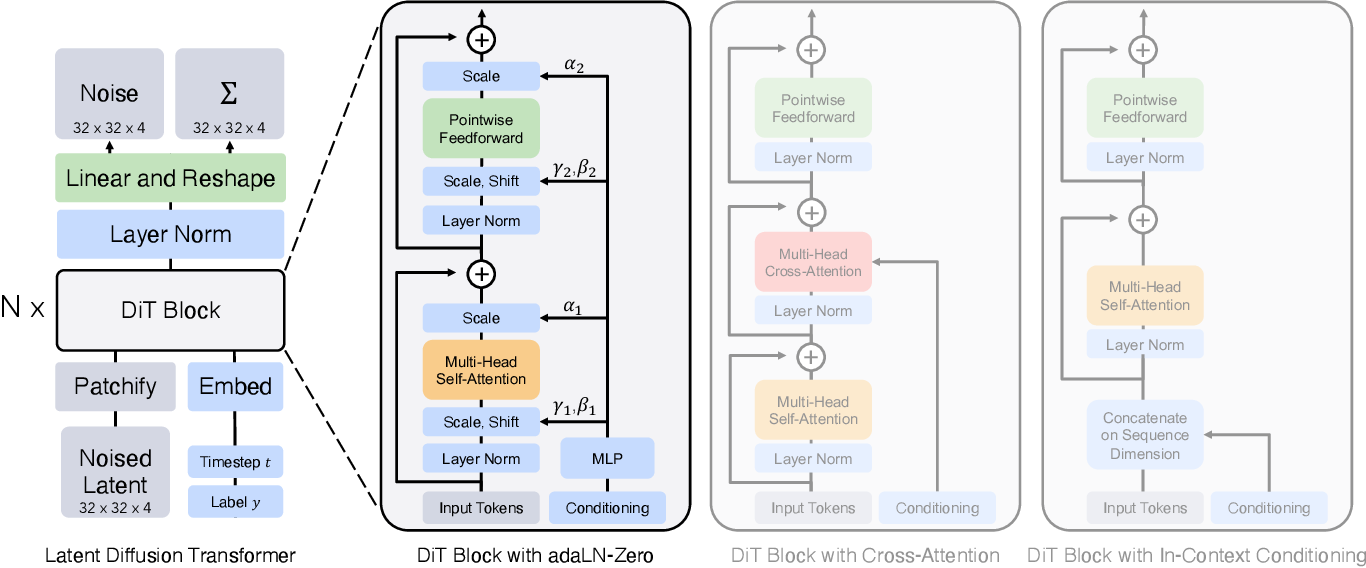
Fig. 3 of Peebles & Xie (2023): the DiT block with adaLN-Zero conditioning, shipped as ConditionalTransformer2D and AdaLNZeroBlock.
from torchebm.models import ConditionalTransformer2D

net = ConditionalTransformer2D(in_channels=3, out_channels=3, input_size=32,
                               patch_size=4, embed_dim=384, depth=12, num_heads=6,
                               cond_dim=10)
out = net(torch.randn(8, 3, 32, 32), cond=torch.randn(8, 10))    # (8, 3, 32, 32)
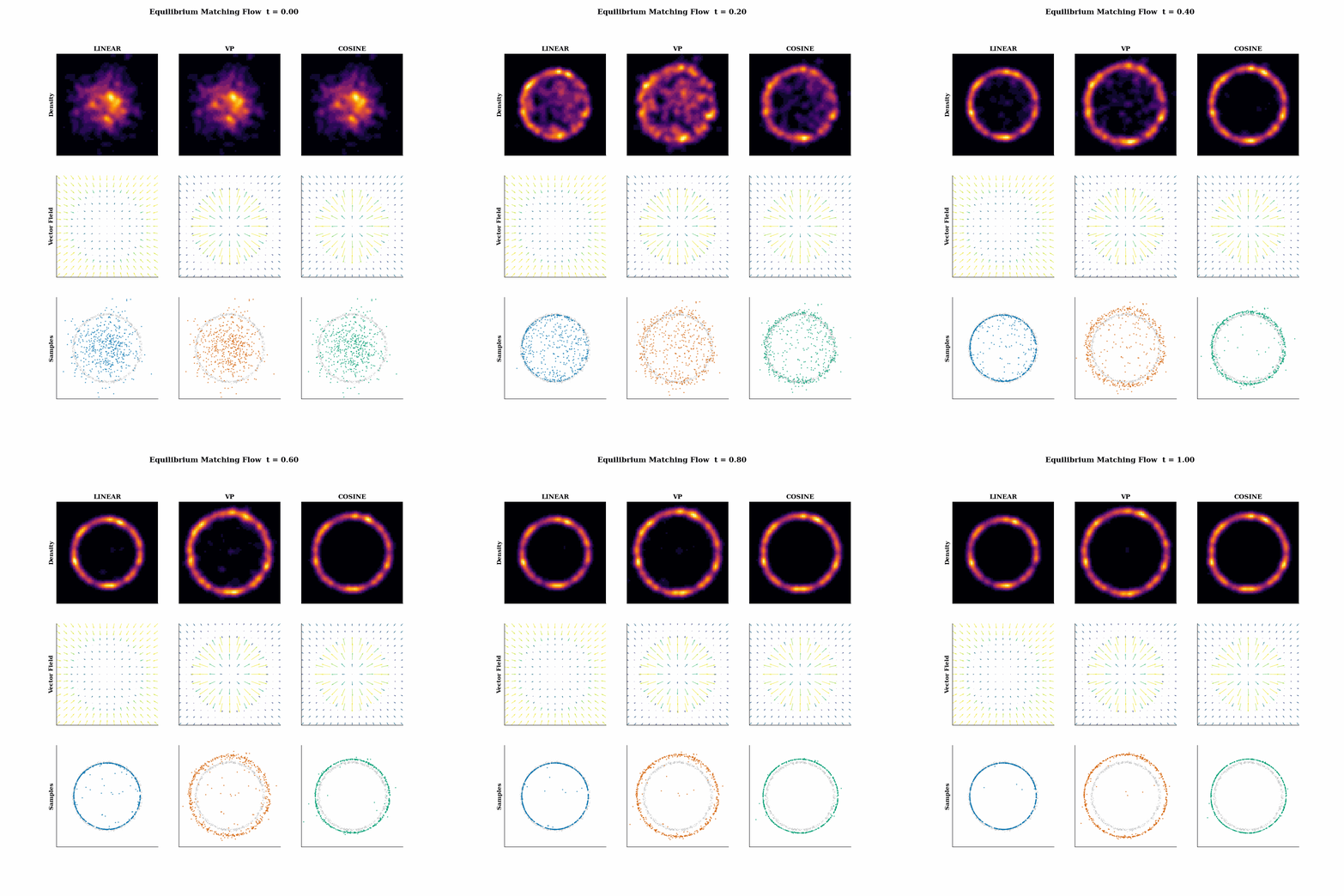
One objective, three interpolants (linear, variance-preserving, cosine): the path changes, the code does not.
Examples
The examples/ tree is a tiered, runnable curriculum, executed in CI so it cannot drift from the library. Browse it on the website.
| Tier | You learn to |
|---|---|
00-foundations/ |
work with energies, datasets, schedulers, and interpolants |
10-sampling/ |
sample a fixed target with MCMC, parallel chains, integrators, and flows |
20-training/ |
learn a target: CD, persistent CD, score matching, equilibrium and energy matching, couplings |
90-showcase/ |
study end-to-end demos that push the components |
python examples/10-sampling/01-mcmc/01-langevin-101/main.py
Contributing
Contributions are welcome. Please read the CONTRIBUTING.md guide before getting started. The Developer Guide covers setup, architecture, and the PR workflow; adding an example is a good first contribution. Check the issues for open tasks, several labelled good first issue.
Show your support for ∇ TorchEBM 🍓
If TorchEBM helps your research, please ⭐️ the repository and spread the word. It genuinely helps others find the project.
Citation
If TorchEBM is useful in your research, please cite it:
@misc{ghaderi2024torchebm,
  author       = {Ghaderi, Soran},
  title        = {{TorchEBM}: A Composable {PyTorch} Library for Energy-Based and Transport-Based Generative Models},
  year         = {2024},
  howpublished = {\url{https://github.com/soran-ghaderi/torchebm}},
}
References
@article{hinton2002training,
  title   = {Training products of experts by minimizing contrastive divergence},
  author  = {Hinton, Geoffrey E.},
  journal = {Neural Computation},
  volume  = {14},
  number  = {8},
  year    = {2002},
}
@article{hyvarinen2005estimation,
  title   = {Estimation of non-normalized statistical models by score matching},
  author  = {Hyv{\"a}rinen, Aapo},
  journal = {Journal of Machine Learning Research},
  volume  = {6},
  year    = {2005},
}
@article{vincent2011connection,
  title   = {A connection between score matching and denoising autoencoders},
  author  = {Vincent, Pascal},
  journal = {Neural Computation},
  volume  = {23},
  number  = {7},
  year    = {2011},
}
@article{girolami2011riemann,
  title   = {Riemann manifold {L}angevin and {H}amiltonian {M}onte {C}arlo methods},
  author  = {Girolami, Mark and Calderhead, Ben},
  journal = {Journal of the Royal Statistical Society: Series B},
  volume  = {73},
  number  = {2},
  year    = {2011},
}
@inproceedings{song2019sliced,
  title   = {Sliced Score Matching: A Scalable Approach to Density and Score Estimation},
  author  = {Song, Yang and Garg, Sahaj and Shi, Jiaxin and Ermon, Stefano},
  year    = {2019},
  eprint  = {1905.07088},
  url     = {https://arxiv.org/abs/1905.07088},
}
@inproceedings{du2019implicit,
  title   = {Implicit Generation and Generalization in Energy-Based Models},
  author  = {Du, Yilun and Mordatch, Igor},
  year    = {2019},
  eprint  = {1903.08689},
  url     = {https://arxiv.org/abs/1903.08689},
}
@inproceedings{song2021scorebased,
  title   = {Score-Based Generative Modeling through Stochastic Differential Equations},
  author  = {Song, Yang and Sohl-Dickstein, Jascha and Kingma, Diederik P. and Kumar, Abhishek and Ermon, Stefano and Poole, Ben},
  year    = {2021},
  eprint  = {2011.13456},
  url     = {https://arxiv.org/abs/2011.13456},
}
@inproceedings{lipman2023flow,
  title   = {Flow Matching for Generative Modeling},
  author  = {Lipman, Yaron and Chen, Ricky T. Q. and Ben-Hamu, Heli and Nickel, Maximilian and Le, Matt},
  year    = {2023},
  eprint  = {2210.02747},
  url     = {https://arxiv.org/abs/2210.02747},
}
@inproceedings{liu2023flow,
  title   = {Flow Straight and Fast: Learning to Generate and Transfer Data with Rectified Flow},
  author  = {Liu, Xingchao and Gong, Chengyue and Liu, Qiang},
  year    = {2023},
  eprint  = {2209.03003},
  url     = {https://arxiv.org/abs/2209.03003},
}
@article{albergo2023stochastic,
  title   = {Stochastic Interpolants: A Unifying Framework for Flows and Diffusions},
  author  = {Albergo, Michael S. and Boffi, Nicholas M. and Vanden-Eijnden, Eric},
  year    = {2023},
  eprint  = {2303.08797},
  url     = {https://arxiv.org/abs/2303.08797},
}
@article{tong2024improving,
  title   = {Improving and generalizing flow-based generative models with minibatch optimal transport},
  author  = {Tong, Alexander and Fatras, Kilian and Malkin, Nikolay and Huguet, Guillaume and Zhang, Yanlei and Rector-Brooks, Jarrid and Wolf, Guy and Bengio, Yoshua},
  journal = {Transactions on Machine Learning Research},
  year    = {2024},
  eprint  = {2302.00482},
  url     = {https://arxiv.org/abs/2302.00482},
}
@article{wang2025equilibrium,
  title   = {Equilibrium Matching: Generative Modeling with Implicit Energy-Based Models},
  author  = {Wang, Runqian and Du, Yilun},
  year    = {2025},
  eprint  = {2510.02300},
  url     = {https://arxiv.org/abs/2510.02300},
}
@article{balcerak2025energy,
  title   = {Energy Matching: Unifying Flow Matching and Energy-Based Models for Generative Modeling},
  author  = {Balcerak, Michal and Amiranashvili, Tamaz and Terpin, Antonio and Shit, Suprosanna and Bogensperger, Lea and Kaltenbach, Sebastian and Koumoutsakos, Petros and Menze, Bjoern},
  year    = {2025},
  eprint  = {2504.10612},
  url     = {https://arxiv.org/abs/2504.10612},
}
@inproceedings{peebles2023scalable,
  title   = {Scalable Diffusion Models with Transformers},
  author  = {Peebles, William and Xie, Saining},
  year    = {2023},
  eprint  = {2212.09748},
  url     = {https://arxiv.org/abs/2212.09748},
}
@article{debortoli2021diffusion,
  title   = {Diffusion {S}chr{\"o}dinger Bridge with Applications to Score-Based Generative Modeling},
  author  = {De Bortoli, Valentin and Thornton, James and Heng, Jeremy and Doucet, Arnaud},
  year    = {2021},
  eprint  = {2106.01357},
  url     = {https://arxiv.org/abs/2106.01357},
}
Changelog
See CHANGELOG for version history.
License
MIT License. See LICENSE for details.
Research collaboration
If you are interested in collaborating on research around energy-based, flow-based, or diffusion models, feel free to reach out. Contributions to TorchEBM 🍓 and discussions that push the field forward are always welcome.
1 maintainer

Metadata
1 maintainer
Release files for torchebm 0.8.9
For a detailed explanation of source distributions (sdists) and built distributions (wheels), please see the package formats documentation.
Source distribution (sdist)
| File | Size | Uploaded | |
|---|---|---|---|
| torchebm-0.8.9.tar.gz | 213.5 kB | Details |
Built distribution (wheel)
| File | Interpreter | ABI | Platform | Reset |
|---|---|---|---|---|
| torchebm-0.8.9-py3-none-any.whl | Python 3 | none | any | Details |
Total release size: 407.4 kB
Release files / torchebm-0.8.9.tar.gz
| Download URL | torchebm-0.8.9.tar.gz |
|---|---|
| Size | 213.5 kB |
| Tags | Source |
|
SHA-256 checksum How to use checksums |
bfe57c8e673b3ec5160850ca201b0c5352164e73a6072efe46701f70b0345d5b
|
|
BLAKE2b-256 checksum How to use checksums |
3f54d78fbf78621164c2a6e996dec7d7f71ceeb7a50bb73e1d063e712dd7b11c
|
| Upload date | |
|
Uploaded using Trusted Publishing? What is trusted publishing? |
No |
| Uploaded via |
twine/7.0.0 CPython/3.13.14
|
Release files / torchebm-0.8.9-py3-none-any.whl
| Download URL | torchebm-0.8.9-py3-none-any.whl |
|---|---|
| Size | 193.9 kB |
| Tags | Python 3 |
|
SHA-256 checksum How to use checksums |
571517b3342fbf312e5a1dc42cf51fe8783f1430ea4e9b3bedb7f5af603f4238
|
|
BLAKE2b-256 checksum How to use checksums |
130d53064863f5ac5043e9213ef955aea01267944f1751c2e4b26cdeb70d9301
|
| Upload date | |
|
Uploaded using Trusted Publishing? What is trusted publishing? |
No |
| Uploaded via |
twine/7.0.0 CPython/3.13.14
|














