
GPU-accelerated photometric preprocessing with UMI detrending for exoplanet transit searches

Project description
TorchFlat
GPU-native photometric preprocessing pipeline for exoplanet transit searches.


TorchFlat replaces the standard CPU preprocessing workflow (quality filtering, gap handling, sigma clipping, detrending, normalization, and windowing) with a GPU-accelerated pipeline. It uses UMI (Unified Median Iterative), a novel asymmetric robust location estimator implemented as a fused HIP/CUDA kernel, to detrend light curves faster and more accurately than existing methods.
Performance
Benchmarked on AMD Radeon RX 9060 XT (16 GB VRAM) with real TESS sector 6 data (19,618 stars):
| Method | Rate | Full Sector | Speedup |
|---|---|---|---|
| Celix wotan 12-worker | 4.2 stars/sec | ~78 min | baseline |
| TorchFlat v0.5.0 (hybrid) | 59.3 stars/sec | ~5.5 min | 14.2x |
| TorchFlat + UMI kernel | 154 stars/sec | ~2.1 min | 37x |
Transit Depth Recovery Accuracy
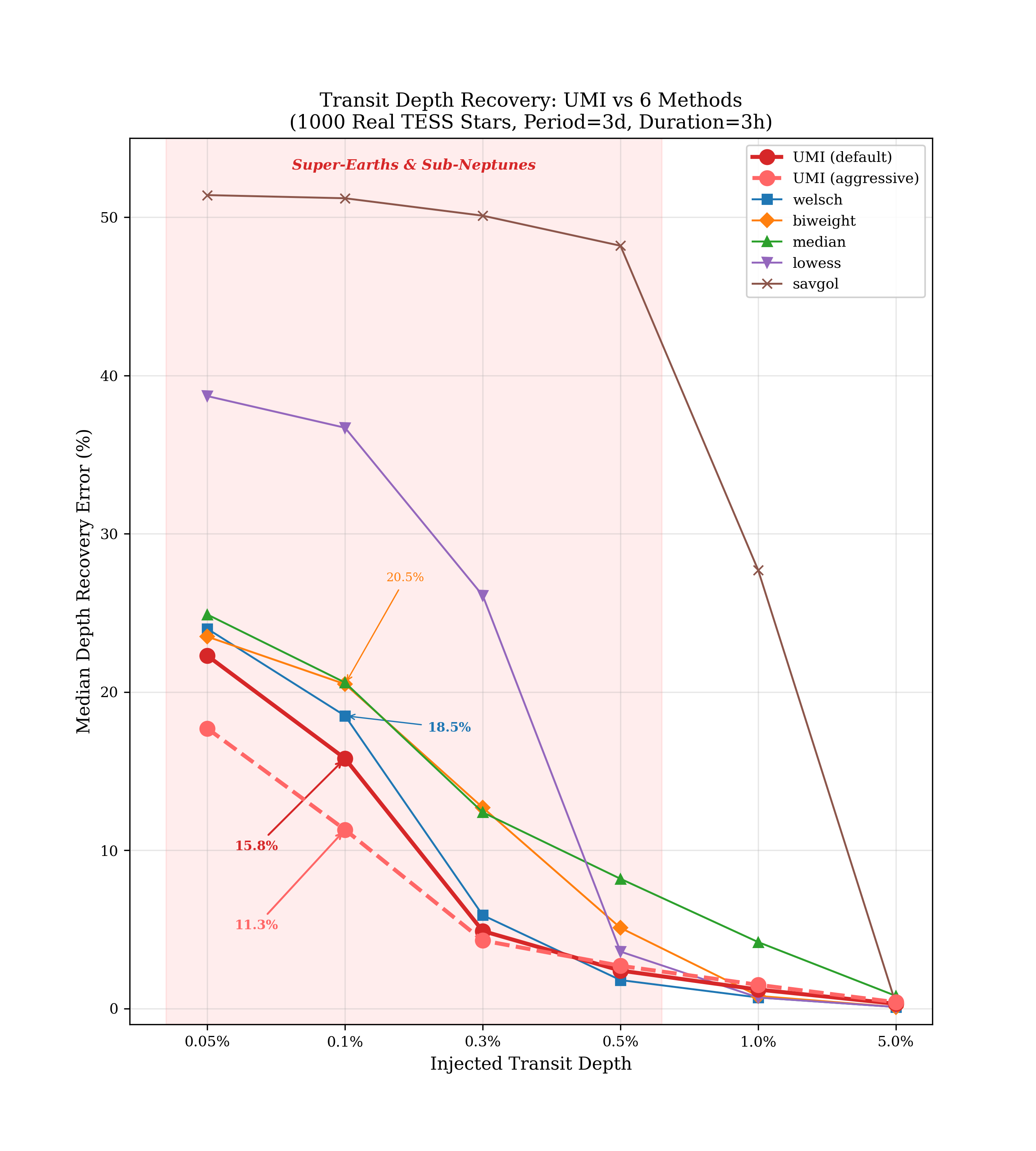
Injection-recovery test on 1000 real TESS stars, median per-star error (lower = better):
| Depth | wotan biweight | wotan welsch | TorchFlat UMI | Winner |
|---|---|---|---|---|
| 0.05% (Earth-size) | 23.5% | 24.0% | 22.3% | TorchFlat |
| 0.1% (super-Earths) | 20.5% | 18.5% | 15.8% | TorchFlat |
| 0.3% (sub-Neptunes) | 12.7% | 5.9% | 4.9% | TorchFlat |
| 0.5% (Neptunes) | 5.1% | 1.8% | 2.4% | welsch |
| 1.0% (hot Jupiters) | 0.8% | 0.7% | 1.2% | welsch |
| 5.0% (deep transits) | 0.1% | 0.1% | 0.3% | both perfect |
TorchFlat is more accurate at the transit depths where most detectable planets live (0.05-0.3%). Per-star detrending is 69x faster (3.4ms vs 234ms).
Known Planet Recovery
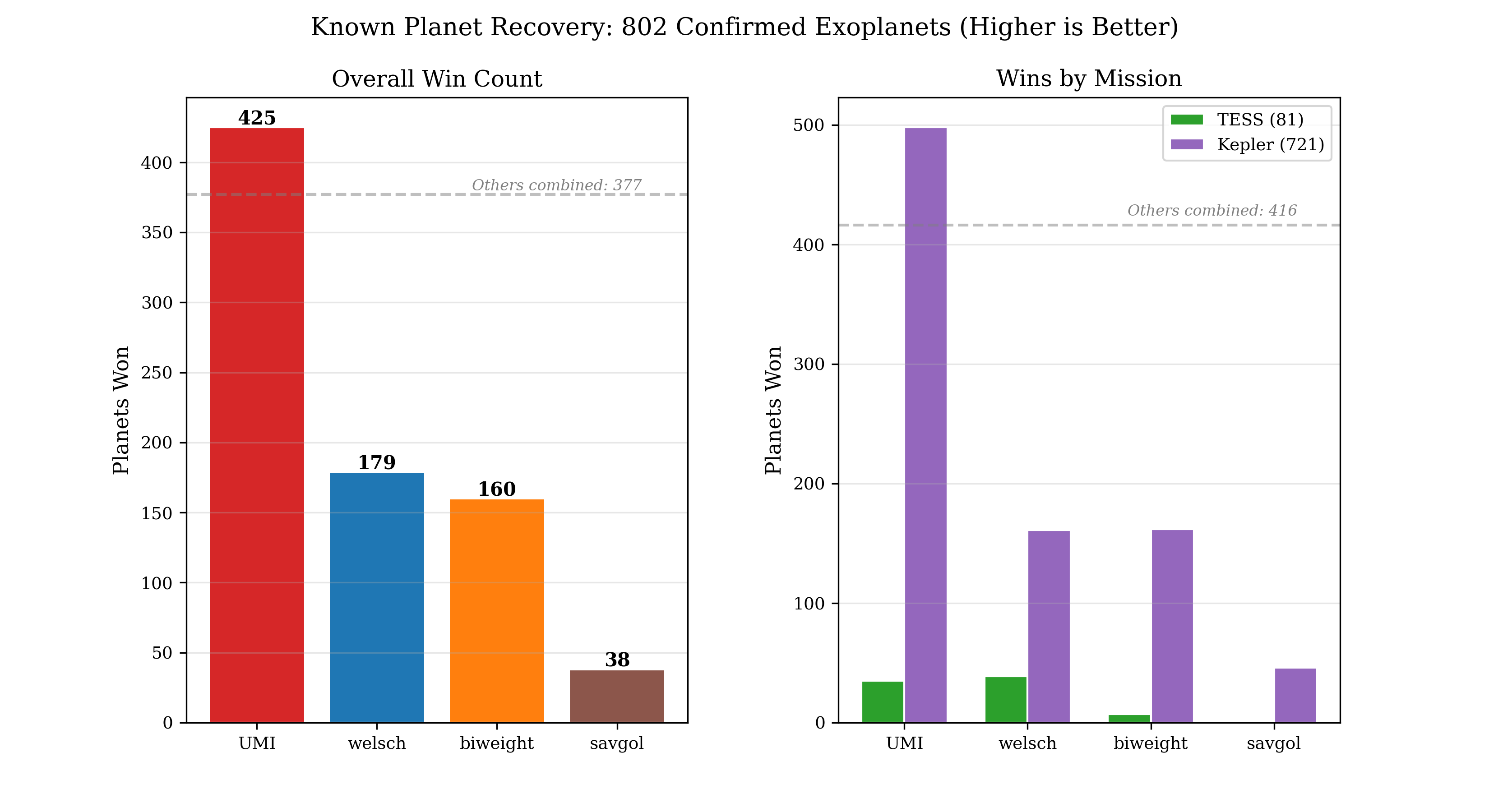
Validated on 802 confirmed exoplanets (81 TESS + 721 Kepler). UMI recovers more planets (425) than biweight, Welsch, and Savitzky-Golay combined (377).
Speed
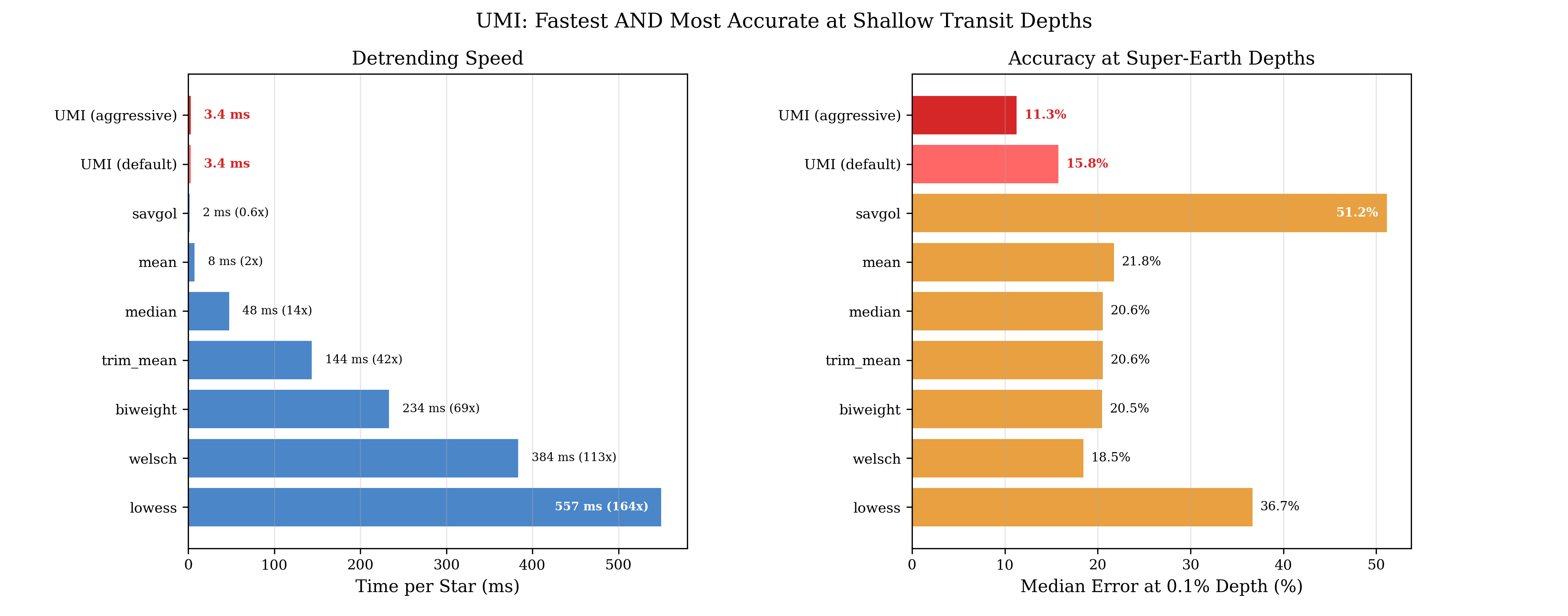
Validated on 8 TESS sectors, 4 Kepler quarters (Q2, Q5, Q9, Q17), K2, and 10,000-star parameter validation. All results with 95% bootstrap confidence intervals. Full data in results/.
The UMI Algorithm
UMI (Unified Median Iterative) is a three-phase robust location estimator:
- Quickselect median -- exact median via O(n) selection algorithm, computed per-thread on GPU
- Upper-RMS scale -- RMS of points above the median only. Transit dips never contaminate the scale estimate, giving a tighter and more accurate noise measurement than standard MAD
- Asymmetric bisquare iterations -- weighted location refinement where downward deviations (transit dips) are penalized 2x more than upward ones
The asymmetric weight function exploits the fact that transits are always below the continuum. Standard biweight treats dips and spikes equally. UMI penalizes dips more aggressively, so the trend stays above the transit and transit depth is preserved.
All three phases run in a single fused GPU kernel call -- median, upper-RMS, and 5 iterations happen per-thread with zero global memory traffic between steps.
When the GPU kernel is not available (no ROCm/CUDA toolkit), UMI falls back to a pure-PyTorch path using torch.sort for median + upper-RMS scale.
Installation
pip install torchflat
Or from source:
git clone https://github.com/omarkhan2217/TorchFlat.git
cd TorchFlat
pip install -e .
Requirements: PyTorch >= 2.1.0, NumPy >= 1.24.0, SciPy >= 1.10.0
Works with both NVIDIA CUDA and AMD ROCm (via PyTorch's unified CUDA API). The UMI kernel compiles automatically on first use via JIT (requires ROCm SDK or CUDA toolkit).
Quick Start
Process a TESS sector
import numpy as np
import torchflat

star_data = [
    {
        "time": np.load("star_001_time.npy"),
        "pdcsap_flux": np.load("star_001_pdcsap.npy"),
        "sap_flux": np.load("star_001_sap.npy"),
        "quality": np.load("star_001_quality.npy"),
    }
    # ... for each star in the sector
]

results, skipped = torchflat.preprocess_sector(
    star_data,
    device="cuda",
)

for i, result in enumerate(results):
    if not result:
        continue
    windows = result["windows_2048"]
    trend = result["trend"]
Standalone UMI detrending
import torch
from torchflat import umi_detrend

# flux, time, valid_mask, segment_id are [B, L] tensors on GPU
detrended, trend = umi_detrend(
    flux, time, valid_mask, segment_id,
    window_length_days=0.5,
    asymmetry=2.0,       # 2.0=best accuracy, 1.0=variable stars, 1.5=mixed
)
Architecture
TorchFlat implements two processing tracks:
- Track A (Transit Search): Quality filter > gap interpolation > sigma clipping > UMI detrending > normalization > multi-scale window extraction
- Track B (Anomaly Detection): Quality filter > gap interpolation > conservative clipping > FFT highpass filter > MAD normalization > fixed-length padding
UMI kernel
The direct HIP/CUDA kernel (torchflat/csrc/umi_kernel.cu) runs one thread per (star, window position) pair. Each thread reads directly from the raw [B, L] flux array, no unfold or tensor copies needed:
- Reads W values from raw flux, checks segment validity inline
- Quickselect for exact median (O(n))
- Upper-RMS scale from above-median points (no sort needed)
- 5 asymmetric bisquare iterations
- Writes the final location estimate
VRAM usage: 319 MB for a 50-star batch. The kernel compiles via JIT on first import and is cached for subsequent runs.
Validation
All validation results are saved as JSON in results/:
| Validation | Result | File |
|---|---|---|
| Asymmetry train/test split | optimal=2.0, validated on 2000+10,000 stars | asymmetry_validation_2k.json |
| Known planet recovery | UMI wins 425/802 confirmed planets (53%), more than all others combined | known_planet_recovery_all.json |
| Multi-sector consistency | UMI wins 9/15 across sectors 6, 7, 12 (2000 stars each) | multisector_validation_2k.json |
| Multi-mission | Kepler: 10.5% vs wotan 36.6% at 0.1%. K2: 4.5% vs 46.6% at 0.5% | multi_mission.json |
| Kepler multi-quarter | Q2=3.7%, Q5=4.2%, Q9=4.5%, Q17=5.2% at 0.1% (consistent) | kepler_multi_quarter.json |
| Method comparison | UMI #1 at 0.1% vs 8 methods (biweight, welsch, lowess, etc.) | method_comparison.md |
135/135 unit tests passing.
CLI
# Detrend a TESS sector
torchflat umi_detrend --input /path/to/fits/

# Detrend a single star
torchflat umi_detrend --input star.fits --output-format fits

# Kepler data
torchflat umi_detrend --input /path/to/kepler/ --mission kepler

# Plot a star
torchflat plot --fits star.fits --save output.png

# Speed benchmark
torchflat benchmark --input /path/to/fits/ --n-stars 500
Benchmarks
# Full sector speed benchmark
python benchmarks/bench_real_tess.py --data-dir /path/to/fits/sector_6 --n-stars 19618

# Asymmetry parameter validation
python benchmarks/validate_asymmetry.py

# Known planet recovery
python benchmarks/validate_known_planets.py

# Multi-sector validation
python benchmarks/validate_multisector.py
Note: Set $env:TORCHFLAT_NO_KERNEL = "0" (PowerShell) or export TORCHFLAT_NO_KERNEL=0 (bash) to enable the UMI kernel.
API Reference
Main Entry Points
torchflat.preprocess_sector(star_data, ...)-- Full pipeline (Track A + Track B).torchflat.preprocess_track_a(times, fluxes, qualities, ...)-- Track A only.torchflat.preprocess_track_b(times, sap_fluxes, qualities, ...)-- Track B only.torchflat.umi_detrend(flux, time, valid_mask, segment_id, ...)-- Standalone UMI kernel.
Key Parameters
| Parameter | Default | Description |
|---|---|---|
device |
"cuda" |
Torch device |
window_length_days |
0.5 |
Sliding window width (days) |
asymmetry |
2.0 |
Dip penalty: 2.0 (TESS), 3.0 (Kepler), 1.0 (variable stars -- avoids -7240 ppm bias) |
n_iter |
5 |
Number of bisquare iterations |
cval |
5.0 |
Rejection threshold in MAD units |
skip_track_b |
False |
Skip Track B (FFT highpass) |
window_scales |
4 scales | [(256,128), (512,256), (2048,512), (8192,2048)] |
dtype |
float32 |
Computation precision |
Limitations
- Tested on AMD and NVIDIA. HIP kernel validated on AMD RX 9060 XT (ROCm 7.2). CUDA kernel validated on NVIDIA GTX 1650 Ti (CUDA 12.8). Requires CUDA toolkit 12.8+ and Visual Studio Build Tools on Windows.
- Fallback is slower. Without the compiled HIP/CUDA kernel, UMI uses torch.sort (20x slower, 44x more VRAM). Install the ROCm or CUDA toolkit to enable the fused kernel.
- Asymmetry bias. The default asymmetry=2.0 introduces a -451 ppm bias on flat stars. This is below TESS noise (~1000 ppm) but may matter for population-level radius studies. Use
--bias-correctto remove it, or--asymmetry 1.0for zero bias. - Variable star bias. On stars with >1% variability, asymmetry=2.0 causes -7240 ppm bias. Use
--asymmetry 1.0for variable stars. - Kepler long-cadence. Kepler 30-min cadence gives W=25 (vs TESS W=361). The
min_segment_pointsparameter auto-scales to W//3 to avoid all-NaN output. Validated on Quarters 2, 5, 9, 17 (4000 stars). - 8-hour transits. Both UMI and wotan fail on transits longer than ~5 hours with the default 0.5-day window. Use
--window-length 1.5for long-duration transits.
Development
git clone https://github.com/omarkhan2217/TorchFlat.git
cd TorchFlat
pip install -e ".[dev]"
pytest tests/ -v
Citation
If you use TorchFlat in your research, please cite:
@software{torchflat,
  author = {Khan, Omar},
  title = {TorchFlat: GPU-Accelerated Photometric Preprocessing with UMI Detrending},
  year = {2026},
  url = {https://github.com/omarkhan2217/TorchFlat}
}
License
MIT License. See LICENSE for details.


Download files
Download the file for your platform. If you're not sure which to choose, learn more about installing packages.
Source Distribution
Built Distribution
Filter files by name, interpreter, ABI, and platform.
If you're not sure about the file name format, learn more about wheel file names.
Copy a direct link to the current filters
File details
Details for the file torchflat-0.9.21.tar.gz.
File metadata
- Download URL: torchflat-0.9.21.tar.gz
- Upload date:
- Size: 58.1 kB
- Tags: Source
- Uploaded using Trusted Publishing? No
- Uploaded via: twine/6.2.0 CPython/3.13.7
File hashes
| Algorithm | Hash digest | |
|---|---|---|
| SHA256 |
4c13719b9a677560e9987a88dae4846f070311cc6ccfdbe055eb9e7a682cc01c
|
|
| MD5 |
c2b807354f9dbc3f821410307863742e
|
|
| BLAKE2b-256 |
eb045305d9193a9a32498457517e1d7b2cadc36b298ccaba9a7839f9ca3fe5aa
|
File details
Details for the file torchflat-0.9.21-py3-none-any.whl.
File metadata
- Download URL: torchflat-0.9.21-py3-none-any.whl
- Upload date:
- Size: 43.8 kB
- Tags: Python 3
- Uploaded using Trusted Publishing? No
- Uploaded via: twine/6.2.0 CPython/3.13.7
File hashes
| Algorithm | Hash digest | |
|---|---|---|
| SHA256 |
6b7eddb41f579a0a6d2dce54ab155f3c4ab39087950b781d73706bf24a6d7b20
|
|
| MD5 |
8706cbe36dc0c04afabd7d03f660193d
|
|
| BLAKE2b-256 |
35f89b870790914402194006435d55a7cf624f068c42c31d3ed6737c5e254103
|






