
torchkm, a PyTorch-based library that trains kernel SVMs and other large-margin classifiers

Project description
torchkm

This is a PyTorch-based package to solve kernel SVM with GPU.
Table of contents
Introduction
torchkm, a PyTorch-based library that trains kernel SVMs and other large-margin classifiers with exact leave-one-out cross-validation (LOOCV) error computation. Conventional SVM solvers often face scalability and efficiency challenges, especially on large datasets or when multiple cross-validation runs are required. torchkm computes LOOCV at the same cost as training a single SVM while boosting speed and scalability via CUDA-accelerated matrix operations. Benchmark experiments indicate that TorchKSVM outperforms existing kernel SVM solvers in efficiency and speed. This document shows how to use the torchkm package to fit kernel SVM.
When dealing with low-dimensional problems or more complex scenarios, such as requiring non-linear decision boundaries or higher accuracy, kernel SVMs can be formulated using the kernel method within a reproducing kernel Hilbert space (RKHS). For consistency, we adopt the same notation introduced in the high-dimensional case in Chapter One.
Given a random sample $\{y_i, x_i\}_{i=1}^n$, the kernel SVM can be formulated as a function estimation problem:

where 
According to the representer theorem for reproducing kernels (Wahba, 1990), the solution to our problem takes the form:
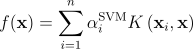
The coefficients $\alpha^{SVM}$ are obtained by solving the optimization problem:

where $\mathbf{K}$ is the kernel matrix.
Installation
You can use pip to install this package.
pip install torchkm
Quick start
Import necessary libraries and functions:
from torchkm.cvksvm import cvksvm
from torchkm.functions import *
import torch
import numpy
The usages are similar with scikit-learn:
model = cvksvm(Kmat=Kmat, y=y_train, nlam=nlam, ulam=ulam, nfolds=nfolds, eps=1e-5, maxit=1000, gamma=1e-8, is_exact=0, device='cuda')
model.fit()
Usage
Generate simulation data
functions provides a simulation data generation function, data_gen, to generate data from a mixture of Gaussian models. functions also provides kernel operations like rbf_kernel and kernelMult, as well as data processing functions such as standardize.
# Sample data
nn = 10000 # Number of samples
nm = 5    # Number of clusters per class
pp = 10   # Number of features
p1 = p2 = pp // 2    # Number of positive/negative centers
mu = 2.0  # Mean shift
ro = 3  # Standard deviation for normal distribution
sdn = 42  # Seed for reproducibility

nlam = 50
torch.manual_seed(sdn)
ulam = torch.logspace(3, -3, steps=nlam)

X_train, y_train, means_train = data_gen(nn, nm, pp, p1, p2, mu, ro, sdn)
X_test, y_test, means_test = data_gen(nn // 10, nm, pp, p1, p2, mu, ro, sdn)
X_train = standardize(X_train)
X_test = standardize(X_test)

sig = sigest(X_train)
Kmat = rbf_kernel(X_train, sig)
Basic operation
torchkm mainly provides cvksvm to tune kernel SVM fast with GPU acceleration and compute exact leave-one-out cross-validation (LOOCV) errors if needed.
model = cvksvm(Kmat=Kmat, y=y_train, nlam=nlam, ulam=ulam, nfolds=5, eps=1e-5, maxit=1000, gamma=1e-8, is_exact=0, device='cuda')
model.fit()
### Tune parameter
cv_mis = model.cv(model.pred, y_train).numpy()
best_ind = numpy.argmin(cv_mis)
best_ind

### Test Error and objective value
Kmat = Kmat.double()
alpmat = model.alpmat.to('cpu')
intcpt = alpmat[0,best_ind]
alp = alpmat[1:,best_ind]
ka = torch.mv(Kmat, alp)
aka = torch.dot(alp, ka)
obj_magic = model.objfun(intcpt, aka, ka, y_train, ulam[best_ind], nn)

Kmat_new = kernelMult(X_test, X_train, sig)
Kmat_new = Kmat_new.double()

result = torch.mv(Kmat_new, alpmat[1:,best_ind]) + alpmat[0, best_ind]

ypred = torch.where(result > 0, torch.tensor(1), torch.tensor(-1))

torch.mean((ypred == y_test).float())
Probability estimation
### Platt scaling
oof_f = torch.where(model.pred > 0, 1, -1).to(device = 'cpu')[:, best_ind]
platt = platt.PlattScalerTorch(dtype=torch.double, device='cuda').fit(oof_f, y_train)

X_test_raw = torch.mv(Kmat_new, alpmat[1:,best_ind]) + alpmat[0, best_ind]

with torch.no_grad():
    p_platt = platt.predict_proba(X_test_raw)[:, 1].cpu().numpy()
    y_test_np = torch.as_tensor(y_test).cpu().numpy()

# Reliability data for Platt
bc, mp, fp, cnt = platt.reliability_curve(y_test_np, p_platt, n_bins=15)
ece_platt  = platt.expected_calibration_error(mp, fp, cnt)
brier_platt = platt.brier_score(y_test_np, p_platt)

platt.plot_calibration(bc, mp, fp, cnt, label=f"Platt (ECE={ece_platt:.3f}, Brier={brier_platt:.3f})")
Real data
torchkm works well with sklearn datasets. We need to convert these datasets to torch.tensor with $y=1 \text{ or} -1$.
from sklearn.datasets import make_moons

# Generate non-linear dataset
X, y = make_moons(n_samples=300, noise=0.2, random_state=42)

X = torch.from_numpy(X).float()
y = torch.from_numpy(y).float()
y = 2 * y - 1

sig = sigest(X)
Kmat = rbf_kernel(X, sig)

model = cvksvm(Kmat=Kmat, y=y, nlam=nlam, ulam=ulam, nfolds=nfolds, eps=1e-5, maxit=1000, gamma=1e-8, is_exact=0, device='cuda')
model.fit()
Extensions to large-margin classifiers
It also provides applications for other large-margin classifiers:
- Kernel logistic regression
 model = cvklogit(Kmat=Kmat, y=y_train, nlam=nlam, ulam=ulam, foldid=foldid, nfolds=nfolds, eps=1e-5, maxit=1000, gamma=1e-8, is_exact=0, device='cuda')
 model.fit()
- Kernel distance weighted discrimination
model = cvkdwd(Kmat=Kmat, y=y_train, nlam=nlam, ulam=ulam, foldid=foldid, nfolds=nfolds, eps=1e-5, maxit=1000, gamma=1e-8, is_exact=0, device='cuda')
model.fit()
Getting help
Any questions or suggestions please contact: yikai-zhang@uiowa.edu


Download files
Download the file for your platform. If you're not sure which to choose, learn more about installing packages.
Source Distribution
Built Distribution
Filter files by name, interpreter, ABI, and platform.
If you're not sure about the file name format, learn more about wheel file names.
Copy a direct link to the current filters
File details
Details for the file torchkm-4.0.1.tar.gz.
File metadata
- Download URL: torchkm-4.0.1.tar.gz
- Upload date:
- Size: 42.2 kB
- Tags: Source
- Uploaded using Trusted Publishing? No
- Uploaded via: twine/6.1.0 CPython/3.13.7
File hashes
| Algorithm | Hash digest | |
|---|---|---|
| SHA256 |
6641991830ecb4483901f3b00e5cd3dfdb55634b7c91373cff28a4252ffaf8f9
|
|
| MD5 |
c018fafdb3ed9c46331083069d999993
|
|
| BLAKE2b-256 |
c7dc8241c87b5f17ad0231fc3ed4aa8511501e75bd12800510eed10167b5e4f6
|
File details
Details for the file torchkm-4.0.1-py3-none-any.whl.
File metadata
- Download URL: torchkm-4.0.1-py3-none-any.whl
- Upload date:
- Size: 54.0 kB
- Tags: Python 3
- Uploaded using Trusted Publishing? No
- Uploaded via: twine/6.1.0 CPython/3.13.7
File hashes
| Algorithm | Hash digest | |
|---|---|---|
| SHA256 |
1f543066def8d02ceac00622357b292d7ca3985f2b346ea9a3ad167381b10d50
|
|
| MD5 |
9a4985ee1da261e1d0423528f6e33d35
|
|
| BLAKE2b-256 |
88a19ddbffc0e183b218cbfdf1f6cdcc21ce87a55be48443aa91a647d7788edd
|






